

CCSD code G5100: Bypass of duodenum billing guide
CCSD code G5100 bills a bypass that leaves the duodenum in place CCSD code G5100...

Last Updated: Oct 16, 2026
H4200 is the CCSD code for perineal repair of prolapse of rectum. It covers repair of full-thickness rectal prolapse through the perineum, most often by the Altemeier or Delorme procedure. UK private medical insurers use it to process claims for this surgery.
The code sits in Chapter 11 of the CCSD schedule, under 11.6 Rectum/Anus. Abdominal repairs bill under rectopexy codes instead, such as H3502 for open rectopexy or H3580 for laparoscopic ventral rectopexy.
Let Pabau's smart automation suggest the right codes, reduce claim denials, and keep your practice compliant—effortlessly.
Automate repetitive tasks and focus on what matters most—your patients.
Reduce coding errors and ensure compliance with the latest regulations.
Clean claims, fewer denials, and faster reimbursements.
Powerful insights and reporting to help your practice thrive.
HIPAA compliant SOC 2 certified GDPR-compliant Trusted by 4,000+ clinics worldwide

CCSD Code H4200 covers the perineal approach to rectal prolapse repair only, while abdominal and laparoscopic rectopexy bill under separate codes.
Major UK private medical insurers, including Bupa, AXA Health, and Aviva, recognize H4200 and typically require pre-authorization before surgery.
The operative note must confirm the perineal approach, the technique used, and any concurrent procedures to prevent a claim denial.
Pabau, the practice management platform we build, handles CCSD-coded invoicing and insurer claim submission for UK private practices.
CCSD Code H4200 is the procedure code for perineal repair of prolapse of rectum in the Clinical Coding & Schedule Development (CCSD) schedule.
It sits in Chapter 11, Abdomen (excluding urinary and reproductive organs), under sub-chapter 11.6 Rectum/Anus. Bupa, AXA Health, Aviva, Freedom Health, and Cigna all use it to process claims for this surgery.
The defining feature of H4200 is the surgical approach. The surgeon operates through the perineum rather than through an abdominal incision or laparoscopic ports. That route is also the billing boundary. A perineal operation billed under an abdominal rectopexy code gets rejected or queried, and so does the reverse.
The Clinical Coding & Schedule Development (CCSD) Group maintains the schedule and publishes updates to it. Coders should check H4200’s business rules in the CCSD Technical Guide (October 2025 edition), because descriptors and rules can change between versions.
Perineal repair corrects full-thickness rectal prolapse (procidentia) through the perineal route. Surgeons most often use one of two named techniques: the Altemeier procedure or the Delorme procedure.
The Altemeier procedure is a full-thickness resection of the prolapsed rectum and, where needed, part of the sigmoid colon.
The surgeon cuts circumferentially through the rectal wall just above the dentate line and mobilizes the prolapsed segment. The segment is then removed and the bowel ends are joined in a primary anastomosis. Levatoroplasty is often added to tighten the pelvic floor muscles.
The Delorme procedure removes only the rectal mucosa, leaving the rest of the bowel wall in place. The mucosa is stripped from the underlying muscle and the redundant length is excised.
The bare muscle wall is then plicated with sutures, and the mucosal edges are sewn back together. Surgeons usually prefer it for patients too frail for a proctosigmoidectomy.
Both techniques use the perineal route. Neither Bupa’s 2026 schedule nor Freedom Health’s July 2026 fee schedule lists a separate perineal prolapse code, so both bill as H4200. The operative note should still name the technique, because a payer reviewing the claim will ask which one was done.
H4200 applies when full-thickness rectal prolapse has not responded to conservative management and the surgical team has chosen the perineal route over abdominal surgery. The indications matter for billing because payers ask for evidence of clinical necessity, especially for elective procedures under private cover.
Common clinical scenarios supporting the use of CCSD Code H4200 include:
The operative note and pre-procedure clinic letters should document which of these indications applies. A payer querying medical necessity for H4200 will look for evidence that conservative management was tried, or considered and ruled out.
Sub-chapter 11.6 Rectum/Anus holds H4200 alongside rectal biopsy, examination under anesthetic, and stricture dilation codes. H4200 is the only perineal prolapse repair in it. The codes it gets confused with are the rectopexy codes, which treat the same condition through the abdomen.
The table below shows how each one differs from CCSD Code H4200. You can look up the rest of the sub-chapter in our CCSD code library.
Descriptors follow Bupa’s 2026 schedule of procedures and the CCSD bulletin of July 2024. Check them against the current schedule before billing, because CCSD revises narratives and adds codes between versions.
The surgical approach decides the code. H4200 covers the perineal route only. Abdominal repair, open or laparoscopic, bills under the rectopexy codes in sub-chapter 11.6, and the use of mesh splits them further.
The most common coding error on rectal prolapse cases is choosing the code by procedure name alone. A coder sees “rectal prolapse repair” and never checks the approach recorded in the operative note. The diagram below walks through the route, then the mesh or resection question.
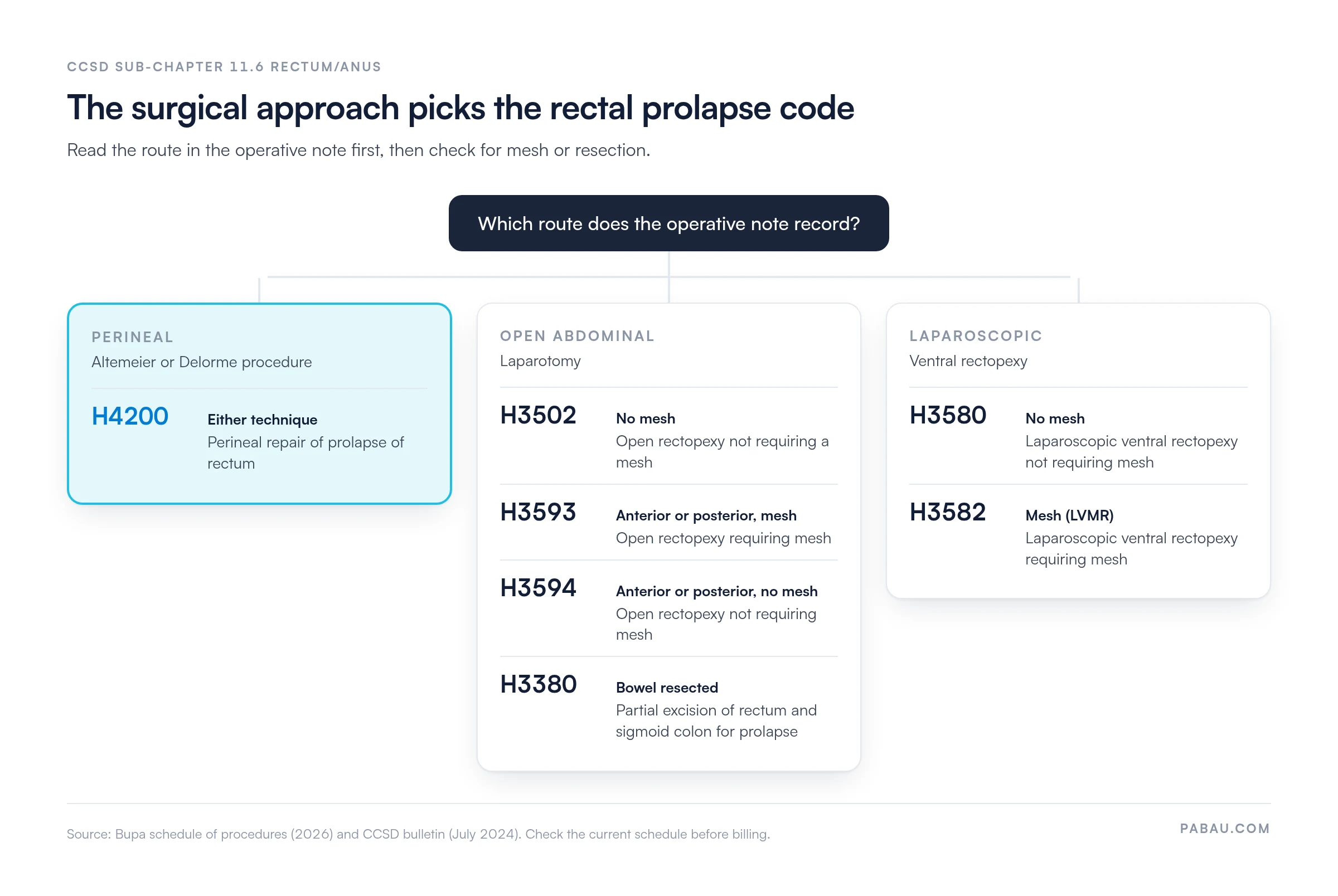
Ventral mesh rectopexy, now often performed laparoscopically for obstructed defecation, causes frequent confusion. Its pelvic floor repair may extend toward the perineum, but the approach is laparoscopic and abdominal. With mesh it bills as H3582, never as CCSD Code H4200.
Abdominal resection for prolapse carries its own trap. H3380 covers partial excision of the rectum and sigmoid colon for prolapse. A sigmoid colectomy done for another condition, such as diverticular disease, bills as H1000 instead.
The operative note is the primary document a payer reviews when processing or auditing an H4200 claim. A note that does not state the perineal approach invites a query or denial, even when the procedure was done correctly.
Structured private healthcare claims management software links the operative note to the submitted claim, so the coder bills from the record the surgeon signed. These elements must appear in the operative note for H4200 to be supported:
If a concurrent levatoroplasty was performed, document it separately with its own description. The CCSD Technical Guide sets out unbundling rules. Some concurrent procedures can be billed in addition to H4200, while components considered integral to the perineal repair cannot.
Most UK private medical insurance (PMI) payers require pre-authorization before elective colorectal surgery, and H4200 is no exception. Operating without it is one of the most avoidable causes of non-payment.
Requirements vary, so confirm them with the insurer before booking the case. Fees vary too. Freedom Health’s July 2026 schedule, for example, pays £500 to the specialist and £285 to the anesthetist for H4200. The table below summarizes the major payers that recognize the code and their general pre-authorization position.
A pre-authorization request for H4200 should include:
Payers use the Bupa CCSD code schedule and equivalent insurer schedules to confirm that the submitted code matches the clinical picture described.
The perineal repair covered by H4200 may be performed alongside other procedures. Whether those can be billed separately depends on the unbundling rules in the CCSD Technical Guide. Procedures considered integral to the primary operation cannot be coded separately.
Bundling errors, where separately billable concurrent procedures are left off, leave legitimate revenue unclaimed. Unbundling errors, where integral components are coded separately, trigger claim rejection. Reviewing the CCSD Technical Guide for each procedure code before submission prevents both.
Claim denials on CCSD Code H4200 follow predictable patterns, and most are preventable with the right documentation and pre-submission checks. These triggers come up most often on rectal prolapse claims.
When a claim is denied, ask the payer for the specific denial reason in writing. Many denials can be overturned on appeal with a complete operative note and clinical correspondence. Billing workflows that link authorization records to invoices before submission prevent many of these denials in the first place.
Before submitting any H4200 claim, run a three-point check. Confirm the operative note states the perineal approach. Check that the pre-authorization reference is on the invoice, and match the code against the current CCSD schedule. These three checks catch the most common preventable rejections.
Most H4200 denials start with three records that live apart: the operative note, the pre-authorization reference, and the invoice. When each sits in a different system, someone retypes the code and the reference by hand. That retyping is where mismatches slip in.
Pabau keeps the patient record, clinic letters, operative notes, and invoices together. The H4200 code and the insurer’s authorization reference go on the invoice from the same record, and claims travel to the insurer through Healthcode.
Fewer claims come back for a missing reference or a code that contradicts the note. Your billing team spends less time chasing insurers, and surgeons get paid for the operation they performed.

Pabau helps colorectal and surgical practices manage CCSD-coded invoicing, insurer submissions, and clinical documentation in one place. Your team spends less time chasing authorizations and more time with patients.

The H4200 decision is made in the operating room, when the surgeon chooses the perineal route. Your job is to make the paperwork prove it, with an operative note that names the approach and a pre-authorization reference on the invoice.
If you change one habit, check the operative note against the code before every rectal prolapse claim goes out. That check catches the approach mismatch behind most avoidable rejections, and it takes less time than a single appeal.
Book a demo to see how Pabau links the operative note, the authorization, and the invoice for every CCSD-coded procedure your practice bills.

Revising an existing ileal pouch? CCSD Code H0480: Abdominal revision of restorative proctocolectomy covers the code for a second abdominal operation on a pouch.
Treating hemorrhoids in the same patient? CCSD code H5100: Haemorrhoidectomy walks through the code for excision of hemorrhoids.
CCSD Code H4200 covers perineal repair of prolapse of rectum, the surgical correction of full-thickness rectal prolapse via the perineal approach. It does not cover abdominal or laparoscopic rectopexy. Those bill under separate codes in Chapter 11 of the CCSD schedule, such as H3502 and H3580.
H4200 is the perineal approach code. Open abdominal rectopexy bills as H3502, H3593, or H3594, and laparoscopic rectopexy as H3580 or H3582. The approach documented in the operative note decides which code applies. Choosing by procedure name alone is the most common coding error on these cases.
Yes, major UK private medical insurers, including Bupa, AXA Health, Aviva, and Freedom Health, typically require pre-authorization before elective colorectal surgery. Requirements vary by payer and policy. Confirm with the specific insurer before the procedure date to avoid non-payment afterward.
The operative note must confirm the perineal approach, the technique used (Altemeier or Delorme), the anatomical extent of the procedure, and any concurrent operations. The pre-authorization reference number must appear on the invoice. The clinic letter should document the clinical indication for the perineal route.
Yes. The anesthetist invoices separately, usually against the same H4200 code at the insurer’s anesthetist fee. An assistant surgeon fee may also be billed, though payer recognition varies. A concurrent procedure such as levatoroplasty may carry its own CCSD code under the Technical Guide’s unbundling rules, so check the current guide first.
All major UK private medical insurers that use the CCSD schedule recognize H4200, including Bupa, AXA Health, Aviva, Freedom Health, and Cigna. Each insurer publishes its own fee schedule for CCSD codes. Reimbursement for H4200 varies between payers, so check it before quoting patients.



