CPT code 93503: Swan-Ganz catheter billing and modifiers
CPT code 93503: Official descriptor and procedure overview In the AMA CPT code s...

Last Updated: Oct 23, 2026
H5510 is the CCSD code for laying open of low anal fistula (fistulotomy) (including sigmoidoscopy). It covers fistulotomy of a low fistula-in-ano, where the tract crosses little or none of the anal sphincter. Sigmoidoscopy in the same operation is part of the code and is never billed separately.
The code sits in Chapter 11 of the CCSD schedule, under 11.6 Rectum / Anus. A high fistula laid open the same way bills under H5520, while plug closure, seton placement and endoscopic ablation each have their own codes.
Let Pabau's smart automation suggest the right codes, reduce claim denials, and keep your practice compliant—effortlessly.
Automate repetitive tasks and focus on what matters most—your patients.
Reduce coding errors and ensure compliance with the latest regulations.
Clean claims, fewer denials, and faster reimbursements.
Powerful insights and reporting to help your practice thrive.
HIPAA compliant SOC 2 certified GDPR-compliant Trusted by 4,000+ clinics worldwide

CCSD code H5510 covers laying open a low anal fistula, and sigmoidoscopy in the same operation is part of the code.
A sigmoidoscopy code billed next to H5510 is an unacceptable combination, so it comes off the claim.
A high fistula laid open bills under H5520, and because one tract gets one classification, the two codes are not claimed together for it.
Plug closure (H5530), seton placement (H5540) and endoscopic ablation (H5580) are different operations with their own codes.
The operative note decides the code, so it has to classify the fistula and say what was divided.
CCSD code H5510 is the UK private practice code for laying open of low anal fistula (fistulotomy) (including sigmoidoscopy). The surgeon opens the fistula tract along its length so it heals from the base up. The sigmoidoscopy done in the same operation is part of the fee.
The code sits in Chapter 11 of the CCSD schedule, Abdomen (excluding urinary and reproductive organs), under 11.6 Rectum / Anus. The other anal fistula codes live alongside it in our CCSD codes library.
“Low” is the word that carries the claim. A low fistula crosses little or none of the anal sphincter, so the surgeon can divide the tissue over it with minimal risk to continence. Superficial, intersphincteric and low transsphincteric tracts usually fall here.
The descriptor names sigmoidoscopy, so the scope the surgeon passes during the fistulotomy is inside H5510. CCSD lists sigmoidoscopy codes, such as H2510, as unacceptable combinations with H5510.
Put one on the same claim and the insurer will strip that line, or query the whole bill.
The rule covers the same operation only. A colonoscopy booked as its own episode, on another day and for its own reason, is coded and claimed on its own.
Several codes in 11.6 deal with anal fistula, and the five below cover the core choices. They split on two questions. Was the tract laid open or treated another way? If it was laid open, was it low or high?
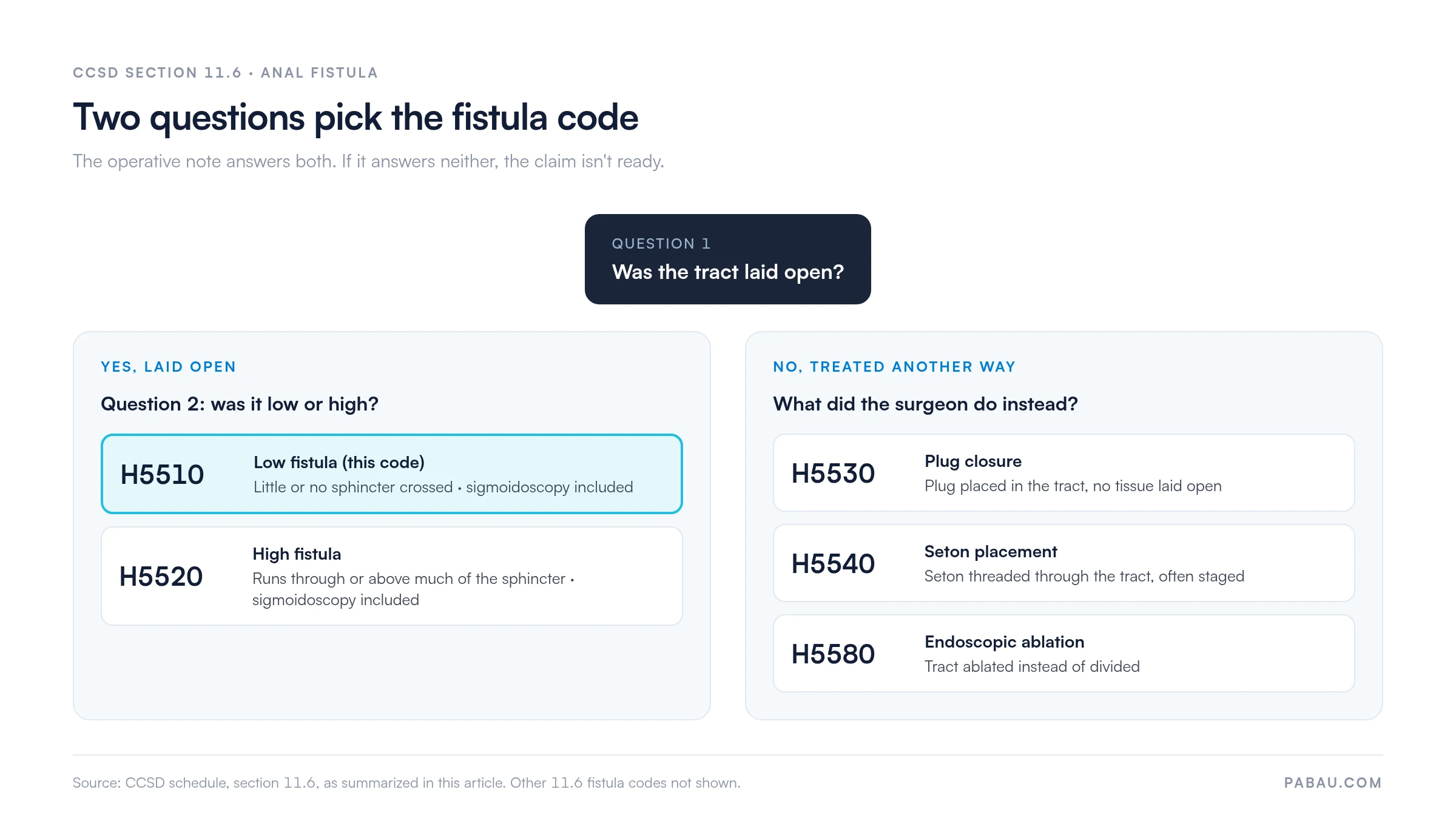
H5510 and H5520 should not be claimed together for the same tract. One tract gets one classification, so the claim carries one of the two codes.
If the note never says low or high, the coder cannot pick between the two. Send it back to the surgeon rather than guessing.
Insurers read the operative note to check the code against the surgery. “Fistulotomy performed” proves an operation happened, but it does not prove H5510. A note that supports the code records five things.
That last point surprises people. The sigmoidoscopy is part of the descriptor, so a note without it describes a smaller operation than the one being claimed.
H5510 is the consultant surgeon’s code. The surgeon, or their medical secretary, sends the claim to the patient’s insurer under the surgeon’s own provider details.
Other people involved in the operation bill separately. The anesthetist sends a separate claim, and the hospital invoices its facility charges directly. Keeping these lines apart stops one claim from carrying another provider’s work.
Insurers usually expect surgery to be authorized before it happens, but the rules vary by insurer and by policy. Check with each insurer before the date is booked, and put the authorization number on the claim. Your insurer’s code search, such as Bupa’s code search, shows how it lists H5510.
Each insurer sets its own fee for the code. Our Bupa CCSD codes guide shows how one major insurer handles its schedule.
H5510 queries tend to trace back to three mistakes. Each one is visible on the claim before it leaves the practice.
Two smaller issues cause delays too. A claim sent without the authorization number stalls, and a diagnosis code that does not describe a fistula raises a mismatch query.
Run this list against every H5510 claim. It takes a couple of minutes with the operative note open next to the claim.
If any check fails, fix it before submission. A query after the fact costs more time than a question to the surgeon now.
In many surgical practices, the operative note sits in one system and the claim is built in another. The coder then works from memory or a pasted summary, which is where low and high get swapped.
Pabau, the practice management software we build for private practices, stores the operative note, letters and authorization documents on the patient record. The person billing H5510 reads the same note the surgeon signed.
From that record, our claims management software sends the claim to UK insurers through the Healthcode integration. Fewer handoffs mean fewer chances for the sigmoidoscopy to slip onto the claim, or for the classification to go missing.


Pabau keeps the operative note and supporting documents on the patient record and sends your CCSD claims through Healthcode. See it in a live walkthrough.

H5510 pays cleanly when the note and the claim agree. Let the operative note choose between low and high, keep the sigmoidoscopy off the claim, and leave H5520 for tracts the surgeon calls high.
When the note is thin, the fix is a quick question to the surgeon before submission. That conversation is cheaper than any insurer query.
Book a demo to see how Pabau puts the operative note and the fistula claim on the same record.

Was the fistula high, not low? CCSD code H5520: Laying open of high anal fistula covers the sister code and what its operative note must show.
Billing another rectum and anus procedure? CCSD code H4200: Perineal repair of prolapse of rectum walks through a neighboring Chapter 11 code.
Coding fistula surgery for a US payer? CPT code 46280: Anal fistula surgery billing and rates explains how complex fistula surgery is reported with CPT codes.
Looking up a different CCSD code? CCSD codes lists the procedure codes we cover, chapter by chapter.
Most H5510 claims pair with K60.3, anal fistula. Use K60.4 for a rectal fistula or K60.5 for an anorectal fistula when the notes describe one. The diagnosis should match what the surgeon recorded.
Often, yes, though the setting is the surgeon’s and hospital’s call. The setting does not change the code. The hospital invoices its own facility charges, separate from the surgeon’s H5510 claim.
Each operation is coded on its own date. A seton placed first bills under H5540, and a later fistulotomy bills under H5510 or H5520. Check the CCSD combination rules if two steps happen in one operation.
The full CCSD schedule sits behind a login on the CCSD website. Insurer code search tools, such as Bupa’s, also show how each insurer lists the code.
No. CCSD codes are used for private medical insurance claims. NHS activity is coded with OPCS-4, a separate classification.