HCPCS Code P9612: Catheterization for urine specimen collection
HCPCS Code P9612: Definition and code attributes HCPCS Code P9612 is the HCPCS L...

Last Updated: Oct 26, 2026
H2510 is the CCSD code for rigid sigmoidoscopy including proctoscopy and biopsy. It bills the rigid scope examination, the proctoscopy and the forceps biopsy as one procedure on claims to UK private medical insurers.
Proctoscopy (H6260) is never billed separately on the same date, and the pathologist bills histology under their own codes. A flexible sigmoidoscopy takes H2502 instead, and a snare loop excision takes H2503.
Let Pabau's smart automation suggest the right codes, reduce claim denials, and keep your practice compliant—effortlessly.
Automate repetitive tasks and focus on what matters most—your patients.
Reduce coding errors and ensure compliance with the latest regulations.
Clean claims, fewer denials, and faster reimbursements.
Powerful insights and reporting to help your practice thrive.
HIPAA compliant SOC 2 certified GDPR-compliant Trusted by 4,000+ clinics worldwide

CCSD code H2510 bundles rigid sigmoidoscopy, proctoscopy and biopsy into one procedure, so proctoscopy (H6260) cannot be billed on the same date.
CCSD lists H2510 as an unacceptable combination with several codes, including H5100, H5260, H5510, H5520 and H2503, so UK private insurers reject those pairs.
Every H2510 claim needs an ICD-10 diagnosis that supports a lower GI endoscopy, such as K62.1 for a rectal polyp or K62.5 for rectal bleeding.
The pathologist bills the biopsy’s histology under their own codes, so the surgeon’s H2510 claim covers specimen collection only.
Pabau, our practice management software, sends CCSD claims to UK private insurers through Healthcode and keeps the operative note on the same patient record.
CCSD code H2510 is the procedure code for rigid sigmoidoscopy (including proctoscopy and biopsy). Consultants quote it when they bill UK private medical insurers such as Bupa, AXA Health, Aviva and Vitality. The code comes from the CCSD schedule, which the Clinical Coding and Schedule Development group maintains for UK private healthcare.
H2510 sits in CCSD chapter 10, Endoscopic GIT Procedures, one of the chapters in our index of CCSD codes. The rigid instrument separates it from the flexible sigmoidoscopy codes. The bundled sigmoidoscopy and biopsy separate it from a standalone proctoscopy, which has its own code, H6260.
One H2510 claim bundles three components. They are the rigid sigmoidoscopic examination of the rectum and distal sigmoid colon, the proctoscopic inspection of the anal canal, and the forceps biopsy. Quoting any of them as a separate code for the same date counts as unbundling, and the insurer will query or reject the claim.
Rigid sigmoidoscopy under CCSD code H2510 follows a defined sequence. Each step shows what the code covers and what the operative note needs to record.
UK private insurers expect the ICD-10 diagnosis on an H2510 claim to justify a lower GI endoscopy with biopsy. The indications below typically meet that test.
A diagnosis that does not fit the procedure, such as an upper GI condition, is a common reason insurers query a claim. Confirm the ICD-10 code matches the documented finding before you submit. UK claims use the WHO ICD-10 classification, so leave out US ICD-10-CM codes such as Z12.11.
The bundling rules decide whether the claim pays cleanly or triggers a query. The table below sets out what CCSD code H2510 does and does not include.
Histopathology is a common source of errors in H2510 billing. The surgeon’s role ends with specimen collection, which H2510 covers. The pathologist bills the laboratory analysis of that specimen as a separate service, under their own codes. A pathology line on the surgeon’s claim duplicates that bill, and the insurer will reject it.
Name the instrument, rigid or flexible, in every operative note. CCSD codes rigid and flexible sigmoidoscopy separately, with H2502 covering a diagnostic flexible procedure. If the note does not specify the scope, the insurer may query the claim or ask you to re-code it.
Several related CCSD procedure codes cover lower GI endoscopy and the anal canal. The deciding factors are the instrument, the depth of the examination and what was done with any lesion. The decision path below applies them in order.
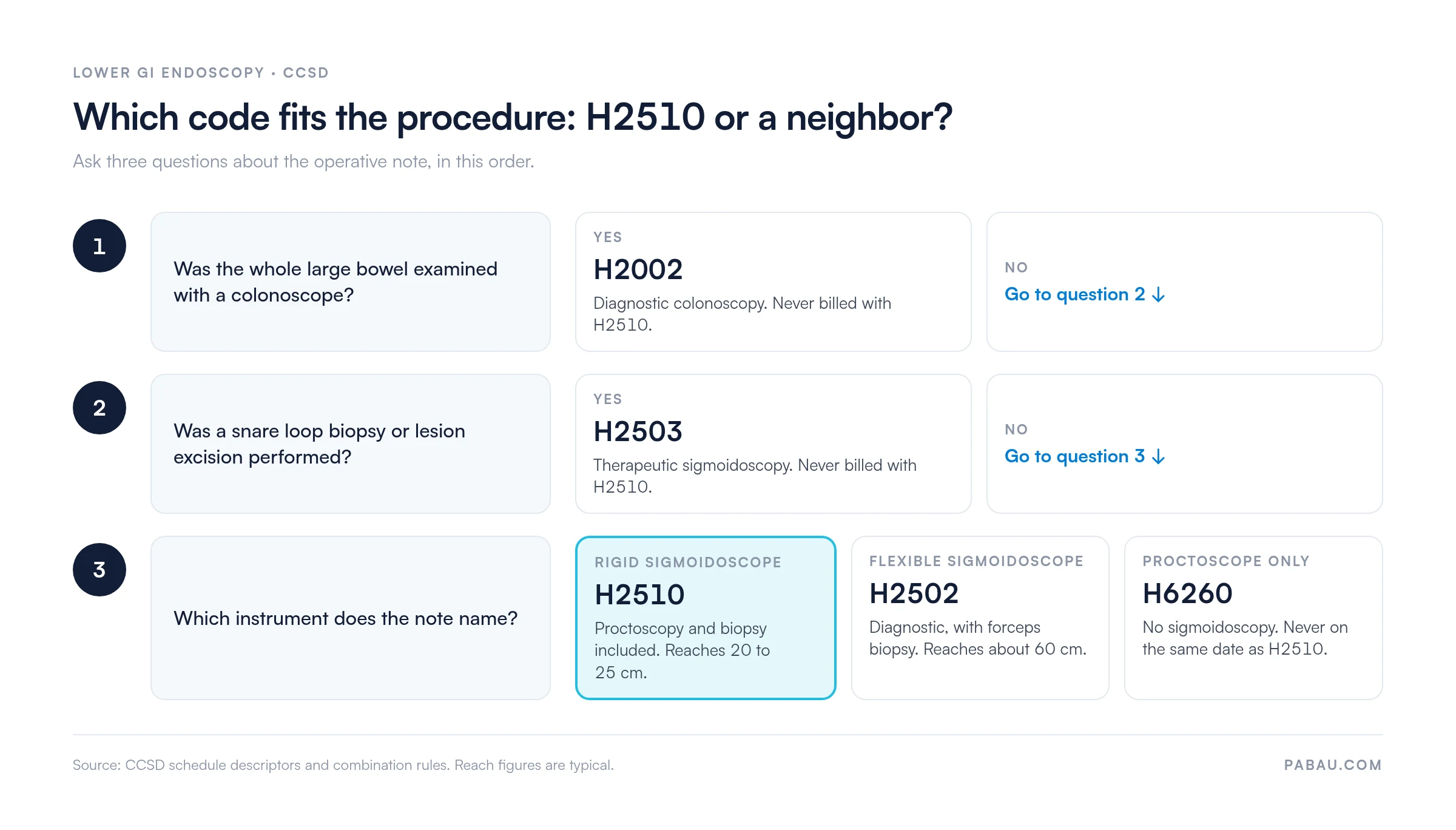
Rigid sigmoidoscopy typically examines 20 to 25 cm of the lower bowel, while flexible sigmoidoscopy reaches about 60 cm. A colonoscopy (H2002) examines the whole large bowel. Quoting H2510 for a flexible procedure misrepresents the work, and insurer audits look for exactly that. Where a snare loop removed the lesion, H2503 replaces H2510 rather than joining it.
Some anorectal operations include a sigmoidoscopy in their own descriptor, and CCSD code H4130 is one example. CCSD also lists it against H2510, so the two cannot be billed together.
CCSD lists H2510 as an unacceptable combination with several codes, including H5100, H5260, H5510, H5520 and H2503. An insurer that follows the schedule will not pay H2510 alongside any code on that list. The five below show the pattern.
Three of those descriptors already include a sigmoidoscopy, so adding H2510 would bill the same examination twice. H4130 is on the CCSD list for the same reason. Proctoscopy (H6260) cannot be billed on the same date as H2510 either, because H2510 already includes it.
CCSD also lists H2002 as an unacceptable combination with H2510. A diagnostic colonoscopy already examines the rectum and sigmoid colon, so a same-day rigid sigmoidoscopy adds no separate fee.
CCSD does not use US CPT-style modifiers such as -59 for H2510. Where two procedures are clinically justified on one date, record the reason for each in the operative note. Then check with the insurer before you submit, because each insurer sets its own payment rules for multiple procedures.
When H2510 shares a date with another procedure, add a short clinical narrative to the claim explaining why both were needed. A two-sentence justification at submission can save a formal appeal later.
The surgeon’s claim for H2510 stops at specimen collection, and the pathologist’s claim covers laboratory analysis. Keeping the two apart avoids a duplicate-service rejection.
If an insurer rejects an H2510 claim as a duplicate service, check whether a pathology code slipped onto the surgeon’s invoice before you appeal.
Thin documentation is a frequent trigger for an H2510 query. The operative note should contain each item below before the claim goes in. Writing the note at the point of care captures each element while the procedure is fresh.
Insurers may ask for the operative note or a procedure report before they pay an endoscopy claim. A complete note, ready from the date of service, avoids that delay.
UK private insurers generally expect preauthorization before an elective procedure such as H2510. Authorization confirms the policy covers the procedure. Policy limits and the insurer’s fee schedule still apply.
Bupa, AXA Health, Aviva and Vitality each run their own authorization process. The patient often calls the insurer first, so give them the code and descriptor in writing. A request typically needs the following.
Requirements vary between insurers and policies, and they change over time. Check each patient’s cover before the procedure date, and keep a record of every authorization reference.
H2510 claims are rejected for a consistent set of reasons. Fixing them before submission is quicker than an appeal. The medical billing fundamentals behind each rejection help practices build a pre-submission checklist.
A clean H2510 claim follows a consistent sequence. Claims management software that checks codes before submission catches errors before the insurer does.
On a busy endoscopy list, the operative note often sits in one system and the invoice in another. Staff then re-key the claim, and each hand-off risks a lost authorization reference or an unbundled proctoscopy line.
Pabau’s Healthcode integration turns the invoice you already raise into an electronic claim. The code, amounts and patient details carry over, and Healthcode’s validation rules check the claim before it is sent.
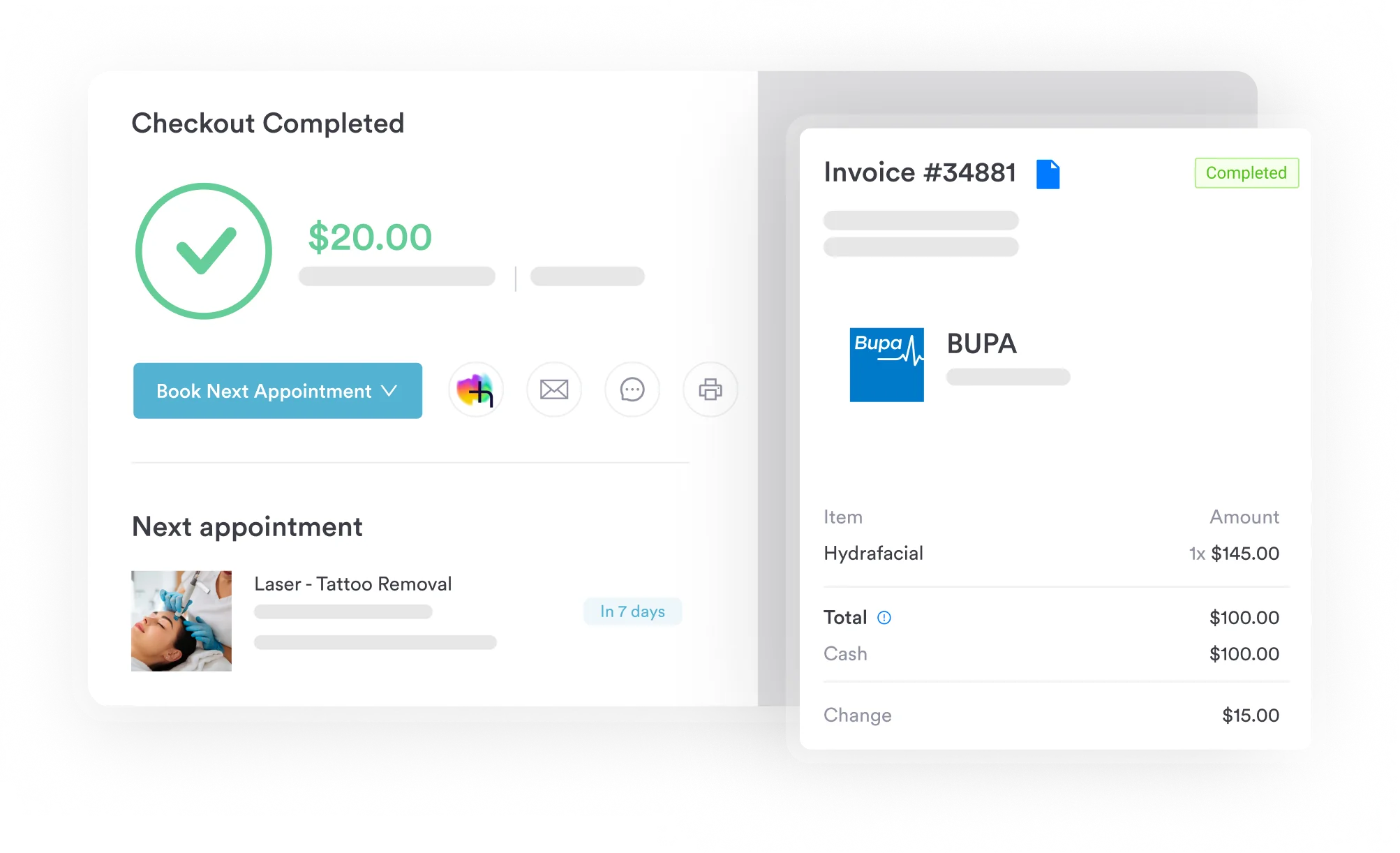
The operative note, consent forms and histology report sit on the same patient record as the invoice. Your team can set a task to review the diagnosis when histology returns, and track each claim until it settles.

Pabau links the operative note, the invoice and the Healthcode claim, so your H2510 claims reach UK insurers complete.

Quote H2510 only when the operative note shows a rigid sigmoidoscopy with proctoscopy and a biopsy. A flexible scope, a snare excision or a proctoscopy alone each points to a different code.
Four problems sit behind many H2510 rejections. The proctoscopy is unbundled, the diagnosis does not fit, or the note does not name the rigid scope. The fourth is a pathology code on the surgeon’s claim. Check those four points, and the CCSD combination list, before each submission. Book a demo to see how Pabau sends CCSD claims through Healthcode and tracks them to settlement.

Need a full CCSD coding reference for insurer submissions? CCSD codes for Bupa submissions walks through the CCSD schedule structure and insurer-specific billing requirements.
Want fewer rejected GI procedure claims across your practice? Pabau’s claims management software shows how claims are raised from the invoice and tracked to payment.
Billing an anorectal operation that includes sigmoidoscopy? CCSD code H4130 explains how perianal excision of a rectal lesion bundles its sigmoidoscopy.
Was the whole large bowel examined instead? CCSD code H2002 covers diagnostic colonoscopy and the biopsies it includes.
Treating a low anal fistula on the same list? CCSD code H5510 sets out how a fistulotomy bundles its own sigmoidoscopy.
CCSD code H2510 covers rigid sigmoidoscopy including proctoscopy and biopsy as one bundled procedure. The scope examination, the proctoscopy and the biopsy collection are all included, so none of them is billed separately on the same date.
Proctoscopy is included in H2510. A standalone proctoscopy code exists, H6260, but it cannot be billed on the same date as H2510. Quoting both counts as unbundling, and UK private insurers will reject it.
No. H2510 covers biopsy collection by the surgeon, not laboratory analysis. The pathologist bills histopathology under their own codes, so a pathology code on the surgeon’s claim creates a duplicate.
Use H2510 when a rigid sigmoidoscope was used and a biopsy was taken. A diagnostic flexible sigmoidoscopy, with or without forceps biopsy, takes H2502. The instrument named in the operative note decides the code.
CCSD lists H2510 as an unacceptable combination with several codes, including H5100, H5260, H5510, H5520, H2503 and diagnostic colonoscopy (H2002). Proctoscopy (H6260) cannot be billed on the same date either, because H2510 already includes it.
A CCSD code is a procedure code from the schedule maintained by the Clinical Coding and Schedule Development group. UK private insurers such as Bupa, AXA Health, Aviva and Vitality use these codes to identify procedures on claims.
Missing preauthorization is a frequent reason. Insurers also reject an ICD-10 code that does not support a lower GI endoscopy, or a note that does not name the rigid scope. Unbundled proctoscopy, an unacceptable code combination and a pathology code on the surgeon’s claim cause rejections too.