CCSD Code D0310: Microtia & anotia ear reconstruction billing guide
CCSD Code D0310: Definition and clinical scope CCSD Code D0310 is defined by the...

Last Updated: Oct 7, 2026
46280 is the CPT code for surgical treatment of anal fistula (fistulectomy/fistulotomy); transsphincteric, suprasphincteric, extrasphincteric or multiple, including placement of seton, when performed.
Denials on this code usually trace back to the operative report. If the note doesn't name the sphincter level, the payer can't confirm 46280 over 46275 or 46270. Coders should check that classification before the claim goes out.
Let Pabau's smart automation suggest the right codes, reduce claim denials, and keep your practice compliant—effortlessly.
Automate repetitive tasks and focus on what matters most—your patients.
Reduce coding errors and ensure compliance with the latest regulations.
Clean claims, fewer denials, and faster reimbursements.
Powerful insights and reporting to help your practice thrive.
HIPAA compliant SOC 2 certified GDPR-compliant Trusted by 4,000+ clinics worldwide

CPT Code 46280 covers fistulotomy or fistulectomy for transsphincteric, suprasphincteric, extrasphincteric or multiple anal fistulas.
Seton placement is included in 46280 when performed, so it is never billed as a separate line alongside this code.
The operative report must name the sphincter classification, or the payer cannot confirm 46280 over 46275 or 46270.
The 90-day global surgical period covers related post-operative care, and modifier 79 is required for unrelated procedures in that window.
Pabau’s claims management software tracks claim status and flags denial patterns at the code level, so billing teams can spot systemic 46280 rejections.
CPT Code 46280 reports fistulotomy or fistulectomy for an anal fistula whose tract crosses, rises above, or bypasses the external sphincter, or for multiple tracts. Seton placement is included when performed.
The code sits in the Surgery section of the AMA’s code set, under the Anus subsection. Confirm it against the AMA’s CPT code set before billing.
The code covers four tract classifications. Each one involves more of the sphincter complex than a subcutaneous fistula (46270) or an intersphincteric fistula (46275).
A reliable medical billing workflow for colorectal surgery starts here. Confirm the sphincter classification from the operative note before the claim is submitted, rather than after the denial arrives.
The anal fistula code family (46270-46288) is sorted by how deep the tract runs through the sphincter complex, with 46288 reserved for flap closure. Picking the wrong level changes both the payment and the documentation the payer expects to see.
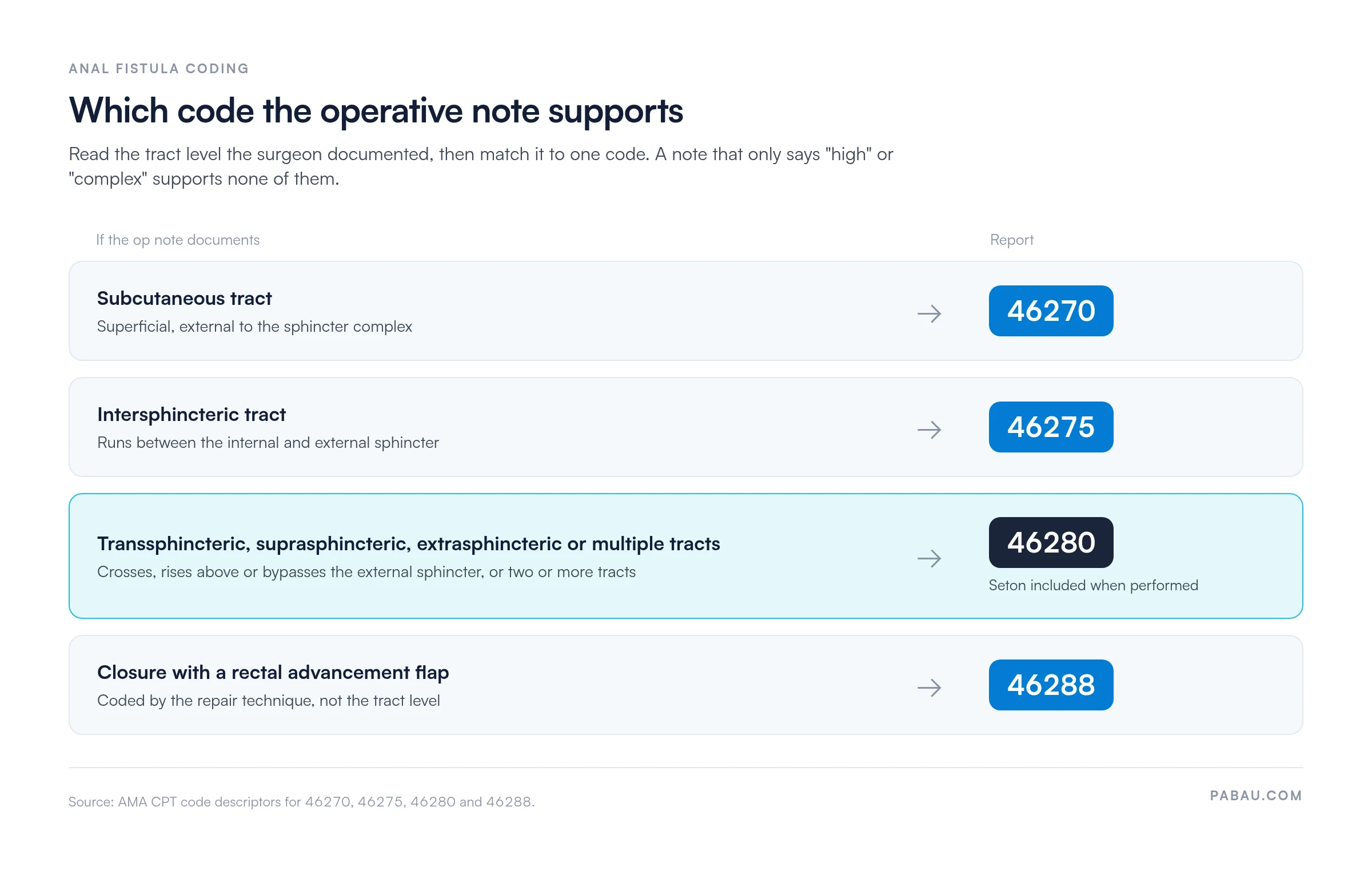
Decision rule for coders: Code 46280 when the operative note documents a transsphincteric, suprasphincteric or extrasphincteric tract. Those tracts cross the external sphincter or pass above or around it. An intersphincteric fistula is coded 46275, never 46270. Reserve 46270 for a subcutaneous tract that stays outside the sphincter complex.
The chart below maps each documented finding to the one code it supports.
No, seton placement is not separately billable when reported with CPT Code 46280. The AMA descriptor includes “placement of seton, when performed,” so NCCI edits bundle the seton service into the primary code.
Billing a separate seton code alongside 46280 triggers an NCCI bundling edit and an automatic denial of the secondary line. The operative report should still record that a seton was placed, its type (cutting or draining), and the clinical rationale. That detail supports the complexity of 46280 rather than a separate charge.
Payers scrutinize anal fistula surgery claims because code selection (46270, 46275 or 46280) hinges on intraoperative findings that only appear in the operative report. A weak op note is the main driver of downcoding and denial.
The operative report must address each of the following to support a 46280 claim. Accurate superbill documentation captures these elements at the point of service, before the claim is built.
Submitting a clean claim for CPT Code 46280 depends on capturing this detail before the encounter closes. Re-querying the surgeon after the claim is built adds days to the revenue cycle. It may still not produce a complete note if documentation habits aren’t set upfront.
Medical necessity for CPT Code 46280 requires a matching ICD-10-CM diagnosis code. The table below lists the primary codes accepted by most payers for FY2026.
Use the most specific code the documentation supports. K60.3 is the preferred starting point for fistula-in-ano. Submitting K60.5 when K60.3 is clearly supported may prompt a payer specificity edit on some commercial plans.
Modifier use on CPT Code 46280 follows standard surgical modifier rules. The most common questions involve multiple procedures, return-to-OR scenarios, and services performed during the 90-day global period.
Modifier 59 requires particular care. The AAPC notes that overuse of Modifier 59 to unbundle otherwise bundled services is a documented OIG scrutiny area. Only append it when the operative record clearly supports two distinct services performed for separate clinical indications.
When billing 46280 with a second anorectal code in the same session, pull the NCCI edit table for the pair before submitting. The CMS NCCI edit database is updated quarterly, and an edit that did not exist last year may apply today. Catching a bundling conflict before submission avoids the denial, the appeal, and the resubmission cycle.
Medicare reimbursement for CPT Code 46280 is calculated from the Relative Value Units (RVUs) published in the annual Medicare Physician Fee Schedule (MPFS).
The 2026 national rates below are not geographically adjusted, and payment varies by locality. Use the CMS Physician Fee Schedule lookup tool to pull site-specific and facility vs. non-facility rates for your practice location.
The CY2026 Medicare conversion factor is $33.40, or $33.57 for qualifying APM participants. At $33.40, the non-facility national rate comes to roughly $590 and the facility rate roughly $425. These figures are unadjusted estimates, and the FastRVU 2026 RVU lookup applies your geographic practice cost index and produces locality-specific payment amounts.
Private payer rates vary by contract. As a general industry estimate, commercial rates may run 110-150% of Medicare, though contract rates differ widely by payer and geography. Pabau’s Claim.MD clearinghouse integration handles eligibility checks and electronic remittance for CPT Code 46280 claims across thousands of US payers.
The 90-day global surgical period means that follow-up office visits related to the fistula repair are bundled into the procedure payment for three months post-surgery. Use Modifier 24 to bill an evaluation and management service for an unrelated condition during that window. Use Modifier 79 for a wholly unrelated surgical procedure.
Tracking the global period end date is where claims management software earns its keep. A missed end date means either a denied claim or an overbilling risk.
Many commercial payers, including Anthem, UnitedHealthcare, and Cigna plans, require prior authorization for elective anal fistula surgery. When authorization is required and missing, the payer can deny the entire claim.
Requirements vary by payer and plan, so check the plan’s portal before you schedule. Most commercial criteria share the same elements, and a documented prior authorization process keeps staff from rebuilding them case by case.
Emergency presentations, such as an acute abscess with fistula that needs urgent drainage, are generally exempt from elective prior authorization. The clinical urgency still has to be documented. Retroactive authorization requests for emergent cases have a low approval rate unless the operative note clearly establishes urgency.
CPT Code 46280 denials cluster around three root causes: code selection errors, missing documentation, and bundling violations. Each has a distinct appeal path and a specific documentation fix.
Effective denial management for CPT Code 46280 tracks rejections at the code level as well as the account level. If 40% of your 46280 denials share the same remark code, one template change fixes them faster than 40 separate appeals. Knowing the denial codes in medical billing helps billing teams respond faster.
Run a 6-month lookback on all 46280 claims and pull the denial remark codes. If CARC 252 (missing or incomplete documentation) appears on more than 20% of claims, fix the operative note template before retraining the billing team. One checklist in the surgeon’s post-op note workflow stops a pattern that individual appeals never will.
In many colorectal practices, the billing team learns that a sphincter classification is missing only when the denial arrives. By then the surgeon has moved on to other cases, and the re-query adds days to the revenue cycle.
Pabau’s practice software keeps the operative note, the diagnosis code and the claim in the same patient record. Coders check the documented tract level before the 46280 claim goes out, and claims management follows it through to remittance.
Denials are grouped by code, so a run of documentation rejections on 46280 points to the note template rather than to one bad claim. That turns revenue cycle management for colorectal surgery into fixing causes instead of chasing appeals.

Pabau connects clinical documentation and claims management in one workflow. Sphincter classification and ICD-10 codes are captured at the point of care, before a denial forces a re-query.

For CPT Code 46280, the coding decision is effectively made in the operating room. If the surgeon names the tract level in the op note, the code, the diagnosis and any appeal all follow from it.
So the change worth making sits upstream of billing. Make the sphincter classification a required field in the post-op note, and check NCCI pairs and global period dates before submission. It asks a little more of the surgeon per case, and that costs far less than a run of appeals.
Book a demo to see how Pabau links operative notes to claims, so your 46280 claims go out complete the first time.

Need to verify eligibility before submitting a 46280 claim? Insurance eligibility verification covers how to confirm patient coverage and authorization status before the procedure date.
Tracking 835 remittances for your surgical claims? Electronic remittance advice explains how to read ERA files and match payment postings to 46280 claim lines.
Want to understand how clearinghouse submission works? 837 file submission walks through the electronic claim format used to transmit CPT 46280 claims to Medicare and commercial payers.
CPT Code 46280 covers surgical treatment of anal fistula via fistulotomy or fistulectomy for transsphincteric, suprasphincteric, extrasphincteric, or multiple fistula tracts. Seton placement is included when performed. Subcutaneous fistulas are reported with 46270, and intersphincteric fistulas with 46275.
CPT 46280 applies when the fistula tract crosses or bypasses the external sphincter muscle (transsphincteric, suprasphincteric, or extrasphincteric), or when there are multiple tracts. CPT 46270 applies to subcutaneous fistulas, which stay superficial and outside the sphincter complex. The operative report’s classification drives the code selection.
No. The AMA descriptor for CPT 46280 includes “placement of seton, when performed,” making it a bundled service. Billing a separate seton code triggers an NCCI bundling edit and will result in denial of the secondary line.
At the CY2026 national conversion factor of $33.40, the estimated non-facility payment is roughly $590 and the facility payment roughly $425. Qualifying APM participants use $33.57. Rates vary by geographic locality, so use the CMS Physician Fee Schedule lookup tool or an RVU calculator for your practice-specific rate.
CPT 46280 carries a 90-day global surgical period under Medicare. All related post-operative services are bundled into the procedure payment for 90 days. Use Modifier 78 for return-to-OR complications during that window and Modifier 79 for unrelated procedures.
The primary supported ICD-10-CM codes are K60.3 (anal fistula), K60.4 (rectal fistula), and K60.5 (anorectal fistula). K60.3 is the preferred code for fistula-in-ano. Select the most specific code the operative documentation supports and confirm validity against the FY2026 ICD-10-CM tabular list.