ICD-10 Code R06.02: Shortness of breath billing guide
ICD-10 Code R06.02: Definition and quick-reference details ICD-10 Code R06.02 is...

Last Updated: Nov 9, 2026
Billable Code Specific Code
E78.5 is the billable ICD-10-CM code for hyperlipidemia, unspecified. It covers elevated blood lipids when the physician's note doesn't name a subtype, such as pure hypercholesterolemia or mixed hyperlipidemia.
When the chart does name a subtype, the specific E78 code replaces E78.5, and defaulting to E78.5 on those encounters invites a specificity denial. E78.5 is valid for FY 2026 and FY 2027 and sits in category E78, Disorders of lipoprotein metabolism and other lipidemias.
Let Pabau's smart automation suggest the right codes, reduce claim denials, and keep your practice compliant—effortlessly.
Automate repetitive tasks and focus on what matters most—your patients.
Reduce coding errors and ensure compliance with the latest regulations.
Clean claims, fewer denials, and faster reimbursements.
Powerful insights and reporting to help your practice thrive.
HIPAA compliant SOC 2 certified GDPR-compliant Trusted by 4,000+ clinics worldwide

E78.5 codes hyperlipidemia when the note names no lipid subtype. It is the residual code in category E78, not the default one.
When the physician documents a subtype, the specific code replaces E78.5: E78.00, an E78.01- familial code, E78.1, E78.2, E78.41 or E78.49.
Hyperlipidemia caused by hypothyroidism, a drug or another condition is coded with that cause sequenced first and the lipid code after it.
Pabau’s claims management software keeps imported lab results and the claim on one patient record, so the coder sees the lipid values before choosing E78.5.
ICD-10 Code E78.5 is the billable ICD-10-CM code for hyperlipidemia, unspecified, the official descriptor in the CMS tabular list. It is billable and specific, so it can stand alone as a diagnosis on a claim.
“Unspecified” means the physician documented elevated lipids but didn’t name the subtype. The note doesn’t say whether it is pure hypercholesterolemia, hyperglyceridemia or mixed hyperlipidemia. When the chart does name one of those, E78.5 is the wrong code.
E78.5 applies when the physician documents elevated lipids without saying which fraction is mainly abnormal. Use it in these scenarios:
The code often appears as a secondary diagnosis. Take a patient seen for hypertension whose chart lists hyperlipidemia on statin therapy. If no lipid subtype is documented, E78.5 is the right secondary code.
E78.5 is a residual code. The ICD-10-CM tabular list and the AAPC ICD-10-CM coding reference both treat it that way. Whenever the documentation supports a more specific code, that code wins.
Specificity rule: The ICD-10-CM Official Guidelines require coding to the highest level of specificity the documentation supports. If the physician writes “pure hypercholesterolemia,” E78.00 applies, or an E78.01- code when it is familial.
Secondary dyslipidemia comes from an underlying condition such as thyroid disease, diabetes, drug therapy or kidney disease. It is not a primary disorder of lipid metabolism, so the sequencing guidelines put the underlying condition first.
E78.5 can still appear on that claim, as a secondary code after the causal diagnosis. Listing E78.5 first when the documentation points to a secondary cause is a common audit finding and denial trigger.
Category E78 holds more than a dozen billable codes, and the subtype the physician documents decides between them. The chart below follows the order a coder reads the note in: the subtype first, then any underlying cause.
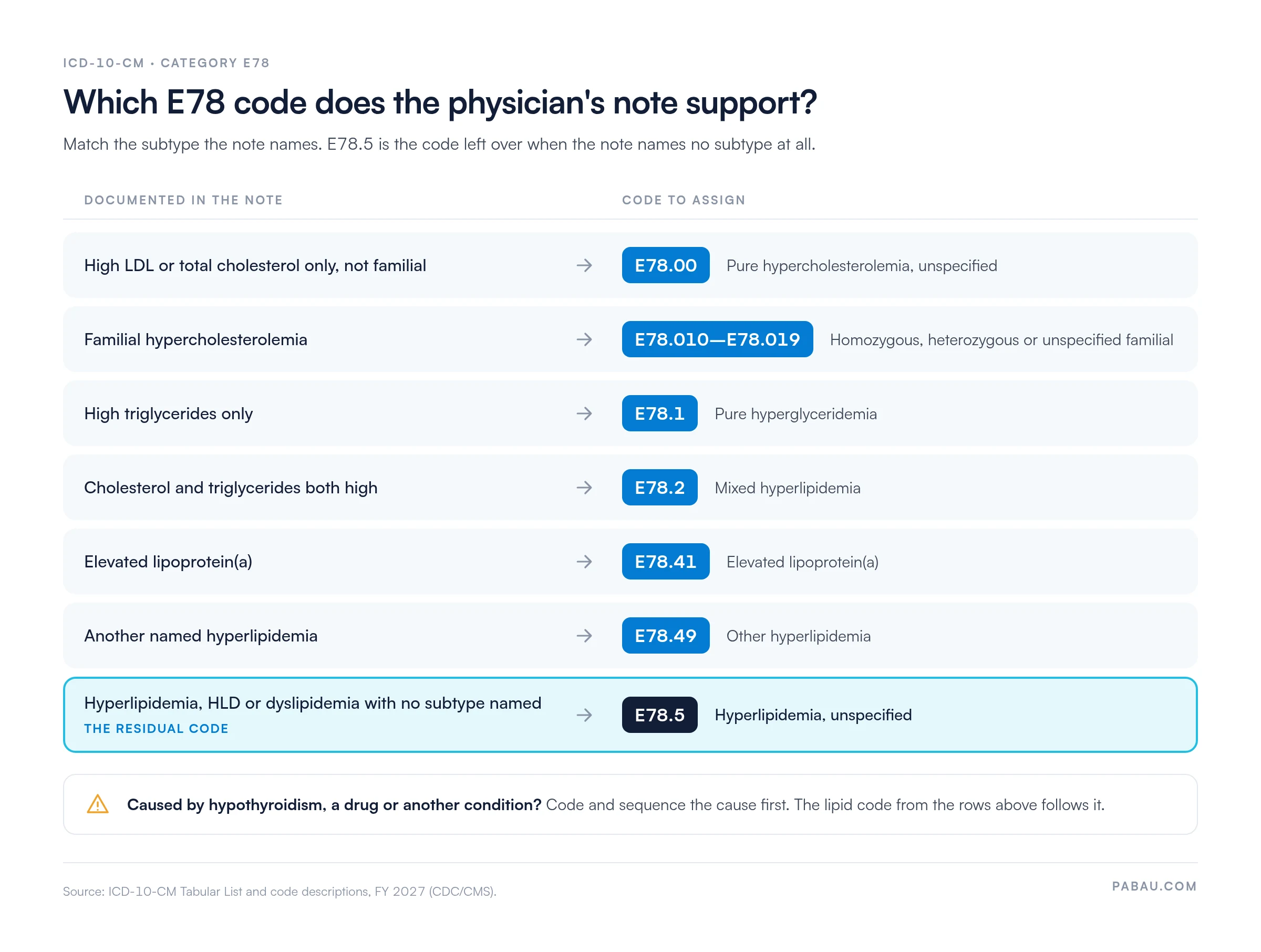
The table lists the codes most likely to replace E78.5 when the documentation supports them.
CMS publishes the full code set in its ICD-10 code files, updated each fiscal year. Check E78 subcategory boundaries there, since FY 2026 split the familial code into three.
E78.5 needs documentation that establishes the diagnosis and shows why no more specific code applies. Payers look for four elements in the chart.
If the physician documents hypercholesterolemia beside an LDL of 160 mg/dL and normal triglycerides, the code is E78.00, not E78.5. When the values point to a subtype but the note doesn’t name one, query the physician. A coder can’t assign a subtype from lab values alone.
Audit your E78.5 claims each quarter against the matching lipid panel values. Flag any chart where the LDL, the triglycerides or the physician’s note points to a subtype. Those encounters should carry E78.00, E78.1 or E78.2, and fixing them before submission saves the rework.
Hyperlipidemia rarely appears as the only diagnosis. These conditions are often documented alongside E78.5, and each needs correct sequencing to keep the claim clean.
E78.5 is paired with essential hypertension, I10, at many chronic disease visits. Both codes belong on the claim when both conditions are managed in the encounter, sequenced by the reason for the visit.
Payers treat E78.5 differently depending on the service it supports. For Medicare, National Coverage Determinations (NCDs) and Local Coverage Determinations (LCDs) set which services are paid when E78.5 is the supporting diagnosis.
Medicare and Medicaid: Medicare covers the lipid panel, billed as CPT 80061, with E78.5 for diagnosis and monitoring, subject to frequency limits. E78.5 alone may not establish medical necessity for high-cost drugs such as PCSK9 inhibitors.
Plans usually want documented LDL values, a prior statin trial and a cardiovascular risk assessment before they approve those drugs. Check the plan’s current criteria before you submit.
Commercial payers: Requirements vary by plan. Many accept E78.5 for routine lipid management but want extra diagnosis codes, such as cardiovascular risk codes, before they authorize high-cost drugs. Your revenue cycle management workflow should include a payer-specific check for E78.5 encounters that involve specialty drugs.
E78.5 denials follow the same pattern across payers. Most come from one of four sources:
Good denial management workflows for E78.5 start at the point of coding, not at the remittance. A claim that reaches the payer with an under-specified code is far harder to overturn on appeal than one corrected before submission.
When a lipid claim does come back, the reason code on the remittance tells you what to fix. Our list of denial codes explains each CARC and RARC you are likely to see.
A clean E78.5 claim carries four things:
Our guide to the clean claim covers the rest of the pre-submission checklist.
Before you submit an E78.5 claim tied to a PCSK9 inhibitor, read the plan’s prior authorization criteria. Most ask for cardiovascular risk documentation and a record of prior statin therapy. Where the chart documents I10 or I25.10, adding them as secondary codes often supplies the risk evidence without a second request.
A coder who can’t see the lipid panel can only code what the problem list says. When results sit in a lab portal or a scanned PDF, E78.5 becomes the easy pick, even when the values point to E78.1 or E78.2.
Pabau, the practice management and EHR platform we build, puts the lab result and the claim on one record. Practices that switch on lab integrations get Quest and Labcorp results imported onto the patient record automatically.
A trends chart on that record shows each result over time, so the coder can check for a named subtype before picking the code.
Claims go out from the same record through our claims management software. It submits through the Claim.MD clearinghouse, which connects to over 4,000 US payers for claims submission, with real-time eligibility for 400+ payers.
ERA remittances post back to the patient, so a specificity denial on an E78.5 line shows up against the encounter that caused it. The billing team corrects the code with the note in front of them instead of chasing the chart later.
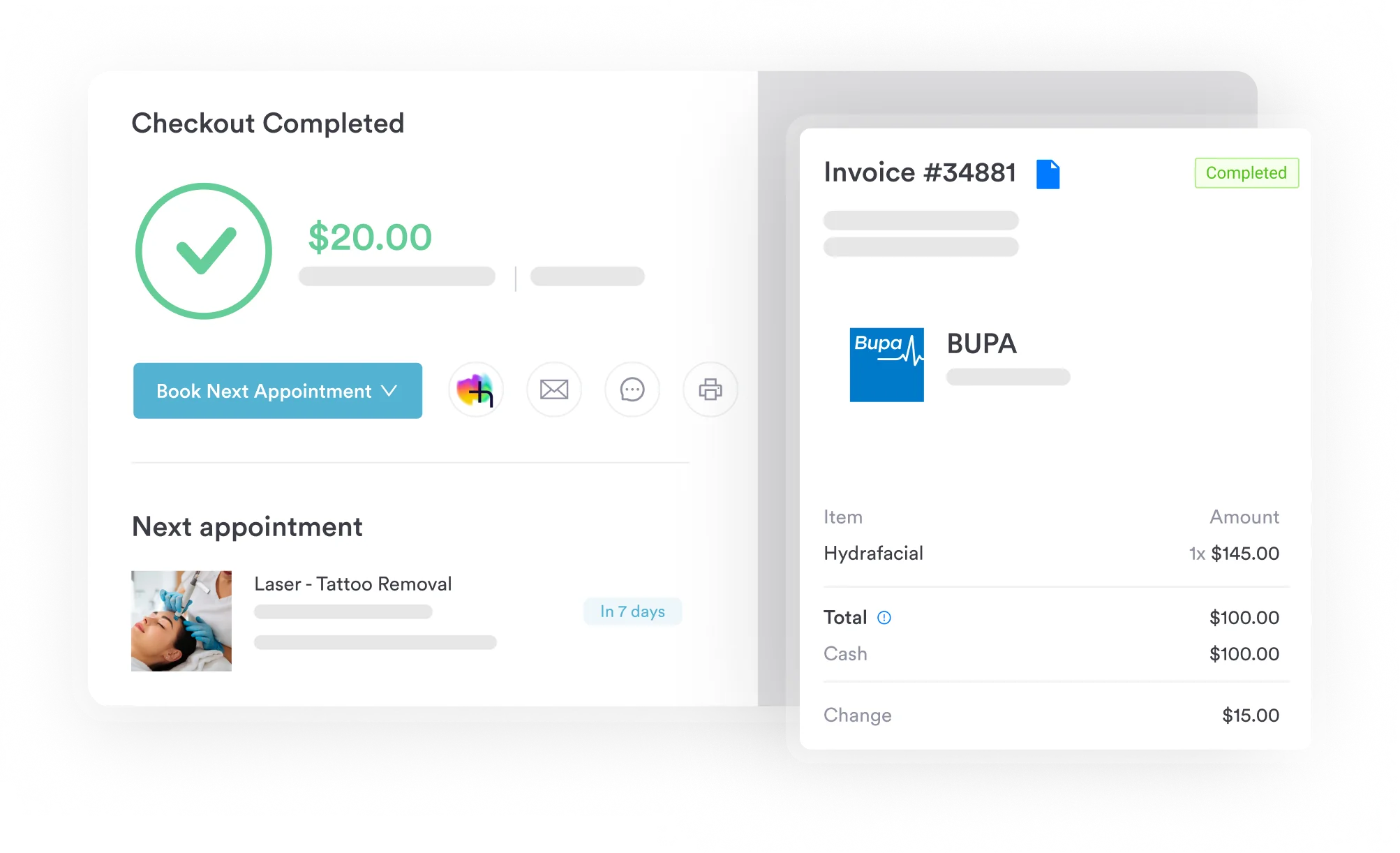

Pabau puts imported lab results, the physician’s assessment and the claim on one patient record. Your coder sees the lipid subtype before choosing E78.5, and the claim goes out through Claim.MD.

E78.5 is the right code only when the note names no lipid subtype. A physician who writes hypercholesterolemia, hyperglyceridemia or mixed hyperlipidemia has already chosen a more specific code for you.
The practical step is to read the note and the lipid panel together before coding. Where they disagree, query the physician rather than default to E78.5. That check takes a minute per claim and heads off the specificity denial before the payer sees it.
Book a demo to see how Pabau keeps lab results, the physician’s note and the claim on one record for your coding team.

Preparing for a payer audit? Medical billing compliance outlines the documentation and coding standards an audit checks.
New to the payer side of coding? What is medical billing walks through the path from encounter to payment.
Coding coronary artery disease alongside E78.5? ICD-10 code I25.10 covers atherosclerotic heart disease without angina and how it is sequenced.
ICD-10 Code E78.5 is the billable ICD-10-CM code for hyperlipidemia, unspecified. It covers elevated blood lipids when the documentation names no subtype, such as pure hypercholesterolemia (E78.00) or pure hyperglyceridemia (E78.1). It applies when the note doesn’t say which lipid fraction is mainly abnormal.
Yes. E78.5 is a valid billable ICD-10-CM code for FY 2026 and FY 2027, and it can stand alone on a claim. Payers may still deny it when the chart clearly supports a more specific E78 code.
E78.00 is pure hypercholesterolemia, unspecified. It applies when the physician documents high LDL or high cholesterol as the main lipid abnormality. E78.5 applies only when the documentation names no lipid subtype. If the note says hypercholesterolemia and triglycerides are normal, E78.00 is the correct code.
HLD, short for hyperlipidemia, codes to E78.5 when no subtype is documented. If the clinician’s note names the subtype, use the matching E78 code instead. HLD is a clinical abbreviation, not an ICD-10-CM term, so the code depends on how specific the physician’s documentation is.
Yes. E78.5 and K76.0, fatty liver not elsewhere classified, can be coded together when both conditions are documented and managed in the encounter. Neither code carries an Excludes note against the other. Sequence by the reason for the visit, so a fatty liver workup usually puts K76.0 first.
The most common reason is a more specific E78 code that the chart supported but the claim didn’t use. Others are a missing lipid panel, E78.5 listed first when a secondary cause exists, and thin medical necessity for high-cost lipid-lowering drugs. Checking the code against the note and the lipid panel before submission prevents most of them.