ICD-10 Code Z86.73: Personal history of TIA
ICD-10 Code Z86.73: Definition, descriptor, and code hierarchy ICD-10 Code Z86.7...

Last Updated: Nov 20, 2026
Billable Code Specific Code
E78.00 is the billable ICD-10-CM code for pure hypercholesterolemia, unspecified. It covers elevated LDL or total cholesterol when triglycerides are normal and no familial hypercholesterolemia is documented.
The code sits under E78.0 in category E78, Disorders of lipoprotein metabolism and other lipidemias. Assignment turns on the lipid panel. Combined triglyceride elevation points to E78.2, and a documented familial diagnosis points to E78.010, E78.011 or E78.019.
Let Pabau's smart automation suggest the right codes, reduce claim denials, and keep your practice compliant—effortlessly.
Automate repetitive tasks and focus on what matters most—your patients.
Reduce coding errors and ensure compliance with the latest regulations.
Clean claims, fewer denials, and faster reimbursements.
Powerful insights and reporting to help your practice thrive.
HIPAA compliant SOC 2 certified GDPR-compliant Trusted by 4,000+ clinics worldwide

E78.00 is the billable code for pure hypercholesterolemia, unspecified. It covers elevated LDL or total cholesterol with normal triglycerides and no confirmed familial diagnosis.
Use a familial code only when the chart documents a genetic diagnosis or a family history meeting clinical criteria. Since FY2026 that means E78.010, E78.011 or E78.019, not E78.01.
Combined LDL and triglyceride elevation is mixed hyperlipidemia (E78.2), and E78.5 is reserved for hyperlipidemia documented without its type.
The most common E78.00 denial is thin documentation. The note must record the lipid values, normal triglycerides and the medical necessity for any lipid panel.
Pabau’s practice management software submits CMS-1500 and 837P claims through Claim.MD, with eligibility checks and ERA remittances. Your team can track every E78.00 claim in one place.
ICD-10 Code E78.00 is the billable ICD-10-CM diagnosis code for pure hypercholesterolemia, unspecified. Its official descriptor is listed in the CDC/NCHS ICD-10-CM tabular list under category E78, Disorders of lipoprotein metabolism and other lipidemias. That category sits in Chapter 4, Endocrine, nutritional, and metabolic diseases.
The E78.0 subcategory gained its first child codes in FY2017 (effective October 1, 2016): E78.00 and E78.01. E78.00 became the default when familial hypercholesterolemia cannot be confirmed. In FY2026, E78.01 itself split into three billable codes for homozygous, heterozygous, and unspecified familial hypercholesterolemia.
E78.00 applies when lab findings show isolated elevation of LDL cholesterol or total cholesterol. Triglycerides are normal, and no familial diagnosis is confirmed. The tabular list gives four inclusion terms: Fredrickson’s hyperlipoproteinemia type IIa, hyperbetalipoproteinemia, LDL-type hyperlipoproteinemia, and (pure) hypercholesterolemia NOS.
This is the most common lipid presentation in primary care and cardiometabolic practices. Metabolic health and longevity practices also use the code often, usually alongside cardiovascular risk assessments and preventive counseling visits.
The following clinical presentations support an E78.00 assignment:
Four neighboring codes are often confused with ICD-10 Code E78.00. Each carries a distinct clinical meaning, which affects code selection, payer acceptance, and medical necessity review.
Using E78.5 when the labs clearly support E78.00 is a specificity error. ICD-10-CM guidelines call for the most specific code the documentation supports. A claim with E78.5 for documented LDL-only elevation can trigger a records request or a medical necessity review. PCSK9 inhibitor prior authorizations feel this most, because payers often require E78.00 or a familial code as the qualifying diagnosis.
Choosing between these codes is the most common decision point in lipid disorder encounters. Three questions settle it, asked in order. Is a familial diagnosis documented? Are triglycerides elevated along with LDL? Does the note record which lipid is elevated? The diagram below follows the same order.
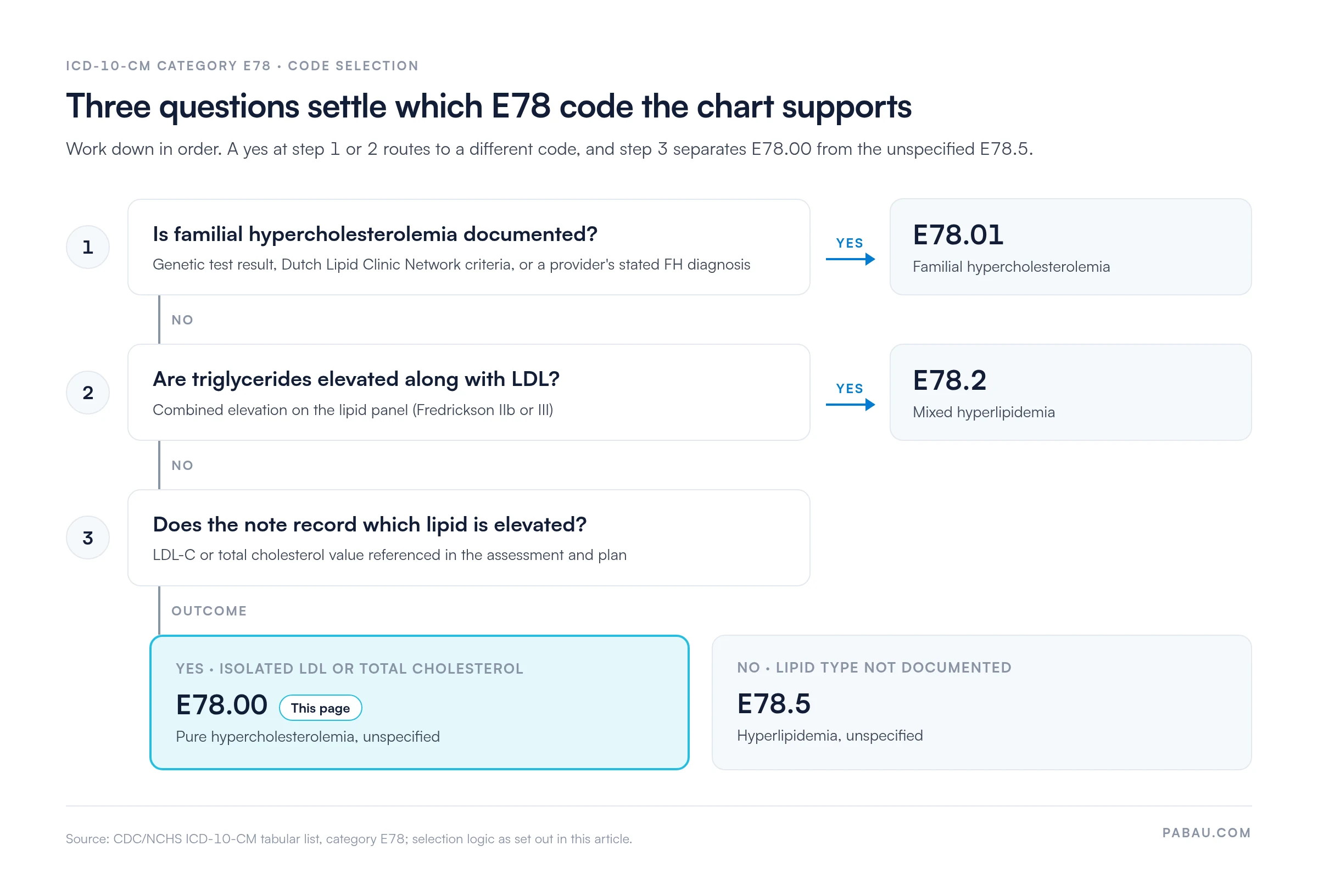
A familial code requires documented evidence of a genetic or hereditary basis. The clinical note must record one of the following:
Without that documentation, E78.00 is correct. Do not move to a familial code on a very high LDL value alone. Since FY2026, E78.01 has been a subcategory header rather than a billable code. A documented FH diagnosis is billed as E78.010 for homozygous FH, E78.011 for heterozygous FH, or E78.019 when the type is unspecified.
This distinction matters beyond code specificity. PCSK9 inhibitors such as evolocumab and alirocumab commonly require prior authorization. Many payer policies list a heterozygous FH diagnosis, now E78.011, as the qualifying diagnosis for that indication. E78.00 supports the primary hyperlipidemia indication, while ASCVD is documented with its own diagnosis. The wrong code can send a prior authorization down the wrong clinical pathway.
Run a documentation query before you submit a claim with a familial code. Confirm the note holds a genetic test result, a provider statement of familial hypercholesterolemia, or a documented family history with LDL thresholds. If none is present, default to E78.00 and avoid the PCSK9 prior authorization mismatch.
The note must carry enough clinical detail to support both the diagnosis and any associated procedure or service. For ICD-10 Code E78.00, that means five specific documentation elements.
These are the CPT codes most often submitted with E78.00 as the supporting diagnosis. Verify coverage linkage against the applicable CMS Physician Fee Schedule and the local coverage determinations (LCDs) for your payer and jurisdiction. Full descriptors for each one sit in our CPT reference for coders.
The 80061 lipid panel carries most E78.00 lab claims. 82465 is billed instead when only total cholesterol is measured.
Once the codes are right, the claim still has to reach the payer. Pabau, a practice management platform with built-in claims software for practices, submits claims through Claim.MD. The same connection runs eligibility checks and posts ERA remittances, which cuts the rework after a preventable denial on a lipid code.
Medicare covers screening lipid panels every five years for beneficiaries without a diagnosis. Follow-up testing with E78.00 is covered as diagnostic lipid testing under NCD 190.23, subject to frequency and medical-necessity rules. Statin therapy itself is rarely restricted, and most formularies list statins without prior authorization when ICD-10 Code E78.00 is present.
PCSK9 inhibitors are where the authorization burden concentrates. Most commercial payers and many Medicare Part D plans require all of the following before approving evolocumab or alirocumab:
A prior authorization can be denied for wrong indication when you submit E78.00 but the payer’s criteria expect a familial code. That happens most when LDL is very high and FH is plausible. Document familial status explicitly before the PA is filed, and use a clear denial management process for the ones that still come back.
Most E78.00 denials are fixable with documentation corrections rather than code changes. The table below lists the four most common denial patterns and the specific resolution step for each.
Knowing what makes a clean claim lets you build the lipid value and familial status into your note template, so E78.00 claims need less rework. Lipid codes recur at nearly every chronic-care visit, so the check belongs in your wider revenue cycle management routine.
Hypercholesterolemia rarely presents in isolation. The following ICD-10-CM codes appear most commonly in the same encounter as E78.00, with sequencing notes where relevant.
The ICD-9-CM predecessor code for E78.00 is 272.0 (Pure hypercholesterolemia). ICD-9-CM did not separate familial from unspecified pure hypercholesterolemia, so E78.00 and the familial E78.01- codes all trace back to 272.0.
This matters for practices reconciling historical claims data or supporting research queries across the ICD-9/ICD-10 transition period. Use the CMS ICD-10 codes and GEMs crosswalk files for the official forward and backward mapping tables. For current FY lookup, verify the AAPC ICD-10-CM code lookup against the tabular list.
Accurate E78.00 coding starts at the point of documentation, not at the billing queue. These steps reduce downstream errors for cardiometabolic and primary care practices.
Before each fiscal year starts, check E78.00’s status, adjacent codes, and coding note updates in the CDC/NCHS ICD-10-CM browser.
E78.00 rework usually starts in the note. An LDL value missing from the assessment, or a familial status nobody recorded, surfaces weeks later as a denial or a stalled prior authorization.
In Pabau, the clinical note and the claim sit on one patient record. With the Quest or Labcorp integration switched on, lab results sync back to that record too. The LDL value your coder needs is then already next to the assessment.
Claims then go out as CMS-1500 or 837P submissions through Claim.MD, with eligibility checks before the visit. ERA remittances post back to the same record, so a lipid panel denial shows up beside the note that needs fixing.
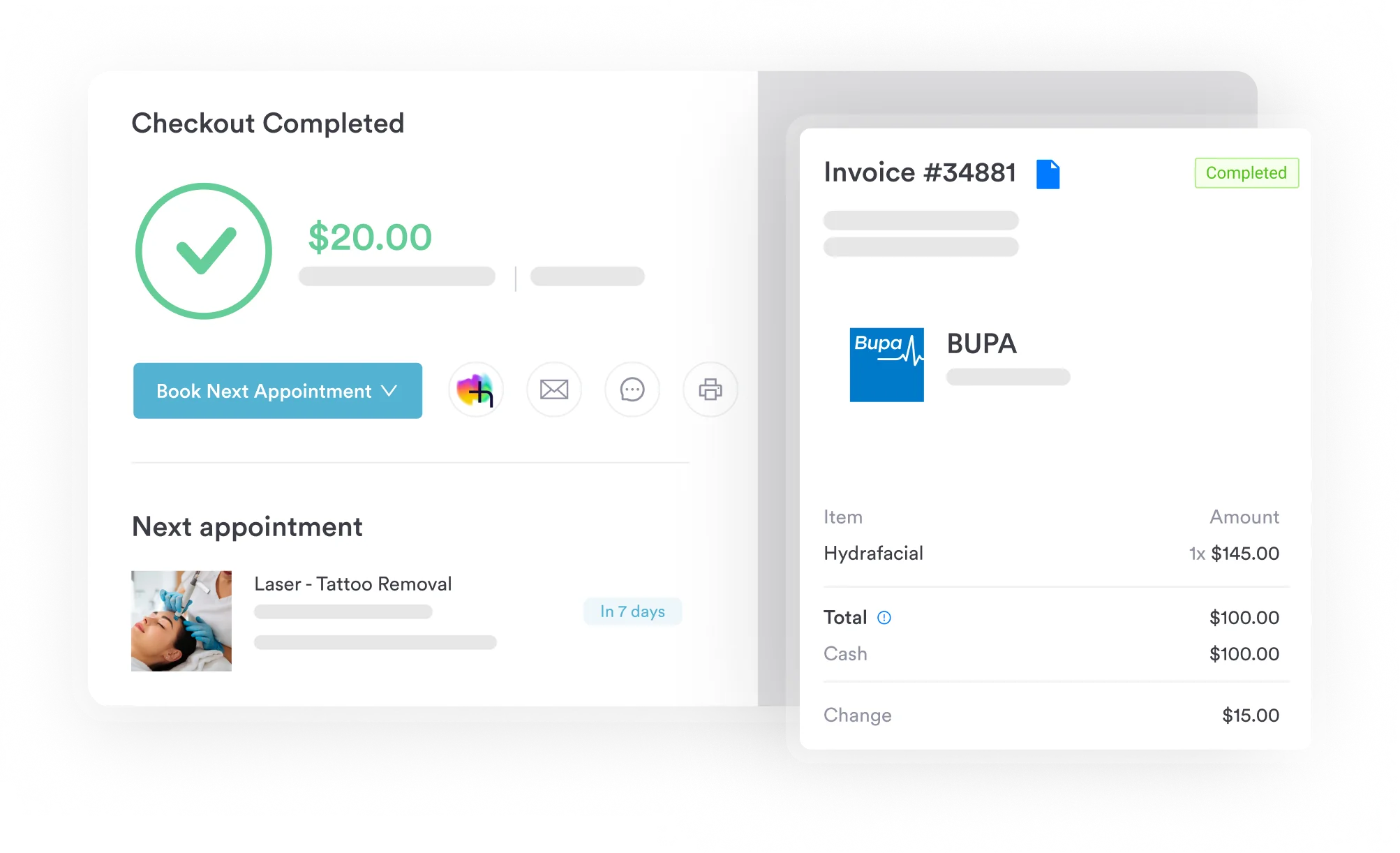

Pabau holds the lipid values, the diagnosis and the claim on one patient record. Your team submits through Claim.MD, checks eligibility and tracks remittances without switching systems.

E78.00 is usually the right code. The work that protects it happens in the note. Record an LDL value in the assessment, a word on triglycerides, and a line on familial status, and most denials on this code never happen.
Start with the FY2026 familial split, because E78.01 is no longer a valid billing code. Then audit one month of lipid panel claims against the three questions above, and fix the note template wherever the same omission repeats.
Pabau’s claims management and Claim.MD connection let practices submit claims, check eligibility, and track remittances in one system. Book a demo to see a lipid follow-up go from note to paid claim on one patient record.

Coding hyperlipidemia without a documented type? ICD-10 code E78.5 covers when the unspecified code is the right choice.
Billing the lipid panel itself? CPT code 80061 explains the panel’s components and how payers check medical necessity.
Want to understand what happens after a denial lands? Denial management in healthcare walks through the full appeals and rework process.
Submitting claims through a clearinghouse for the first time? What is revenue cycle management explains how the claim lifecycle works from encounter to payment.
ICD-10 Code E78.00 is the billable ICD-10-CM diagnosis code for pure hypercholesterolemia, unspecified. It is assigned when elevated LDL or total cholesterol is documented with normal triglycerides and no confirmed familial hypercholesterolemia. It sits under category E78 and became effective October 1, 2016.
E78.00 is for pure hypercholesterolemia when familial status is unconfirmed or ruled out. E78.01 is the familial hypercholesterolemia subcategory, and since FY2026 it is billed as E78.010, E78.011 or E78.019. A familial code needs a confirmed genetic diagnosis or a family history meeting clinical criteria. Very high LDL alone does not justify one.
Yes, when the lipid panel shows isolated elevated LDL or total cholesterol without triglyceride elevation and without a familial diagnosis. If triglycerides are also elevated, E78.2 (mixed hyperlipidemia) applies. E78.5 fits only when hyperlipidemia is documented without its type.
The most common are 80061 (lipid panel), 82465 (total cholesterol), 83721 (direct LDL measurement), and the office visit codes 99213 and 99214. Lipid panel CPTs need E78.00 or another qualifying diagnosis to establish medical necessity for coverage.
Familial hypercholesterolemia falls under E78.01, which is not billable on its own since FY2026. Use E78.010 for homozygous FH, E78.011 for heterozygous FH, or E78.019 when the type is unspecified. Each requires documented evidence of a genetic or hereditary basis in the provider’s note.