

ICD-10 Code R63.4: Abnormal weight loss
ICD-10 code R63.4: Definition, billability and code structure ICD-10 code R63.4 ...

Last Updated: Nov 13, 2026
Billable Code Specific Code
E66.9 is the billable ICD-10-CM code for obesity, unspecified. Use it when the provider documents obesity but names no type, cause or class.
E66.9 sits under category E66, Overweight and obesity. The provider's own wording decides whether a more specific E66 code applies. A Z68 code is added to report the BMI when it is known.
Let Pabau's smart automation suggest the right codes, reduce claim denials, and keep your practice compliant—effortlessly.
Automate repetitive tasks and focus on what matters most—your patients.
Reduce coding errors and ensure compliance with the latest regulations.
Clean claims, fewer denials, and faster reimbursements.
Powerful insights and reporting to help your practice thrive.
HIPAA compliant SOC 2 certified GDPR-compliant Trusted by 4,000+ clinics worldwide

E66.9 is the billable ICD-10-CM code for obesity when the provider names no type, cause or class of obesity.
Since October 1, 2024, category E66 holds ten billable codes, including the class 1, 2 and 3 obesity codes E66.811 to E66.813.
Add a Z68 code to identify the BMI when it is known, and only beside a reportable diagnosis such as obesity.
A BMI in the vitals can’t support E66.9 on its own. The provider has to document the obesity diagnosis.
E66.9 carries no HCC weight, while E66.01, E66.2, E66.813 and Z68.41 to Z68.45 do.
ICD-10 code E66.9 is the billable diagnosis code for “Obesity, unspecified.” Use it when the provider documents obesity but doesn’t say whether it’s morbid, drug-induced, due to excess calories, or a specific obesity class.
It’s valid on HIPAA-covered claims under ICD-10-CM, which the Centers for Medicare and Medicaid Services (CMS) and the National Center for Health Statistics (NCHS) maintain.
If the note supports a more precise code, use that code instead. Our ICD-10-CM library for coders lists the rest of chapter 4 in the same layout.
Since October 1, 2024, category E66 holds ten billable codes. They are E66.01, E66.09, E66.1, E66.2, E66.3, E66.811, E66.812, E66.813, E66.89 and E66.9.
E66.8 is now a header over E66.81- and E66.89, so it can’t go on a claim. E66.9 is the code for a chart that supports none of its siblings. The provider’s own wording picks the code, as the table below shows.
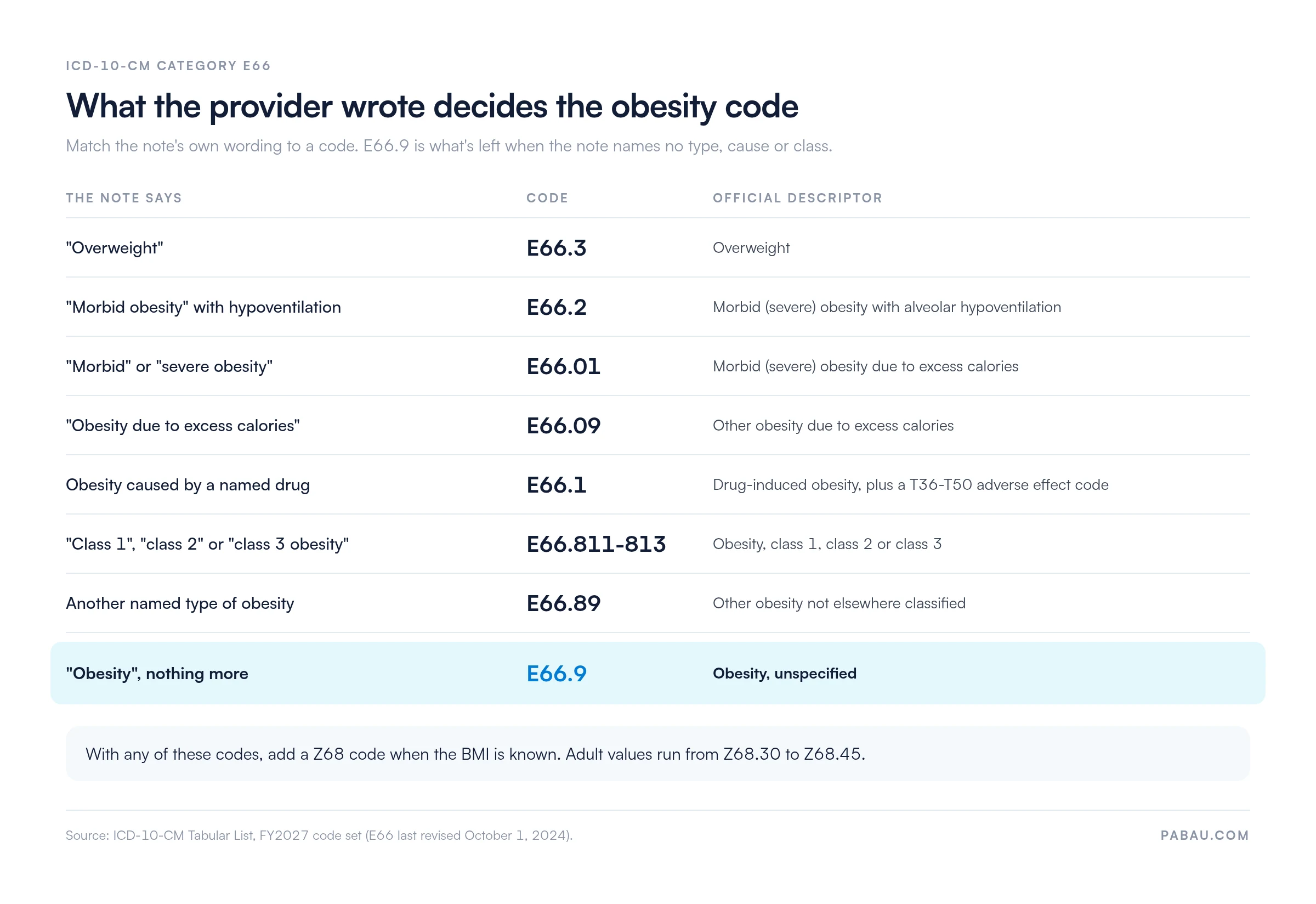
Watch E66.01 most closely. It needs the provider to write “morbid” or “severe” obesity, or a clinical equivalent. A BMI of 42 in the chart without that language doesn’t qualify. Query the provider before you move from E66.9 to E66.01, and apply the same rule to the class codes.
E66.9 inherits its instructional notes from category E66. The CDC/NCHS ICD-10-CM web tool lists them, and there are three to know.
These conditions aren’t part of E66. If the patient also has one, report it with its own code.
When a pregnant patient has obesity, code first obesity complicating pregnancy, childbirth and the puerperium (O99.21-). The E66 code follows it.
The tabular list says to use an additional code to identify body mass index, if known (Z68.-). When the BMI is in the record, add the matching Z68 code beside E66.9.
Run a quarterly audit of encounters coded E66.9. Pull any visit where a BMI appears in the vitals but no Z68 code went out with E66.9. Those visits lose specificity, and a high BMI that counts toward Medicare Advantage risk adjustment goes unreported.
These three codes get mixed up most often. Each one maps to a different clinical picture and a different line in the note.
Coders can’t infer the grade of obesity from the BMI. If the BMI is 44 and the provider writes only “obesity,” E66.9 is correct. Send a query to ask whether morbid obesity or a class applies. Only the provider can make that call and document it.
Section I.C.21.c.3 of the ICD-10-CM Official Guidelines allows a Z68 BMI code only with an associated reportable diagnosis, such as obesity. The Z68 code is always secondary, so it never leads the claim. Adult codes apply from age 20.
Under Section I.B.14, the BMI itself can come from clinicians other than the provider, such as a nurse or dietitian. The obesity diagnosis can’t. A BMI in the vitals with no provider diagnosis of obesity doesn’t support E66.9.
Obesity rarely shows up alone. When obesity isn’t the reason for the visit, list the reason first and report E66.9 and the Z68 code as secondary codes. Hyperlipidemia is a frequent partner, reported as code E78.5 when the type is unspecified. These conditions turn up beside E66.9 most often.
When obesity is the reason for the visit, as in a weight-management appointment, list E66.9 first and the comorbidities after it. When the visit is for a comorbidity such as diabetes control, that condition goes first. Prediabetes follows the same rule, so a visit to recheck an elevated A1c lists R73.03 ahead of E66.9. Some LCDs won’t accept obesity alone for a total insulin test, so list the documented metabolic diagnosis on any CPT 83525 claim. A fatty liver documented at the same visit is coded separately as fatty liver code K76.0.
Don’t move a chart from E66.9 to a more specific code without the provider’s documentation. If the chart hints at more, such as a BMI of 45 and a bariatric referral, send a query before you assign E66.01 or E66.813. It matters on surgical claims: on a 43845 claim, E66.9 as the primary diagnosis usually draws a medical necessity denial.
Here’s the path a typical outpatient claim takes, and where each step tends to slip.
Take an illustrative example. A 52-year-old patient comes in for a hypertension follow-up, with a BMI of 33.4. The note reads “obesity, counseled on diet.” The claim carries I10 first, then E66.9, then Z68.33.
E66.9 problems follow a few predictable patterns, and each one has a fix. Good denial management workflows start with knowing which ones hit your practice.
A clearinghouse scrub catches format errors before the claim reaches the payer. Pabau, the practice management platform we build, sends electronic claims through Claim.MD with eligibility checks. The same habits sit behind medical billing compliance as a whole.
The same diagnosis can pass for one service and fail for another. The table covers the four services where E66.9 most often drives coverage.
Medicare’s obesity counseling benefit is billed with G0447, and the visit limits sit in the CMS Physician Fee Schedule. Nutrition counseling under 97802 is a different story for Medicare patients with obesity alone. Check commercial plans one by one.
GLP-1 coverage criteria change often at the plan level. Confirm the current formulary position and step therapy rules before you send a prior authorization built on E66.9 alone.
The General Equivalence Mapping (GEM) files from CMS and NCHS link the legacy ICD-9-CM codes to ICD-10-CM. You’ll need them for historical data, audit defense, or patient records that span the October 2015 switch.
The map from 278.00 to E66.9 is one-to-one in the GEM files, and the AAPC ICD-10-CM code lookup shows the same pairing. No other ICD-10-CM code maps from 278.00.
E66.9 is valid in the FY2027 ICD-10-CM code set, effective October 1, 2026, with its code and descriptor unchanged. The last change to category E66 came in the FY2025 update, effective October 1, 2024.
That update turned E66.8 into a header code. It added E66.811, E66.812 and E66.813 for obesity classes 1 to 3, plus E66.89 for other obesity not elsewhere classified. E66.9 itself didn’t change, but a provider who now documents a class gives you a better code than E66.9.
Review the final CMS ICD-10-CM files each summer, before the October 1 update. Check whether any new E66 codes match wording your providers already use, so you can retire E66.9 where a better code now exists.
In many practices the obesity diagnosis lives in one system, the BMI in another and the claim in a third. The coder rebuilds the visit from screenshots, and the Z68 code is the piece that gets dropped.
Pabau keeps the treatment note, the vitals and the claim on one patient record. The Measures tab charts weight and vitals over time, so the provider sees the trend before writing the assessment.
Once the visit is coded, our claims software for billing teams sends the claim through Claim.MD. Eligibility checks run before the visit and ERA remittances post after it, so your team spends less time chasing weight-management claims.
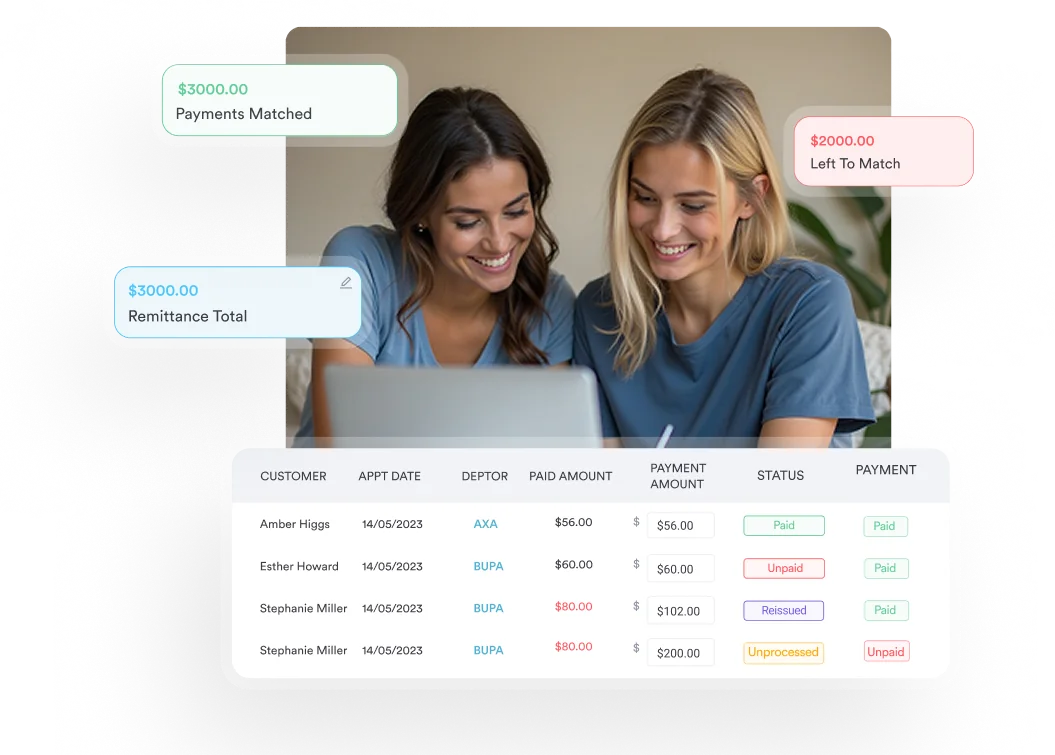

Pabau keeps treatment notes, weight trends and Claim.MD claims on one patient record. Your team can check the E66.9 and Z68 pair before the claim leaves.

E66.9 is the right code more often than its “unspecified” label suggests. When the provider writes obesity and nothing more, it’s correct. Upgrading it on a hunch is the bigger risk.
The work sits upstream. Ask providers to name the class or cause when they know it, and add the Z68 code whenever the BMI is known. That one habit sharpens your specificity and your risk scores at the same time.
Book a demo to see how Pabau keeps the obesity note, the weight trend and the claim on one patient record.

Does the note say morbid or severe obesity? ICD-10 code E66.01 covers the documentation that code needs and how it differs from E66.9.
Looking to cut obesity-claim denials across your billing team? Denial management in healthcare outlines the workflow steps that catch coding errors before claims leave the practice.
Need to understand how claims move from diagnosis code to payment? Revenue cycle management explained covers the full lifecycle from intake to remittance.
New to the billing side of the practice? What is medical billing explains how diagnosis codes feed into the claim lifecycle.
No. E66.9 doesn’t map to a payment HCC in the CMS-HCC model Medicare Advantage uses. Morbid obesity codes E66.01, E66.2 and E66.813 do, and so do BMI codes Z68.41 to Z68.45.
Use the E66 code the provider’s wording supports, as you would for an adult. For the BMI, use a pediatric percentile code from Z68.5- instead of an adult code. Adult Z68 codes apply from age 20, and pediatric codes cover ages 2 to 19.
Only when the provider documents obesity at that visit and it affects care, treatment or management. That’s the test in Section IV.J of the outpatient guidelines. Carrying it forward from an old problem list doesn’t meet it.
The sixth character sets the timing. O99.211, O99.212 and O99.213 cover the first, second and third trimesters. O99.214 covers childbirth, O99.215 covers the puerperium, and O99.210 is the unspecified trimester.



