



CCSD code G5100: Bypass of duodenum billing guide
CCSD code G5100 bills a bypass that leaves the duodenum in place CCSD code G5100...

Last Updated: Oct 16, 2026

CPT code 80061 is the lipid panel code covering three component tests: total cholesterol (82465), triglycerides (84478), and HDL cholesterol (83718).
Medicare prices 80061 on the Clinical Laboratory Fee Schedule at a national rate of $13.39, with no geographic or place-of-service adjustment.
Medicare covers lipid testing once every 5 years for screening; more frequent testing requires a qualifying ICD-10 diagnosis such as E78.5 or Z13.220.
Never bill component codes 82465, 84478, or 83718 separately when the full panel is ordered, because CCI edits bundle them into 80061.
Practice management software like Pabau links lab orders to CPT codes automatically, which lowers the risk of unbundling errors on lipid panel claims.
CPT code 80061 describes a lipid panel. The American Medical Association (AMA) defines it as three tests run on a single specimen. Those tests are total cholesterol, triglycerides, and high-density lipoprotein (HDL) cholesterol. Clinicians order the panel to assess cardiovascular risk, monitor known hyperlipidemia, and screen eligible adults at preventive visits.
The panel sits in the Organ or Disease Oriented Panels section of the CPT codebook. It is one of the highest-volume outpatient lab codes billed across primary care, internal medicine, cardiology, and endocrinology.
All three components must be performed and reported to bill CPT 80061. Missing any single component disqualifies the claim for the panel code. The coder then bills only the individual components actually performed.
LDL cholesterol is not a required component of CPT 80061. It is usually calculated from the other three values rather than measured directly, so it carries no component code inside the panel. If a provider orders a direct LDL measurement (CPT 83721), that is a distinct and separately billable test.
Medicare prices CPT 80061 on the Clinical Laboratory Fee Schedule (CLFS), not the Physician Fee Schedule. The published national rate for CY2025 and CY2026 is $13.39. Rates on this schedule are set under PAMA from reported private payer data.
Two consequences follow, and both contradict how 80061 is often described. The rate carries no geographic practice cost index adjustment, so it does not move between a rural and an urban ZIP code. It also does not split into facility and non-facility amounts, because a lab test has no site-of-service differential.
80061 carries no work, practice expense, or malpractice RVUs either. Clinical lab tests are not RVU-priced, so an RVU lookup returns no payment amount for this code. The CLFS national rate is the figure to check your remittance against.
Private payer rates still vary considerably. Commercial insurers commonly reimburse a percentage of the Medicare allowable, and some negotiate flat fee contracts with reference laboratories. Compare each remittance against the published CLFS rate, because that is how a contract paying below schedule shows itself.
Medicare covers lipid testing under National Coverage Determination (NCD) 190.23. The rules divide into screening and diagnostic categories, and the split changes the frequency limit, the diagnosis code, and what the patient pays.
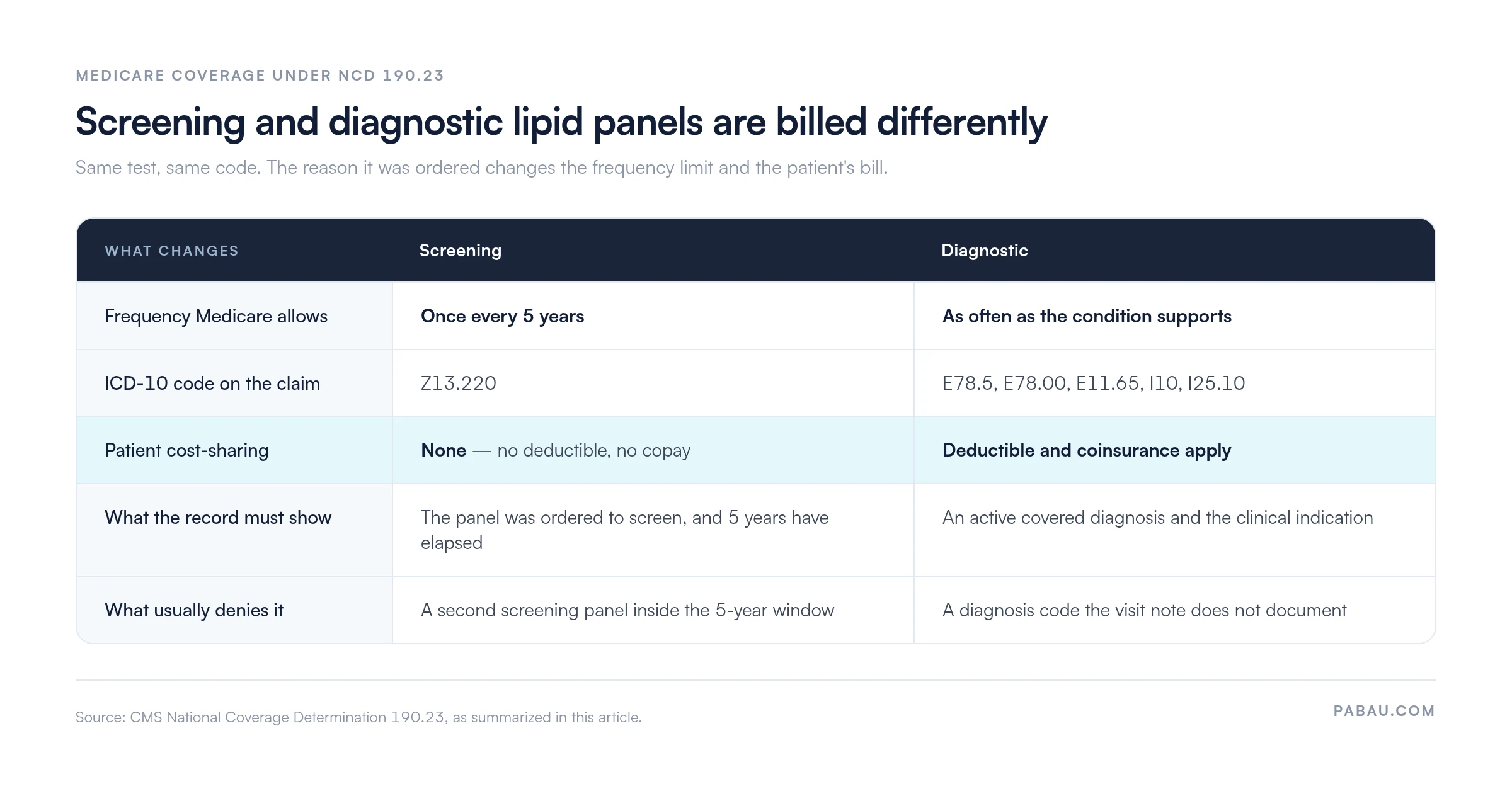
Medicare covers lipid panel screening once every 5 years for beneficiaries with no diagnosed lipid disorder. The ordering provider must document that the test is for screening, and the correct ICD-10 code must appear on the claim. That code is usually Z13.220. Screening tests carry no patient cost-sharing when they are billed correctly as preventive.
The cost-sharing distinction causes a lot of billing errors. A lipid panel ordered during a wellness visit and billed as preventive (Z00.00) is free to the patient. The same panel linked to a diagnostic code shifts the encounter to diagnostic status, and cost-sharing applies. Tell patients which one they are getting before the visit.
Medicare covers lipid testing more often than once every 5 years when the patient has a qualifying diagnosis. Hyperlipidemia, cardiovascular disease, diabetes, and hypertension all qualify. The medical record must document the clinical indication, and a covered ICD-10 code must be present on the claim. Checking coverage before the specimen is drawn also surfaces any frequency restriction while the patient is still in the office.
The diagnosis code decides whether a CPT 80061 claim pays or denies more often than any other field. The CMS ICD-10-CM guidelines require the code to reflect the clinical reason for the test, not a default entry meaning a lipid panel was ordered.
Payer-specific LCD policies may restrict or expand the list above, so verify the LCD for your MAC before assuming a code is covered. Some contractors require the lipid disorder code to appear as the primary diagnosis. Placing a symptom code first can trigger a denial even when a lipid code is listed second. Full descriptors and coding notes for each code sit in our ICD-10-CM code reference.
The bundling prohibition is the most consequential billing rule for CPT 80061. When a provider orders a complete lipid panel, the claim reports only 80061. Submitting 80061 alongside 82465, 84478, or 83718 on the same date of service triggers a CCI edit violation.
The unbundling trap usually starts in the result feed rather than with the coder. A lab order generates individual results for each analyte, and some billing systems populate component codes from those results instead of the ordered panel. The order is the billing authority, not the result report. What the code on the claim should be comes down to what the lab actually performed.
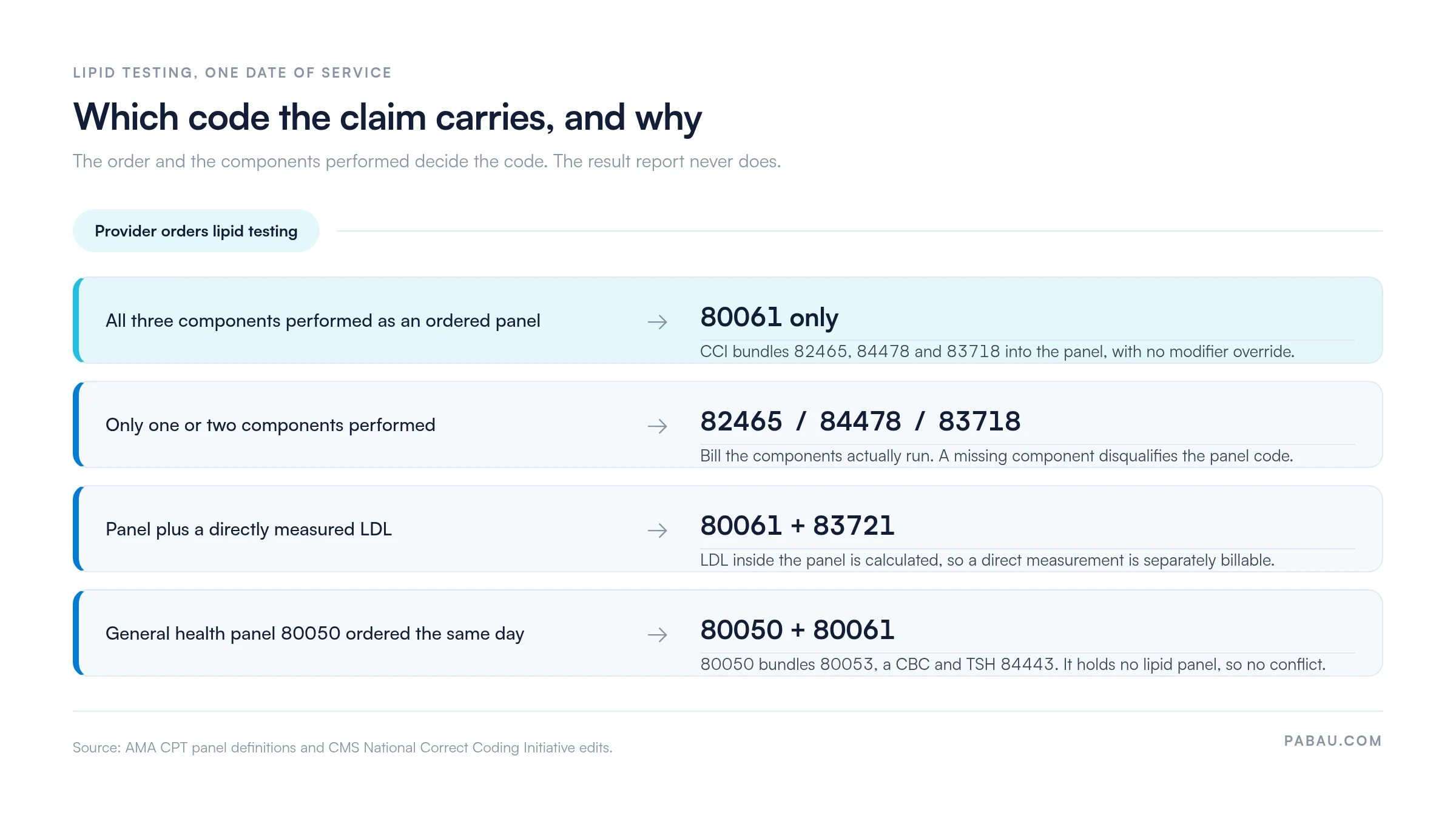
The Correct Coding Initiative (CCI) bundles CPT 82465, 84478, and 83718 into 80061 with no modifier override. These edits cannot be bypassed. If only two components were performed, bill those component codes and leave 80061 off the claim. If all three were performed as a panel, bill 80061 alone. Verify current edits each quarter through the AAPC code lookup, since CMS updates them four times a year.
A clean 80061 claim needs the correct place-of-service code, the rendering provider’s NPI, and the matching ICD-10 code linked to the panel. All three belong on the claim before it leaves the practice.
Run a quarterly CCI edit check on your top 10 lab panel codes, including 80061. The CMS CCI edit table is updated four times per year. A bundling rule that did not exist in Q1 may trigger denials in Q3. Flag any code pair changes in your billing system before the new quarter begins.
Medical necessity documentation is the primary audit target for lipid panel claims. A superbill listing CPT 80061 without supporting chart documentation will not survive a post-payment audit or a MAC probe review. The medical record must contain all of the following before the claim goes out.
Palmetto GBA, the Medicare Administrative Contractor for Jurisdictions J and M, requires medical necessity documentation on every lipid panel claim, diagnostic ones included. Jurisdiction N is administered by First Coast Service Options, which covers Florida, Puerto Rico, and the US Virgin Islands. Other MACs set equivalent requirements in their local coverage determinations. Compliance for lab panels starts in the clinical record, not on the claim form.
The lipid panel generates a predictable set of denial patterns, and most of them are preventable with the right pre-submission workflow. Effective denial management for lab codes starts by addressing these root causes before claims leave the practice.
Reviewing denial codes systematically shows whether an 80061 pattern is systemic or a one-off. CO-4 (unbundling) and CO-50 (not medically necessary) are the two worth watching. A cluster of CO-4 denials on lipid panel claims almost always points to the EHR order set. It is populating component codes instead of the panel code.
Track your lipid panel denial rate separately from your overall lab denial rate. If 80061 denials are running above 5%, audit the last 20 denied claims for the root cause. In most cases one or two causes account for the bulk of them, and fixing those upstream removes the rework without touching individual claims.
Lipid panels are rarely ordered in isolation. These related codes commonly appear on the same claim or in the same patient encounter.
Coding round-ups often describe CPT 80050 as containing a lipid panel. It does not. The general health panel bundles a comprehensive metabolic panel (80053), a complete blood count, and a TSH (84443). No lipid component sits inside it, so 80061 and 80050 create no bundling conflict. Both may be billed on the same date when both panels were ordered and performed.
Liver chemistry prompts the same question, and a hepatic function panel ordered beside the lipids bills under its own code. CPT code 80076 reports seven measurements, including ALT, AST, and alkaline phosphatase, and none of them sit inside 80061.
Most 80061 errors start between the clinical order and the claim. A provider orders a lipid panel, and the lab returns individual analyte results. A billing system that does not connect the two then populates the component codes. That single disconnect produces the CO-4 denials described above, on one of the highest-volume lab codes a practice bills.
Practice management software like Pabau closes that distance. Pabau’s claims software for practices links the lab order to the billing workflow. The CPT code assigned at ordering carries through to submission without re-entry. When a provider orders a full lipid panel, 80061 populates the claim instead of the three components. The ICD-10 code attached to the order maps to the patient’s active chart diagnoses.
For US practices, claims route through the Claim.MD clearinghouse, which checks eligibility in real time and validates claim data against payer edits before submission. Electronic remittance advices come back inside the same platform, so denial codes sit beside the original claim rather than in a separate payer portal. Reading them in one place surfaces a recurring 80061 pattern long before it spreads across hundreds of claims.

Pabau links lab orders to claim submission automatically. CPT codes populate from the order, ICD-10 codes link to the chart, and claims validate before they reach the payer. See how it works for your practice.

CPT 80061 pays $13.39, which is precisely why it deserves a workflow rather than case-by-case attention. At lipid panel volumes, reworking a denied claim costs more staff time than the panel earns. The economics only work when the claim goes out correctly the first time.
Three habits remove almost every denial pattern in this article. Bill the panel code the provider ordered, attach a diagnosis the visit note supports, and check the frequency before the specimen leaves the building. None of them is difficult; all of them are easy to skip when the order and the claim live in separate systems.
Book a demo to see how Pabau keeps the lipid panel order, its diagnosis code, and the outgoing claim in one patient record.

Need a framework for managing lab claim denials systematically? Denial management in healthcare covers root-cause analysis methods and workflows for reducing recurring claim rejections.
Want to understand how ERA data connects to your revenue cycle? Electronic remittance advice explains how 835 transactions work and how to use ERA data to catch payer underpayments.
Looking to tighten up your pre-submission compliance process? Medical billing compliance outlines the documentation standards that protect practices during MAC audits and RAC reviews.
Wondering what a payer counts as a clean claim? Clean claim sets out the fields a claim needs to pass adjudication without a resubmission.
Building a superbill for lab work? Superbill explains what belongs on one and how patients use it to claim reimbursement.
CPT code 80061 is a lipid panel that includes three required component tests: total cholesterol (CPT 82465), triglycerides (CPT 84478), and HDL cholesterol (CPT 83718). All three must be performed on the same specimen to bill the panel code. LDL cholesterol is calculated from these values and is not a required component of 80061.
Medicare pays CPT 80061 from the Clinical Laboratory Fee Schedule, not the Physician Fee Schedule. The published national rate for CY2025 and CY2026 is $13.39. That rate is not adjusted by geographic practice cost index, and it does not change between facility and non-facility settings. The code carries no physician RVUs.
No. When a full lipid panel is ordered, only CPT 80061 should be billed. Billing 82465, 84478, or 83718 alongside 80061 triggers a CCI edit violation. Individual component codes may only be billed separately when fewer than all three components were actually performed.
Medicare covers lipid panel screening once every 5 years under NCD 190.23 for patients without a qualifying diagnosis. More frequent testing is covered when the patient has a documented covered condition such as hyperlipidemia (E78.5), diabetes, cardiovascular disease, or hypertension. Medical necessity must be documented in the chart.
Four causes account for most of them. CCI edit violations from unbundling component codes alongside 80061 come first. Next is a frequency limit exceeded when screening is billed inside 5 years without a qualifying diagnosis. The other two are a missing or undocumented ICD-10 diagnosis, and duplicate billing by both the practice and the reference lab.
CPT 80053 is the comprehensive metabolic panel, which measures kidney function, liver enzymes, electrolytes, glucose, and albumin. It includes no lipid values. CPT 80061 measures only lipid markers, meaning total cholesterol, triglycerides, and HDL. Both may be billed on the same date when both panels are ordered and performed, because they are not bundled with each other.
No. CPT 80050, the general health panel, bundles a comprehensive metabolic panel (80053), a complete blood count, and a TSH (84443). It contains no lipid panel component, so there is no bundling conflict with 80061. Both codes may be billed on the same date when both panels were ordered and performed.



