CPT code 86481: TB IGRA billing guide
CPT code 86481: Official descriptor and procedure description CPT code 86481 des...

Last Updated: Nov 2, 2026
82465 is the CPT code for cholesterol, serum or whole blood, total. It covers a single lab measurement of total cholesterol by any method, from a fasting or non-fasting specimen.
Bill it only when total cholesterol is the whole order. When the lab runs a full lipid panel, CPT 80061 already includes it, and NCCI blocks billing both on the same date. Medicare also expects a covered diagnosis, such as an E78.x lipid disorder code.
Let Pabau's smart automation suggest the right codes, reduce claim denials, and keep your practice compliant—effortlessly.
Automate repetitive tasks and focus on what matters most—your patients.
Reduce coding errors and ensure compliance with the latest regulations.
Clean claims, fewer denials, and faster reimbursements.
Powerful insights and reporting to help your practice thrive.
HIPAA compliant SOC 2 certified GDPR-compliant Trusted by 4,000+ clinics worldwide

CPT code 82465 covers total cholesterol only, from serum or whole blood. It cannot be billed on the same date as CPT 80061, which already includes it.
Covered diagnoses include E78.00, E78.01, and E78.5, and Z13.6 supports cardiovascular screening. Medicare NCD 190.23 requires a covered diagnosis for reimbursement.
Modifiers 90, 91, and QW are the three most often applied to 82465, and each carries its own payer rules and documentation requirements.
Pabau’s claims management software integrates with Claim.MD to check 82465 claims against payer edits before submission, which cuts denials for labs and primary care practices.
CPT code 82465 is described by the American Medical Association as: Cholesterol, serum or whole blood, total. That descriptor is the complete AMA text. It specifies the analyte (total cholesterol), the specimen type (serum or whole blood), and the measurement scope (total, not fractionated). No method is named because both enzymatic and colorimetric assay techniques qualify.
82465 sits within the Chemistry subsection of the CPT codebook (codes 82000-84999). It is a standalone chemistry code, not a panel code. That distinction matters for bundling. Panel codes like 80061 contain 82465 as a defined component, while 82465 billed alone represents a single-analyte test ordered without the rest of the panel.
82465 covers the measurement of total cholesterol from any serum or whole blood specimen, regardless of method. That scope is intentionally narrow.
What it does not cover:
The most consequential exclusion is CPT 80061. When a provider orders a full lipid panel, 82465 is already a defined component of that panel. Billing 82465 separately on the same date triggers an NCCI bundling edit, and the standalone code is denied. The rule: If 80061 is billed, 82465 must not appear on the same claim for the same date of service.
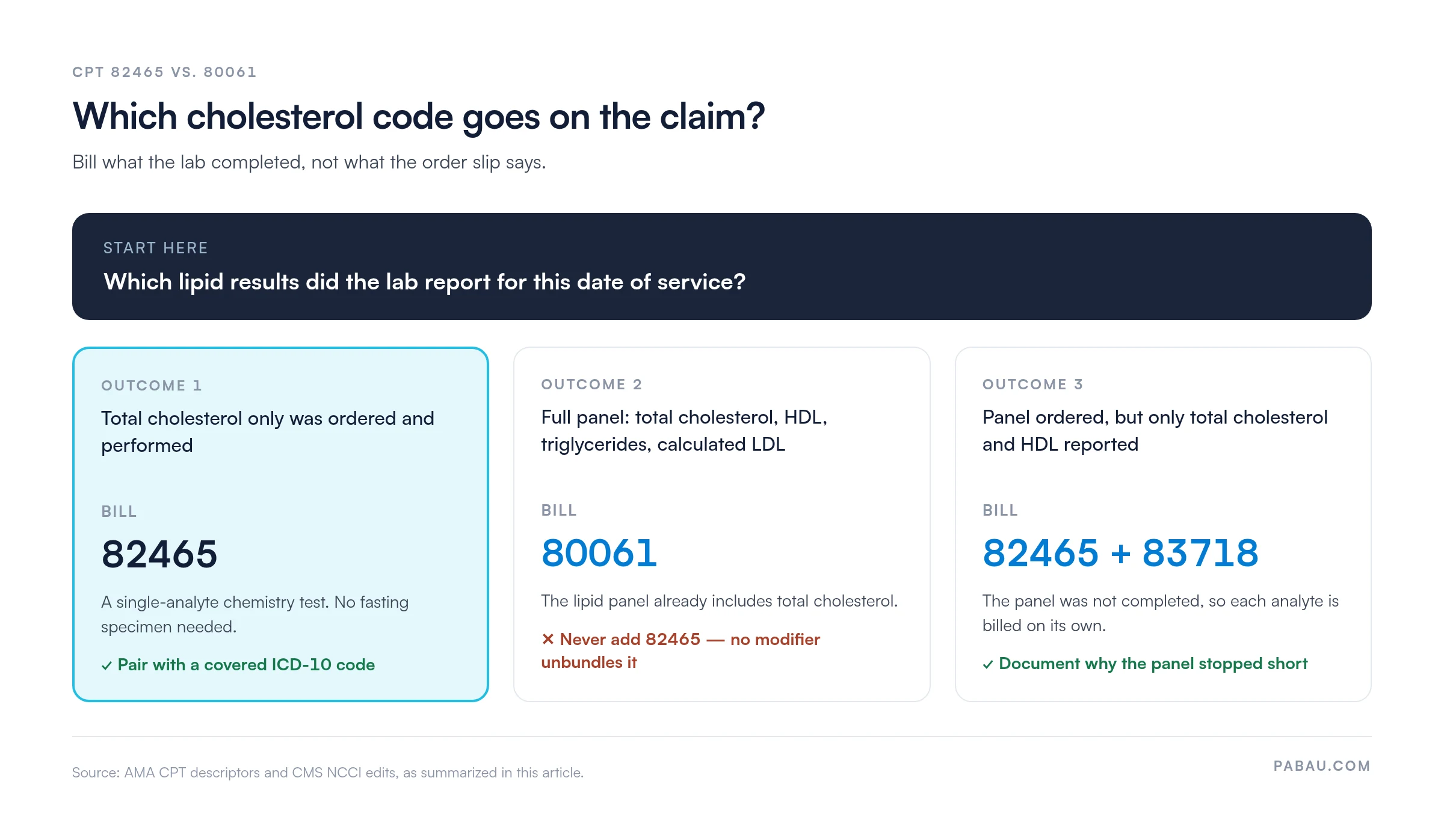
Choosing between 82465 and 80061 comes down to what the provider ordered and what the lab completed. The comparison below sets out the decision.
Partial panels are where coders slip. A patient’s order slip says “lipid panel,” but the lab reports only total cholesterol and HDL. The specimen volume was too small for the full run. In that case, bill 82465 (total cholesterol) and 83718 (HDL) as individual codes, not 80061, since the full panel was not completed. Document the reason in the order record. The three outcomes side by side:
Pairing 82465 with a non-covered diagnosis is the second most common denial driver. The ICD-10 code must support medical necessity and, for Medicare, must appear on the NCD 190.23 covered-diagnoses list.
NCD 190.23 covers lipid testing for patients with known cardiovascular disease or risk factors, patients on lipid-lowering therapy, and initial cardiovascular risk assessment. Z00.00 alone does not satisfy any of those criteria. Pair a covered E78.x code, or Z13.6 for a screening encounter, whenever the clinical record supports it.
When billing a cholesterol test ordered during an annual wellness visit, do not rely on Z00.00 as the sole ICD-10 code. If the patient has a documented lipid disorder or cardiovascular risk factor, list that E78.x or I10 code as the primary diagnosis. Many MACs will deny 82465 if Z00.00 is the only code on the claim.
82465 does not require a fasting specimen. Total cholesterol levels are not significantly affected by recent food intake, so the test is valid on both fasting and non-fasting samples.
This distinguishes it from triglycerides (CPT 84478), which require fasting to produce a clinically meaningful result. When a provider orders only total cholesterol, no fasting instruction is clinically necessary and no fasting documentation is required on the claim.
Documentation the ordering provider should still record:
Three modifiers apply to CPT code 82465 with meaningful frequency. Applying the wrong one, or omitting a required one, is a frequent cause of modifier-related denials on lab claims.
Modifier 59 (distinct procedural service) does not override the NCCI bundling edit between 82465 and 80061. CMS gives the 82465-to-80061 edit no modifier indicator, so no modifier can unbundle them when both are performed on the same date.
Medicare reimbursement for CPT code 82465 is published annually in the Medicare Physician Fee Schedule. Rates vary by geographic locality through the Geographic Practice Cost Index (GPCI). MPFS rates are updated each January, so check the CMS Physician Fee Schedule lookup tool for a current-year figure. The national non-facility rate for 82465 has historically been under $10, placing it among the lower-reimbursed chemistry codes.
Because the payment is so small, an underpaid 82465 claim is easy to miss. After submission, reading electronic remittance advice shows which adjustment reason code applied when an 82465 claim pays below the expected rate.
Medicare NCD 190.23 coverage criteria:
Commercial payers generally follow similar coverage criteria to Medicare, though frequency limits and required ICD-10 codes vary. Confirm with the specific payer’s lab benefits policy before relying solely on NCD 190.23 criteria for commercial claims.
The National Correct Coding Initiative places 82465 as a column 2 code bundled into CPT 80061. No modifier overrides this edit. Any claim submitting both codes on the same date of service for the same patient will result in denial of 82465.
The reason is the panel’s makeup. CPT 80061 (lipid panel) covers total cholesterol, HDL, triglycerides and calculated LDL, so total cholesterol is already paid inside it.
NCCI edits are updated quarterly. The edition and quarter should be cited when documenting a bundling determination, since edit status can change. Maintaining medical billing compliance on panel bundling requires checking the current NCCI table rather than relying on edit status from a prior quarter.
Most 82465 denials fall into six categories. Each has a specific corrective action that prevents the same denial on the next submission.
A structured denial management workflow that tracks 82465 denials by reason code will reveal which of these six categories is most frequent at your practice. Refer to the denial codes reference for the remittance advice codes that map to each category.
The place of service (POS) code on an 82465 claim directly affects the payment rate and payer editing logic.
CLIA waiver eligibility is analyzer-specific. The CMS waived-test list is updated periodically, and a device approved for waiver status at the time of purchase may not remain listed indefinitely. Verify current waiver status for the specific analyzer model and lot number before appending modifier QW.
Medical necessity documentation for 82465 must show a clinical reason for measuring total cholesterol that aligns with a covered ICD-10 diagnosis. Follow this five-step process to support every claim.
Flag 82465 claims where the ordering provider’s NPI differs from the billing provider’s NPI. On standalone cholesterol claims referred to outside labs, this mismatch is one of the easiest edits to prevent. Build a pre-submission check into your billing workflow that verifies both NPIs are populated and match your payer’s enrollment records.
Most 82465 denials are set before the claim leaves the building. A lipid panel billed alongside total cholesterol, a Z00.00 left on its own, or a missing modifier 90 each guarantees a rejection. Catching them by hand means a coder rereading every lab claim against the NCCI table and the NCD list.
Pabau, the practice management platform we build, sends claims through its Claim.MD clearinghouse integration. Pre-submission edits catch a same-day 82465 and 80061 pair, or a missing diagnosis code, before the payer sees the claim. ERAs come back into the same system automatically.
When a claim is denied anyway, the claims management dashboard filters denials by CPT code and shows the CARC behind each one. Your team sees which of the six denial categories keeps recurring, so the fix goes into the workflow instead of the next resubmission.

Pabau’s claims management software connects to Claim.MD to validate CPT code claims against payer edits before submission. Reduce denials and get paid faster for every cholesterol test you bill.

CPT 82465 is easy to code and surprisingly easy to get denied. Two habits prevent most of those denials. Bill 82465 only when total cholesterol was the whole order, and pair it with a covered E78.x code, or Z13.6 for a screening encounter.
Put both checks into the order-to-claim workflow, not the appeal queue. On a code that pays under $10, one rework cycle can cost more than the claim is worth. Submitting a clean claim the first time is the only version that pays.
Still seeing 82465 denials at your lab or primary care practice? Book a demo to see how Pabau’s pre-submission edits catch them before the payer does.

Need a full overview of the claims submission process? Revenue cycle management basics covers how lab claims move from order to payment.
Dealing with repeated clearinghouse rejections? Claim.MD clearinghouse overview explains how the integration validates claims before they reach the payer.
Want to see where codes land before the claim is built? Superbill documentation guide walks through how procedure codes, diagnosis codes, and modifiers appear on the superbill that feeds the claim.
CPT code 82465 covers the measurement of total cholesterol from serum or whole blood, using any enzymatic or colorimetric method. It does not include HDL, LDL, triglycerides, or any other lipid fraction. Those need their own codes or the lipid panel code (CPT 80061).
CPT 82465 covers total cholesterol alone. CPT 80061 (lipid panel) covers total cholesterol, HDL, triglycerides and calculated LDL together. Because 82465 is a component of 80061, the two cannot be billed on the same date of service for the same patient. Doing so triggers an NCCI unbundling denial, with no modifier override available.
The most commonly paired ICD-10 codes are E78.00 (pure hypercholesterolemia, unspecified), E78.01 (familial hypercholesterolemia), and E78.5 (hyperlipidemia, unspecified). For a screening encounter, use Z13.6 (encounter for screening for cardiovascular disorders). Z00.00 (general adult medical examination) does not independently support medical necessity for 82465 under Medicare.
Yes. Medicare covers CPT code 82465 under NCD 190.23 for patients with cardiovascular disease or risk factors, patients on lipid-lowering therapy, and initial risk screening. For low-risk asymptomatic patients, Medicare typically covers the test once every five years. More frequent testing needs documented at-risk status, or an ABN for non-covered frequencies.
Three modifiers apply. Modifier 90 marks a test the ordering provider bills after sending it to an outside reference lab. Modifier 91 marks a repeat test on the same date for a distinct clinical reason. Modifier QW marks a CLIA-waived test run on a listed point-of-care analyzer by a facility with a valid certificate of waiver. Modifier 59 does not override the NCCI bundling edit between 82465 and 80061.
No, a fasting specimen is not required for CPT 82465. Total cholesterol levels are not materially affected by recent food intake, so both fasting and non-fasting specimens are acceptable. Fasting is required for triglycerides (CPT 84478) but not for standalone total cholesterol testing.
The Medicare reimbursement rate for CPT 82465 varies by geographic locality and changes annually with the Medicare Physician Fee Schedule update. The national non-facility rate has historically been under $10. For the current-year rate in your locality, search CPT code 82465 and your MAC region in the CMS Physician Fee Schedule lookup tool.
Six denial reasons come up most often. They are billing 82465 with CPT 80061 on the same date, a non-covered ICD-10 diagnosis, and exceeding the Medicare frequency limit without an ABN. The other three are a missing modifier 90 on a reference lab claim and the wrong place-of-service code. An invalid or expired CLIA certificate of waiver also denies a QW claim.