

CCSD Code D1010: Radical mastoidectomy including meatoplasty
CCSD Code D1010: Definition and clinical scope CCSD Code D1010 is the UK private...

Last Updated: Nov 25, 2026
84478 is the CPT code for a standalone triglycerides test, the quantitative measurement of triglycerides in serum or plasma. It sits in the Chemistry subsection of the CPT Pathology and Laboratory section, and Medicare pays it under the Clinical Laboratory Fee Schedule.
Triglycerides are also one of the three required components of the lipid panel, CPT 80061. Bill 84478 alone when triglycerides are the only lipid ordered, and bill 80061 when the full panel is run.
Let Pabau's smart automation suggest the right codes, reduce claim denials, and keep your practice compliant—effortlessly.
Automate repetitive tasks and focus on what matters most—your patients.
Reduce coding errors and ensure compliance with the latest regulations.
Clean claims, fewer denials, and faster reimbursements.
Powerful insights and reporting to help your practice thrive.
HIPAA compliant SOC 2 certified GDPR-compliant Trusted by 4,000+ clinics worldwide

CPT code 84478 reports a standalone triglycerides test. Triglycerides are also part of lipid panel 80061, so billing both on one date without a modifier draws an NCCI bundling denial.
A diagnostic claim needs a supporting diagnosis such as E78.1 (pure hypertriglyceridemia) or E78.5 (hyperlipidemia, unspecified).
Medicare’s cardiovascular screening benefit is billed with Z13.6 and paid once every 5 years. Many commercial payers accept Z13.220 for lipid screening instead.
Medicare pays 84478 under the Clinical Laboratory Fee Schedule (CLFS), which CMS updates every year, so check the current rate in the CMS CLFS files.
Claims software such as Pabau keeps the lab order, chart note and diagnosis on one record. The biller can then spot an 84478 and 80061 overlap early.
CPT code 84478 is a Chemistry subsection code with the official AMA descriptor “Triglycerides.” It reports quantitative measurement of triglycerides in a serum or plasma specimen, typically using a colorimetric enzymatic (GPO-PAP) method on an automated clinical analyzer.
CMS’s claims processing manual lists 84478 Triglycerides among the four codes billable for cardiovascular disease screening, alongside lipid panel 80061. As a single-analyte code, it stands apart from panel codes that report several analytes together.
The quick-reference table below covers the key billing attributes a coder needs before submitting a claim.
CPT 84478 measures the concentration of triglycerides, the most abundant dietary fat, in a patient’s blood. Elevated triglyceride levels are an independent cardiovascular risk factor and are routinely monitored in patients with metabolic syndrome, type 2 diabetes, and familial hypertriglyceridemia.
The lab performing the test must hold a valid CLIA certificate at the appropriate complexity level. Standard enzymatic colorimetric triglycerides assays run on automated analyzers are classified as moderate complexity under CLIA. Some FDA-cleared point-of-care devices carry a waived status. Confirm it for the specific device in use before billing under a CLIA waiver number.
Triglyceride values are significantly elevated for 4 to 8 hours after a meal, making fasting specimens the clinical standard for cardiovascular risk assessment. Many clinical guidelines recommend a 9- to 12-hour fast before the draw.
Some protocols now use non-fasting triglycerides for initial cardiovascular screening. If payer policy or the LCD specifies fasting, the ordering provider must document the clinical rationale for a non-fasting specimen. Record fasting status in the chart note so the claim holds up in an audit.
The most common billing error with CPT 84478 is submitting it on the same date as CPT 80061 without a valid distinct-service modifier. The lipid panel already includes triglycerides as one of its three required components, alongside total cholesterol and HDL cholesterol.
Billing both codes on the same date tells the payer you ran the same analyte twice. That triggers an automatic NCCI Column 1/Column 2 bundling denial.
When a distinct service warrants separate reporting, modifier 59 (distinct procedural service) can override the edit. So can an X-modifier, such as XU for an unusual non-overlapping service. Verify current NCCI tables before relying on this, because NCCI is updated quarterly and edit pairs do change.
Triglycerides are rarely ordered in isolation. The table below shows codes frequently billed alongside CPT 84478 and the clinical context where each pairing is appropriate.
Every CPT 84478 claim needs a paired ICD-10-CM diagnosis code that documents clinical justification for the test. CMS covers diagnostic triglycerides testing under NCD 190.23 (Lipid Testing), and most MACs align their LCDs with the same set of accepted diagnoses. The codes below are those payers recognize most consistently, and E78.5 is the broadest of them.
ICD-10-CM codes are updated each October, so confirm the codes above are valid for the current fiscal year before submitting. Medicare screening claims need particular care.
Medicare’s cardiovascular screening benefit is billed with Z13.6 and pays once every 5 years for beneficiaries without symptoms. Testing more often needs documented medical necessity under NCD 190.23. Without it, give the beneficiary an Advance Beneficiary Notice (ABN) before the draw.
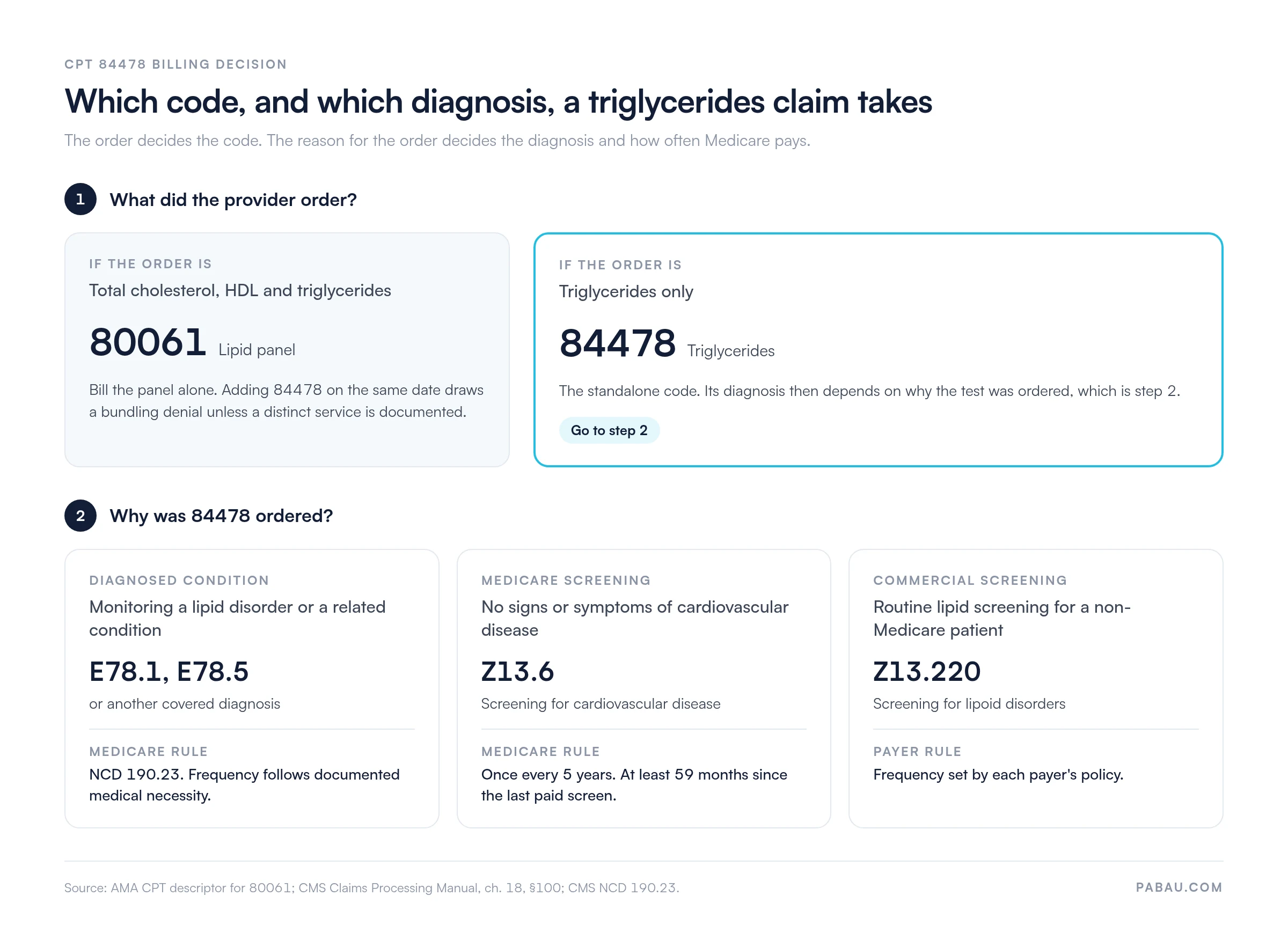
The chart below puts the code choice and the diagnosis choice in the order a biller makes them.
The Medicare payment rate for CPT 84478 is set under the Clinical Laboratory Fee Schedule (CLFS). The Protecting Access to Medicare Act (PAMA) of 2014 restructured it to base rates on private payer market data. CMS publishes updated CLFS files every year, so a dollar figure printed in a coding reference can go out of date quickly.
For the current-year allowable, download the rate files from the CMS Clinical Laboratory Fee Schedule page and look up code 84478. Lab codes do not carry facility and non-facility rate distinctions the way professional service codes do. The CLFS rate is a single national limitation amount.
Commercial payer rates for 84478 vary widely. Most fall in a range above the Medicare allowable, though self-funded employer plans may negotiate rates closer to or below the Medicare floor. Document the contractual rate and expected reimbursement in your fee schedule master before submitting to avoid write-off surprises at posting.
Check your Medicare CLFS rates against the CMS fee schedule files after every update, starting with the January release. A change of a few cents per claim adds up quickly across high-volume lab codes like 84478.
CMS NCD 190.23 (Lipid Testing) is the national coverage policy for diagnostic triglycerides claims for Medicare beneficiaries. It covers lipid testing, including standalone triglycerides, when the record shows cardiovascular disease, a lipid disorder, or symptoms that call for lipid assessment.
Routine screening sits outside the NCD, under Medicare’s separate cardiovascular screening benefit. Each MAC may also publish an LCD with more specific documentation requirements, so check your jurisdiction’s current policy.
These elements must appear in the medical record to defend a CPT 84478 claim under audit:
When more frequent testing than the payer’s frequency limit is clinically warranted, document the specific medical rationale in the note. For Medicare, failure to do so before a screening draw should trigger an ABN so the beneficiary can decide whether to proceed at personal cost.
The National Correct Coding Initiative (NCCI) places CPT 84478 as a Column 2 (component) code to CPT 80061 (Column 1, comprehensive lipid panel). When both codes appear on the same claim for the same date of service and beneficiary, the payer’s claim system suppresses payment for 84478. The edit is automated, and it fires regardless of which code is listed first on the claim.
The edit carries a modifier indicator of “1,” so a modifier can override it when documentation supports a distinct service. Verify the current indicator in the CMS NCCI tables before relying on it, because NCCI updates quarterly and indicators can change.
Modifier 59 (distinct procedural service) or an X-modifier fits when the triglycerides test served a separate clinical purpose on the lipid panel’s date. Take a patient who has a full lipid panel at a morning cardiovascular appointment. That afternoon, they present to urgent care for pancreatitis evaluation, and the treating provider orders a stat triglycerides test to assess severity. These are distinct encounters with distinct clinical indications.
Routine same-day billing of both 84478 and 80061 without documentation of separate indication is a compliance risk. Some MACs flag this pattern for pre-payment review. Tracking your revenue cycle management metrics will surface these patterns before they reach a payer audit. The claim needs to withstand the question: Why was this analyte measured twice on the same day?
Most CPT 84478 denials fall into five predictable categories. The table below maps each denial reason to its resolution, using the CARC (Claim Adjustment Reason Code) on the ERA remittance.
Our guide to resolving denial codes explains each CARC in more depth. For practices with high denial volumes, a structured denial management workflow catches these before they age into write-offs.
A clean CPT 84478 claim starts with the chart note, not the claim form. Ensuring the medical record is complete before the encounter closes eliminates the most common reasons for denial and simplifies any retrospective audit.
For practices aiming for clean claim submission on the first pass, these documentation checkpoints should be built into the lab ordering and billing workflow.
Set up a billing rule that flags any claim carrying 84478 and 80061 on the same date. Have it fire before the claim reaches the clearinghouse. Catching this in the scrubbing stage costs nothing; catching it after a denial costs time, postage, and staff hours.
The two most expensive CPT 84478 errors start before the claim exists. One is a triglycerides order that duplicates a lipid panel on the same date. The other is a diagnosis that never made it from the chart note onto the claim.
In Pabau, the lab order, the chart note and the claim sit on one patient record. Practices that switch on Labs can order Quest tests from that record, and results import automatically. The biller sees an 84478 order beside any 80061 order, with the documented diagnosis, before deciding what to bill.
Pabau’s claims management software builds the CMS-1500/837P claim and sends it through the Claim.MD clearinghouse, Pabau’s US partner. Eligibility checks and ERA remittances come back to the same record. When a CARC 97 or CARC 50 denial arrives, the order and the note that explain it are already on file.

Pabau connects scheduling, clinical notes, and claim submission in one platform, so your team spends less time cross-referencing codes and more time on patient care.

Bill 84478 only when triglycerides are the sole lipid ordered. Once cholesterol and HDL join the order, the claim belongs on 80061, and adding 84478 on top invites a CARC 97 denial.
The diagnosis settles the rest. A diagnostic claim needs a documented lipid disorder such as E78.1. A Medicare screening claim needs Z13.6 and 59 clear months since the last screen. Make both choices when the test is ordered, and the denial table above has little left to catch.
Book a demo to see how Pabau keeps lab orders, chart notes and claims on one record for your billing team.

Want to understand the 837 file your clearinghouse sends? 837 EDI transaction set guide explains what each loop contains and how to spot data errors that cause downstream claim failures.
CPT code 84478 covers quantitative measurement of triglycerides in a serum or plasma specimen, using colorimetric enzymatic methodology on an automated clinical analyzer. It reports the triglycerides analyte as a standalone test, separate from the lipid panel code 80061, which bundles triglycerides together with total cholesterol and HDL.
The Medicare Clinical Laboratory Fee Schedule (CLFS) rate for CPT 84478 changes each year. Check the current amount in the CMS CLFS files for the calendar year you are billing. A figure published elsewhere may already be out of date.
No, not without a modifier. CPT 80061 (lipid panel) includes triglycerides as a required component. NCCI bundles 84478 as a Column 2 code when both appear on the same claim for the same date. Billing both without modifier 59 (or an X-modifier) triggers an automatic denial under CARC 97. A modifier can override the edit only when documentation supports a genuinely distinct clinical service on the same date.
The most commonly accepted diagnosis codes are E78.1 (pure hypertriglyceridemia) and E78.5 (hyperlipidemia, unspecified). E11.65 (type 2 diabetes mellitus with hyperglycemia), I10 (hypertension) and Z82.49 (family history of cardiovascular disease) are also widely accepted. For screening, Medicare requires Z13.6, while many commercial payers accept Z13.220. Diagnostic testing for Medicare beneficiaries falls under NCD 190.23.
Yes, for screening. Medicare’s cardiovascular screening benefit covers a lipid panel or its components, including triglycerides, once every five years for beneficiaries without symptoms. Those claims carry Z13.6. Under NCD 190.23, more frequent testing is covered when documented medical necessity exists, such as monitoring lipid-lowering therapy or managing a diagnosed lipid disorder. Without that documentation, give the beneficiary an Advance Beneficiary Notice (ABN) before the draw.
The lipid panel CPT code is 80061. It bundles three analytes that must all be reported: Total cholesterol (82465), HDL cholesterol (83718), and triglycerides (84478). Use 80061 when all three are ordered and performed. Use 84478 alone only when triglycerides are the sole analyte ordered, such as for isolated hypertriglyceridemia follow-up or monitoring fibrate therapy response.




