Healthcare workforce planning: a practical guide for practice leaders
Healthcare workforce planning is the structured process of matching clinical cap...

Last Updated: Oct 13, 2026
What is patient engagement? It describes how actively a patient takes part in their own care, from booking through to aftercare and the follow-up visit. Engaged patients understand their diagnosis, complete their forms, show up, and act on advice between appointments. Practices build that behavior through the touchpoints that surround the treatment.
The experience around the treatment is where patients get lost. Appointments are confirmed by phone. Intake forms arrive on paper. Aftercare advice is given once, out loud, and then forgotten by the time the patient gets home.
This guide is written for practice owners, managers, and clinicians in independent or small group practices. It covers the definition, the five strategies that work without hiring anyone, and the three numbers that show you where engagement is failing.

Patient engagement is how actively patients take part in understanding, managing, and deciding on their own care.
A satisfied patient can still skip the follow-up, so satisfaction scores never stand in for engagement.
Higher patient activation correlates with better health outcomes, according to the CDC’s health literacy research.
Appointment attendance, recall conversion, and treatment plan completion are the three numbers that expose where engagement fails.
Automated recall, digital intake forms, and portal access close the touchpoints where independent practices lose patients.
Patient engagement is the degree to which patients take an active part in their own healthcare. It combines a patient’s knowledge, skills, and willingness to manage their condition with the support a practice builds around them. Healthcare IT News defines it in the same terms. Engaged patients understand their diagnoses, talk to their providers, attend follow-ups, and act on advice between visits.
Patient satisfaction measures how someone felt about one encounter. Engagement is behavioral, and it runs across the whole relationship. A patient can rate a consultation highly and still miss the recommended follow-up, forget the aftercare, or never finish the intake forms. Those are engagement failures.
The FDA’s Center for Devices and Radiological Health has its own definition. It calls patient engagement “intentional, meaningful interactions with patients that provide opportunities for mutual learning and continued effective collaboration.” Read that as an operational instruction. Engagement is something a practice builds, and patients rarely arrive carrying it.
Engagement runs straight into revenue. Patients who take part in their care come back more often, refer more, and follow through on treatment packages and memberships. Disengaged patients cancel late, ask for refunds, and absorb admin time in rescheduling and chasing.
The CDC’s health literacy research confirms that patients with higher activation levels have measurably better health outcomes. Activation means holding the knowledge, skills, and confidence to take part in your own care. For chronic conditions, aesthetic treatment plans, and wellness programs, that difference shows up as retention and word-of-mouth growth.
| Engagement level | Clinical behavior | Business impact |
|---|---|---|
| High | Attends follow-ups, follows the care plan, gets in touch early | Higher lifetime value, more referrals, fewer no-shows |
| Medium | Attends some appointments, inconsistent aftercare compliance | Moderate retention, periodic dropout risk |
| Low | Misses appointments, ignores follow-up, poor treatment adherence | Revenue leakage, higher admin cost, worse outcomes |
Practices running chronic condition management, multi-session aesthetic treatments, or membership models feel this hardest. A dermatology practice delivering a six-session laser program needs the patient present at every stage. A med spa with a quarterly Botox client base lives on retention as much as acquisition.
Patient activation describes a patient’s internal readiness. It covers their confidence, their knowledge, and their belief that they can manage their own health. Patient engagement is the behavior that follows, shaped by the patient and by the practice around them.
Activation is the precondition and engagement is the outcome. A highly activated patient can still disengage when a practice communicates badly. A low-activation patient can be carried into higher engagement by good design. A clear pre-appointment email, a structured intake form, and a follow-up message with specific aftercare all do that work.
For a practice owner, the distinction changes who carries the responsibility. Activation is where the patient starts. Engagement is partly yours to build. A system that guides patients through each step beats hoping they turn up motivated.
Audit your last 30 cancellations. Sort them into three groups: silent no-shows, late cancellations, and cancellations that came with notice. The mix tells you which touchpoint to repair first.
Most engagement advice is written for hospital systems with dedicated patient experience teams. Independent practices work differently, with smaller teams, tighter budgets, and patients who expect a personal relationship. The strategies that hold up here automate the low-value touchpoints so the clinical conversation can carry more weight.
Six moments in a single visit cycle carry most of that load, and each one fails in its own way.
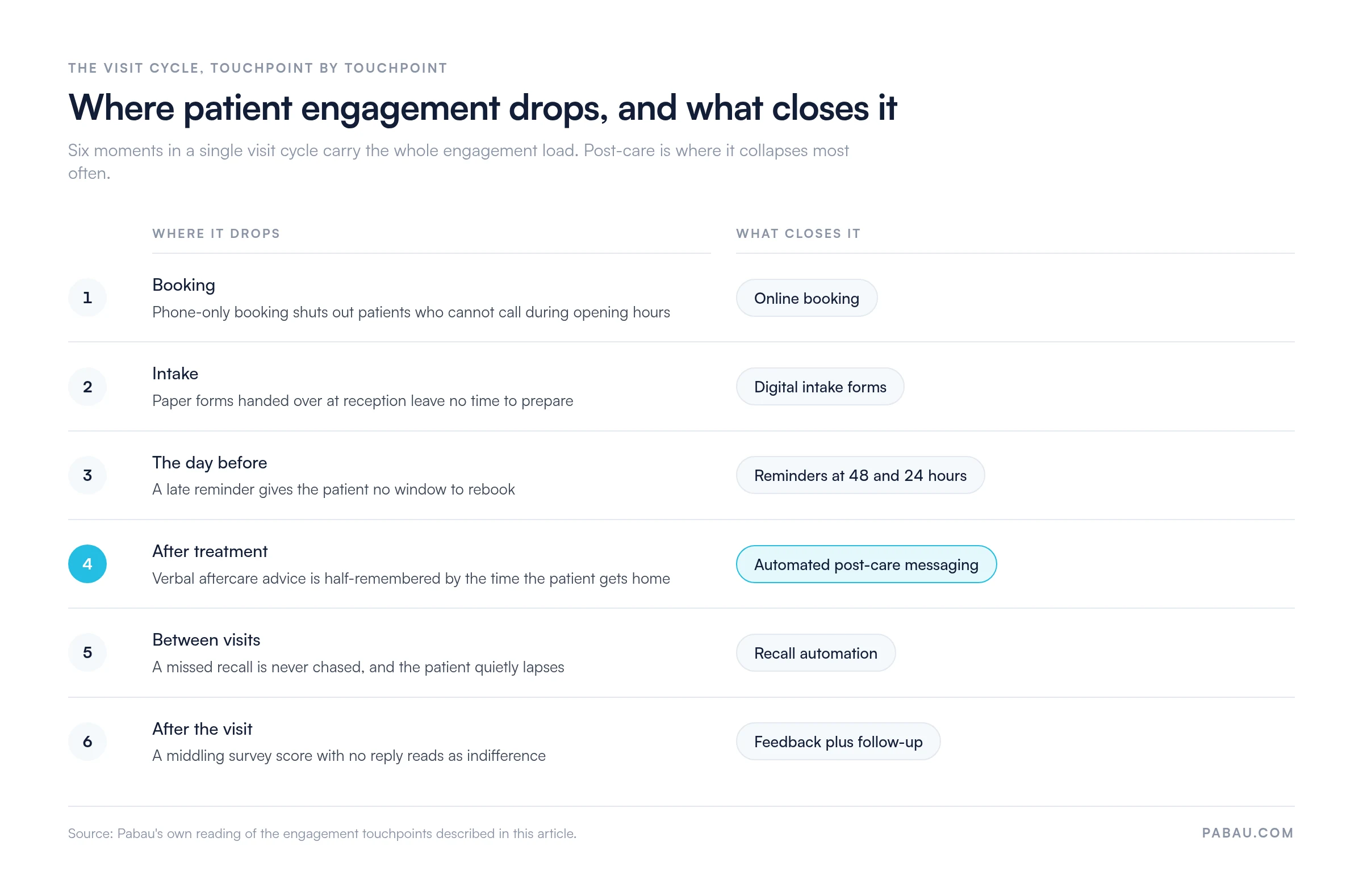
Friction at booking is the first place engagement fails. If the only route in is a phone call during opening hours, a whole segment of patients never gets through. Letting people book themselves in removes that barrier. Booking software for practices takes reservations at 10PM on a Sunday, when nobody is at the desk.
Automated reminders sent 48 and 24 hours ahead cut no-shows. They also give the patient enough time to move the appointment rather than quietly skip it.
Intake is an engagement touchpoint as much as an administrative one. Patients who complete their forms before they arrive have already read their own history and thought about what they want. That preparation raises the quality of the consultation and improves adherence afterward.
Paper forms handed over at reception do the reverse. They make the first impression rushed and bureaucratic, and they push the patient’s thinking into the waiting room.
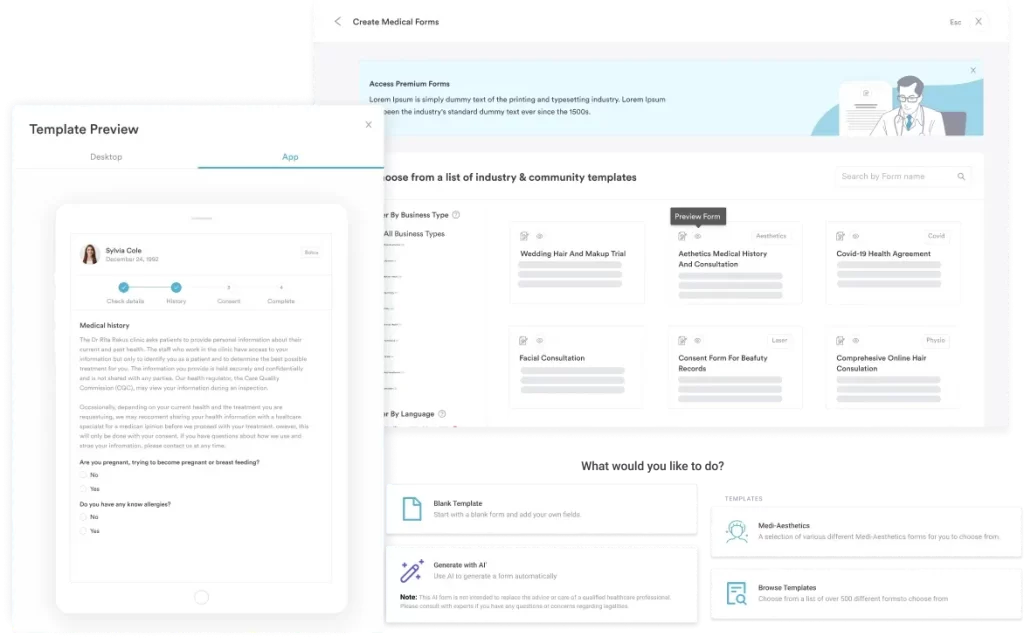
Post-treatment instructions are where engagement collapses most often. The patient leaves with verbal aftercare advice, half-remembers it, and either calls back with questions or ignores it. Automated post-care messaging sent within hours of treatment repeats what was said in the room.
Pair that with automated recalls for repeat treatments and the communication loop runs without anyone remembering to start it. Patient anxiety drops, and so does the volume of follow-up calls landing at reception.
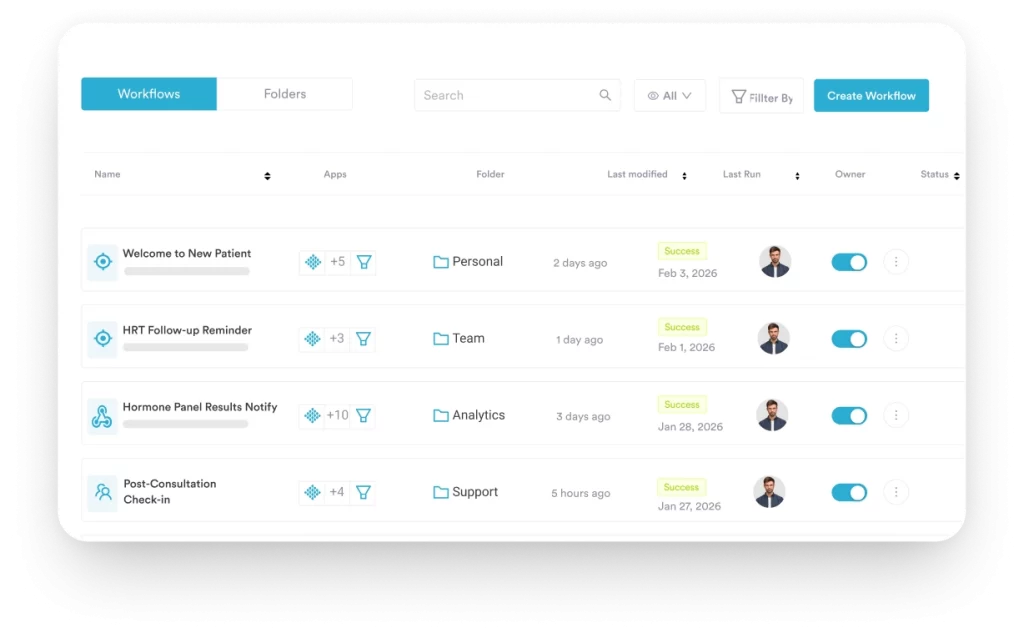
Patient portals raise engagement by opening up records, invoices, and treatment history between appointments. Patients who can read their own notes and track their progress are more invested in the outcome.
The ONC’s 2024 data brief reports that 77% of individuals were offered access to their online medical record. It found that 65% accessed it at least once, up from 57% in 2022. Access alone moves the patient from passive recipient to participant in the care plan.
Sending a survey after every appointment is table stakes. What you do with the answers is the part that retains patients. Practices that capture patient feedback and route low scores into a follow-up process keep far more at-risk patients. Surveying and then going quiet does the opposite.
A score of three out of five with no reply tells the patient nobody read it. The same score followed by a message from the practice manager tells them somebody did.
Scoring those replies the same way each time turns feedback into a trend you can act on. Healthcare NPS benchmarks put the sector average at 65, so you have a line to measure against.
Digital patient engagement means running the touchpoints that used to need manual effort through technology instead. That covers online booking, automated reminders, digital consent, patient portals, telehealth, and SMS or email campaigns. Each tool targets one friction point in the patient journey. Those touchpoints work best in a single inbox, where every channel shares the same thread.
For an independent practice, the value is consistency rather than sophistication. A solo practitioner cannot personally chase every patient who missed a recall. An automated campaign triggered by a lapse can. The technology protects the clinical relationship by making sure patients are never quietly forgotten.
AI is shifting what is possible here too. AI-assisted notes cut the documentation load during appointments, so the clinician can listen instead of type. Communication quality rises, and that is a large part of what patient experience measures. The improvement feeds straight back into engagement.
Engagement is measurable. Most practice management systems already capture the data, so the work is picking which numbers to watch and knowing what good looks like. Three metrics cover most of it.
What it is: The percentage of booked appointments that are attended without rescheduling or no-showing.
Why it matters: Practices with strong engagement systems typically see attendance above 85%. A rate below 75% points to a communication problem in the system, not to unreliable patients.
What it is: The proportion of patients who are recalled for a follow-up or repeat treatment and go on to book.
Why it matters: For treatment-based practices, this metric decides lifetime patient value. A Botox client who returns every three to four months is worth several times more per year than one who returns once. Low conversion usually means the recall was mistimed, generic, or sent through a channel the patient ignores.
What it is: For multi-session treatments, the percentage of patients who finish the full recommended course instead of dropping off mid-plan.
Why it matters: Dropping out mid-plan carries both a clinical and a financial cost. Patients who abandon a laser resurfacing course or a physical therapy program often get weaker results and blame the practice for them. Completion rate is the strongest single proxy for engagement health.
Tracking these consistently needs one system that connects scheduling, communications, and clinical records. Once you can see where the number drops, you can turn the pattern into a patient engagement program instead of a run of one-off fixes.
If your current setup cannot show you those three numbers, compare the best patient engagement software before you build more process on top of it.
In most independent practices, engagement work falls to whoever has a spare ten minutes. Reception phones tomorrow’s bookings. Someone retypes aftercare instructions from a saved draft. Recalls sit in a spreadsheet, and the ones nobody opens quietly expire.
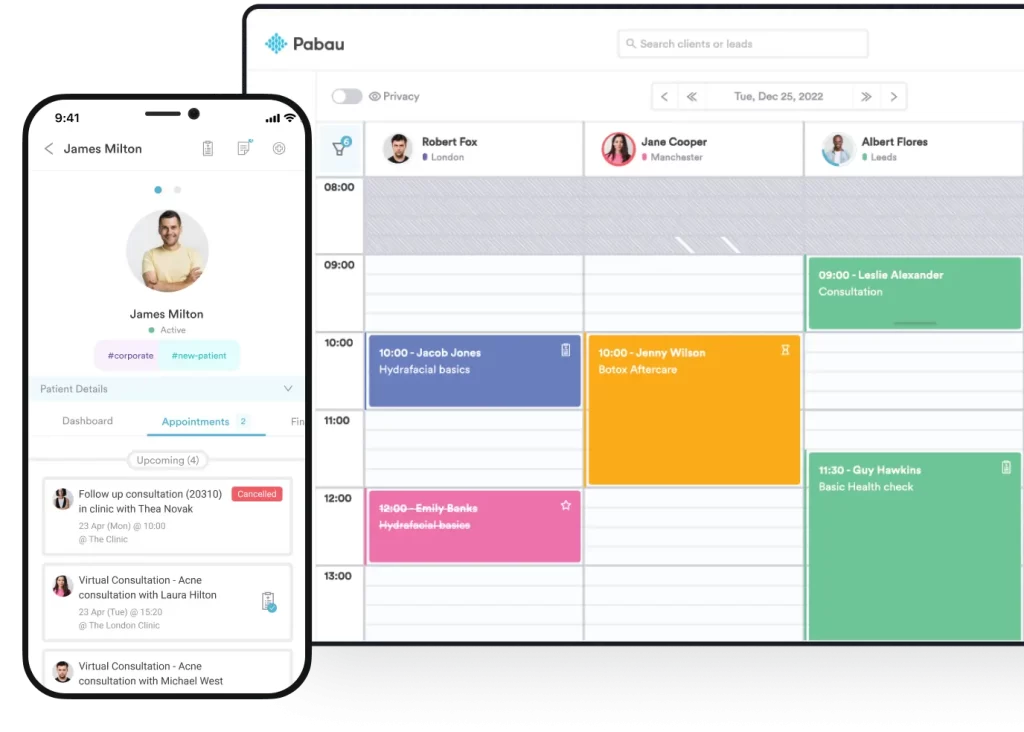
Practice management software like Pabau runs those touchpoints from the patient record itself. Reminders go out 48 and 24 hours ahead. Intake forms and consents reach the patient before the visit and file themselves against the record. Aftercare sends on a timer set by the treatment.
The client portal carries the rest. Patients can check their treatment history, their invoices, and their upcoming appointments without calling the desk. Every Pabau subscription includes all of this, so none of it sits behind a higher tier.
For your team, that means fewer chase calls and a recall list that works without a weekly reminder. For the patient, it means a practice that stays in touch between visits rather than only at the appointment.

Pabau connects automated recall, digital intake forms, post-care messaging, and the client portal to one patient record. Independent practices get the engagement infrastructure that large health systems staff whole teams to run.

Engagement gets built in the spaces around the appointment, and it gets built deliberately. Practices that win on retention are usually the ones that removed three points of friction from the visit cycle.
Start by measuring. Pull your attendance rate, your recall conversion, and your treatment plan completion for the last quarter. The weakest of the three names the touchpoint to repair first, and it is rarely the one the team expected.
After that, the question is whether the reminder, the form, and the recall run on their own. Book a demo to see how Pabau runs those touchpoints for independent practices.

Ready to reactivate patients who stopped booking? Patient reactivation software compares tools that re-engage lapsed patients through targeted SMS, email, and recall campaigns.
Looking for tools that support patient onboarding and retention? Patient care management explains how coordinated care workflows reduce dropout and improve clinical continuity.
Need to understand how record access drives engagement? Benefits of patient portals outlines how secure portal access shifts patients from passive recipients to active participants.
Want satisfaction tracking that feeds engagement? Measuring patient satisfaction details which metrics matter most and how to act on them systematically.
Patient engagement in healthcare is the active participation of patients in understanding, managing, and making decisions about their own care. It matters because engaged patients have better clinical outcomes, attend more appointments, follow care plans more consistently, and generate higher lifetime value for practices. The CDC has confirmed the link between patient activation and measurable health outcome improvements.
Patient experience is a patient’s perception of one specific interaction with a practice. It covers how they felt during the appointment, whether staff were friendly, and whether the room was comfortable. Patient engagement is behavioral and ongoing. It shows in whether the patient returns, follows the care plan, finishes the treatment program, and gets in touch when something changes. A practice can score well on experience and still have low engagement.
Examples include completing intake forms digitally before the visit and responding to SMS appointment reminders. Patients also read their treatment records in a portal and follow automated post-care instructions. Booking a recall online and answering a post-visit survey both count too. Each one is a measurable touchpoint that a practice can track and improve.
Focus on automating the communication touchpoints that still rely on manual effort: appointment reminders, post-care instructions, and recall messaging. Replace paper intake with digital forms patients complete before arriving. Give patients access to their own records through a portal. Collect feedback systematically and follow up on low scores. These four changes address the most common drop-off points without adding staff.
Patient activation refers to a patient’s internal readiness: the knowledge, confidence, and skills they hold to manage their own health. Engagement is the behavior that follows. A highly activated patient can still disengage when a practice communicates badly. A practice cannot control activation, but it can build systems that support engagement whatever the starting point.