Massage Gift Card Template
A massage gift card template is a fill-in-the-blank certificate you customize wi...

22
Last Updated: Sep 11, 2026

EHR software cost ranges from $3,000-$25,000 in year one for small practices, rising to $65,000-$200,000+ for mid-sized clinics.
Subscription pricing ($100-$600 per user/month) is now the dominant model, but hidden fees for integrations, training, and upgrades frequently add 30-50% to the quoted price.
Cloud-based EHR systems cost significantly less upfront than on-premise deployments, which require $10,000-$50,000 in hardware infrastructure alone.
Pabau bundles EHR, scheduling, CRM, and marketing tools into one subscription, eliminating the need for multiple point-solution licenses that inflate total software spend.
Most clinic owners underestimate the cost of EHR software by a factor of two. The subscription fee on the vendor’s pricing page for Electronic Health Records (EHR) software is just one line item. Implementation, training, data migration, interface fees, and ongoing maintenance can quietly double or triple what you actually pay. According to a Commonwealth Fund study funded by the Agency for Healthcare Research and Quality, the average purchase and implementation cost of an EHR system reaches $32,606 per full-time equivalent physician, with maintenance adding another $1,500 per physician per month. For small and mid-sized clinics evaluating practice management software, those figures represent a significant operational commitment.
This guide breaks down every cost component you need to plan for, benchmarks by practice size, and explains where all-in-one platforms can reduce your total software spend.
EHR software cost is not a single number. The total electronic health records cost is a stack of line items that vendors present in different orders, bundle in different ways, and sometimes obscure until contract negotiation. Understanding each component prevents budget surprises six months into an implementation.
| Cost component | Typical range | Notes |
|---|---|---|
| Software subscription | $100-$600/user/month | Per-provider or per-seat pricing |
| Implementation and setup | $2,000-$15,000 | Varies by vendor and practice size |
| Data migration | $1,000-$8,000 | Higher for complex legacy records |
| Training | $500-$3,000 | Per-session or included in onboarding |
| Hardware (on-premise only) | $10,000-$50,000 | Servers, workstations, networking |
| Interface/integration fees | $500-$5,000 per interface | Labs, billing, pharmacy connections |
| Ongoing maintenance | $1,500/physician/month (per the Commonwealth Fund/MGMA study) | Support, updates, compliance patches |
The clinical documentation tools inside any EHR are only as cost-effective as the surrounding infrastructure. A platform with a low subscription price but high interface fees can easily cost more than a pricier all-in-one system over a three-year contract.
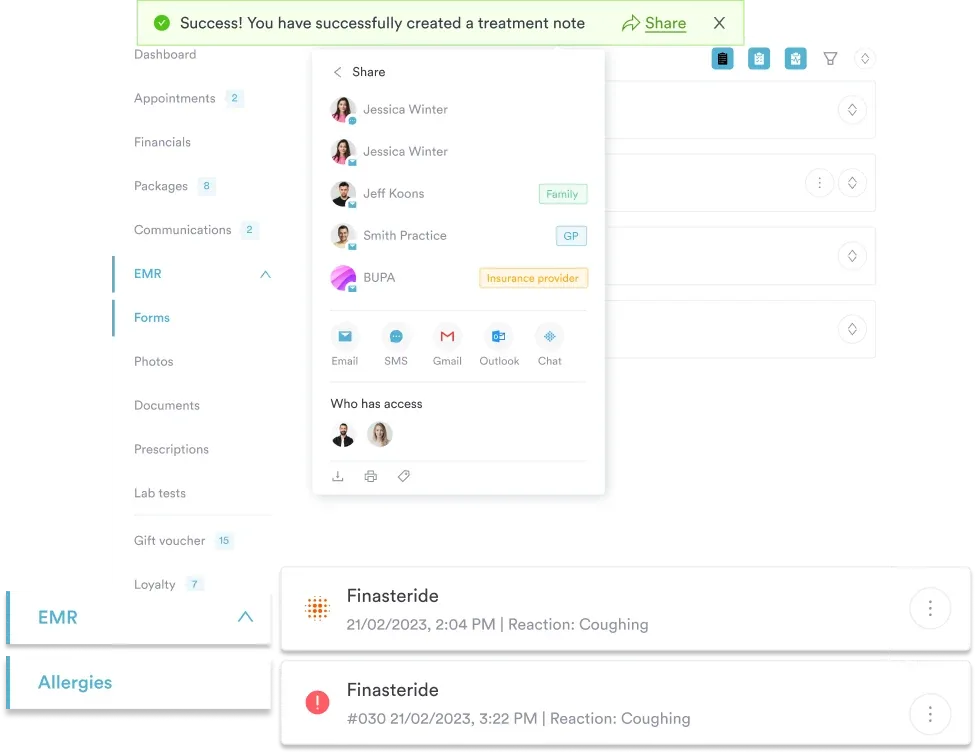
Understanding EHR integration workflows matters here, because every third-party connection typically carries its own setup and annual maintenance cost. Practices connecting to labs, billing clearinghouses, and pharmacy networks can find integration fees alone exceeding the software subscription.
The pricing model shapes your cash flow as much as the total cost. Two primary models dominate the market, and they suit different practice profiles.
Subscription pricing means a recurring monthly or annual fee, typically per user or per provider. Cloud-based EHR software monthly pricing plans run from $100 to $600 per user, according to ITRex Group’s EHR cost analysis, with specialty platforms built for aesthetics and wellness clinics often sitting at the lower end. Upfront capital outlay is minimal. Vendor handles hosting, security patches, and system updates. This model suits practices without dedicated IT staff and those expecting to scale quickly.
Understanding how practice management systems differ from EMRs is relevant here: many subscription-based platforms bundle scheduling and billing into the EHR subscription, while standalone EMRs charge separately for each module.
Perpetual licensing requires a large upfront payment for the software license, plus ongoing annual maintenance fees (typically 18-22% of the license cost). Hardware infrastructure adds $10,000 to $50,000, according to OmniMD’s implementation cost guide. Total perpetual license costs range from $15,000 to $70,000 per provider for purchase and implementation. This model suits large health systems with existing IT teams and strict data sovereignty requirements. For most small and mid-sized clinics, the upfront burden makes subscription pricing the more practical choice.
The average cost of an EHR system shifts considerably as headcount and patient volume grow. These benchmarks reflect typical first-year costs, including software, implementation, and training, so you can gauge the cost of EHR systems at your practice’s scale.
First-year EHR software cost typically totals $3,000 to $25,000, with ongoing annual costs of $2,000 to $15,000, according to the HIPAA Journal’s February 2025 EMR cost report. Solo practitioners often opt for low cost EHR software in the $150-$300/month range. When choosing an EHR for private practice, the key decision is whether a standalone EMR is sufficient or whether bundled scheduling, intake forms, and billing tools would reduce overall spend by consolidating multiple subscriptions.
Implementation costs jump to $65,000-$200,000 for mid-sized clinics, driven by more complex data migration, multi-user training programs, and integration requirements. Per-provider subscription costs accumulate quickly at this scale. A 6-provider clinic paying $300/provider/month reaches $21,600/year in subscription fees before accounting for any add-ons.
Enterprise EHR implementations (Epic, eClinicalWorks) regularly exceed $200,000, with some reaching seven figures when IT infrastructure, custom integrations, and staff retraining are factored in. These systems are built for large hospital networks and academic medical centers, not aesthetics or wellness clinics. When evaluating primary care EHR platforms at this scale, IT procurement and compliance teams typically manage the process, with implementation timelines of six months to two years.
Sticker price rarely tells the full story. These are the fees that frequently appear after contract signing.
Paperless transitions carry their own learning curve. Digital intake forms that replace paper-based workflows can reduce administrative overhead significantly, but only after staff are trained and comfortable with the new process. Factor three months of reduced throughput into your budget model.
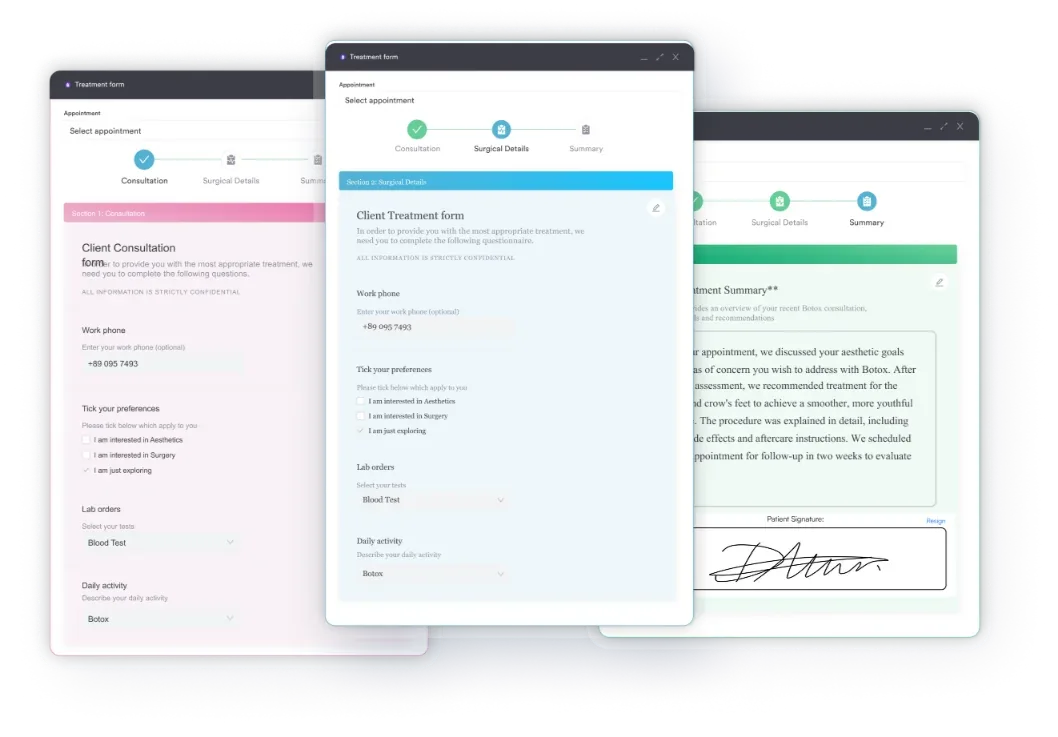
For practices considering simpler setups, direct primary care EHR options often bundle core functionality at flatter monthly rates, avoiding many of the per-module charges that inflate costs in traditional insurance-billing environments.
Before signing any EHR contract, ask vendors to provide a complete three-year total cost of ownership estimate in writing, including all interface fees, upgrade charges, per-message fees, and annual maintenance costs. Vendors who refuse or cannot provide this figure are signaling that additional charges are likely.
The deployment model determines where your budget goes, not just how much you spend.
| Factor | Cloud-based (SaaS) | On-premise |
|---|---|---|
| Upfront cost | Low (setup fee only) | High ($15,000-$70,000+/provider) |
| Ongoing cost | Monthly subscription | Annual maintenance (18-22% of license) |
| Hardware | Not required | $10,000-$50,000 |
| IT staff needed | No | Yes |
| Security responsibility | Vendor (with HIPAA BAA) | Practice |
| Scalability | Easy, add users monthly | Complex, requires new hardware |
| Disaster recovery | Vendor-managed | Practice-managed |
For aesthetics, wellness, and private practice clinics, cloud-based EHR software is the practical default. On-premise systems require IT infrastructure expertise that most clinic teams do not have, and the HIPAA compliance burden falls entirely on the practice when data is hosted locally. Under the HHS HIPAA Security Rule, practices hosting their own EHR data must implement administrative, physical, and technical safeguards independently, a significant operational responsibility.
Total cost of ownership (TCO) gives a more accurate budget figure than the subscription price alone. Use this framework to build your estimate.
Practices that run this calculation often find that simplifying practice management overhead through bundled platforms costs less over 36 months than assembling point solutions, even when the bundled subscription appears more expensive on a monthly basis.
Resources on features that reduce administrative processing can help identify which EHR capabilities generate the fastest return, particularly automated recalls, paperless intake, and integrated billing workflows.

Pabau bundles clinical records, online booking, automated workflows, and marketing tools into a single platform. No per-module fees, no separate integration charges for core functionality.

Most EHR cost guides are written for primary care or mental health practices. Aesthetics and wellness clinics have different requirements that affect pricing in specific ways.
For medical spa software buyers specifically, the total cost calculation often favors purpose-built platforms over adapted general-practice EHRs, because the workarounds required by general systems (separate photo tools, separate consent platforms, separate CRM) generate more annual spend than a higher-priced specialty platform that includes them. Our roundup of the best medical spa scheduling software compares those purpose-built options in detail.
Pabau is an all-in-one clinic management platform built for aesthetics, wellness, and private practice clinics. Its pricing model is designed to reduce the total cost of ownership that fragmented point-solution stacks generate. Staff moving between treatment rooms can run this platform from a mobile practice management app rather than logging into a shared computer.
Rather than charging separately for scheduling, EHR, patient communication, and marketing modules, Pabau bundles these into a single subscription. Practices moving from a combination of a standalone EHR, a separate booking tool, and a separate SMS platform typically find that Pabau’s consolidated pricing through Pabau’s transparent pricing model costs less annually than maintaining those separate subscriptions.
Key cost advantages include:
For practices concerned about the cost of NOT having integrated systems, every disconnected tool adds manual reconciliation work. A practice manager reconciling data between a standalone EHR, a booking platform, and a CRM spends time that has a real labor cost. According to the American Medical Association’s study on the allocation of physician time in ambulatory practice, for every hour physicians spend in direct clinical face time with patients, they spend nearly two additional hours on EHR and desk work — administrative burden that disconnected, fragmented systems only compound.
When comparing EHR quotes, ask each vendor to list the specific tools you would need to add separately to get: automated appointment reminders, digital intake forms, photo documentation, patient recall, and basic reporting. Add the cost of those tools to their base subscription price before comparing. That is the real monthly cost.
EHR software cost is not what most vendors advertise. The subscription fee is the starting point, not the destination. Implementation, integration, training, and ongoing maintenance routinely push first-year costs two to three times beyond the quoted monthly price. The practices that manage this most effectively treat EHR selection as a three-year TCO decision rather than a monthly subscription comparison.
For aesthetics and wellness clinics with specialized documentation needs, a purpose-built all-in-one platform like Pabau typically reduces total software spend by consolidating the tools that general EHRs require you to buy separately. If you’re weighing EHR options, map the real three-year total cost of ownership before you sign — subscription, implementation, integration fees, per-message charges, and the separate photo, consent, and CRM tools general EHRs make you buy on the side. Book a Pabau demo and we’ll build a side-by-side TCO comparison against your current stack using your actual provider count, seat count, and add-ons, so you can see what consolidating into one platform would save you over 36 months.

Want a complete breakdown of clinic software options? Best EMR software for clinics evaluates leading platforms across pricing, specialty fit, and feature depth.
Weighing EHR costs against software options? Best medical software guide compares top EMR platforms across billing, scheduling, and documentation needs.
Practicing under Canadian regulatory requirements? Best practice management software in Canada evaluates platforms against the regulatory and billing constraints unique to Canadian practices.
EHR software cost for a small practice (1-3 providers) typically totals $3,000 to $25,000 in the first year, including subscription, implementation, and training. Ongoing annual costs then run $2,000 to $15,000, according to the HIPAA Journal’s 2025 report. Cloud-based platforms with bundled tools often come in at the lower end of this range.
The average budget per user for EHR software is approximately $6,000 annually, according to EHR in Practice research. Monthly subscription costs typically run $100 to $600 per user, though total per-user cost rises significantly when implementation and interface fees are included.
The most common hidden EHR costs are interface fees ($500-$5,000 per external connection), per-message charges for automated reminders, additional user seats beyond provider count, software upgrade fees, and the staff productivity loss (typically 10-20% for 60-90 days) during transition. These can add 30-50% to the quoted subscription price.
Cloud-based EHR software is significantly cheaper upfront. On-premise systems require $10,000-$50,000 in hardware alone, plus ongoing IT staff. Cloud platforms shift cost to a predictable monthly subscription with no hardware investment. For small and mid-sized clinics without IT teams, cloud-based is almost always the lower total-cost option.
Calculate EHR ROI by comparing the total cost of ownership (subscription plus implementation plus integration plus training) against quantifiable gains: reduced billing errors, faster claims processing, lower no-show rates through automated reminders, and administrative time saved per provider per week. Most practices target cost recovery within 12-24 months of go-live.
EHR implementation cost typically runs $2,000 to $15,000 for a small cloud-based clinic and $65,000 to $200,000 for mid-sized practices, covering setup, data migration, and staff training. On-premise systems add $10,000 to $50,000 in hardware before go-live. Cloud platforms with structured onboarding included keep the cost of implementing an EHR at the lower end of that range.
The average cost of an EHR system works out to roughly $6,000 per user per year once subscription, implementation, and support are combined, according to EHR in Practice research. Actual EHR system cost varies widely with practice size, deployment model, and how many staff seats you pay for beyond your providers, so the cost of EHR systems at a solo clinic looks very different from a multi-location group.
Epic does not publish standard monthly pricing, and it is built for large hospital networks rather than small clinics. Full Epic EHR implementations regularly run from $200,000 into seven figures once licensing, IT infrastructure, and integration are included, with smaller hospitals reporting around $1 million per published implementation guides. For a small or mid-sized practice, the realistic comparison is a per-provider cloud subscription of roughly $100 to $600 per user per month, not an enterprise platform like Epic.
The lowest-priced platforms start around $49 to $150 per user per month, usually specialty or flat-rate cloud tools aimed at solo and small practices. But the cheapest sticker price rarely delivers the lowest total cost. Once you add interface fees, per-message charges, and separate tools for photo documentation, consent, and patient recall, a slightly higher all-in subscription that bundles those functions often costs less over a three-year contract.