Massage Gift Card Template
A massage gift card template is a fill-in-the-blank certificate you customize wi...

23
Last Updated: Sep 11, 2026

The clunk test is an orthopedic special test performed supine to detect glenoid labral tears and SLAP lesions.
A positive clunk test produces a clunking or grinding sensation during humeral rotation in full abduction.
Well-validated diagnostic-accuracy data specific to the clunk test are not currently available, so pair it with other special tests and imaging.
Pabau’s digital forms and clinical documentation features streamline clunk test assessment recording for practice records.
A ready-to-use clinical assessment template for documenting patient positioning, examiner observations, positive/negative findings, and clinical interpretation of the clunk test. Streamlines record-keeping and ensures consistent documentation across your practice team.
Download templateShoulder labral tears affect thousands of patients annually, particularly in overhead athletes and individuals with glenohumeral instability. Many practitioners struggle to confidently perform and interpret special tests during the clinical examination, leading to missed pathology or unnecessary imaging referrals. The clunk test is a widely used orthopedic assessment that detects glenoid labral tears and superior labral pathology during a standard shoulder exam. An EMR built for physical therapy keeps exercise prescriptions and outcome measures in the same record.
This guide explains how to perform the clunk test, interpret positive findings, and document results accurately. Physical therapists, athletic trainers, orthopedic surgeons, and sports medicine specialists all rely on accurate shoulder assessment to guide treatment.
The clunk test is a specialized orthopedic test that assesses the integrity of the glenoid labrum. It helps clinicians detect labral pathology, including glenoid labral tears and SLAP lesions (superior labral anterior to posterior tears). Performed with the patient supine, the test moves the shoulder through specific ranges while applying force. The examiner listens for sounds or sensations that indicate structural damage.
In clinical practice, the clunk test serves as a screening tool during shoulder examination. A positive result is a clunking, clicking, or grinding sensation. This suggests labral involvement and typically prompts imaging (MRI or MRA) or a specialist referral. The test is particularly valuable in sports medicine settings, where overhead athletes frequently present with labral tears.
Unlike imaging, the clunk test requires no equipment and takes seconds to perform during a routine shoulder examination. However, clinicians must understand its limitations. Well-validated diagnostic-accuracy data specific to the clunk test are not currently available in the literature.
Clinicians should treat it as one part of a broader clinical picture, not a standalone diagnostic figure. Always integrate the clunk test result with patient history, other special test findings, and imaging results before drawing clinical conclusions.
Understanding the anatomy underlying the clunk test helps clinicians interpret findings and explain results to patients. The glenoid labrum is a ring of fibrocartilage attached to the rim of the glenoid, the socket of the shoulder joint. It deepens the socket, stabilizes the humeral head, and distributes load across the glenohumeral joint during movement.
When the labrum is torn, the shoulder loses both mechanical stability and proprioceptive feedback. During the clunk test, a torn labral edge or loose piece may shift suddenly as the examiner applies anterior force and rotates the humerus. This produces the characteristic “clunk” sound that signals a positive test. That mechanism is why the clunk test remains a practical bedside screening tool.
The clunk test is straightforward to perform and requires no special equipment. Below is the standard procedure clinicians use to assess labral integrity during shoulder examination.
The entire maneuver should take 5-10 seconds. A skilled examiner performs the test smoothly while maintaining constant communication with the patient about discomfort or unusual sensations.
Clinical form capture tools let staff complete assessments like this on a tablet during the session itself.
A positive clunk test is indicated by a distinct clunking, grinding, or clicking sensation felt or heard during the maneuver. This sound typically suggests a mechanical disruption. A torn labral edge may be shifting within the joint space as the humerus rotates.
Always contextualize the clunk test result within the broader clinical picture. A patient with a positive clunk test but no symptoms of instability, catching, or overhead pain may not require immediate imaging. A negative clunk test combined with a positive comprehensive shoulder assessment may still warrant imaging, especially when the patient reports catching.
No separately named “posterior clunk test” exists in the literature. The clunk test itself has only one documented direction of force. The examiner presses anteriorly against the posterior humeral head. Its only variation is the abduction angle. Examiners “circle the shoulder” through different degrees of abduction to assess different segments of the labrum. Walsh also described a horizontal-adduction relocation variant.
Posterior labral lesions and posterior instability are instead assessed with two separately named tests: the jerk test and the Kim test.
Kim et al. (2005) verified findings by arthroscopy in 172 shoulders. They reported the Kim test at 80% sensitivity and 94% specificity, and the jerk test at 73% sensitivity and 98% specificity, for posteroinferior labral lesions. Some sources describe a “posterior clunk” as a sign of posterior instability, not a named clunk-test variant. It differs from the anterior clunk test this article covers.
The clunk test is one of several special tests available to assess shoulder pathology. Understanding how it compares to related tests helps clinicians build a comprehensive assessment battery and improve diagnostic accuracy.
The O’Brien test, also called the active compression test, is performed with the patient seated. The arm is forward-flexed 90 degrees and internally rotated, with the thumb pointing downward. A positive result is pain with the arm supinated that improves when pronated, suggesting SLAP involvement.
Reported sensitivity for the O’Brien test varies by population and study. It can also reproduce AC joint pain, making it less specific for labral pathology alone.
The crank test involves positioning the arm at 160 degrees of elevation in the scapular plane, seated or standing, then externally rotating the humerus. Grinding, clicking, or pain reproduction during this movement suggests SLAP involvement. Reported sensitivity for the crank test also varies by population and study. It complements the clunk test in a comprehensive shoulder assessment.
Evidence for the clunk test’s diagnostic accuracy is limited. Well-validated sensitivity and specificity data specific to the clunk test are not currently available in the peer-reviewed literature. Clinicians should treat it as one part of a broader clinical picture, not a standalone diagnostic figure.
The clunk test itself has not been the subject of a published diagnostic-accuracy study. Related maneuvers used in the same throwing-athlete population have been studied. This gives useful context, even though the numbers below do not describe the clunk test.
These figures come from Nakagawa et al. (2005), published in Arthroscopy (21:1290-1295). The study evaluated the forced shoulder abduction and elbow flexion test against arthroscopy in 54 competitive throwing athletes. It also reported accuracy for the crank test and O’Brien’s test.
That study did not evaluate the clunk test, and no comparable diagnostic-accuracy study of the clunk test has been published. Pair the clunk test with the O’Brien test and the crank test rather than relying on it alone.
Documenting special test findings accurately and consistently across your practice supports continuity of care and informed clinical decisions. Paper-based assessment forms are error-prone and hard to track over time. Practice management software like Pabau replaces them with digital intake forms and custom assessment templates.
These let you record clunk test results, patient positioning, and examiner observations in one place. Clinical interpretation stays attached to that same unified patient record.

The clunk test template above integrates with Pabau’s client record system. You can store and retrieve structured assessment data alongside treatment plans and imaging reports.
Audit your clunk test technique quarterly by recording a practice session and reviewing it with a colleague. Look for smooth, controlled movements, consistent palpation of the posterior humeral head, and subtle sounds that novice examiners often miss. This deliberate practice sharpens your diagnostic accuracy and confidence.
Streamline how your practice documents shoulder assessments and tracks patient outcomes with integrated clinical documentation software. Automating assessment templates and centralizing patient records cuts down on paperwork and keeps every provider’s notes consistent.

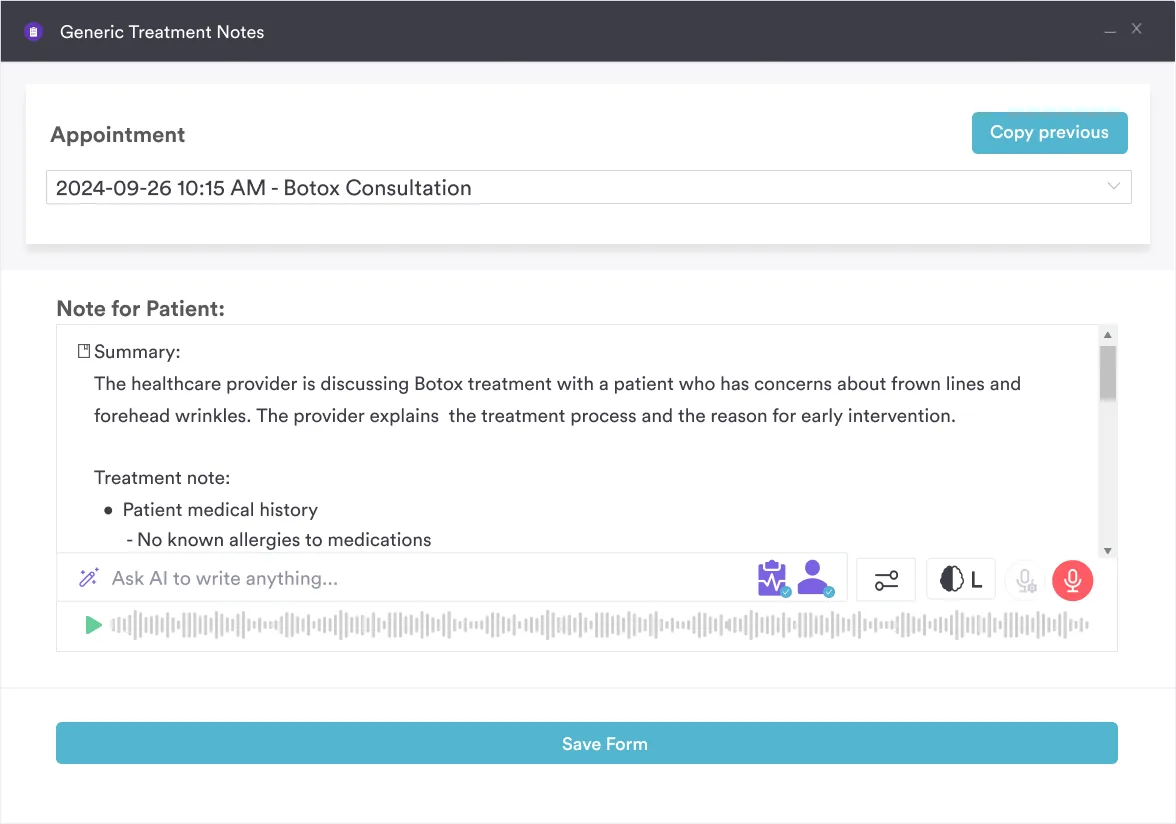
See how Pabau’s digital forms and AI-assisted clinical notes help you document special tests like the clunk test faster. Track patient progress accurately and reduce administrative overhead.

Use the clunk test alongside the O’Brien test and crank test to improve diagnostic accuracy. A patient with a positive clunk test and a positive crank test, but a negative O’Brien test, is more likely to have true SLAP involvement. This multi-test pattern is more reliable than any single test alone.
The clunk test remains a practical, equipment-free screening tool for detecting glenoid labral pathology in the clinical setting. When performed correctly and interpreted within context, it provides valuable information to guide imaging decisions and treatment planning. However, remember that sensitivity varies across populations. Never rule out labral involvement based on a negative clunk test alone.
Documenting your clunk test findings systematically keeps trends visible to you and your team over time. Structured digital assessment templates in your practice management system support evidence-based practice and improve patient handoff communication.
Download the free clunk test template above to standardize how your practice records shoulder assessment findings. Book a demo to see how Pabau streamlines clinical documentation for teams like yours.

Want to build out your shoulder exam beyond special tests? Range of motion assessment walks through the goniometry and scoring clinicians use alongside the clunk test.
Looking for another special-test walkthrough? Hypoglossal nerve test covers the same step-by-step procedure and interpretation format for cranial nerve XII.
Need another downloadable clinical assessment template? Falls efficacy scale is a free, ready-to-use tool for scoring fear of falling in older patients.
The clunk test detects glenoid labral tears and SLAP lesions during shoulder examination. A positive test-a clunking sensation during the maneuver-suggests mechanical labral disruption and usually prompts imaging (MRI) or specialist referral for confirmation.
No. Well-validated diagnostic-accuracy data specific to the clunk test are not currently available, so a negative result cannot reliably exclude labral pathology on its own. Always interpret the test alongside patient history, mechanism of injury, other special tests, and imaging findings.
Both tests target SLAP lesions but use different positions. Nakagawa et al. (2005) reported the crank test at 58% sensitivity and 72% specificity in throwing athletes. That study did not evaluate the clunk test, and no comparable diagnostic-accuracy figures exist for it. Clinicians typically perform both tests together rather than rely on either alone.
Overhead athletes (baseball, volleyball, swimming, tennis), throwing athletes, and patients with complaints of shoulder catching, instability, or recurrent dislocation are key populations. The test is also useful in general orthopedic practices for routine shoulder screening.
Yes. A tense, guarding patient may not relax enough for the test to be valid. Always emphasize relaxation, use reassuring communication, and repeat the test if the patient appears tense on the first attempt. Poor muscle relaxation reduces test sensitivity.
The clunk test uses supine positioning with abduction and rotation. The O’Brien test uses seated forward flexion and internal rotation. Reported sensitivity for the O’Brien test varies by population and study. It can also reproduce AC joint pain, making it less specific for labral pathology alone.