Book a demo Book a demo
Compare

Best AI Clinical Notes Software: 7 Platforms Compared (2026)

Avatar photo Katy Piper
April 17, 2026
Reviewed by: Avatar photo Lucy Galloway
Key Takeaways

Key Takeaways

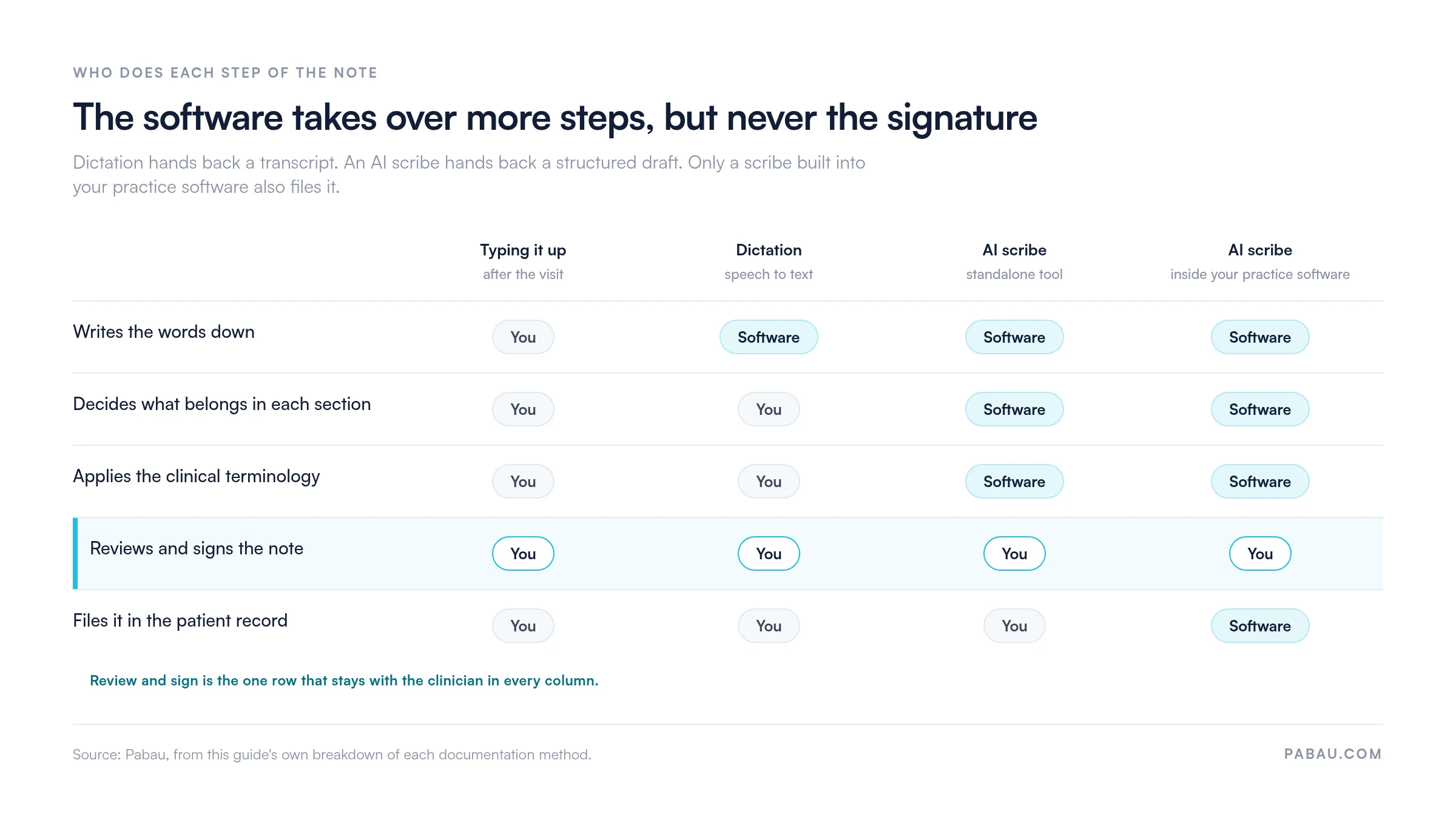
AI clinical notes software listens to or summarizes patient encounters and drafts structured documentation, removing most of the after-hours note-writing burden that drives clinician burnout.

Pabau Scribe is the strongest pick when AI documentation needs to sit inside one platform alongside scheduling, billing, forms, and the patient record rather than as a standalone tool.

Heidi Health, Freed, and Suki lead for solo and small-group practices that already have an EHR and only need an ambient scribe bolted on top of it.

Abridge, DAX Copilot, and Augmedix dominate the enterprise tier with deep Epic, Cerner, and athenahealth integrations and HIPAA-aligned hospital deployment models.

Clinical documentation is the work that pays clinicians the least and costs them the most. A 2024 analysis published by the American Medical Association attributes a significant share of physician burnout to documentation load, and the average primary care clinician still spends one to two hours on notes outside scheduled patient time every day. AI clinical notes software exists to claw that time back without sacrificing chart quality, billing accuracy, or compliance.

This guide compares seven AI clinical notes platforms across documentation quality, EHR integration, specialty fit, compliance, and price. Some are full AI practice management platforms with AI documentation built in. Others are dedicated ambient scribes that bolt onto an existing EHR. Whether you run a solo private practice, a multi-discipline clinic, or a hospital-affiliated specialty group, one of these tools is operationally right for your setup.

Best AI clinical notes software: quick comparison at a glance

Here is how the seven platforms stack up across the criteria most clinicians weigh first.

Platform Best for Standout feature Starting price (USD) Rating
Pabau All-in-one practice management with AI documentation Pabau Scribe inside one record system From $65/month 4.7/5 (600+)
Heidi Health Solo clinicians on a tight budget Free tier with unlimited consults Free, paid from around $99/month 4.8/5
Suki Voice-first ambient documentation Voice commands across Epic, Cerner, athenahealth Around $399/month per clinician 4.7/5
Abridge Hospital and health-system deployment Deep Epic integration with linked-evidence notes Enterprise (custom quote) 4.6/5
DAX Copilot Health systems already on Dragon Medical Microsoft Cloud for Healthcare integration Enterprise (custom quote) 4.5/5
Freed Solo cash-pay and locum clinicians Fast, simple scribe with personalized style From $99/month 4.8/5
Augmedix High-volume specialty and ED workflows Hybrid human-plus-AI documentation Enterprise (custom quote) 4.4/5

Ratings reflect publicly available customer feedback on Capterra, G2, and clinician-led forums. Pricing marked “from around” reflects publicly reported customer benchmarks; final pricing varies by specialty, headcount, and EHR integration scope, so verify directly with the vendor before signing.

Pabau: Best for all-in-one practice management with AI documentation

Pabau is the only platform in this comparison where AI clinical notes are not a standalone product. They are one feature inside a full practice management system that also handles scheduling, billing, digital forms, telehealth, and the patient record.

For private clinics, multi-discipline practices, and wellness-led businesses, that matters more than raw AI quality. A note written by an ambient scribe is only useful if it lands in the chart, links to the appointment, surfaces in billing, and triggers the follow-up workflow without a second login.

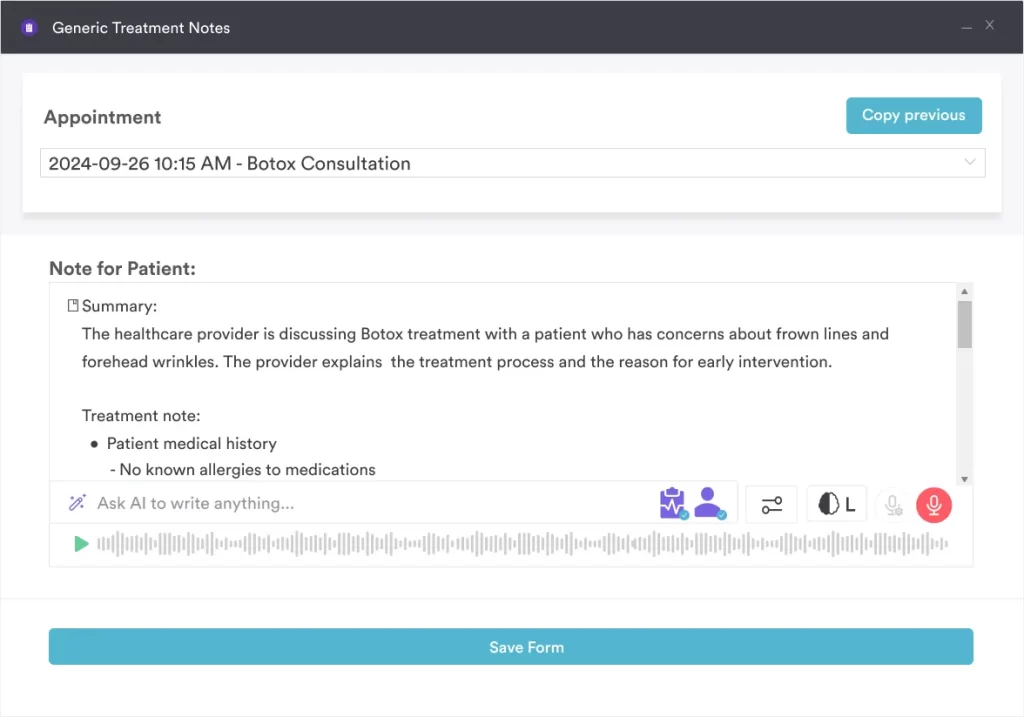
Pabau Scribe generating clinical notes, treatment summaries, and prescription instructions inside the patient record

Pabau Scribe listens during the appointment and drafts structured SOAP, DAP, or specialty-specific notes that the clinician reviews, edits, and signs off. Templates are customizable per service line, so an aesthetics consultation produces a different format than a psychotherapy session or a chiropractic visit.

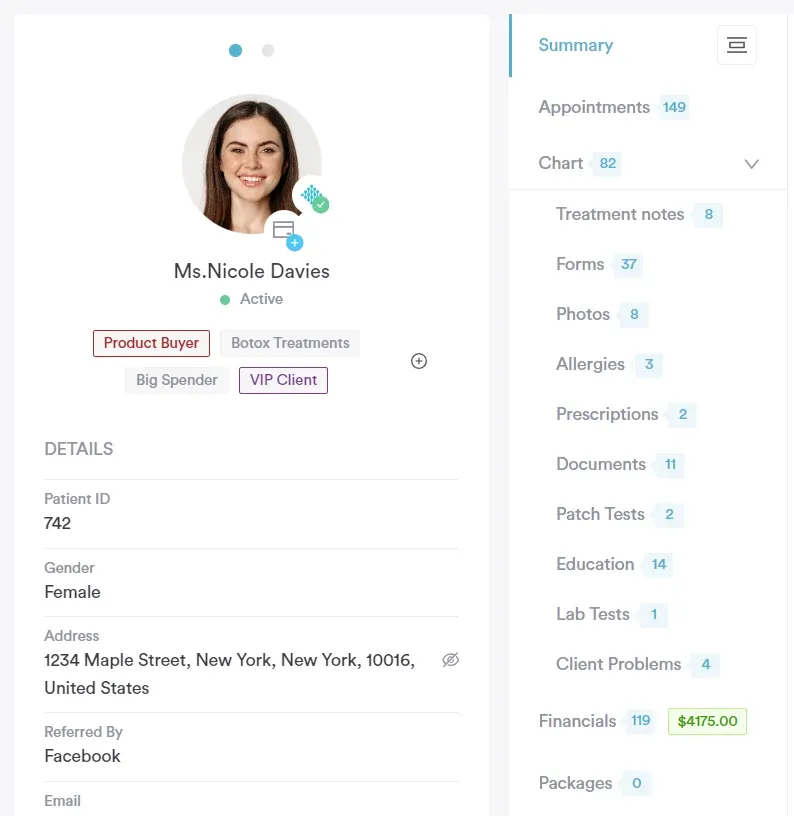
Pabau electronic health record showing integrated AI clinical notes, treatment history, and appointment links

Key features

  • Pabau Scribe ambient documentation: Real-time note generation during in-person and telehealth consultations
  • Customizable templates: SOAP, DAP, BIRP, aesthetics, chiropractic, and wellness templates with discipline-specific fields
  • Notes attached to the full record: Each note links to the appointment, treatment plan, invoice, and follow-up automation
  • Integrated telehealth: Sessions transcribed and summarized whether the visit is on-site or remote
  • Custom digital forms: Pre-visit intake, PROMs, and consent flow directly into the AI note context
  • Workflow triggers: Recall, follow-up, and review-request automations kicked off from the signed note

Pricing

Plan Price Who it’s for
Starter From $65/month Solo and small practices
Team Contact for pricing Growing group practices
Enterprise Contact for pricing Multi-site clinics and integrated wellness networks

Where Pabau shines

  • End-to-end visibility: A signed AI note connects directly to billing, recall, and the next appointment without any export, copy, or paste
  • Multi-discipline flexibility: One template engine covers aesthetics, mental health, chiropractic, allied health, and wellness coaching under one record
  • Strong customer reviews: 4.7/5 on Capterra from 600+ verified reviews with consistent feedback on documentation time savings

Where Pabau falls short

  • Standalone AI scribes are cheaper at entry: Heidi Health and Freed have lower starting prices for clinicians who only need a scribe and already have an EHR they like
  • Onboarding requires more setup: Configuring templates, automations, and integrations across a whole practice takes longer than installing a single-feature scribe
  • Not built around hospital EHRs: Practices running Epic, Cerner, or athenahealth as the system of record will get tighter integration from Abridge, DAX Copilot, or Suki

Who Pabau is best for

Private clinics and multi-discipline practices that want AI documentation as one feature inside a full practice management platform, not as a separate tool. Group practices ready to consolidate scheduling, billing, telehealth, and clinical notes onto one record. Operators who care as much about what happens after the note is signed (follow-up, recall, billing) as the note itself.

Heidi Health: Best for solo clinicians on a tight budget

Heidi Health offers one of the most generous free tiers in AI clinical documentation. Solo clinicians can run unlimited ambient consults at no cost, with paid tiers unlocking templates, integrations, and team features.

The product was originally built by Australian clinicians and now serves general practice, mental health, allied health, and aesthetic medicine. Outputs include SOAP, letters, referrals, and patient-friendly summaries from a single recording.

Key features

  • Free unlimited ambient consults: No per-note or session caps on the free tier
  • Multiple output types from one recording: SOAP, referral letter, patient summary, billing codes
  • Custom templates: Paid tiers add personalized templates and team sharing
  • EHR-agnostic: Copy-paste workflow rather than deep EHR integration

Pricing

Free for solo use. Paid plans start at around $99/month per clinician for Pro, with Team and Enterprise tiers adding shared templates, admin controls, and dedicated onboarding. Pricing tiers shift periodically, so verify on the vendor’s site.

Where Heidi Health shines

Cost. Few competitors match a genuinely usable free tier for unlimited solo consults. Output quality on common note types is strong, and the multi-output workflow saves time on dual-purpose documentation like a clinic note plus a GP referral.

Where Heidi Health falls short

No native deep EHR integration means most clinicians still copy and paste the final note. Team and admin controls are thinner than enterprise-focused tools. Specialty-specific template depth varies.

Who Heidi Health is best for

Solo clinicians who want the cheapest viable ambient scribe and are content to copy and paste into their existing EHR. GPs and allied health practitioners who need referral and patient summary outputs alongside the clinical note.

See Pabau Scribe inside a full practice management platform

Most AI scribes hand you a note. Pabau Scribe writes the note, attaches it to the appointment and patient record, fires the right follow-up workflow, and feeds the billing system in one place. Book a personalized demo to see how it fits your specialty.

Pabau Scribe AI clinical notes demo inside the patient record

Suki: Best for voice-first ambient documentation

Suki was one of the first venture-backed AI scribes to ship a voice-first clinician assistant. The product covers ambient documentation, dictation, code suggestion, and chart Q&A inside Epic, Cerner, athenahealth, and Elation.

Voice commands sit at the center: a clinician can ask Suki to summarize the last visit, pull up labs, or draft a note without leaving the exam room. That voice-first design appeals to specialists who already use Dragon Medical or similar dictation tools.

Key features

  • Ambient AI note generation: Listens during the encounter and drafts a structured note
  • Voice commands: Hands-free chart navigation, dictation, and Q&A
  • Deep EHR integration: Epic, Cerner, athenahealth, and Elation
  • Coding assistance: ICD-10 and CPT code suggestions inside the note workflow

Pricing

Suki typically lands around $399/month per clinician for individual users, with enterprise pricing negotiated by health-system contract. Add-ons for advanced voice features and EHR integration vary by deployment.

Where Suki shines

Voice-first clinician experience for physicians who already work hands-free. Native integrations with the big four hospital EHRs. Strong code suggestion for billing-heavy specialties.

Where Suki falls short

Price is high relative to ambient-only scribes like Heidi or Freed. Best returns require committing to the voice-first workflow, which suits some specialties more than others. Small practices without one of the supported hospital EHRs see less of the integration upside.

Who Suki is best for

Specialists on Epic, Cerner, athenahealth, or Elation who want voice-driven documentation. Practices already using Dragon-style dictation that want a modern ambient layer on top.

Abridge: Best for hospital and health-system deployment

Abridge is the AI clinical notes platform most often selected by US hospitals and large multi-specialty health systems. Its enterprise focus shows in the depth of Epic integration, the linked-evidence approach to notes, and the breadth of specialty coverage.

Linked-evidence notes show each clinical statement traced back to the part of the conversation it came from, which addresses a common audit concern with ambient AI scribes. Abridge also covers more than 50 specialties out of the box.

Key features

  • Linked-evidence notes: Every clinical fact traces back to the recorded conversation snippet
  • Epic integration: Embedded inside the Epic workflow with HMaaS and Workshop access
  • 50+ specialties: Specialty-tuned models from primary care to oncology, cardiology, and ortho
  • Multilingual support: Documentation across 14+ languages with translation summaries for patients

Pricing

Enterprise only. Custom quoted per health system based on clinician count, specialty mix, and integration scope. Standalone clinician pricing is not publicly available.

Where Abridge shines

Hospital-grade compliance, multilingual coverage, and depth of specialty tuning. Linked evidence is a strong differentiator for risk-averse compliance teams. Used in named deployments across Kaiser Permanente, UPMC, and other major health systems.

Where Abridge falls short

Not built for solo or small group practices. Procurement, deployment, and onboarding move at enterprise pace. Pricing is opaque and out of reach for most independent clinicians.

Who Abridge is best for

Health systems and large hospital groups running Epic that need linked-evidence AI documentation across many specialties and languages, with the compliance posture of an enterprise vendor.

DAX Copilot: Best for health systems already on Dragon Medical

DAX Copilot is Microsoft’s ambient documentation product, formerly Nuance Dragon Ambient eXperience. It builds on the same speech-recognition stack that powers Dragon Medical, with Microsoft Cloud for Healthcare handling identity, security, and EHR integration.

For hospitals already standardized on Microsoft and Dragon, DAX Copilot is the natural extension. The product covers ambient documentation, automatic note drafting in the EHR, and follow-up patient summaries.

Key features

  • Ambient documentation: Drafts a structured note from the live encounter
  • Dragon Medical lineage: Built on the same clinical speech stack used by hundreds of thousands of US clinicians
  • Microsoft Cloud for Healthcare: Enterprise identity, security, and EHR integration
  • Patient summaries: Auto-generated post-visit summaries shared with the patient

Pricing

Enterprise only. Custom quoted by Microsoft per health system, typically bundled with Dragon Medical and broader Microsoft Cloud for Healthcare licensing.

Where DAX Copilot shines

Tight fit with hospitals already running Dragon Medical and Microsoft 365. Enterprise security and identity story. Speech-recognition accuracy is mature across specialties.

Where DAX Copilot falls short

Not built for independent solo or small group practices. Limited value unless the rest of the Microsoft Cloud for Healthcare stack is already in place. Vendor lock-in is a real consideration.

Who DAX Copilot is best for

Hospitals and health systems already standardized on Dragon Medical and Microsoft Cloud for Healthcare that want an ambient layer built on the same stack.

Freed: Best for solo cash-pay and locum clinicians

Freed is one of the fastest-growing AI scribes among solo US clinicians, especially in primary care, mental health, and locum work. The product is deliberately narrow: ambient scribe, personalized style, one clinician per account.

Setup takes minutes, and the scribe learns a clinician’s preferred note style over time. Outputs land in a web app for review, edit, and copy into the EHR of choice.

Key features

  • Ambient scribe: Listens during the visit and drafts a structured note
  • Personalized style: Learns the clinician’s voice and formatting preferences
  • EHR-agnostic: Web app with copy-paste workflow to any EHR
  • Mobile-first: Record on a phone or tablet without extra hardware

Pricing

Around $99/month per clinician for individual users. Group pricing available for small clinics. No free tier as of 2026.

Where Freed shines

Speed to value. Strong personalization for clinicians who write notes in a distinctive style. Mobile-first design fits home-visit and locum workflows.

Where Freed falls short

No deep EHR integration. Team and admin features are limited. The scribe-only scope means it does nothing for scheduling, billing, or patient communication.

Who Freed is best for

Solo cash-pay clinicians, locums, and mobile providers who want a fast, personal ambient scribe and have an EHR or note system they intend to keep.

Augmedix: Best for high-volume specialty and ED workflows

Augmedix takes a hybrid approach: AI drafts the note, and trained medical documentation specialists review and finalize it. The result is enterprise-grade documentation accuracy aimed at high-volume settings like the emergency department, hospital medicine, and busy specialty clinics.

The product is most often deployed inside hospitals and health systems on Epic, Cerner, or athenahealth, with multiple offerings spanning ED, ambulatory, and inpatient settings.

Key features

  • Hybrid AI plus human documentation specialists: Notes drafted by AI and reviewed by trained scribes
  • Specialty offerings: ED, hospital medicine, ambulatory, and surgical workflows
  • Deep EHR integration: Epic, Cerner, and athenahealth deployments
  • Compliance posture: Hospital-grade BAAs, audit trails, and access controls

Pricing

Enterprise only. Custom quoted by clinician count, specialty, and the level of human review included. Hybrid pricing typically runs higher than pure AI scribes because of the human-in-the-loop component.

Where Augmedix shines

High-acuity, high-volume settings where note accuracy and turnaround speed matter more than software cost. Strong fit for ED and hospital medicine.

Where Augmedix falls short

Cost. The human-plus-AI model is more expensive than ambient-only scribes. Not the right shape for solo or small practice clinicians on a budget.

Who Augmedix is best for

Hospitals and health systems with high-volume documentation in the ED, hospital medicine, or surgical specialties, where the cost of a hybrid scribe is justified by the time clinicians get back.

How to choose the best AI clinical notes software for your practice

A side-by-side feature matrix flatters every platform. The real test is what happens after the note is signed. Use these five criteria to narrow the field before booking demos.

  1. Standalone scribe or full platform: A standalone scribe like Heidi or Freed solves one problem cheaply. A platform like Pabau solves documentation, scheduling, billing, recall, and the patient record at once. If you are already happy with your EHR, pick a scribe. If you are stitching three or four systems together, replacing them with one platform is usually the better long-term move. The best clinical notes software guide covers the platform-vs-standalone trade-off in more depth.
  2. EHR integration depth: Copy-paste is fine for solo practitioners but eats into the time savings at scale. Hospital systems running Epic, Cerner, or athenahealth should prioritize Abridge, DAX Copilot, Suki, or Augmedix. Private clinics that want the record system itself to host the AI should consider Pabau.
  3. Specialty fit: Notes for psychotherapy, aesthetics, chiropractic, and ED look nothing alike. Verify that the platform’s templates and underlying model have been tuned for your specialty before signing. A general SOAP draft is useful; a specialty-tuned draft is materially better. Reading our SOAP notes guide alongside vendor demos helps calibrate quality.
  4. Compliance posture: HIPAA is the floor. Confirm the BAA terms, encryption posture, audit log scope, and recording retention policy. Linked-evidence notes (Abridge) and human-in-the-loop review (Augmedix) raise the compliance bar further, which matters for inpatient and ED settings under tight regulatory review. The HHS HIPAA documentation is the standard reference.
  5. Total cost of ownership, not just sticker price: A $99/month scribe that needs copy-paste and another tool for follow-up automation is not cheaper than a $65/month platform that does all of it. Compute the bundled cost across scribe, EHR, billing, recall, and reporting before deciding. How AI scribes affect patient care covers the qualitative payoff alongside the financial one.
Continue your research

Continue your research

Want a broader read on AI inside the practice? How AI is enhancing practice management looks at how documentation, scheduling, and patient communication tools are converging.

Curious about clinician-side benefits in detail? How AI scribes are revolutionizing medical documentation for physicians covers the clinician productivity story with specific time-savings data.

Want a primer on writing safer, more defensible notes? Write faster, safer clinical notes: a GP’s guide walks through the structure and risk-management principles that good AI scribes are built to support.

Conclusion

AI clinical notes software is no longer experimental. Every platform in this comparison runs production deployments at thousands of clinicians, and the question is not whether to adopt an AI scribe but which one fits your operational shape best.

For private clinics and multi-discipline practices that want AI documentation inside one system that also runs scheduling, billing, telehealth, and patient communications, Pabau is the most operationally complete pick. Heidi Health and Freed lead the standalone scribe tier for solo clinicians on a budget. Abridge, DAX Copilot, Suki, and Augmedix dominate the hospital and health-system tier with deep Epic, Cerner, and athenahealth integration. To see how Pabau Scribe handles your specialty inside a full practice management workflow, book a demo and bring your hardest documentation scenario.

Frequently Asked Questions

What is the best AI clinical notes software in 2026?

Pabau is the strongest pick when AI clinical notes need to live inside a full practice management platform that also handles scheduling, billing, telehealth, and the patient record. For solo clinicians who want a standalone ambient scribe, Heidi Health (with a free tier) and Freed lead the value tier. For hospitals and large health systems, Abridge, DAX Copilot, Suki, and Augmedix dominate based on EHR integration depth and compliance posture.

How much does AI clinical notes software cost?

Standalone AI scribes for solo clinicians typically run between free (Heidi Health) and around $99/month per clinician (Freed, Heidi Pro). Pabau, as a full practice management platform with AI documentation included, starts from $65/month. Voice-first products like Suki land around $399/month per clinician. Enterprise platforms such as Abridge, DAX Copilot, and Augmedix are custom quoted by health system and not publicly priced.

Is AI clinical notes software HIPAA compliant?

All seven platforms in this comparison offer HIPAA-aligned deployments with encryption, audit trails, and a Business Associate Agreement. Compliance is not binary, so review each vendor’s BAA terms, recording retention policy, and access controls before signing. Hospital deployments often require additional review around 42 CFR Part 2 (for substance use records) and state-specific privacy regulations.

Can AI clinical notes software work with my existing EHR?

Standalone ambient scribes like Heidi Health and Freed are designed to sit alongside any EHR using copy-paste workflows. Suki, Abridge, DAX Copilot, and Augmedix all offer deep integrations with Epic, Cerner, and athenahealth. Pabau replaces the EHR entirely with one record system that includes AI documentation, which is the right shape for private clinics and multi-discipline practices but not for hospitals already standardized on a major EHR.

How accurate are AI clinical notes?

Modern ambient scribes typically produce structured notes that require minor edits before sign-off, with accuracy rates that vary by specialty, accent, and audio environment. Linked-evidence approaches (Abridge) and hybrid human-plus-AI review (Augmedix) provide stronger audit trails for high-stakes settings. The clinician remains responsible for reviewing and signing the final note in every case.

Will AI clinical notes save me time?

Published clinician surveys and vendor case studies report meaningful documentation time savings, often in the range of one to two hours per day for primary care and outpatient specialties. Actual savings depend on baseline workflow, specialty, and how tightly the scribe integrates with the EHR or practice management system. The biggest gains come from tools that eliminate copy-paste rather than just speeding up note drafting.

×