Health appraisal form
A health appraisal form is a record a licensed provider signs to document someon...

2
Last Updated: Oct 13, 2026

The best AI tool for your med spa is the one that fixes your biggest bottleneck first, whether that is missed calls, no-shows, treatment notes, or marketing that never gets done.
Our top pick is Pabau, an all-in-one practice management platform built for med spas, because it replaces a stack of disconnected tools and keeps every AI feature tied to the patient record.
For documentation alone, Freed is a strong AI medical scribe. For front-desk calls, Podium answers and books after hours. For reviews and getting found, Birdeye handles reputation.
Point tools only pay off when they connect to your patient records, so EMR integration matters more than any single AI feature.
Never paste patient details into a consumer AI like ChatGPT unless you have a HIPAA-safe setup, because general chatbots are not compliant by default.
Every AI tool for a med spa earns its place by killing one specific headache, so the best one for you is whichever fixes your biggest bottleneck first.
If the phone rings out after 6pm, you need an AI receptionist. If notes eat your evenings, you need a scribe. If your calendar has gaps, you need marketing and rebooking that run themselves.
Below are the nine AI tools we would put in front of a med spa owner in 2026, each mapped to the problem it solves. Some are full practice management software platforms, while others are focused point tools that automate a single job.
Our top pick is Pabau, an all-in-one practice management software built for med spas, because it handles most of these jobs in one place instead of leaving you to wire together six apps.
One thing to get straight before you shop: searching med spa AI turns up dozens of shiny features, but a feature only pays off when it connects to your patient records. Keep that test in mind as you read.
| Tool | Best for | What it does | Med spa fit | Pricing model |
|---|---|---|---|---|
| Pabau | Replacing a patchwork of separate tools | All-in-one practice management with built-in AI: scribe, prescribing agent, concierge, and marketing | Purpose-built for med spas | Subscription by location and users, every feature included |
| Zenoti | Multi-location operations | All-in-one spa platform with AI receptionist, marketer, and scribe | Enterprise and multi-site med spas | Subscription (quote-based) |
| Freed | Treatment notes and documentation | AI medical scribe that records a consultation and writes the note | Add-on for solo and small med spas | 7-day free trial, then paid |
| Boulevard | Front desk and self-booking | Booking, calendar, and client-experience platform | Salons and premium med spas | Subscription (quote-based) |
| Podium | Missed calls and after-hours leads | AI assistant that answers, qualifies, and books appointments | Has a dedicated aesthetics solution | Subscription |
| GoHighLevel | Lead capture, CRM, and rebooking | CRM plus marketing automation with Voice AI and chatbots | Used by med spas, often set up through an agency | Subscription (agency or self-serve) |
| Birdeye | Reviews and getting found | AI reputation, reviews, and local and AI-search visibility | Multi-location healthcare and med spas | Subscription |
| Canopy | Bookkeeping and accounting | AI-assisted accounting and back-office tools | Back office, not clinical care | Subscription |
| ChatGPT and general AI | Ad-hoc writing and ideas | General assistant for drafts, checklists, and SOPs | Not HIPAA-safe for patient data by default | Free tier, then paid |
We ranked these by how much day-to-day pain they remove for a working med spa, whether that is a medical spa built around injectables or a weight-loss clinic managing GLP-1 programs, starting with the platform that covers the most ground.
The AI runs inside the system that already holds your calendar, records, and payments.
Pabau is an all-in-one, AI-powered practice management software built specifically for medical spas, so instead of buying a scribe here and a booking bot there, the AI lives inside the system that already holds your calendar, client records, and payments.
That is the difference that matters: every AI action writes back to the patient file automatically. Here is where Pabau’s AI does the heavy lifting:
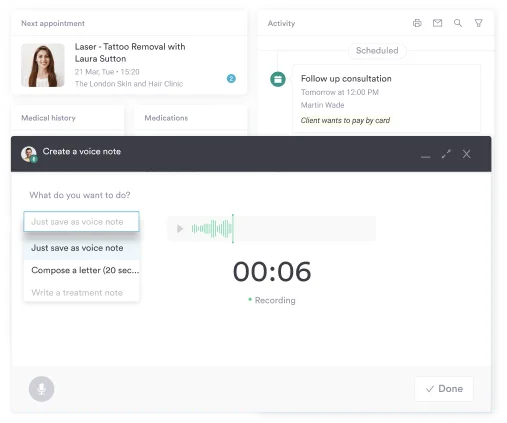
Because everything runs on one patient timeline, estheticians spend less time rekeying data between apps and more time with clients. In our Ageless Enhancements case study, a two-location med spa that added weight-loss services cut about 10 minutes of admin per patient after switching to Pabau.
Pabau’s pricing scales with your locations and users, and every subscription includes the full platform. AI actions run on usage credits, with an unlimited option if you need it.
Best for: med spas that are tired of stitching tools together and want AI built into one system. Not for: someone who only wants a single free gadget and nothing else.
Enterprise-grade AI automation for groups, heavier than a single-site med spa needs.
Zenoti is an all-in-one spa and med spa platform whose AI shines at scale, so it is the pick for groups running several sites. It bundles an AI receptionist, concierge, marketer, and scribe alongside smart scheduling, and it is built for the reporting and staffing complexity that comes with multiple locations.
That enterprise focus is also the catch: it can be heavier than a single-site med spa needs. If you are weighing AI automation for med spas across a franchise or chain, Zenoti is a serious contender. Best for: multi-location and enterprise med spa brands. Not for: a solo studio that wants something lightweight.
A focused AI scribe that takes notes off your plate, but not a practice management system.
Freed is the best standalone AI medical scribe for a med spa that just wants documentation off its plate. It listens, transcribes, and uses natural language processing to write the note in your style, then formats it so it is ready to drop into an EHR.
It captures notes in multiple languages, handles medical terminology and product names accurately, and filters background noise. As a HIPAA-compliant AI scribe, it keeps client data encrypted.
Freed does not have a free-forever plan, but it offers a 7-day free trial with no card required, so you can test it before you commit to a paid subscription. Freed is not a practice management system, though, so it works best as an add-on rather than the backbone of your operations.
Best for: solo and small med spas that only need faster notes. Not for: practices that want the note tied to bookings, payments, and marketing in one place.
A polished booking and checkout front desk, with limited clinical documentation.
Boulevard is a client-experience and booking platform popular with premium salons and med spas, so its strength is a polished front desk. Clients self-book, reschedule, and pay online, while the calendar and staff scheduling stay in sync, which takes pressure off reception during peak hours.
Related reading: tooling helps, but so does morale — our French-language guide shares conseils pour motiver vos employés.
It leans more toward the appointment and payment experience than clinical documentation, so most med spas pair it with a dedicated notes tool. Best for: med spas that want a slick booking and checkout experience. Not for: clinical-heavy practices that need deep charting and prescribing.
An AI receptionist that catches after-hours inquiries, with no records or billing behind it.
Podium answers the messages and calls your front desk cannot, which is why it lands here for missed-call recovery. Its AI assistant responds around the clock, qualifies the lead, and books the appointment on its own, and Podium runs a dedicated aesthetics solution for exactly this audience.
A large share of booking attempts happen after hours, so an AI that captures those inquiries turns lost calls into filled slots. These are the AI chat tools that can book med spa appointments automatically without a person in the loop.
Best for: busy med spas losing bookings to voicemail. Not for: practices that need full records and billing in the same tool.
A capable AI marketing engine for lead conversion, provided someone configures it.
GoHighLevel is an AI-powered CRM and marketing-automation platform that med spas use to capture leads, nurture them, and automate rebooking. Its Voice AI and conversation chatbots reply to inquiries, and its workflows chase deposits and lapsed clients without anyone lifting a finger.
It is powerful but built for people comfortable configuring automations, which is why many med spas run it through a marketing agency rather than in-house. For an owner who wants an affordable AI marketing platform for a small med spa, it is a capable engine, provided you have someone to set it up.
Best for: lead-hungry med spas with agency support. Not for: owners who want something clinical and ready out of the box.
Automated review requests and listings that improve visibility, separate from clinical work.
Birdeye is an AI reputation and reviews platform, so it solves the problem of a med spa that does great work but stays invisible online. It requests reviews automatically, replies to them, and keeps your listings consistent so you show up in local search and in AI-generated answers.
Reviews and visibility drive new-client volume, and Birdeye automates a follow-up step that easily slips during a busy week. It does not touch clinical work, so it complements rather than replaces your core system. Best for: med spas that need more new clients and a stronger reputation. Not for: practices whose bottleneck is admin or notes.
AI bookkeeping for the back office, with nothing for scheduling or patient records.
Canopy is accounting practice management software with AI built in, so it earns a spot for the back-office finance work med spas often neglect. It generates reporting from plain-language prompts, drafts professional emails, and cleans up grammar and translation for client communication.
Bookkeeping only works if the hours going in are accurate. If your team logs shifts on paper, a free timesheet template is the quickest way to tidy that up.
Its focus is accounting rather than clinical care, so treat it as the tool your bookkeeper loves, not your treatment room. Best for: med spas that want tidier books and finance admin. Not for: anyone looking for scheduling or patient records.
Cheap help with everyday writing, unsafe for anything touching patient data.
A general assistant like ChatGPT is the cheapest AI most med spas already have, and it is genuinely useful for drafting social posts, aftercare emails, standard operating procedures, and quick ideas. For non-clinical writing, it can save hours each week.
The caveat is compliance: consumer chatbots are not HIPAA-safe by default, so the best HIPAA-compliant AI for anything touching patient data is a purpose-built medical tool with a business associate agreement, not a public chatbot.
Use general AI for marketing and operations, and keep patient details out of it. Best for: low-cost help with everyday writing. Not for: anything involving protected health information.
The right AI practice management software should remove admin from four jobs a med spa does every day, not just add another dashboard to check. Whether you call it software for clinic management or med spa management software, judge it on how much manual work it takes off your team.
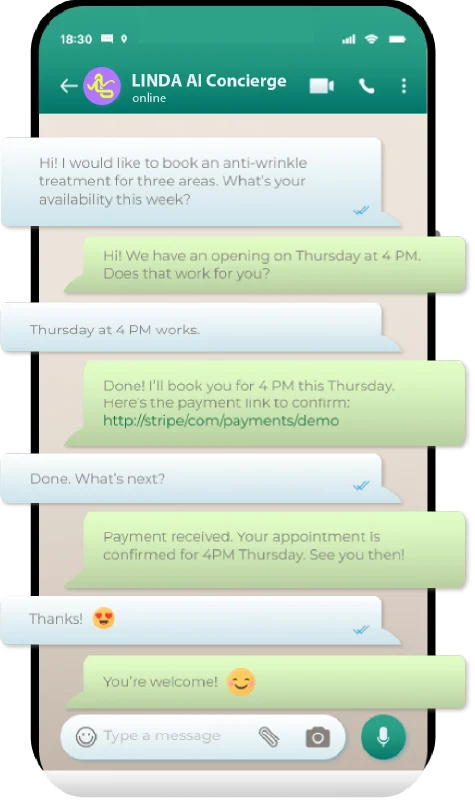
AI-driven online booking should let clients book, reschedule, and cancel themselves, then fill gaps automatically. The payoff is a front desk that stops playing phone tag and a calendar that stays full.
Look for AI medical scribe software that records a consultation and returns a structured note, so your team writes up nothing by hand. The best versions save the note straight to the client record, not a separate app.
AI should handle routine questions and reminders across phone, SMS, and email, including deposit requests and templated aftercare like a chemical peel aftercare guide, both of which cut no-shows and follow-up calls. That keeps communication fast and consistent without adding to anyone’s workload. Automated deposit management secures the booking further, charging clients upfront before they cancel or no-show.
AI marketing support should draft campaigns, personalize outreach, and manage reviews, so promotion happens even in a busy week. For a smaller team, that is the difference between marketing that runs and marketing that stalls.
EMR integration with AI medical assistants is what separates a tool that saves time from one that quietly creates more, because an AI feature only helps if it can read from and write to the patient record. A scribe that writes a beautiful note you then copy into your EHR by hand has just moved the admin, not removed it.
A system that builds the AI into the record itself is an AI EMR, and that is the category worth shortlisting. Ask each vendor which fields its AI can write to without a human retyping them.
This is where the patchwork approach falls down. Run a separate scribe, booking bot, CRM, and marketing tool, and you are the integration: reconciling four systems, chasing which one owns a piece of data, and rekeying between them. Every disconnected tool is another place for something to fall through the cracks.
An all-in-one platform like Pabau sidesteps this because the AI and the patient record are the same system, so a consultation becomes a note, a booking, and a follow-up without a single export. When you compare AI medical assistants, weigh integration ahead of any single flashy feature.
Pick the tool that fixes your most expensive problem first, then check it connects to everything else. Four steps keep the decision honest.
Start with the job that costs you the most time or revenue right now, whether that is missed calls, no-shows, notes, or empty slots. The best AI tool is the one aimed at that specific pain, not the one with the longest feature list.
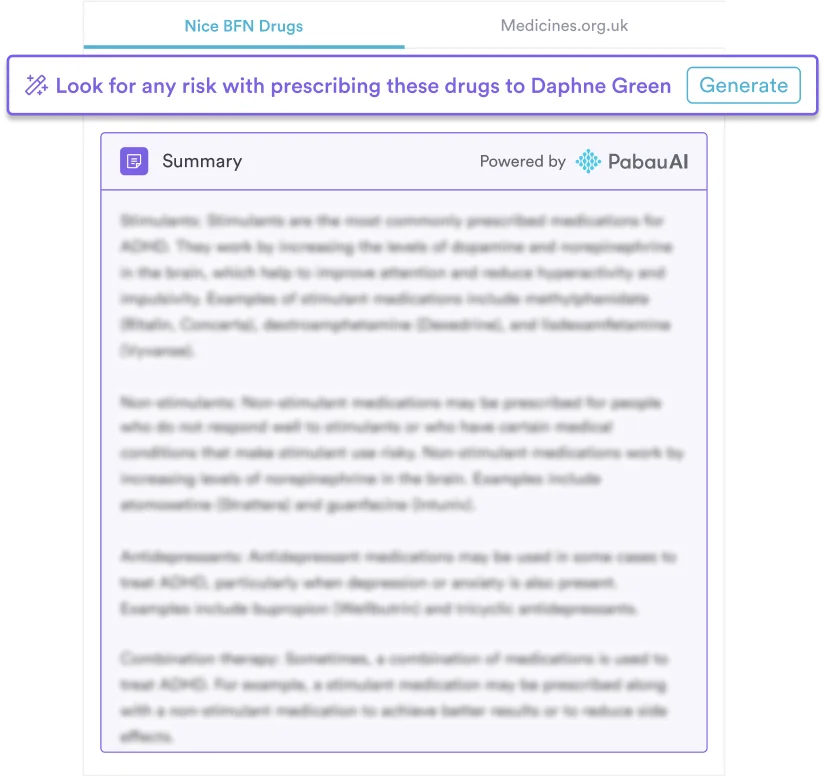
If missed calls top your list, Pabau’s AI receptionist can pick up the ones that land after closing. Every agent runs in training first, so a staff member approves each reply before the patient reads it.
Confirm the tool understands aesthetic treatments, consent forms, an emergency contact form, before-and-after photos, and deposits, not just generic bookings. A tool built for restaurants or gyms will fight your workflow.
Ask exactly how the tool reads and writes to your patient records and calendar. If the answer is manual export, the time you save writing is time you lose copying.
Make sure anything touching patient data is HIPAA-compliant and will sign a business associate agreement. Skip this and a time-saving tool becomes a compliance risk.
The winning move is rarely nine separate tools. One system that removes the admin lets your team focus on treatments and clients. Point tools each solve a slice, but the patient journey holds together only when bookings, notes, payments, and marketing sit in one place.
That is what Pabau does for med spas: AI-powered notes, prescribing, booking, and marketing on one patient timeline, priced by your size with every feature included. Book a demo to see how much time AI could give your med spa back.
For most med spas, Freed is the best standalone AI medical scribe: it records the consultation, writes up the note, and adapts to your style. If you would rather not run a separate tool, Pabau Scribe does the same job inside your practice management software, so the note lands straight on the client record.
Not exactly. Freed does not have a free-forever plan, but it offers a 7-day free trial with no card required, so you can test documentation before you commit. Other ambient scribe tools offer similar short trials rather than permanent free tiers. The trade-off with a trial is that it is time-limited and still is not connected to your patient records, so notes need copying across once you are on a paid plan.
A HIPAA-compliant AI scribe is one that signs a business associate agreement and encrypts patient data in transit and at rest, which purpose-built medical scribes do and consumer chatbots do not. Always confirm the agreement is in place before any patient information goes near the tool.
AI receptionists like Podium answer calls and messages and book the slot without staff involvement, and all-in-one platforms like Pabau and Zenoti do the same through online booking tied to your live calendar. The value is capturing the inquiries that land after hours, when your front desk is not there to answer.
Pricing ranges from free consumer assistants to point tools at a flat monthly fee and full platforms priced by location and number of users. The cheaper the tool looks up front, the more likely you will pay for it later in the admin time spent stitching it to everything else.
If your problem is one specific job, a focused tool is fine to start. But if your AI features live in separate apps that do not talk to your patient records, an all-in-one platform like Pabau usually wins, because the data stays in one place and nothing gets rekeyed by hand.