Nitrates medication list
A nitrates medication list is a point-of-care reference that sets out the main c...

2
Last Updated: Oct 6, 2026
Arestin post op instructions come down to three rules. Do not brush the treated site for 12 hours. Do not floss or use interdental cleaners there for 10 days. Avoid hard, sticky, crunchy and chewy foods for a week.
Arestin is minocycline hydrochloride, placed as 1 mg microspheres into periodontal pockets after scaling and root planing. The microspheres keep releasing antibiotic for about three weeks, and mechanical disturbance in the first 10 days is what undoes them.
The template below turns those rules into a one-page handout your practice can print, email, or send through a patient portal. It also documents what the patient was told, which is the part a paper sheet handed over in the operatory never does.
A one-page patient handout covering the 12-hour brushing rule, the 10-day flossing restriction, and the week of soft foods. It also lists the side effects worth a phone call, with space for your practice name and after-hours number.
Download template
Do not brush the treated area for 12 hours after placement.
Avoid flossing and all interdental cleaning at the site for a full 10 days.
Skip hard, sticky, crunchy and chewy foods for one week, because chewing force reaches the treated pocket.
Mild sensitivity and soreness are expected, but severe pain, swelling or allergic signs need a same-day call.
Send the handout through your digital forms and book the re-evaluation four to six weeks out.
Arestin (minocycline hydrochloride) is an antibiotic placed directly into periodontal pockets after scaling and root planing. It comes as 1 mg microspheres that release slowly over about three weeks, targeting the bacteria behind gum disease. Your dentist or hygienist packs them subgingivally, deep inside the pocket, where they dissolve and release minocycline.
Because the antibiotic works locally, none of it has to travel through the bloodstream to reach the infection. That also means the dose is only as good as the pocket it sits in. Brushing, flossing, or biting into something hard at the site can move the microspheres and cut the effect.
The first 12 hours after placement decide how much of the dose stays in the pocket. The microspheres are still settling and starting to release minocycline, so they are easiest to displace right now.
For swelling or moderate discomfort, apply an ice pack for 15 minutes at a time, with 15-minute breaks. Over-the-counter acetaminophen or ibuprofen will manage most of the pain. Avoid aspirin, which can increase bleeding.
Keep cleaning the rest of your mouth on your normal schedule. The restriction applies to the treated site only, and it is tighter than patients expect.
Why does the 10-day window matter so much? The microspheres release minocycline over roughly three weeks, and the first 10 days are when they are easiest to dislodge. A floss pass, a wooden pick, or a water flosser jet at the site can clear them out in one movement.
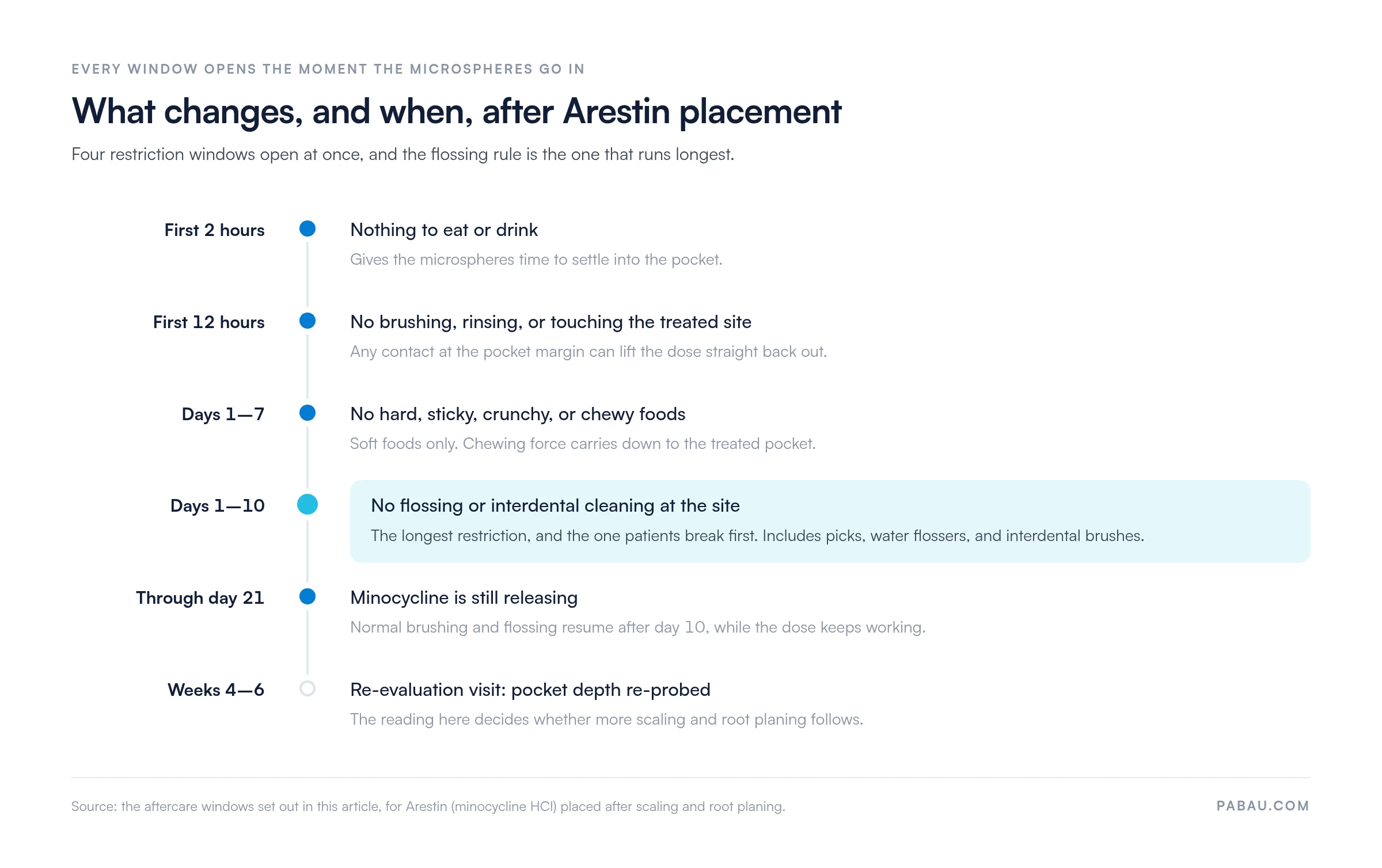
What you eat in the first week decides how long the microspheres stay where they were placed.
Chewing force and hot liquids both reach the treated pocket. One week of cool, soft food protects a dose that keeps working for three.
Print this grid alongside the handout. It is the version patients check at the kitchen table on day four, when the instruction sheet has already gone missing.
Arestin releases minocycline, a tetracycline-class antibiotic. A few interactions and cautions apply while it is working.
Sun sensitivity and the dairy timing rule are the two patients forget by day two. Scheduling automated post-care instructions for the days after placement puts both in front of them again.
Most patients get through the 10 days with nothing worse than a tender gum. The two lists below separate what is expected from what needs a call.
These usually settle within 7 to 10 days as the gum heals. Over-the-counter pain relief and an ice pack cover most of it.
Serious reactions are rare, but each of these warrants professional attention the same day.
Not every call is an emergency. During the 10-day window, the office would rather hear about the following than not.
The re-evaluation is what turns the treatment into a result you can show the patient.
Record the new probing depths on the same periodontal charting form used at the initial exam. One sheet carrying both readings makes the result obvious to the patient. If the depths support maintenance instead of more treatment, the patient’s risk level sets the recall interval.
The handout is built to be customized, printed, and sent. Keep it wherever your practice already stores its digital patient intake forms, so nobody is working from an old print run.
The same layout carries over to your other post-op sheets. If your practice also does extractions, the wisdom teeth removal aftercare template follows the same structure, so patients recognize the format.
In most practices the handout leaves the operatory as paper. The hygienist prints it, the patient folds it into a bag, and the chart carries no note of which version they got. When a call comes in on day four asking whether a water flosser counts, nobody can check what was handed over.
Practice management software like Pabau sends the same document as a digital form once the appointment is marked complete. The patient opens it on their phone, and their acknowledgment is written back to the record with a timestamp. Your front desk stops photocopying, and the chart stops relying on memory.
Follow-up then runs on its own schedule. A day-three message repeats the flossing rule, and a week-three message asks the patient to book the re-evaluation. By the time they sit down for it, the pocket readings and the aftercare record are already in the same file.

Pabau sends your Arestin handout as a digital form, records the patient’s acknowledgment against their chart, and schedules the re-evaluation reminder. Your hygienists stop printing and chasing.

The 10-day flossing restriction is the instruction patients break, and it decides whether the minocycline stays where your hygienist put it. Say it twice: once in the chair, and once in writing they can reopen at home.
A printed sheet satisfies the record. It rarely survives to day four, which is exactly when the questions arrive. A handout the patient can pull up on a phone, backed by a logged acknowledgment, holds up better on both counts.
Customize the template with your practice name and after-hours number before the next Arestin case goes on the schedule. Book a demo to see how Pabau sends aftercare instructions, records who opened them, and books the re-evaluation without a phone call.

Building out the rest of your dental document set? Dental new patient form covers the intake side of the same patient file.
Treating the gum surgically as well? Gum contouring recovery sets out aftercare for a very different healing curve.
Documenting consent before treatment? Dental treatment consent form records what the patient agreed to before the microspheres go in.
Charting which tooth was treated? Tooth charts give your team one numbering reference for the notes.
Do not floss or use any interdental cleaning devices in the treated area for 10 days after Arestin placement. After 10 days, you may resume normal flossing as directed by your dentist. Flossing in the treated pocket during this window can disturb the microspheres and reduce their effectiveness.
Avoid hard, sticky, crunchy, and chewy foods for one week after treatment. Examples include nuts, caramel, popcorn, raw vegetables, and tough meats. Stick to soft foods like soup, yogurt, eggs, pasta, and mashed potatoes. These precautions protect the microspheres and prevent mechanical disruption of the treated pocket.
Common mild side effects like tooth sensitivity, localized discomfort, and minor swelling typically resolve within 7 to 10 days as the gums heal. If side effects persist beyond 10 days or worsen, contact your dentist. Serious side effects like severe pain or allergic reactions require immediate attention.
Do not brush the treated area for 12 hours after Arestin placement. After 12 hours, you may gently brush the rest of your mouth, but avoid the treated area entirely for the full 10 days. After 10 days, resume normal brushing throughout your mouth as your dentist advises.
Arestin is frequently not covered by dental insurance plans, though some policies may provide partial coverage. Insurance coverage varies widely by plan and provider. Contact your insurance company or ask your dentist’s billing office about your specific coverage before treatment to understand your out-of-pocket cost.
Yes, Arestin is an FDA-approved adjunct to scaling and root planing for treating periodontitis. Clinical studies show that combining Arestin with SRP reduces pocket depth more effectively than SRP alone. Success depends on patient compliance with post-op care and follow-up appointments, along with improved home oral hygiene.