Nitrates medication list
A nitrates medication list is a point-of-care reference that sets out the main c...

2
Last Updated: Oct 6, 2026
The cardiovascular review of systems is a structured, symptom-by-symptom inquiry clinicians use to surface cardiac and vascular complaints the patient never volunteered.
It covers eight domains: chest pain, palpitations, dyspnea, orthopnea, paroxysmal nocturnal dyspnea, syncope, peripheral edema, and claudication. The clinician records what the patient reports and what the patient denies.
The review of systems (ROS) sits inside the medical history, separate from the physical examination. Since January 1, 2021, counting ROS systems no longer sets the billing level for an office or outpatient visit.
Published guidance still repeats the old problem-pertinent, extended, and comprehensive tiers, so the change is worth stating plainly. The cardiovascular ROS now earns its keep by supporting medical necessity and the decision making behind the claim.

The cardiovascular review of systems covers symptom inquiry across the cardiac and vascular system, including chest pain, palpitations, dyspnea, syncope, edema, and claudication
Pertinent negatives belong in the note explicitly, because a blank field does not show a reviewer that the clinician asked the question
Since January 1, 2021, E/M codes 99202 to 99215 are leveled by medical decision making complexity or total time, not by counting ROS systems
The cardiovascular ROS still supports medical necessity and evidences the problems addressed, the data reviewed, and the risk that drive MDM complexity
Structured EHR templates and customizable digital forms reduce documentation burden and help clinicians capture consistent cardiovascular ROS data
A cardiovascular review of systems is a clinician-led, symptom-based inquiry focused on the heart, the vasculature, and related hemodynamic function. It is distinct from the hands-on cardiac physical examination, and it relies entirely on what the patient reports.
The ROS is part of the medical history. It is the systems review component that sits between the chief complaint and the physical examination. Clinicians ask about the presence or absence of symptoms. The patient confirms, denies, or elaborates. The clinician documents both responses.
The two are often confused because they cover the same organ system. The difference is the source of information.
Conflating the two is a common documentation error. A murmur heard on auscultation belongs in the physical exam section, not the ROS. A patient’s report of occasional chest tightness belongs in the ROS, not the exam.
The core cardiovascular symptoms are well established across clinical training and documentation standards. What varies between practices is how systematically clinicians ask about them. Rushing through one or two questions leaves the note thin, and that shows up in audit reviews and in missed diagnoses.
Chest pain is the anchor symptom of any cardiovascular ROS. Asking “do you have chest pain?” is a start, but it is rarely enough. Patients frequently deny “chest pain” while describing pressure, heaviness, or tightness that meets the same clinical threshold.
Palpitations are common and frequently benign, but they can also represent atrial fibrillation, SVT, or ventricular ectopy. How the patient characterizes them matters as much as their presence.
Shortness of breath overlaps significantly with respiratory pathology. In patients with either complaint, review the cardiovascular ROS and the respiratory ROS together. The specific patterns of orthopnea and paroxysmal nocturnal dyspnea (PND) are strongly cardiovascular in origin and should always be asked about.
Syncope is a red-flag symptom in the cardiovascular context. Vasovagal syncope is the most common cause and typically benign, but arrhythmic syncope during exertion warrants urgent evaluation.
Leg swelling and leg pain with walking are the primary peripheral vascular symptoms included in the cardiovascular ROS. Both can indicate heart failure or peripheral arterial disease, depending on their characteristics.
Clinicians routinely work through the full symptom list and then leave the negative answers off the page. A reviewer cannot distinguish a symptom that was never raised from one the patient firmly denied. Writing the denial down settles it.
A note that says “cardiovascular: reviewed” does not meet the standard. The finding, positive or negative, must be stated. The table below shows the wording that satisfies a reviewer for each of the eight symptom domains.
The pertinent negative column does more than tidy the chart. It evidences that the clinician asked the question, and it shows which serious causes were considered and ruled out. Both matter when a chart is pulled for retrospective review months later.
Build your cardiovascular pertinent negatives as a checkbox section in your EHR template. Add one attestation line at the bottom: ‘All unchecked items above were reviewed and denied by the patient.’ The attestation keeps the record defensible and cuts several minutes off each encounter.
Counting ROS systems no longer sets the E/M level for an office or outpatient visit. Since January 1, 2021, codes 99202 through 99215 are selected on the complexity of medical decision making (MDM).
Total time spent on the date of the encounter is the alternative. The AMA’s evaluation and management rules say so directly. The extent of history and physical examination is not an element in selecting the level of these codes.
The old math came from the 1995 and 1997 documentation guidelines. Under those rules a problem-pertinent ROS covered one system, an extended ROS covered two to nine, and a comprehensive ROS covered ten or more. Those tiers no longer apply to office and outpatient visits.
A parallel revision took effect on January 1, 2023. It carried the same approach into hospital inpatient and observation visits, consultations, emergency department visits, and nursing facility services. The two rule sets line up like this.
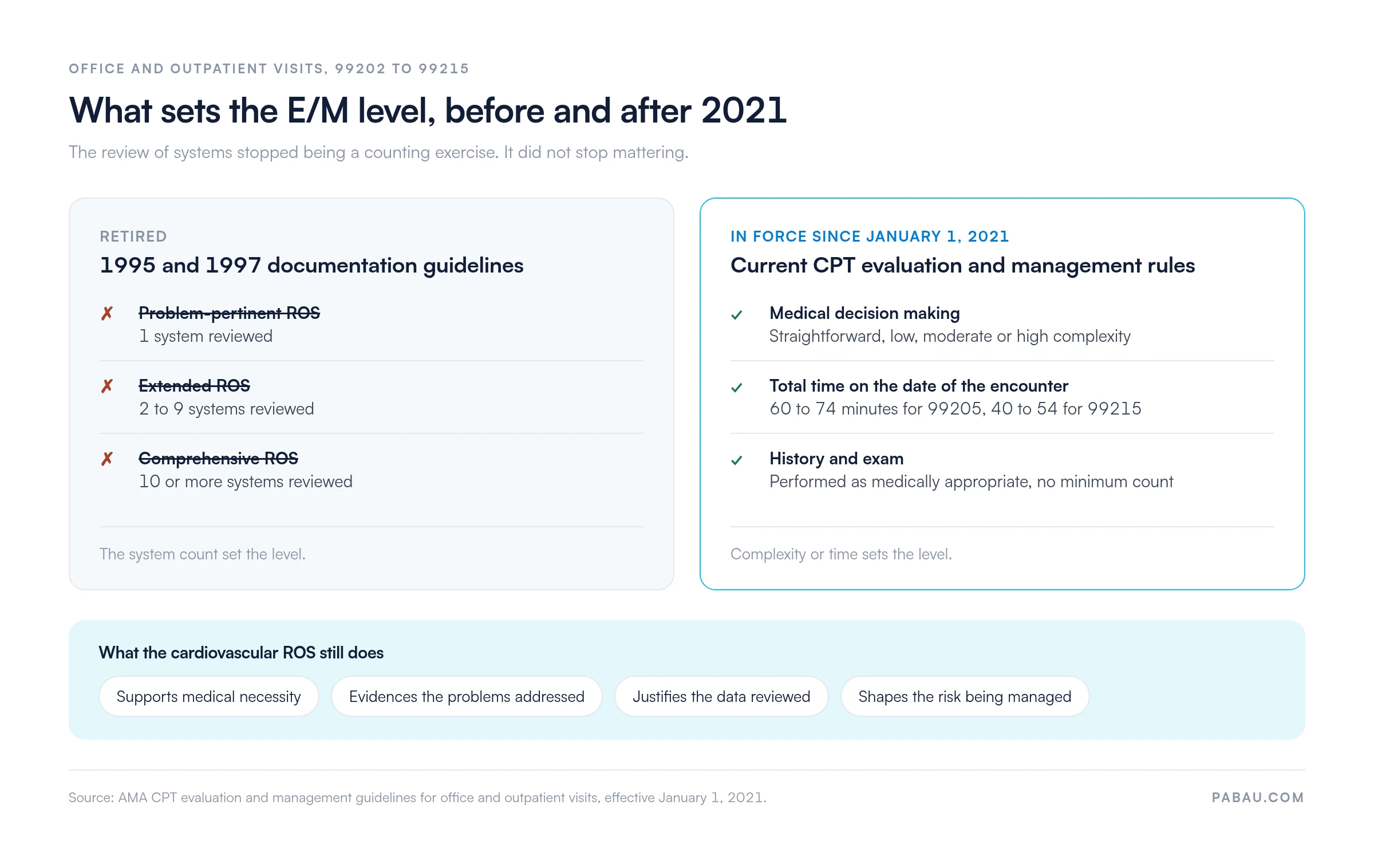
Here is what determines the level now:
None of that makes the cardiovascular ROS optional. Symptoms such as exertional chest pain, new orthopnea, or a syncopal episode define the problems addressed at the encounter, which is the first MDM element. They justify the tests ordered, which feeds the data element. They also shape the risk the clinician is managing, which feeds the third.
Medical necessity remains the overarching criterion for payment, and payers read the history to judge it. Services outside the office E/M family keep their own history requirements, including certain preventive and screening visits.
One compliance risk did survive the change. An auditor reviewing a 99215 claim looks for the thinking behind it. A note that lists symptoms without tying them to an assessment or plan leaves that thinking invisible. Document what the cardiovascular findings led you to consider, order, or rule out.
Pre-built cardiovascular ROS templates solve two problems at once, whether they are configured as EHR autotexts, smart phrases, or digital intake forms. They make sure no symptom category is missed, and they generate the explicit documentation language auditors expect to see. The risk is a template configured once and never revisited, which slowly stops matching how the encounter runs.
Good cardiovascular ROS templates share a few structural features. They list every major symptom category as a discrete item. They distinguish between patient-reported positives and patient-reported negatives. They include a clinician attestation line confirming the ROS was reviewed at the time of the encounter, not completed retrospectively.
Handing the checklist to the patient as a pre-visit intake form changes the sequence. The clinician starts the encounter with the ROS already documented, and only has to review and attest.

For practices using structured medical forms across their locations, the cardiovascular section is one module inside a broader intake workflow. That workflow should cover whichever organ systems the presenting complaint makes relevant. Building modular templates, one per body system, lets clinicians pull in only the sections each encounter type needs.
Most practices start from a general review of systems template and deepen the cardiovascular section for patients with cardiac risk factors. That keeps one form in circulation instead of a separate document per specialty.
CMS guidance permits pre-populated ROS data as long as the clinician reviews and attests to the information at the time of the encounter. Autotexts and structured templates satisfy this when properly configured and attested.
The American College of Cardiology treats systematic cardiovascular history taking as a core element of risk assessment. That makes structured templates clinical best practice as well as a billing convenience.
Practice management software like Pabau lets clinicians build cardiovascular ROS checklists into the patient intake workflow, before the appointment begins. Patients complete the symptom checklist digitally through customizable capture forms, and the responses feed straight into the clinical record.
The clinician reviews that data during the encounter, adds follow-up notes for any positive findings, and attests, all in the same interface. Nobody retypes a denial that the patient already recorded.
Some clinicians would rather capture ROS data during the consultation itself than through pre-visit intake. Pabau Scribe, our AI scribe, structures note content from the clinical conversation, so less time goes into formatting documentation after the encounter. Pabau’s patient records then tie cardiovascular ROS findings to the longitudinal chart, which makes symptom patterns easy to compare across visits.
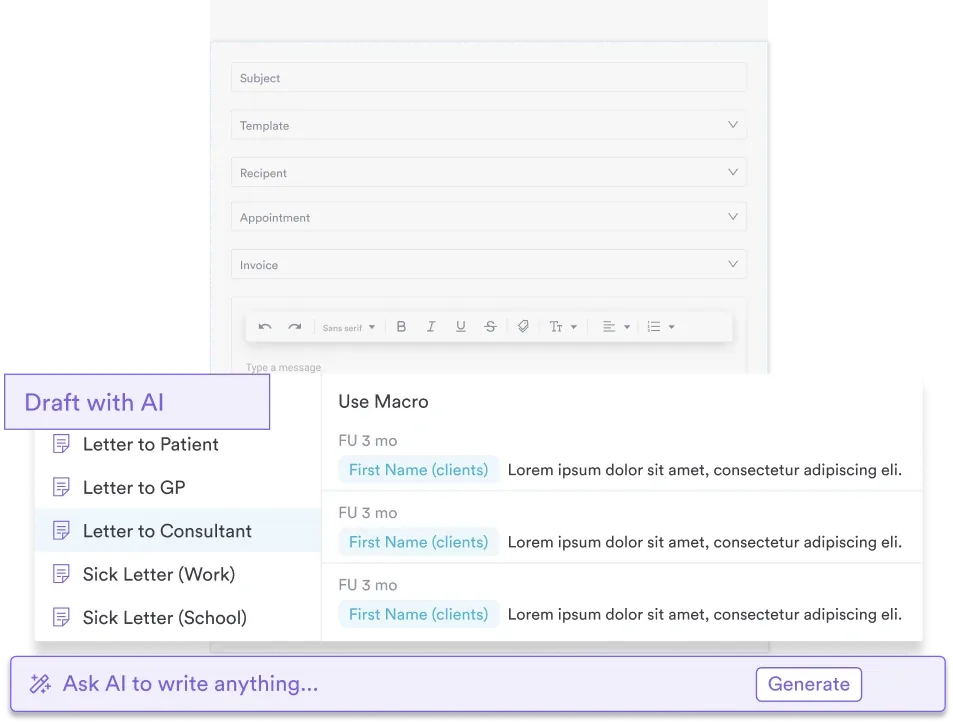
Practices running several providers or locations benefit from one shared ROS template. Documentation that varies clinician by clinician is among the most common audit risk factors. Pabau’s template library supports standardization and customization together. A practice can adapt the cardiovascular checklist to its patient population without rebuilding it for each provider.

Pabau’s customizable digital forms and clinical note templates let you build structured cardiovascular ROS checklists. They feed directly into the patient record, so your documentation is complete before the appointment ends.

The cardiovascular review of systems still shapes both the care and the defensibility of the note, even though it no longer sets the E/M level. Missed symptoms delay diagnoses. Undocumented denials leave a reviewer unable to see what the clinician asked. Templates built once and never revisited stop matching how the encounter runs.
If you change one thing after reading this, make it the pertinent negatives. They cost seconds to record and they are the part of the note a reviewer cannot reconstruct later.
Pabau’s digital forms and clinical note tools help practices build cardiovascular ROS workflows that stay structured and consistent from the moment the patient completes intake. Book a demo to see how customizable ROS templates fit into your existing clinical workflow.

Need the full form the cardiovascular section sits inside? Medical review of systems template covers every organ system in one structured document you can hand to the patient.
Working with a payer that still asks for a 12-point review? 12-point review of systems sets out the twelve systems and the wording that records each one.
Unsure how the constitutional section differs from the cardiovascular one? Constitutional review of systems explains the general symptoms that open almost every history.
Comparing systems to hold your ROS templates? Clinical documentation software weighs the platforms that store, version, and attest clinical templates.
A cardiovascular review of systems covers eight primary symptom domains. They are chest pain or tightness, palpitations or irregular heartbeat, dyspnea (shortness of breath), and orthopnea (breathlessness when lying flat). The list continues with paroxysmal nocturnal dyspnea, syncope or near-syncope, peripheral edema (leg or ankle swelling), and claudication (leg pain with walking). Clinicians document both positive findings (symptoms the patient reports) and pertinent negatives (symptoms the patient explicitly denies).
For office and outpatient visits, there is no required system count. Since January 1, 2021, codes 99202 through 99215 are leveled by medical decision making complexity or by total time on the date of the encounter. The old tiers from the 1995 and 1997 guidelines no longer apply. Those counted one system for problem-pertinent, two to nine for extended, and ten or more for comprehensive. History and exam are performed as medically appropriate. The cardiovascular ROS still supports medical necessity and the problems addressed under MDM.
Pertinent negatives are symptoms the clinician specifically asked about and the patient specifically denied. In the cardiovascular ROS, that reads as “denies chest pain,” “denies palpitations,” or “no history of syncope.” Leaving the field blank is not the same thing. Write the denial down rather than assuming it, because a blank field does not show a reviewer that the system was reviewed at all.
The cardiovascular ROS captures patient-reported symptoms (subjective data), while the physical examination captures clinician-observed findings (objective data). A patient reporting chest tightness on exertion belongs in the ROS. A clinician detecting a heart murmur on auscultation belongs in the physical exam. Both belong in the note, but since 2021 neither one sets the level of an office or outpatient E/M code.
Yes. EHR templates, autotexts, and digital intake forms can satisfy cardiovascular ROS documentation requirements. The clinician must review the pre-populated data and attest to its accuracy at the time of the encounter. CMS guidance permits template-assisted documentation as long as the attestation is present and the clinician takes responsibility for the content.
Cardiovascular history taking is broader and includes the cardiovascular ROS plus the patient’s cardiac history (prior diagnoses, procedures, medications, family history). The cardiovascular ROS is specifically the symptom-inquiry component: asking what the patient is experiencing now. History taking incorporates that ROS alongside past medical history and other contextual factors about the patient’s cardiovascular health over time.