Head to toe assessment cheat sheet: Printable nursing guide
A head to toe assessment cheat sheet gives you one fixed order at the bedside, s...

5
Last Updated: Oct 23, 2026

AI SOAP notes turn a recorded consultation into a structured draft, organized into the four SOAP sections: Subjective, Objective, Assessment, and Plan.
The workflow is always four steps: get consent and record, transcribe, structure into a template, then review and sign off.
The software writes the draft. The clinician is still accountable for the note that gets signed.
The biggest payoff is time back. Routine notes that used to eat evenings get drafted in seconds.
Accuracy depends on how you use the tool. Match the template to your specialty, then run the sign-off check on every draft before signing.
AI SOAP notes turn a recorded consultation into a structured draft in seconds, which is the whole reason practices adopt them.
Drafting the note is only one of the jobs practices are handing over. The admin around the appointment is going the same way. Practice management software like Pabau now runs AI agents for healthcare that handle it. They text back missed callers, chase unsigned forms, and send the aftercare that never went out. The rule is the one you already apply to a drafted note. Software writes it, and a person approves it before a patient sees it.
Documentation now eats close to half of a working clinician’s day, according to the Annals of Internal Medicine, and much of it spills into evenings.
This guide covers what AI SOAP notes are and how they work during a consultation. The guide also covers what to look for in a tool and what separates an accurate note from a messy one. The last section shows where the note lands inside practice management software like Pabau, straight in the client record.
If you are still shortlisting platforms, our round-up of AI practice management tools covers the ones that build documentation in rather than bolt it on.
AI SOAP notes are clinical notes a machine-learning model drafts from a consultation recording or transcript, structured into subjective, objective, assessment, and plan sections. The tool doing the drafting is usually called an AI medical scribe.
Whatever the tool, the draft comes back organized into the four SOAP sections:
An AI scribe does not replace clinical judgment. The scribe produces a draft. The clinician reads it, corrects the errors, and signs it off before the note becomes part of the legal record.
AI SOAP notes work in four steps: the clinician gets consent and records, the software transcribes and structures the draft, then the clinician signs off. Two of those steps belong to the software. Two stay with you.
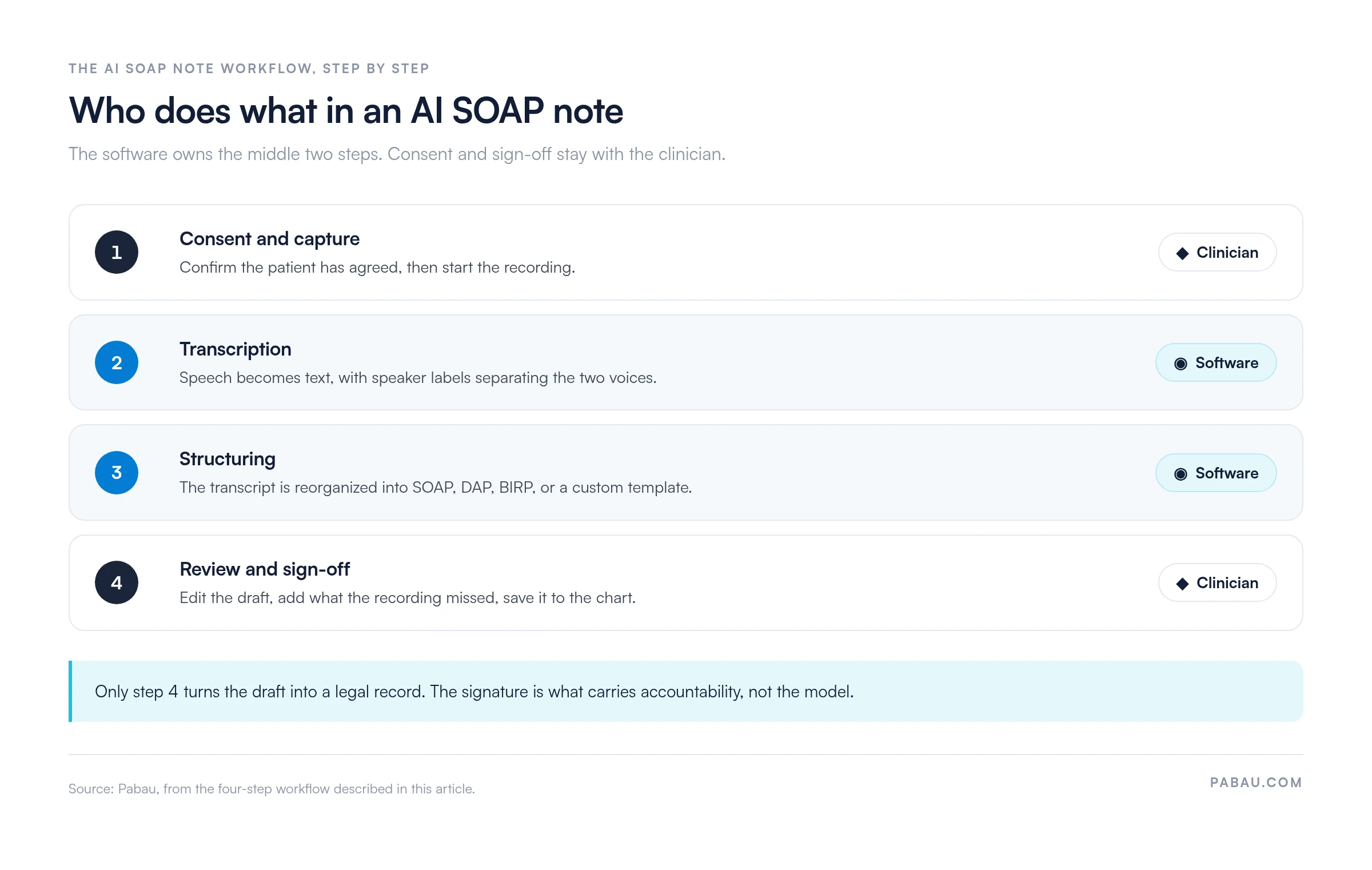
What changes between platforms is where each step happens. A standalone scribe sends the finished draft back as text the clinician then pastes into an electronic health record (EHR). A scribe built into a practice management system writes the note straight into the client record, attached to the right appointment.
The biggest benefit of AI SOAP notes is time back, because the note gets drafted during the appointment instead of typed up after hours. Three other benefits follow from the same recording.
Scribes change day-to-day work in ways that only show up once they’re in production. Our analysis of the benefits of AI scribes for physicians goes deeper on that.
Check five things in an AI SOAP note tool: specialty templates, EHR integration, a verification workflow, HIPAA and BAA coverage, and the pricing model. Those five decide whether the note is usable, in that order.
Lists of the best AI SOAP notes usually rank tools on transcription quality. That axis separates them least, because most engines now handle clinical speech well. What separates them is whether the note lands in your record, in your template, under compliance paperwork you can show an auditor.
| Criterion | Why it matters | What to check |
|---|---|---|
| Specialty templates | A therapy note is DAP or BIRP, and an aesthetic treatment record is neither. | Whether you can load your own template, not only pick from a fixed list. |
| EHR or PMS integration | Integration is the decision axis. A standalone overlay scribe hands back text. Built-in documentation writes into the platform you already use. | Whether the note saves itself against the right appointment, or you paste it in by hand. |
| Verification and accuracy | You sign the note, so you carry any error the model makes into the legal record. | Whether the draft sits beside the transcript, so you can confirm a line rather than guess. |
| HIPAA and BAA compliance | A vendor processing recorded consultations handles protected health information on your behalf. | A signed Business Associate Agreement, plus encryption in transit and at rest. |
| Pricing model | Per-seat pricing penalizes a growing team. Per-minute pricing penalizes long consultations. | What one month of your own visit volume costs, rather than the headline rate. |
Specialty settles the shortlist before price does. If a tool cannot produce the note format your specialty bills against, the rest of the comparison is moot.
Accurate AI SOAP notes come from four habits. Match the template to your specialty, start from a structure you trust, record in quiet conditions, and read every draft before you sign. Speech-to-text quality is rarely the limiting factor now.
The template point is worth making concrete. A fertility service can load its own consultation note template so the draft lands in the right fields. A chiropractic practice can do the same, so adjustments, spinal regions, and range-of-motion findings each land where the team expects them.
The sign-off check is a four-point read-through a clinician runs on every AI-drafted note before signing it. Reviewing “carefully” is not a procedure. These four points are.
On a routine follow-up the sign-off check takes under a minute. In the practices we onboard, review discipline tends to slip once the drafts start looking good. That is exactly when four fixed points earn their keep.
Recording a consultation is regulated. In the US that means HIPAA, and increasingly a state-level recording-consent rule on top. In the UK and EU it means the General Data Protection Regulation (GDPR), and specifically Article 9, which covers special-category health data.
Before turning recording on for live patients, five things are worth checking, whichever tool you use:
The HHS HIPAA Security Rule guidance is the baseline reference for US practices. A vendor who will not put the BAA and the encryption terms in writing has answered the question for you.
AI SOAP notes save the most time on routine encounters and the least on complex ones. A 15-minute follow-up where the clinician already knows the patient produces a clean draft with very little editing. A new-patient intake with comorbidities and a long medication list still needs careful review.
The practices that get the biggest return tend to share three traits:
The adjacent paperwork is where the savings compound. A scribe that only hands back note text leaves the summary, the referral, and the follow-up message on your desk. Documentation built into a wider platform can start all three from the same recording.
AI SOAP tools split along one decision axis: a standalone overlay scribe, or built-in documentation inside the platform you already use. That choice matters more than any single feature on a spec sheet.
A standalone overlay scribe bolts onto whatever EHR you already run. The scribe records the visit and hands back a draft as text, which you then paste into the chart yourself. That shape solves the documentation problem and leaves the rest of your software untouched.
Built-in documentation works differently. The note is generated in the same place the rest of the client record already lives, so no copy-paste step is waiting at the end. The platform also knows which appointment the note belongs to and what the patient was treated for last time.
The two shapes differ on where the note lands, and on how much of the visit they finish for you.
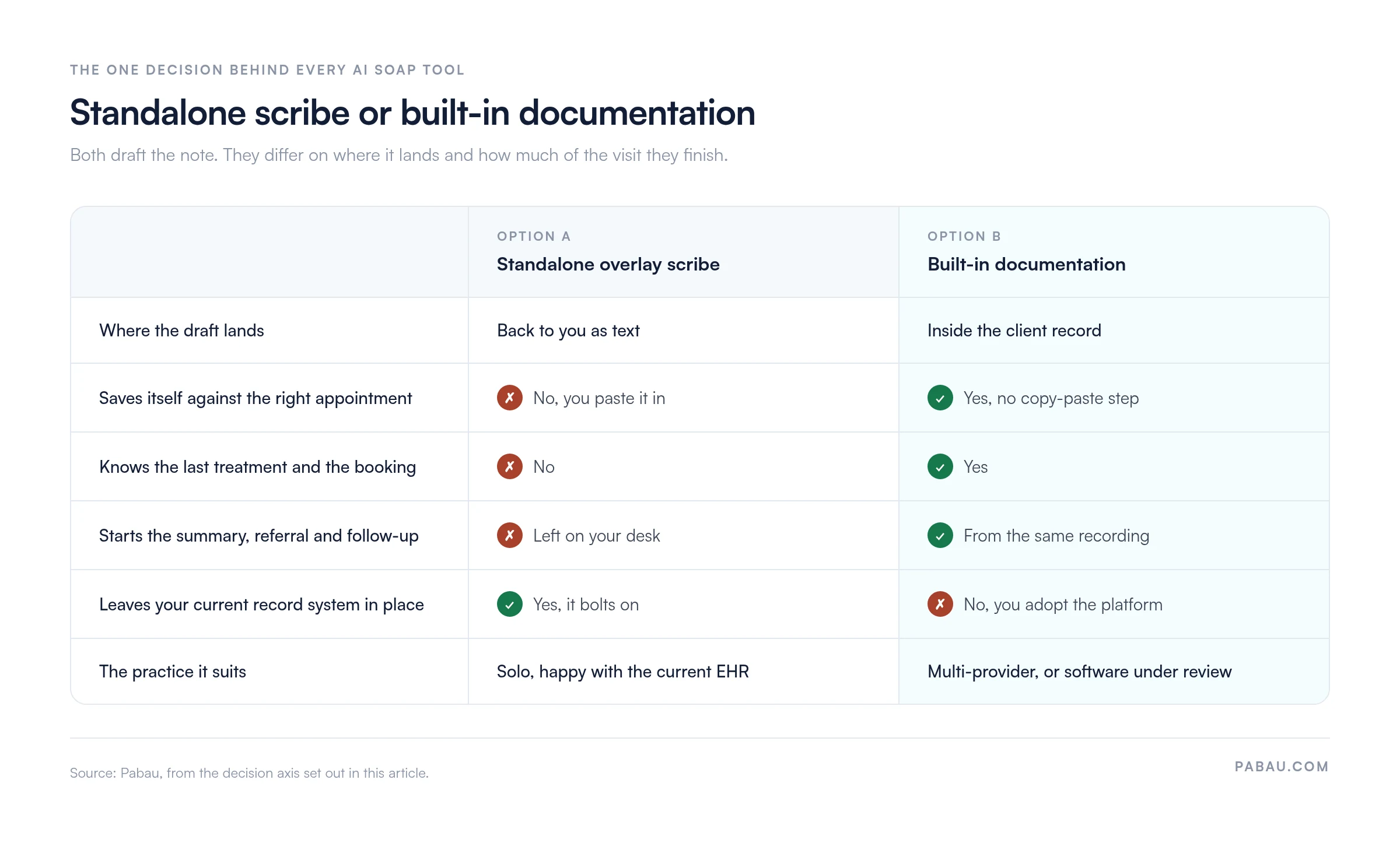
Which shape is right depends on where you are. If you’re happy with your current EHR and just want the note-writing solved, a standalone scribe is the quicker fix. If your scheduling, billing, or client-record software is also under review, built-in documentation saves you stitching two systems together later.
Either way you’ll be shortlisting. Our round-up of the best AI medical scribes compares the standalone tools. Our guide to AI clinical notes software covers what to test before you commit.
In most practices the note gets handled twice. It’s typed or dictated in one place, then copied into the chart in another. Matching it to the right appointment is a third job on top.
Pabau Scribe, our AI scribe, removes the second and third steps. The clinician starts a recording from the appointment screen. Pabau Scribe transcribes the consultation, drafts a SOAP note or a custom template the practice has defined, and writes it into the client record.
Because Pabau Scribe sits inside the wider platform, the same note can trigger a post-care message, a follow-up appointment suggestion, and an invoice. The clinician never switches tools to finish the visit. Pabau holds a 4.7/5 rating from over 550 Capterra reviews and 4.7/5 from around 314 G2 reviews.
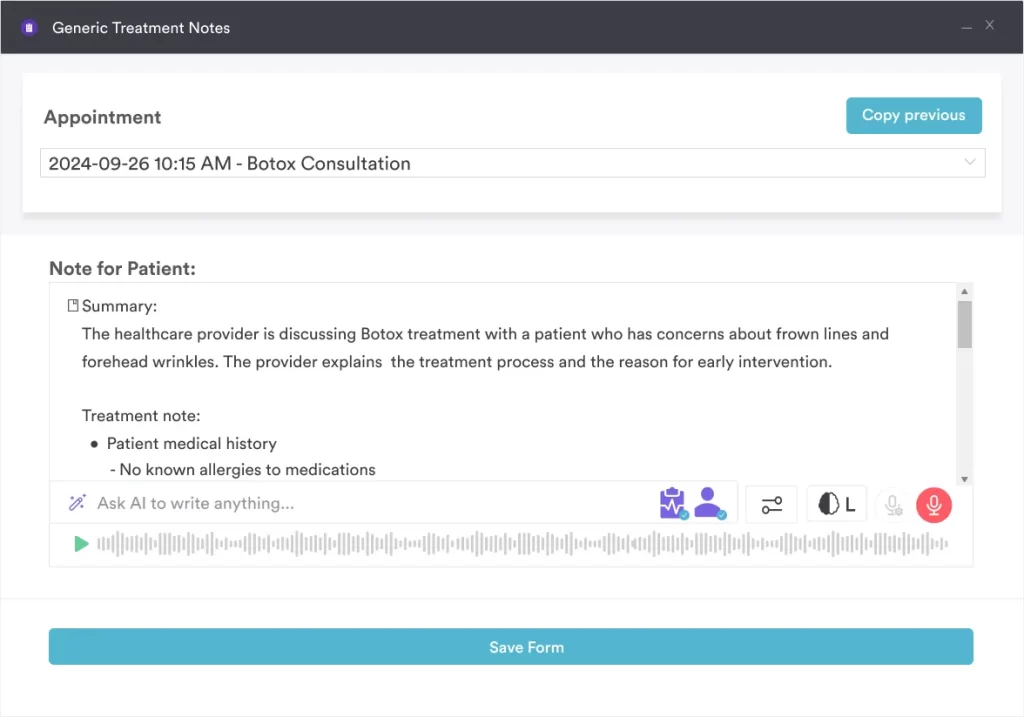

Pabau Scribe records the consultation, drafts the SOAP note to your own template, and writes it into the client record beside the appointment. The same note can trigger the post-care message, the follow-up booking, and the invoice, so you finish the visit in one place.

On routine visits the drafting already works well enough to trust. The question worth sitting with is whether your review habit is strong enough to catch the complex note the model gets wrong. The sign-off check, not the model, is what keeps the record defensible.
So trial it on your own consultations before rolling it out, and settle the consent and BAA questions before the first recording. Then decide which shape you want. A standalone scribe is the faster fix, and built-in documentation is the one you won’t have to unpick later.
Book a demo to watch Pabau Scribe draft a SOAP note straight into the client record. There is no copy-paste step waiting at the end of the visit.

Want AI to handle intake before the visit? AI patient intake collects and verifies patient details before the visit, so check-in becomes a confirmation and the record lands clean.
Want to keep patients engaged between visits? Automated patient engagement covers how automated reminders and follow-ups keep patients from drifting away between appointments.
Worried about compliance as AI tools spread? AI in healthcare compliance covers what practice owners need to know as AI reaches documentation, billing, and scheduling.
Wondering how AI reshapes charting more broadly? AI clinical documentation looks at the wider record, from intake forms to discharge summaries, not just the consultation note.
Yes, as long as a licensed clinician reviews the note, edits it where needed, and signs it before it is finalized. The AI draft is a working document. The clinician’s sign-off is what turns it into a legal record. Most US payers and regulators apply the same standard they use for dictation. The human is accountable for the content, not the tool that produced it.
Yes, patient consent is required before recording a consultation for AI documentation. In the US this is governed by HIPAA plus state recording-consent laws, which are one-party or two-party depending on the state. In the EU and UK it falls under GDPR Article 9 for special-category health data. Most tools publish a sample consent script you can adapt into your practice’s intake form.
On routine encounters they are accurate enough that clinicians make minor edits rather than rewrites. Accuracy still drops on complex cases, heavy medication lists, and patients with strong accents or background noise. Reviewing every draft remains mandatory. The time saved comes from editing instead of writing from scratch.
ChatGPT can format a SOAP-style note from text you paste in, but the consumer version is not built for patient records. The free and Plus tiers come with no Business Associate Agreement, so pasting identifiable patient detail into the chat window creates a HIPAA problem. ChatGPT also cannot listen to a consultation or write into a chart. A purpose-built clinical scribe does both.
Free AI note generators suit study notes and practice drafts, not patient records. Most publish no Business Associate Agreement, keep no audit trail, and do not connect to your chart, so every note is a manual copy-paste. Free tiers also cap how many notes you can produce and may reuse your input for training. For live patients, a paid clinical tool with a signed BAA is the safer choice.
Yes, they work across aesthetic medicine, physical therapy, chiropractic, dental, and most outpatient specialties. The platform has to support the note format and template your specialty uses. Specialty fit matters more than the underlying model. A scribe tuned on therapy sessions writes weaker notes for an injection-heavy aesthetic practice than one with aesthetic templates built in.