Anja Dodevska
Head to toe assessment cheat sheet: Printable nursing guide
A head to toe assessment cheat sheet gives you one fixed order at the bedside, s...

5
Last Updated: Oct 23, 2026
Free PDF 3 pages, print-ready Clinician-reviewed
An infant reflexes chart is a one-page clinical reference that lists the seven primitive reflexes present at birth. Each row gives the stimulus, the expected response, and the ages the reflex should appear and integrate. A final column names the findings that warrant referral.
Primitive reflexes are automatic movements controlled by the brainstem, and their presence is a sign of normal neurological development. According to the American Academy of Pediatrics (AAP), they are present at birth and fade as the cerebral cortex matures and voluntary movement develops.
Knowing when each reflex should appear, and when it should integrate, is what separates normal variation from a referral. Most published reflex charts stop at that timeline. This one carries two more columns. One gives you wording for the record, and the other names the patterns that send an infant to neurology.
A one-page chart covering all seven primitive reflexes, with the stimulus, expected response, age present, age of integration, and red flags for each. Print it for the exam room, or attach it to your newborn assessment form.
Upload this PDF, or any form you already use, and Pabau's AI Form rebuilds it with tick boxes, text fields and a signature. Attach it to the treatment once, and every patient gets it on time.
AI Form rebuilds the consent, history and aftercare forms you already use. You review each one, then publish.
Patients complete forms on their phone before they arrive, so the front desk stops retyping paper.
Every signed form is versioned and attached to the treatment record, ready when you need it.
Set how long a consent stays valid. Returning patients skip forms they have already signed.
Supports HIPAA and GDPR compliance AES-256 encryption 4.8 on G2 4.7 on Capterra Trusted by 4,000+ practices worldwide

An infant reflexes chart records seven primitive reflexes, how to elicit each one, the expected response, and the age it should integrate.
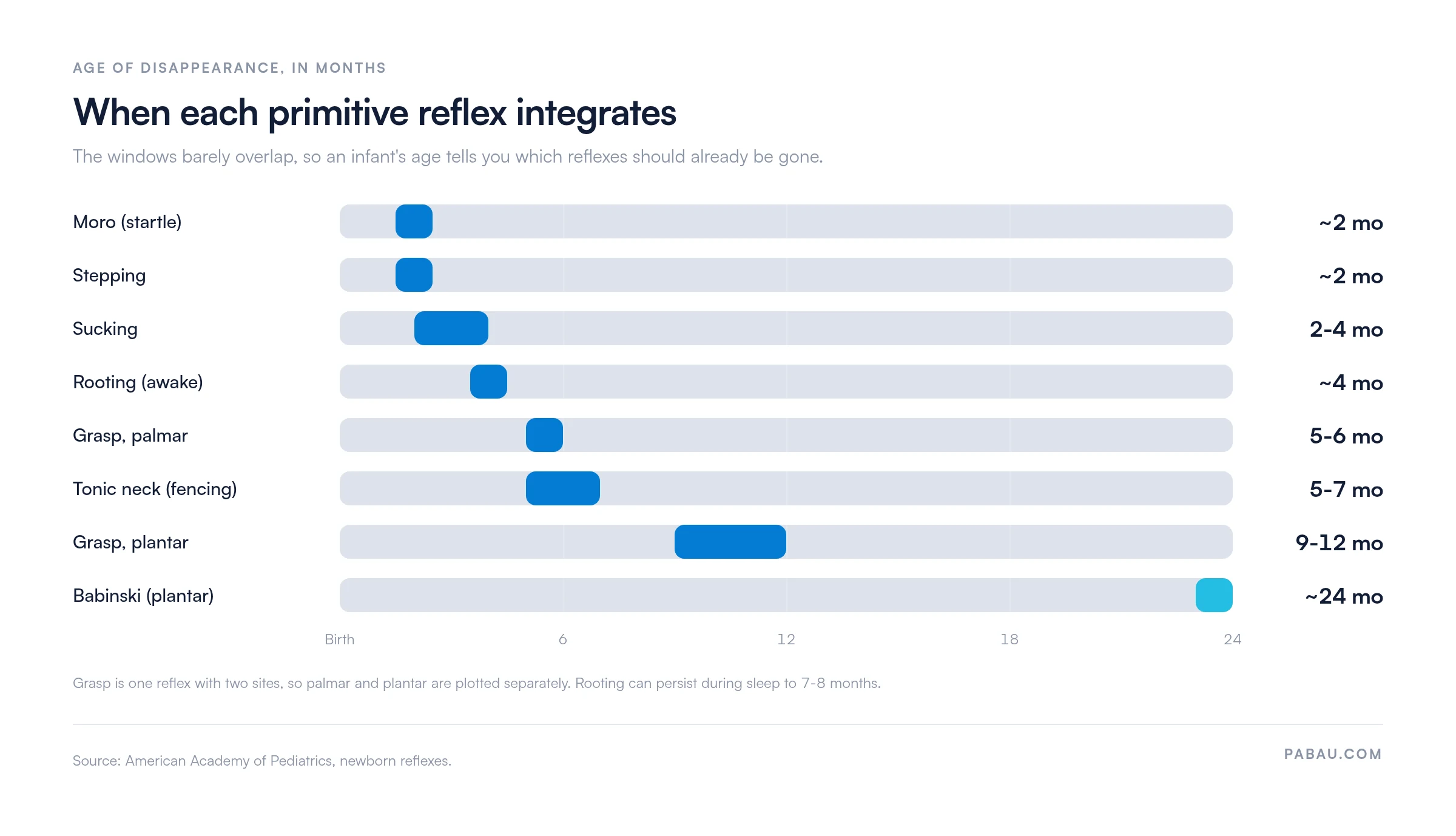
Integration ages run from about 2 months for the Moro reflex to around 2 years for the Babinski reflex.
Absent, asymmetric, or persistently hyperactive reflexes belong in the record and often warrant neurological referral.
A reflex that persists past its integration age is called a retained reflex and may signal delayed neurological maturation.
Digital forms let you capture reflex findings at the cot side and flag an abnormal result for follow-up.
An infant reflexes chart is a standardized table that lists the seven core primitive reflexes checked during a newborn or infant examination. Each row covers a single reflex and records:

Primitive reflexes originate in the brainstem and serve a protective function in newborns. They are present at birth and integrate as the developing brain takes over voluntary control of movement. A newborn cannot choose to perform one, and that automatic quality is what makes reflex testing a reliable indicator of neurological health.
Every standard reflex chart covers these seven, which appear consistently across pediatric assessment guidelines and clinical practice standards.
The integration ages matter more than the order of the list. Plotted on a single axis, they show how little the windows actually overlap.
Recording the exam in a medical records management system standardizes how you test, document, and follow up. The workflow runs in five steps.

Step 1: Prepare the infant and the room. Make sure the infant is calm, warm, and on a safe surface with room to move. A distressed or cold infant can show diminished or absent reflexes, which creates false red flags.
Step 2: Test each reflex in sequence. Work down the chart row by row, using the exact stimulus listed for each reflex. Note the response as symmetric or asymmetric, present or absent, weak or strong.
Step 3: Record the finding against the expected response. For each reflex, mark the response normal, absent, delayed, asymmetric, or exaggerated. An asymmetric finding, such as a Moro present on the right but weak on the left, always warrants further evaluation.
Step 4: Check the finding against the infant’s age. Cross-reference chronological age with the chart’s age-of-integration column. A reflex that is still hyperactive or present past that age may point to delayed neurological maturation, and often to an occupational therapy referral.
Step 5: Flag abnormal findings and plan the follow-up. Any absent, asymmetric, or persistently hyperactive reflex needs a clear note and a stated next step. That step is a same-visit repeat exam, a recheck at the next visit, or an immediate referral to neurology or developmental pediatrics. A medical referral form keeps the handover consistent once the finding leaves your room.
Most newborns and young infants have normal reflex responses. A handful of patterns, though, warrant careful attention and possible referral.
Reflex assessment is one of the most sensitive tools available for finding neurological problems early. A systematic approach using a reflex chart does three things for the exam.
Reflex testing is one part of the wider newborn neurological exam. A neuro exam cheat sheet covers the cranial nerve and motor checks that sit alongside it.
Structured reflex assessment also supports continuity of care. When the findings are recorded in the same format every time, a colleague can read the exam at a glance. They see what was tested, what was found, and what you concluded, which reduces misinterpretation at handover.
In most children, primitive reflexes integrate on schedule. Some infants show retained primitive reflexes, which persist or re-emerge beyond the expected integration age.
This appears in children with cerebral palsy, developmental delay, autism spectrum disorder, and ADHD. The evidence linking retained reflexes to learning and behavior difficulties is still developing. Treat a retained reflex as a prompt to assess rather than a diagnosis.
When a reflex persists abnormally, occupational therapists and developmental pediatricians may recommend integrated movement programs or neurodevelopmental therapy. The chart therefore earns its place beyond newborn screening. It tracks reflex status through the first years of life and identifies candidates for early intervention.
Clear documentation protects you clinically and supports patient safety. Record each of the following.
Capturing these fields on digital intake forms cuts transcription errors. It also lets you flag an abnormal result for follow-up as you type it.
Any clinician who assesses newborns or infants should know the reflex chart. That includes obstetricians, midwives, pediatricians, family medicine doctors, nurse practitioners, and registered nurses in birthing centers or pediatric practices. Occupational therapists and physical therapists use it too.
Practitioners who never run the full exam still need to tell a normal response from an abnormal one. That way a concern reaches the right colleague quickly.
In most practices the reflex chart lives on paper. A clinician ticks a printed grid, writes a line in the notes, and the finding sits inside one visit’s record. Comparing this month’s exam with the last one means pulling both files.
Practice management software like Pabau turns the chart into a structured form instead. Each reflex becomes its own field, so the response is picked rather than written out. The finding saves straight into the client record, and every past assessment sits on the same timeline.
Because the fields are structured, an abnormal answer can trigger the next action on its own. Pabau’s automated workflows book the recheck, send the parent a reminder, or queue the referral letter. Your record then shows the finding and what you did about it.

Pabau turns your reflex chart into structured form fields, stores each assessment on the client’s timeline, and flags abnormal findings for follow-up. Your team records the exam once and the referral trail builds itself.

The value of a reflex chart is consistency. Two clinicians testing the same infant a month apart should produce notes that compare line for line. A shared chart is what makes that possible.
Download the chart, adapt the wording to your practice, and use it at every infant assessment from birth onward. The exam itself will not get much faster. What changes is the record, which another clinician can act on without calling you first.
Book a demo to see how Pabau keeps reflex findings, follow-ups, and referrals in one client record.

Running the wider neurological exam? Neuro checks nursing assessment sets out the observations that sit alongside reflex testing at the bedside.
Need the cranial nerve component? Cranial nerve nursing assessment walks through all twelve nerves and what an abnormal response means.
Recording the rest of the newborn check? Vital signs record gives you a structured sheet for temperature, pulse, respiration, and blood pressure.
Tracking findings across visits? Clinical progress notes show how to write each visit so the next clinician can follow the thread.
An absent reflex is not present at all, even with the right stimulus and a calm infant. A weak reflex is present but less pronounced than expected. Both belong in the record. Weakness in a single reflex may resolve on repeat testing in a calmer room. Absence warrants further assessment.
Most primitive reflexes have disappeared by 6-12 months, and after age 2 they are no longer assessed as part of routine development. Where you suspect developmental delay or a neurological abnormality, testing can continue beyond infancy to check for retained reflexes.
No. A positive Babinski, where the toes fan out when you stroke the sole, is normal in infants up to about age 2. In adults, a positive Babinski indicates upper motor neuron disease. The distinction matters, so never alarm a parent about a newborn’s normal positive Babinski.
Asymmetric reflexes suggest a problem on one side of the nervous system. Causes include brachial plexus injury, localized nerve damage, fractures, and central nervous system injury. Any asymmetry warrants careful documentation and referral for further neurological evaluation.
The standard chart applies to children from birth through about 2 years of age. For older children with suspected developmental delay or a neurological condition, specialized assessments are more appropriate. Examples include the Beery VMI, the Alberta Infant Motor Scale, and formal neurodevelopmental testing.