Nitrates medication list
A nitrates medication list is a point-of-care reference that sets out the main c...

Last Updated: Oct 6, 2026
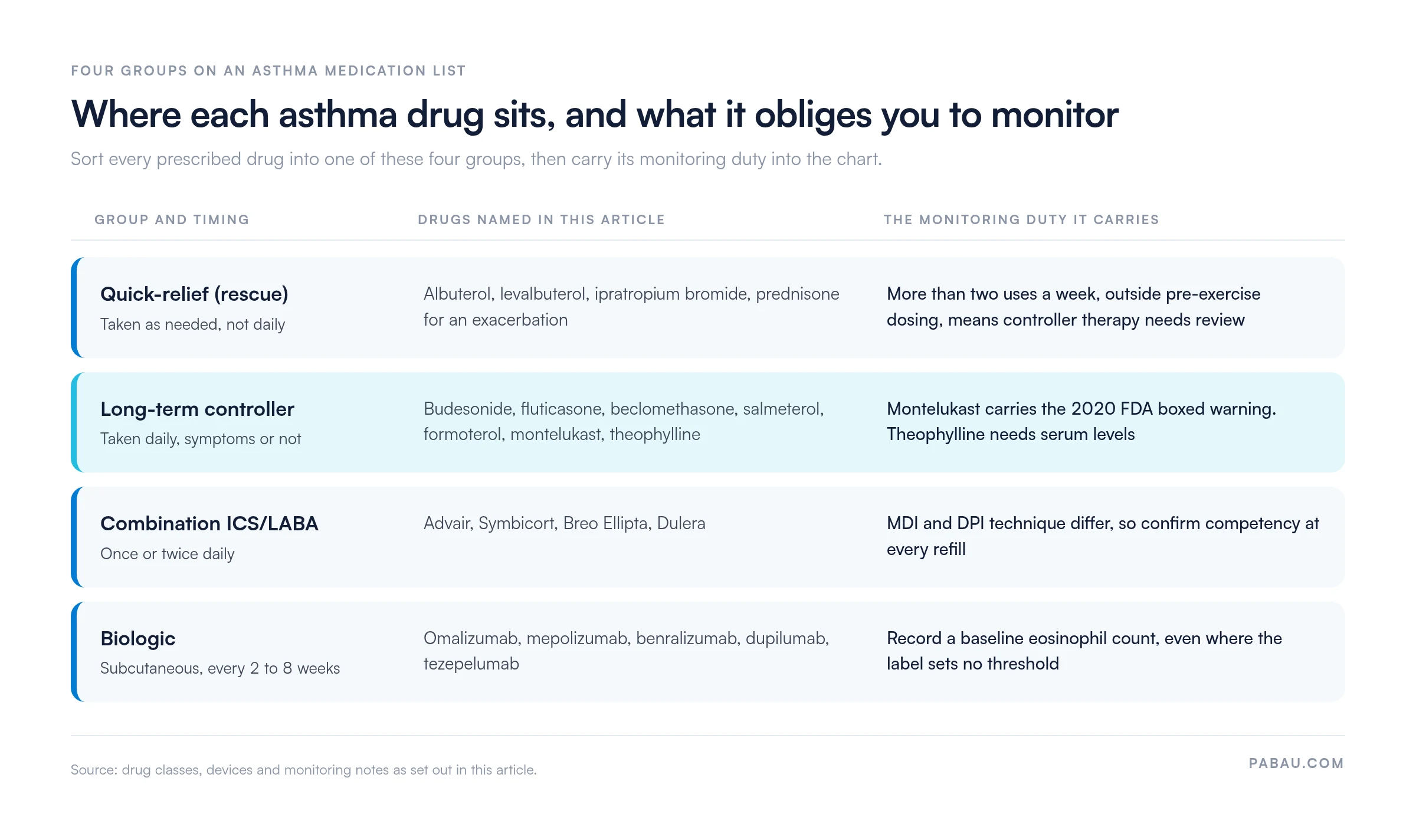
An asthma medication list records every asthma medication a patient takes, grouped by what each drug does. The four groups are quick-relief inhalers, long-term controllers, combination inhalers, and biologics for severe disease.
This page sets out each group in full, with generic and brand names, device types, typical dosing, and the monitoring each class needs. It also shows which fields to capture when you build the list inside your prescription management workflow.
The free download below is a visit preparation checklist, not a medication tracker. It carries identification fields, four check-box sections for the items and paperwork to gather before an asthma appointment, and a blank notes page. Every row is blank, so the clinical detail stays here on the page and in the patient chart.
A blank two-page printable for the run-up to an asthma appointment. Fill in the name, date of birth, and record number, then check off each item, document, and device as it is gathered. The rows are blank, so you write in every entry yourself. The form has no drug name, strength, route, frequency, or monitoring fields.
Download checklist
An asthma medication list groups every prescribed drug by function: quick-relief, controller, combination inhaler, or biologic.
Quick-relief inhalers such as albuterol treat acute symptoms, while daily controllers such as inhaled corticosteroids prevent them.
Combination inhalers pair an inhaled corticosteroid with a long-acting beta-agonist, and biologics target immune pathways in severe asthma.
The free download is a visit preparation checklist with identification fields, check-box rows, and a notes page.
That checklist holds no drug name, strength, route, frequency, device, or monitoring fields, so record those in your clinical system.
Practice management software like Pabau keeps the medication record itself structured, searchable, and ready for audit.
An asthma medication list is a clinical record of every asthma medication a patient takes. It is organized by function, separating rescue therapy from daily control, and it names each drug, its strength, route, frequency, device, and monitoring requirements. Clinicians and care coordinators complete and update it during consultations and medication reviews.
A clinician-facing list goes further than a patient medication card. It records dosing precision, interactions, refill dates, and safety notes such as the montelukast black box warning for neuropsychiatric events. That makes it a safety checkpoint against duplicate therapy, and it keeps what was prescribed aligned with what the chart says.
Audit readiness depends on the same discipline. HIPAA and, where it applies, GDPR require medication records to be accurate, current, and retrievable on request. A standard format for the list supports both patient safety and day-to-day compliance.
The PDF is a preparation checklist rather than a clinical medication record, so it is worth knowing exactly what you get. Page one opens with identification fields: name, date of birth, record or MRN number, who prepared the form, and the date completed. Below those sit four check-box sections.
Each row in those sections carries four columns: item, quantity, who is bringing it, and a confirmed check box. Page two is a blank notes page. There are no preset drug names, strengths, routes, frequencies, device types, or monitoring fields anywhere in the form.
That makes the checklist useful for the practical side of an asthma visit. A patient can write down the inhalers and devices to bring, note who is carrying each one, and check each one off before leaving home.
The prescribing detail belongs in the chart, using the fields described further down this page. For a form that does carry drug rows, the medication log template records name, dose, route, and time for every entry.
Rescue medications open the airways quickly during acute symptoms or an exacerbation. They are taken as needed rather than on a daily schedule.
Albuterol and levalbuterol are the first-line rescue therapies and work within minutes. Ipratropium is not FDA-approved for asthma, so its use alongside a SABA in acute care is off-label and should be documented as such. Oral corticosteroids are reserved for exacerbations and prescribed as a short burst to settle airway inflammation.
Rescue use is also a control signal. A patient reaching for a rescue inhaler more than twice a week, outside pre-exercise dosing, needs controller therapy reviewed before symptoms escalate.
Controller medications are taken daily whether or not symptoms are present. They suppress airway inflammation and reduce how often exacerbations happen, which makes them the foundation of persistent asthma care.
Inhaled corticosteroids do the heavy lifting in maintenance therapy because they act on inflammation at the site of disease. LABAs extend bronchodilation, but on their own they carry a boxed warning in asthma, so they belong in a combination product.
Leukotriene modifiers need a conversation before the first dose: document baseline mental health status and tell the patient and caregiver what to report.
A combination inhaler puts an ICS and a LABA in one device. That simplifies the regimen, protects adherence, and guarantees anti-inflammatory cover alongside long-acting bronchodilation.
Once-daily dosing with Breo Ellipta helps patients who struggle with a twice-daily routine. Technique differs between an MDI and a DPI, so confirm competency at each refill rather than assuming it carried over.
Budesonide and formoterol also underpin maintenance and reliever therapy, where one inhaler covers both daily control and symptom relief. When a patient is on that regimen, record it plainly, because a separate SABA is usually not prescribed alongside it.
Biologic monoclonal antibodies block specific immune pathways in severe, refractory asthma. They are reserved for patients who stay uncontrolled on high-dose ICS and LABA therapy.
Tezepelumab and dupilumab stand out because neither label sets an eosinophil count to clear, which widens the eligible population. Record a baseline eosinophil count before starting any biologic, even where no threshold applies. These therapies also generate refill prompts and adverse-event notes, so log each one against the patient rather than in a separate file.
That covers all four groups. The grid below sets them side by side, with the timing and the monitoring duty attached to each.
Device type changes how much drug reaches the lungs and how likely a patient is to keep using it. Knowing the mechanics of each one makes counseling and troubleshooting faster.
Match the device to the patient’s age, dexterity, and clinical picture rather than to habit. Record the device and what you observed about technique, so the next clinician knows whether training is due.
Building the list follows the same five steps as any medication review, whether you keep it on paper or in your practice management system.
Whatever the format, the same fields have to be present for the list to be safe to act on.
Tie those fields to automated refill reminders, and patients get their prompts on time. Staff get an alert when monitoring labs slip past their due date.

Pharmacists and clinical pharmacy teams: a structured list makes medication therapy management workable, cuts errors, and supports pharmacy-led asthma counseling in community and hospital settings.
Primary care and respiratory practices: physicians and pulmonologists use the list to coordinate care across visits. It also tracks adherence and catches interactions or duplicate therapy.
Care coordinators and nursing staff: anyone handling refill requests and follow-up calls can see every active medication and its monitoring status in one place.
Patients with complex or severe asthma: an annotated list helps a patient understand the regimen. It also supports a clearer conversation with a physician, pulmonologist, or allergist.
Safer prescribing: one agreed format cuts charting errors and prevents duplicate therapy, because every team member reads the record the same way. Records held under HIPAA-compliant access controls stay protected and still reachable for an audit.
Faster reviews and refills: reconciliation during a visit takes minutes instead of a search through old letters, which lifts administrative load off clinical staff.
Better medication therapy management: pharmacists and clinicians can spot a missing ICS behind a LABA, an overdue theophylline level, or an interaction. Each one can then be handled before harm follows.
Defensible documentation: a complete, dated list demonstrates compliance during HIPAA and state board audits, and it stands up if an adverse event is later reviewed.
A patient who can check the record: patients who can read the regimen themselves confirm it and raise questions before the appointment starts. That saves the first five minutes of the consultation.
Set a quarterly medication review date for every asthma patient. On that date, reconcile the list against the active prescriptions in your pharmacy system, refresh monitoring status, and recheck device technique. Log the review in the chart so the audit trail builds itself.
The asthma medication list often lives in three places at once. A patient writes part of it on a paper intake sheet. A nurse retypes another part into the chart. The pharmacy holds the version that is current. Reconciling those at the next visit eats clinical time and still misses changes.
Pabau, our practice management software, keeps one record instead. Patients complete digital intake forms before they arrive, and their answers write straight into the chart.
Prescription management holds each drug with its strength, route, frequency, and review date, so a LABA without an ICS is visible rather than buried. Automated reminders chase refills and monitoring labs. Every edit is stamped with a name and a time for audit.
The result is a medication list your team can trust at the point of care. Nobody retypes a paper sheet, and nobody hunts for the current dose. The chart is ready whenever an auditor or a specialist asks for it.

See how Pabau’s digital intake forms, prescription management, and automated reminders keep asthma medication records accurate, current, and ready for audit.

An asthma medication list is only useful when it is complete and current. Group the drugs by function, record device and dose beside each one, and set review dates.
That turns a scattered history into a record the whole team can act on. The class tables above give you the reference; your practice management system gives you somewhere to keep it.
Use the free checklist for the practical side of the appointment, so inhalers, devices, and paperwork all arrive with the patient. Then hold the prescribing detail where it belongs, in the chart. Book a demo to see how Pabau keeps asthma medication records accurate from intake to refill.

Need a form that records each dose? Medication log template gives you dated rows for the drug, the dose, the route, and the person who administered it.
Planning when each inhaler is taken? Medication schedule template lays the day out by time slot, so controller and rescue doses never collide.
Documenting care for a chronic airway condition? COPD nursing care plan shows how assessment, goals, and interventions fit together on one page.
A rescue inhaler such as albuterol opens the airways within minutes, and it is taken only when symptoms appear. A controller inhaler such as an inhaled corticosteroid is taken every day to calm inflammation and prevent symptoms. Controllers are the foundation of maintenance therapy, and rescue inhalers cover the acute moments.
Biologics are considered when severe asthma stays uncontrolled on high-dose inhaled corticosteroid and long-acting beta-agonist therapy. Mepolizumab and benralizumab target an eosinophilic phenotype. Dupilumab and tezepelumab set no eosinophil threshold in their labels. A pulmonologist or allergist confirms eligibility before treatment starts.
Yes. Primatene Mist, an epinephrine inhalation aerosol, is the only FDA-approved over-the-counter rescue inhaler for mild intermittent asthma from age 12. Prescription inhalers such as albuterol remain the preferred option for both efficacy and safety monitoring. Anyone relying on the over-the-counter version needs a prescription review and probably controller therapy.
The FDA added a boxed warning to montelukast in March 2020 for serious neuropsychiatric effects, including agitation, mood change, and suicidal thoughts. Record baseline mental health status before the first dose. Ask the patient and caregiver to report any behavioral change right away, and consider an alternative where risk factors exist.
Update it at every visit and every time a medication changes. A quarterly review at minimum keeps the list matched to active prescriptions, catches missed refills, and captures new side effects or dose changes. Record the review date and the reviewer so the audit trail stays intact.
No. The download is a visit preparation checklist rather than a medication tracker. It gives you identification fields, four check-box sections with columns for item, quantity, who is bringing it, and confirmed, plus a blank notes page. Drug names, strengths, routes, frequencies, and monitoring notes belong in your clinical system instead.