Questions about gender roles
Questions about gender roles are structured prompts that help clinicians, counse...

1
Last Updated: Oct 20, 2026
Rebuilding trust in a relationship worksheets are structured exercises that guide both partners through repairing trust after betrayal or a long breakdown. Therapists assign them between sessions to give couples a shared, concrete framework. Couples use them to turn difficult conversations into deliberate progress.
Trust repair is slow, and it rarely follows a straight line. The worksheets split that work into five areas: honest communication, accountability, forgiveness, boundaries, and trust-building exercises. Each area gives both partners prompts to answer in writing before they discuss them together.
A five-part worksheet set for couples and the therapists who work with them. It covers honest communication prompts, separate accountability prompts for each partner, forgiveness reflections, boundary-setting pages, and trust-building exercises.
Download template
Rebuilding trust in a relationship worksheets give couples a structured, written path through trust repair.
Five worksheet areas cover communication, accountability, forgiveness, boundaries and trust-building exercises.
Each partner answers privately in writing first, then the couple compares answers and agrees on one or two small commitments.
Research on couples therapy supports the view that trust can be rebuilt with consistent effort over time.
Therapists can keep session notes and completed worksheets in one patient record inside Pabau, the practice software we build.
Yes, trust can be rebuilt after it has been broken, although the process takes sustained effort from both partners. Research from the Gottman Institute and the wider couples therapy literature supports this view. The strongest outcomes come from consistent behavior over many months, rather than from a single conversation.
Repair depends on three conditions holding at once. The partner who broke trust takes clear responsibility, the hurt partner has space to express the impact, and both partners follow through on small commitments.
That long-term work sits alongside the smaller repair attempts couples make in the middle of an argument. Our Gottman repair checklist breaks those attempts down by category.
The worksheet set moves through five areas in a sequence that suits most therapy plans. Each section works on its own, but the order builds from open communication toward practical trust-building.
The sequence also changes who holds the pen. Most worksheets ask both partners to write, while forgiveness belongs to the hurt partner alone, as the overview below shows.
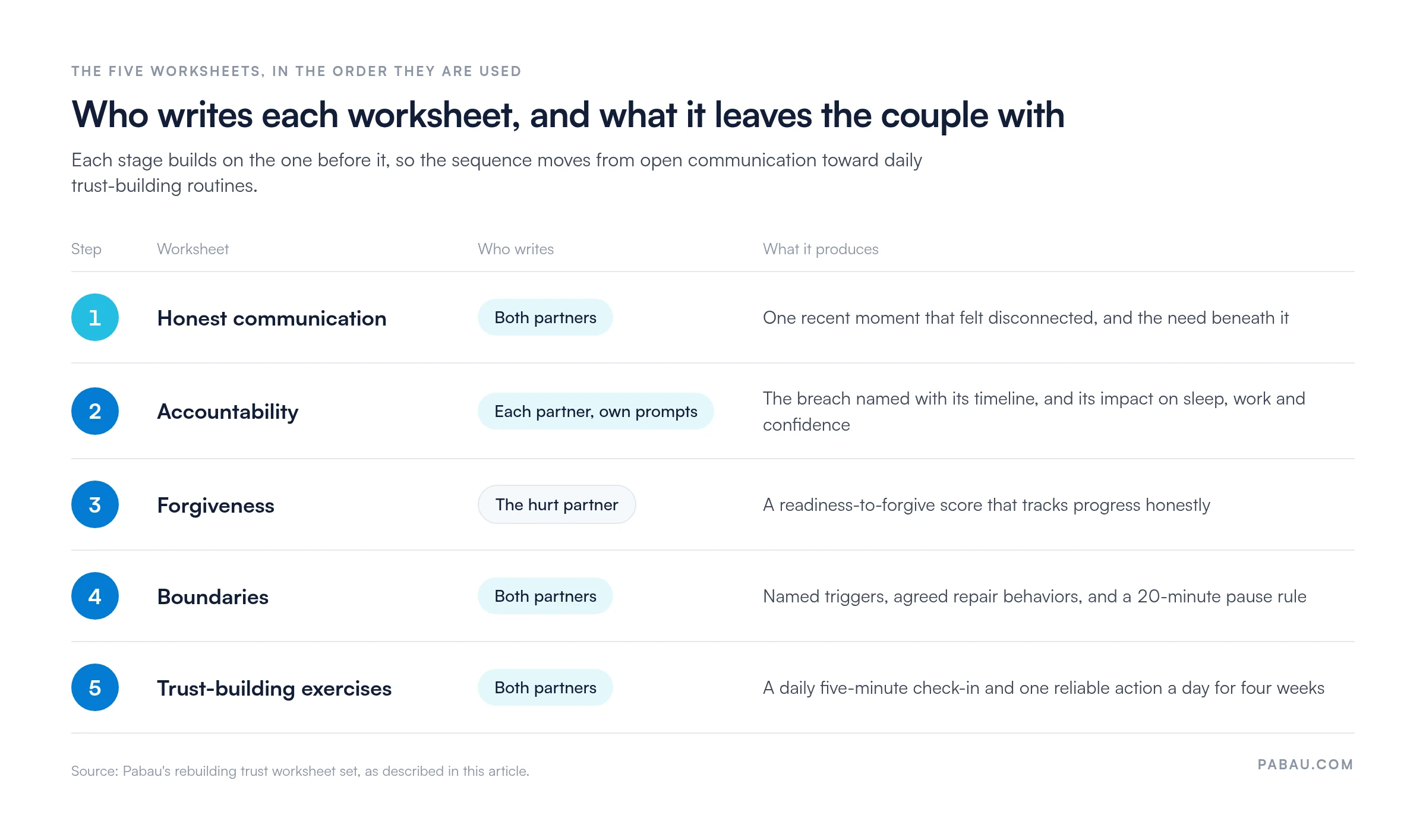
Therapists can use the worksheets in session or assign them as homework, and couples can work through them independently. The PDF is designed for printing, so each partner can complete their own copy before comparing answers.
This worksheet gives both partners structured prompts for expressing feelings, needs and concerns. It is often the first worksheet to use, because it creates the safe space the later exercises depend on.
Prompts ask each partner to describe one recent moment that felt disconnected, then to name the need underneath it. Therapists often find that writing answers first reduces the pressure to respond immediately. A separate couple communication worksheet gives couples more practice before they move on.
Repairing trust starts when the partner who broke it can describe the impact without defensiveness. This worksheet has two sets of prompts, one for each partner.
Clinicians often find that accountability stalls when the responsible partner explains the reasons for the behavior. The prompts keep the focus on the impact and the repair actions.
Forgiveness is distinct from condoning the harmful behavior. The reflection prompts help the hurt partner separate the two, and they include a readiness-to-forgive scale to track progress honestly. A radical forgiveness worksheet takes that reflection further for partners who want it.
Attachment style can shape how quickly a partner feels safe again. Attachment theory offers a useful framework here, although it is not a clinical diagnosis, and the worksheet treats it as a prompt for reflection. An attachment theory worksheet lets each partner explore their own style in more depth.
Conflict resolution strategies in relationships work best when couples agree on the rules before a flare-up. This worksheet asks partners to identify triggers, agree on repair behaviors, and set boundaries that protect the rebuilding work. A standalone conflict resolution worksheet covers disagreements beyond trust repair.
A boundary is a limit on behavior that both partners agree on in advance. One clear example lets either partner pause a heated discussion for 20 minutes, then return to it. Our relationship boundaries checklist lists more examples couples can adapt.
Trust-building exercises for couples turn repair into routine. The worksheet includes short in-session and at-home activities that build predictability, emotional safety and vulnerability over time.
One common exercise is a daily five-minute check-in, where each partner shares one moment that went well and one that felt difficult. Another is a predictability commitment, where each partner agrees to one reliable action per day for four weeks.
Rebuilding trust after infidelity usually needs more time and more structure than other breaches. The worksheets can support that work, but they do not replace individual or couples therapy with a licensed clinician.
Many couples therapists keep printed worksheets, scanned copies and session notes in separate places. By the third session, finding last month’s accountability answers can mean digging through a shared drive.
Pabau, our software built for therapists, keeps those pieces in one place. Completed worksheets sit in Client records alongside each patient’s intake forms and session notes.
Each session can then start from the couple’s own written answers, with last week’s commitments already on screen. Pabau’s compliance tools support workflows aligned with HIPAA requirements, although practices should confirm their own obligations with their legal and data protection advisers.

Pabau gives therapists one patient record for intake, session notes and completed worksheets, so the rebuilding work stays organized between sessions.

Start with the worksheet that matches where the couple is now. A couple still arguing about what happened needs accountability prompts before any talk of forgiveness.
Progress shows up in small, repeated actions, so judge the work over weeks of check-ins. Expect setbacks after infidelity, and bring in a licensed clinician when safety or ongoing deception is part of the picture.
For therapists, the written answers are also the record of the repair, so keep them where the next session can use them. Book a demo to see how Pabau keeps couples’ worksheets, intake forms and session notes in one patient record.

Want a longer program for the couple? Couples therapy workbook gives couples a fuller set of exercises to work through with their therapist.
Need a regular ritual once trust is returning? Relationship check-in template gives couples 30 questions for a recurring conversation.
Looking for an appreciation exercise? Appreciating your partner ACT worksheet helps each partner notice and name what the other does well.
Want the couple’s commitments in writing? Relationship contract turns agreed expectations into a written agreement both partners keep.
Planning sessions with married couples? Marriage counseling questions offers question sets and a 12-week plan for therapists.
A rebuilding trust in a relationship worksheet is a structured set of written prompts for couples. It guides both partners through communication, accountability, forgiveness, boundaries and trust-building exercises.
The timeline varies widely, and most couples need several months of consistent effort. Progress depends on the severity of the breach and on how reliably both partners follow through.
Couples can use the worksheets independently, but a licensed therapist can help if the breach involves infidelity, safety concerns, or ongoing deception.