Mental health self-care checklist
A mental health self-care checklist is a structured daily tool for tracking the ...

Last Updated: Oct 20, 2026
A relationship contract template is a fill-in agreement two partners use to write down how they’ll handle exclusivity, money, living arrangements, and respect. It isn’t legally binding the way a prenuptial agreement is. Its value comes from the conversation it forces and the written record it leaves behind.
Our free template takes a couple through 10 sections, from the parties and exclusivity terms to termination and signatures. Couples can fill it in at home, and therapists can run it as a structured exercise in session.
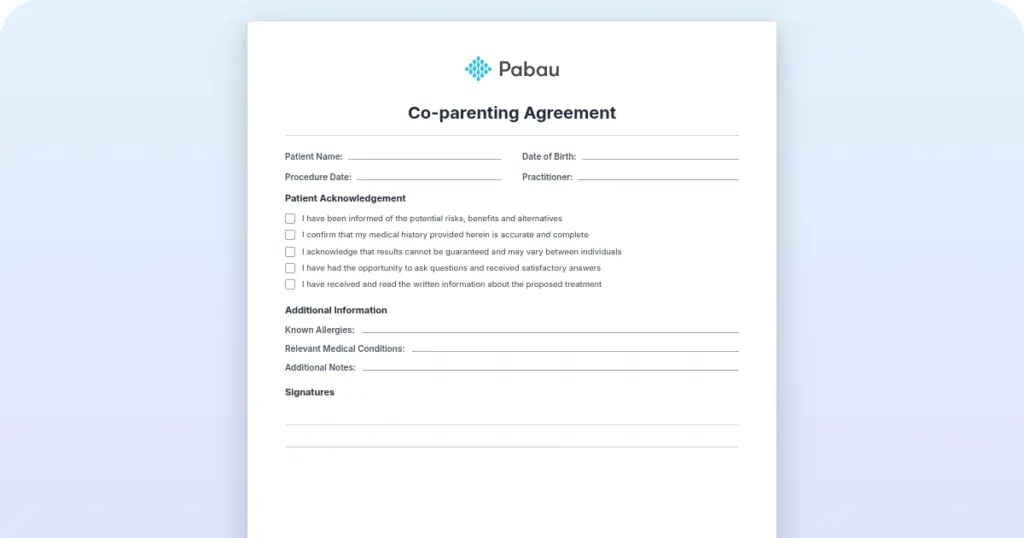
A 10-section agreement with tick-box choices for exclusivity, living arrangements, income, and bank accounts. It also leaves space for personal needs, mutual respect, termination terms, and both partners’ signatures.
Download template
A relationship contract is a written, non-binding agreement that records a couple’s expectations, boundaries, and shared commitments.
Courts generally won’t enforce clauses about intimacy, emotional support, or conflict, but financial and property clauses may have legal standing depending on the state.
Pabau’s free template covers 10 sections, including exclusivity, income, bank accounts, personal needs, and how the agreement ends.
Communication, intimacy, and review clauses go in the template’s free-text sections, so write them in your own words.
Writing the contract together works best in one calm, dedicated session, with a review date agreed before you sign.
A relationship contract is a document two people write together to spell out how they want to show up in their partnership. It can cover communication style, money, time apart, and how you’ll handle disagreements. Done well, it gives both partners the same picture of the relationship.
Couples reach for one for different reasons. Some want to rebuild trust after a breach. Others are moving into a committed relationship and want to start on aligned ground. Many work with a therapist or coach who suggests a written agreement to turn conversations into commitments.
Relationship contracts are emotional and relational tools rather than legal instruments. They record a mutual promise, which creates accountability and heads off misunderstandings later. They also differ from a counseling contract, which sets the terms between a therapist and the person in therapy.
No. A relationship contract covering roles, values, expectations, and personal boundaries is generally not enforceable in court. Courts don’t treat personal relationship agreements like contracts for goods or services.
Financial clauses are the exception to watch. Agreements about shared property, debt responsibility, or cohabitation expenses may have legal standing, depending on your state or country. Clauses about intimacy, emotional support, or conflict resolution carry no legal weight.
A prenuptial agreement, by contrast, is legally binding if both parties sign voluntarily and it meets state law requirements. If you’re planning to marry or combine significant assets, talk to a family law attorney first. For couples who mainly want better communication, a relationship contract does that job without the legal complexity.
A thorough contract covers the parts of the partnership that matter most to both of you. Use this checklist as a starting point and drop the items that don’t apply.
The strongest contracts are specific enough to prevent misunderstandings and loose enough to change as circumstances shift. If conflict is the sticking point, a set of fair fighting rules gives you ready-made wording for that clause.
Pabau’s template turns that checklist into 10 numbered sections. Most use tick boxes, so each partner picks an option instead of drafting from scratch. The chart below shows which sections might matter to a court and which stay between the two of you.
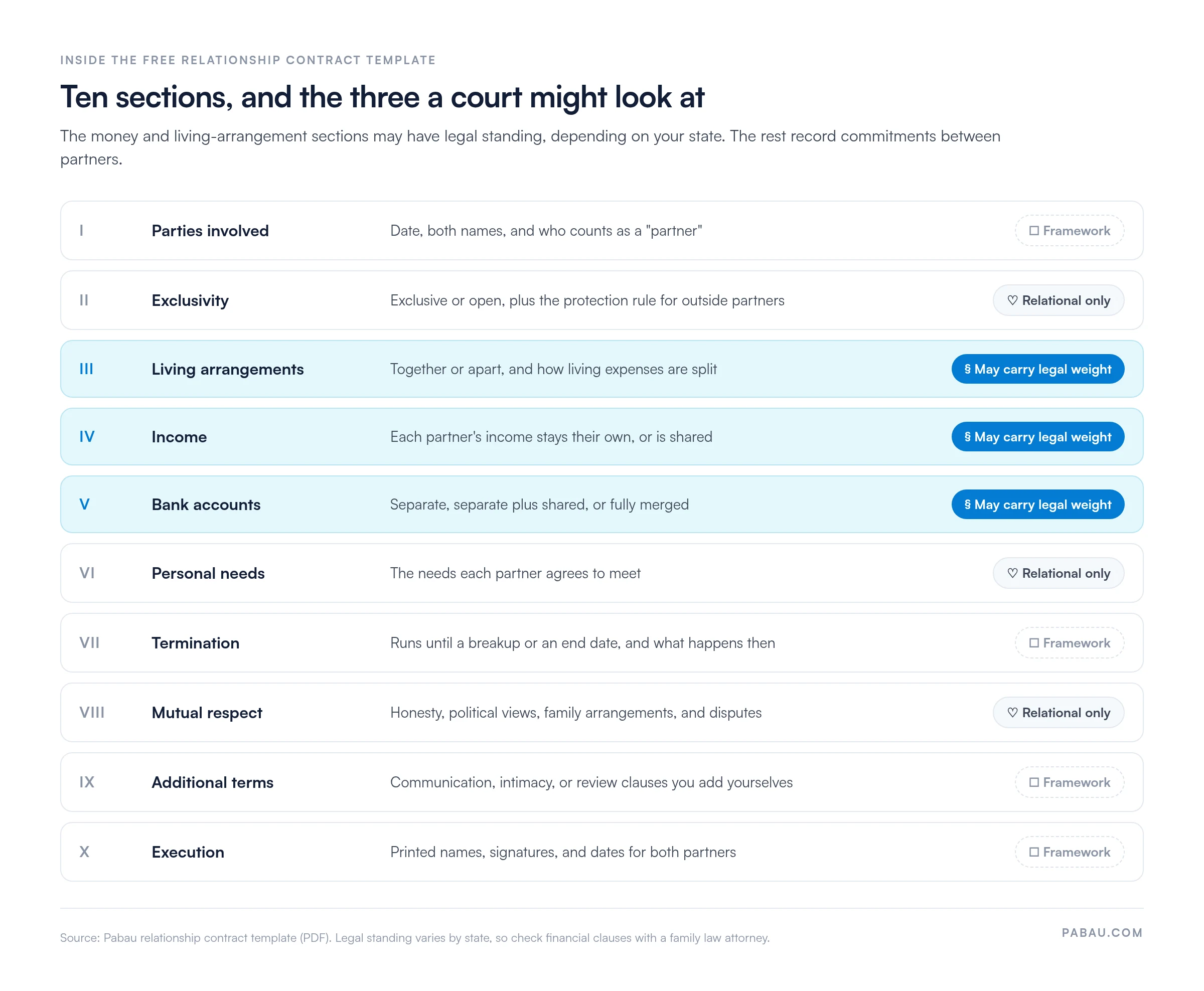
The template has no dedicated section for communication, intimacy, or review dates. Write those commitments into Personal needs, Mutual respect, or Additional terms.
The Termination section asks whether the agreement runs until a breakup or until a set end date. Answering it while things are good makes a hard conversation easier later.
Writing the contract together is useful in itself. The process surfaces unspoken assumptions and makes room for honest negotiation. Work through these eight steps as a couple.
Throughout, approach your partner’s needs with curiosity rather than defensiveness. The goal is understanding and alignment, not winning.
Below is example wording couples use in each key area. Adapt it to your own relationship and values.
Treat these as starting points rather than text to copy word for word. A contract written in your own language is the one you’re more likely to keep. The weekly check-in clause works well alongside a structured relationship check-in form.
The core sections stay the same, but the content shifts with the couple’s structure and circumstances.
Emphasize communication frequency and in-person visit schedules. Define how you’ll handle time zones, what quality time means when you’re apart, and how you’ll manage intimacy expectations. Add a clause about milestones for moving closer.
With multiple partners, the contract needs to cover boundaries between partners, communication with each partner, financial contributions, and how new partners are introduced. The template’s Exclusivity section already offers an open option. Many polyamorous people add a tiered structure, with an agreement for each partner plus a group agreement for shared household dynamics.
Some partners would rather not rank their relationships at all. A relationship anarchy worksheet helps each person set intimacy, commitment, and cohabitation terms one domain at a time, before the contract is drafted.
Where one partner takes the lead on most decisions, the contract spells out which decisions are shared and which are delegated. Include explicit consent, a commitment to agreed expectations, and regular feedback so both partners feel heard.
If trust is being rebuilt after infidelity or another breach, the contract might include transparency agreements. Examples are shared passwords, location sharing, and accountability check-ins. Add a timeline for gradually restoring autonomy as trust grows, and make professional support non-negotiable.
Those clauses cover behavior, while the emotional weight of the breach still needs its own work. A radical forgiveness worksheet gives the wronged partner a way to process that hurt before committing to new terms.
Where one or both partners are neurodivergent, the contract can explain how ADHD, autism, or sensory needs affect communication, intimacy, or task-sharing. It can also name the accommodations each partner needs. Writing them down replaces blame with clarity and mutual support.
Relationship contracts help most when couples want to align early, rebuild trust after a conflict, or navigate a big transition. Moving in together, marriage, and career changes all qualify. They also suit couples working with a therapist or coach to clarify expectations.
They’re less useful for couples avoiding deeper emotional work. A contract can’t replace therapy when trauma or addiction is present.
If one partner resists the idea of a written agreement, that resistance is useful information. It may point to unexplored fears, past experiences of control, or avoidance. A good therapist can help you work through it together.
Therapists who use relationship contracts in couples work often print the PDF, hand it over in session, and scan the signed copy afterward. The signed page then sits in a folder, and the review date lives in someone’s memory.
Practice management software like Pabau moves that exercise online. You can build the contract as a digital form and send it to both partners before the session. Care Pathways guides each patient through the form and signature ahead of the visit, and their answers flow into the patient record automatically.
That’s the admin therapy practice management software should absorb. Book the review session in the calendar, and automated reminders bring the couple back on time with the signed agreement already on file.

Pabau lets therapists send relationship contracts as digital forms, collect both partners’ signatures before the session, and keep each signed agreement in the patient record.

A relationship contract earns its keep in the drafting. Two people who sit down, name their expectations, and agree on wording have already practiced the negotiation the contract describes.
Start with the free template and fill in the tick boxes first. Then spend most of your time on Personal needs and Mutual respect, and pick a review date before you sign. If the money sections cover significant assets, show them to a family law attorney.
If you guide couples through this exercise professionally, a digital version saves the print, sign, and scan routine. Book a demo to see how Pabau sends, signs, and stores couples’ agreements alongside your session notes.

Working through this with a therapist? Couples therapy worksheet gives partners structured prompts to bring into each session.
Not sure what you want long term? Relationship goals checklist helps you agree on shared goals before you write them into the contract.
Boundaries still fuzzy? Relationship boundaries checklist lets each partner mark their limits before you negotiate them.
Arguments keep derailing the talk? Conflict resolution worksheet walks a couple through one disagreement step by step.
Using an evidence-based approach? Gottman method worksheets put the Gottman Institute’s relationship exercises on paper.
A relationship contract is a written document couples create together to define their shared expectations, boundaries, values, and commitments. It is not legally binding like a prenuptial agreement. Instead, it works as a communication tool and a mutual promise to show up for each other in specific ways.
No, a relationship contract covering roles, values, and personal boundaries is not legally enforceable in most jurisdictions. Prenuptial agreements are legally binding if they meet state law requirements, but relationship contracts are emotional tools, not legal instruments.
Key sections include communication norms, personal boundaries, financial transparency, intimacy preferences, shared values, roles and responsibilities, conflict resolution approach, and a review schedule. Customize each section to your relationship and include only what matters to both partners.
Set aside dedicated time, discuss your goals, and list your expectations separately. Then find common ground, negotiate differences, and draft the wording together. Sign it as a symbolic commitment and revisit it annually or after major life changes.
Yes, but only with professional support. A contract can include transparency agreements, accountability check-ins, and a timeline for rebuilding autonomy as trust grows. Couples therapy is essential alongside the contract to process the breach and rebuild connection.