Tanja Lepcheska

MRC dyspnea scale (mMRC): Grades, GOLD cutoff and free PDF
What the MRC dyspnea scale measures and where it came from The MRC dyspnea scale...

Last Updated: Nov 5, 2026
Free PDF 11 pages, print-ready Clinician-reviewed
A marriage counseling worksheet is a printable exercise that therapists use to guide couples through one topic, such as communication, conflict, or trust. Each partner answers the prompts separately, during or between sessions, and the therapist reviews both sets of answers together. The free 11-page version from Pabau, the practice management platform we build, covers 15 prompts on strengths, conflict, appreciation, and shared expectations. This page explains what a worksheet should include, how clinicians use it, and how to read both partners' answers side by side.
An 11-page PDF with 15 prompts that Partner A and Partner B answer separately, covering strengths, conflict, appreciation, and shared expectations. It closes with a notes page and guidance for discussing the answers together.
Start from scratch, or upload this PDF or any form you already use, and Pabau's AI Form rebuilds it with tick boxes, text fields and a signature. Attach it to the treatment once, and every patient gets it on time.
AI Form rebuilds the consent, history and aftercare forms you already use. You review each one, then publish.
Patients complete forms on their phone before they arrive, so the front desk stops retyping paper.
Every signed form is versioned and attached to the treatment record, ready when you need it.
Set how long a consent stays valid. Returning patients skip forms they have already signed.
Supports HIPAA and GDPR compliance AES-256 encryption 4.8 on G2 4.7 on Capterra Trusted by 4,000+ practices worldwide
A marriage counseling worksheet gives each partner the same set of prompts to answer on their own. This free 11-page version holds 15 prompts on strengths, conflict, appreciation, and shared expectations.
Therapists read both sets of answers together in session, so the differences between partners become the starting point for the conversation.

A marriage counseling worksheet gives couples one focused task per session topic.
Worksheets work best as between-session homework that the therapist reviews in the next session.
Common types cover communication, conflict resolution, trust, and premarital preparation.
The free 11-page worksheet holds 15 prompts that each partner answers separately.
Pabau lets therapists attach completed worksheets to Client records and share them with couples through the Client Portal.
A marriage counseling worksheet is a written clinical tool that structures one topic of couples work into prompts, questions, and exercises. Licensed Marriage and Family Therapists (LMFTs) and other couples counselors use it in session to slow down a conversation. They also assign it as between-session homework to carry the work into the week.
Worksheets matter because they turn a general goal, such as “communicate better,” into a specific, observable task. Each partner can complete the sheet separately, then compare answers in the next session. That gives the therapist concrete material to work with rather than relying on memory of what was said.
Therapists assign worksheets when a couple has identified a pattern and needs practice outside the room. The worksheet supports in-session work rather than replacing it. Most clinicians follow a simple cycle.
The approach you take depends on your clinical modality. Gottman-trained clinicians often use worksheets tied to the Four Horsemen and their antidotes. Therapists trained in Emotionally Focused Therapy (EFT) focus on attachment cues and emotional responses instead. Pick a worksheet that reflects the framework your training supports.
Most worksheet libraries group resources by the problem they address. The table below summarizes the main categories and when clinicians typically reach for each one.
Communication worksheets usually focus on active listening and “I” statements. A typical sheet asks each partner to paraphrase what they heard before responding, then to name one feeling behind the message. The speaker-listener format is common in a couple communication worksheet because it gives both people a defined role.
Conflict resolution sheets walk couples through de-escalation and repair. Gottman-informed versions pair each of the Four Horsemen (criticism, contempt, defensiveness, and stonewalling) with a practical antidote. Clinicians often ask couples to log one recent argument, identify the horseman present, and write a repair attempt they could have used. A Gottman repair checklist gives them repair phrases to practice for that step.
Rebuilding trust worksheets are used after a breach or a long period of emotional distance. They often include prompts about what each partner needs to feel safe and a short love-language discovery exercise. Therapists should handle these topics carefully and pace them to the couple’s readiness.
Premarital worksheets cover values alignment, financial expectations, and roles in the household. Premarital counseling is a distinct stage of the work. Clinicians often use these sheets to surface differences early, before they become entrenched.
Review every completed worksheet at the start of the next session before assigning anything new. Couples stop completing homework quickly when they feel the work is not being read. Note one observation per partner in your session record so the thread carries forward.
The free worksheet is an 11-page PDF built for structured sessions between couples and mental health professionals. It opens with name and date fields and a short instruction. Both partners answer honestly and on their own, then discuss their responses.
The core of the sheet is 15 prompts, each with separate answer spaces for Partner A and Partner B to fill in. The prompts fall into four themes, which the map below lays out.
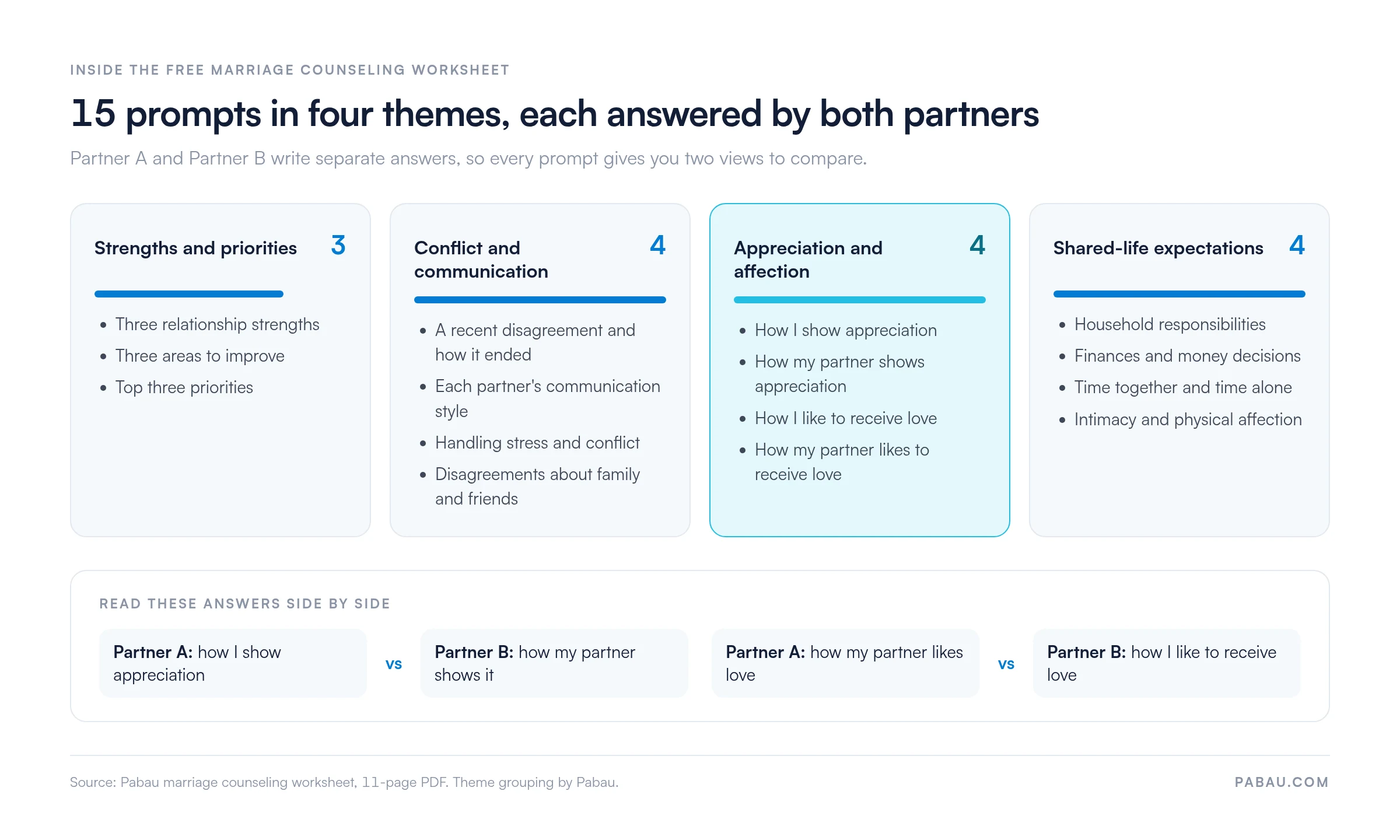
The appreciation prompts work as mirrored pairs. One partner describes how they show appreciation, and the other describes how their partner shows it to them. Read those answers side by side, and any mismatch becomes a concrete topic for the next session. A love languages chart can help couples put a name to what each of them describes.
The last pages hold space for additional notes and guidance for the follow-up conversation. That guidance asks partners to listen with empathy and to share their feelings without blaming each other.
Print it for in-session use or send it digitally as homework. If you want to change the wording, copy the questions into your own forms and keep your practice branding.
Homework is only useful if couples complete it. Frame each worksheet as a shared experiment, not a test. Keep the task short, pick one topic per sheet, and explain how it connects to the work you did in the room.
Ask couples what got in the way before assuming resistance. Practical barriers such as shift work or unclear instructions are common, and a simpler sheet often solves the problem.
Many therapists email a PDF, get a phone photo of the answers back, and file it away from their session notes. By the next appointment, finding both partners’ answers can take longer than reading them.
Pabau is software built for therapists, psychologists, and other clinicians who run their own practice. You attach each worksheet to the couple’s files in Client records, next to the session notes it informs.
Couples receive the worksheet through the Client Portal, the same place they book and reschedule their appointments. When the next session starts, the homework and last week’s notes are open together. Your review then starts from the couple’s own words.

See how Pabau lets you attach completed worksheets to Client records and share them with couples through the Client Portal. Each couple’s homework then sits beside your session notes.

Start with the worksheet that matches the pattern the couple brought in, and assign one topic at a time. A short sheet that both partners finish is worth more than a long one that sits half done.
The most useful answers are the ones that disagree. When one partner’s account of the appreciation they give doesn’t match what the other says they receive, you have the work for the next session. Book a demo to see how Pabau keeps each couple’s worksheets, portal shares, and session notes in one record.

Working with attachment patterns? EFT cycle worksheet maps the negative cycle a couple repeats during conflict.
Want lighter homework between sessions? Relationship journaling prompts gives couples 30 questions to write about.
Need a regular couples check-in? Relationship check-in template offers 30 questions couples can work through together.
Exploring how partners talk to each other? Communication styles worksheet helps each partner name the style they use.
A marriage counseling worksheet is a printable exercise that structures one topic of couples work into prompts and tasks. Therapists use it in session and assign it as homework between appointments.
Yes. The worksheet is a free 11-page PDF. Clinicians can print it or send it digitally, and adapt the questions for their own practice.
They can, but worksheets work best when a therapist introduces them and reviews the answers. Without that review, couples may miss the patterns the sheet is designed to surface.
The terms are used interchangeably in practice. The more useful distinction is the clinical goal of the sheet, such as communication, conflict, or trust, rather than the label.