Despina Petrushevska

Biopsychosocial questionnaire
What is a biopsychosocial questionnaire? A biopsychosocial questionnaire is a st...

1
Last Updated: Nov 18, 2026
Free PDF 4 pages, print-ready Clinician-reviewed
A psychophysiological assessment measures how psychological processes and physiological responses affect each other. It pairs mental health screening with readings such as heart rate variability, skin conductance and muscle tension. Clinicians use it to see how stress, anxiety or chronic pain show up in the body, and to support treatment decisions alongside a clinical interview. Physiological readings are often recorded separately from the psychological history they relate to, which makes review harder. This free template keeps both in one form, from referral and history through baseline and stimulus readings to recommendations and consent.
A four-page form covering patient and referral details, medical and psychiatric history, symptoms, and baseline and stimulus readings for six measures. It closes with the overall assessment, treatment recommendations, assessor signature and patient consent.
Start from scratch, or upload this PDF or any form you already use, and Pabau's AI Form rebuilds it with tick boxes, text fields and a signature. Attach it to the treatment once, and every patient gets it on time.
AI Form rebuilds the consent, history and aftercare forms you already use. You review each one, then publish.
Patients complete forms on their phone before they arrive, so the front desk stops retyping paper.
Every signed form is versioned and attached to the treatment record, ready when you need it.
Set how long a consent stays valid. Returning patients skip forms they have already signed.
Supports HIPAA and GDPR compliance AES-256 encryption 4.8 on G2 4.7 on Capterra Trusted by 4,000+ practices worldwide

The free psychophysiological assessment template is a four-page PDF covering patient details, history, symptoms, six physiological measures and consent.
Physiological measures such as HRV and GSR support clinical judgment and never establish a diagnosis on their own.
Record baseline readings before any stimulus so later changes can be read against a clear reference point.
Pabau, the practice software we build, stores completed assessment forms on the patient record so every practitioner works from the same template.
A psychophysiological assessment template is a structured form that records psychological findings and physiological readings in one document. The physiological side comes from instruments that measure brainwaves, heart function, breathing, muscle activity and skin temperature. That list follows the Association for Applied Psychophysiology and Biofeedback. The form gives clinicians one place for the patient’s history, the readings taken during the session, and the interpretation that links the two.
The template matters for documentation quality. Without a fixed structure, physiological readings are often recorded in one place and psychological history in another, which makes later review and audit difficult. Standardized forms also help practices show that assessments follow a defined protocol.
The template is designed to be completed in the order a session runs, so the record reflects what happened and when. Follow these five steps:
Keep the interpretation section cautious. Physiological measures support clinical judgment, and they do not establish a diagnosis on their own. The form closes with the assessor’s signature and the patient’s consent to the assessment and the use of their data.
A psychophysiological assessment measures autonomic and neural signals that change with psychological state. The template records the six measures listed below.
Compare each reading with the patient’s own resting baseline first, and use population averages only as a secondary reference.
Psychology and psychiatry practices use the template when a referral involves stress, anxiety or trauma symptoms with a physical component. Physical therapy and pain practices use it when chronic pain has a strong psychological element. Biofeedback practitioners use it to log baseline and session data in a form that other clinicians can read.
Practices that already screen with the Perceived Stress Scale can set its self-report score beside the physiological picture this form records.
A standard template makes assessments comparable across patients and across practitioners. When two clinicians record the same measures in the same order, a reviewer can follow the reasoning without a verbal handover.
Templates also support audit readiness. A completed form shows the referral reason, the protocol followed and the interpretation written at the time. That is the kind of record a regulator or insurer may ask to see.
Set up the template with your baseline fields first, and make them mandatory. Baseline readings are the reference point for every later session, so a missing baseline makes the rest of the record hard to interpret.
A usable template covers six areas, and each one answers a question a later reader will ask. The table below sets out what each section should capture.
A consistent protocol makes the readings comparable from one session to the next. The steps below follow the order the template expects.
Each phase fills a different part of the form, and the baseline is the one every later reading depends on.
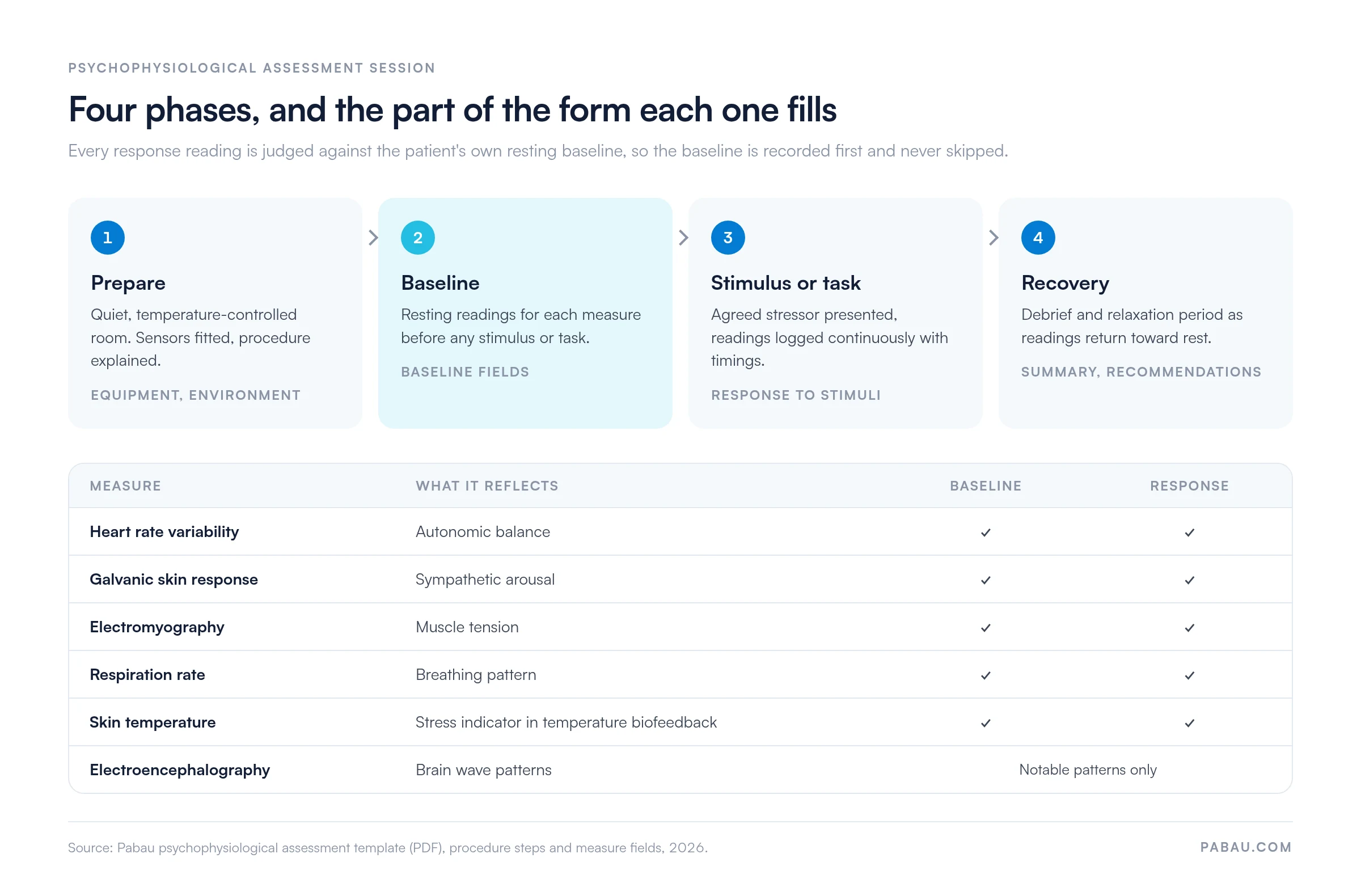
A psychophysiological assessment focuses on the link between mind and body measured through physiological signals. A biopsychosocial assessment is broader, covering biological, psychological and social factors in a single clinical picture.
Many practices use both. The biopsychosocial assessment frames the case, and the psychophysiological record adds objective session data.
Clinicians use this assessment when stress produces physical symptoms, and also in anxiety, PTSD, chronic pain and biofeedback therapy. A score from the GAD-7 anxiety assessment or the PCL-5 PTSD checklist gives the readings a symptom measure to sit beside.
Good documentation links each physiological change to a specific point in the session. Write the observation first, then the interpretation, so a reader can tell which is which.
Separate observed readings from clinical interpretation in two labeled fields. Reviewers can then check your reasoning against the raw data without re-reading the whole form.
On paper, a completed assessment sits in a folder or a scanned file. It stays apart from the session notes and the earlier readings it should be compared with. Repeat assessments make that harder, because each new baseline needs the last one beside it.
Pabau, the practice management platform we build, turns the template into one of its digital forms. Practitioners complete it on a tablet during the session, and the finished form is stored in the patient record.
Baseline readings from earlier sessions are then easy to compare with current ones. Access can be limited by role, which supports data protection obligations under frameworks such as HIPAA and GDPR, where your practice is subject to them. The same therapy practice management software also runs the booking, notes and billing around each assessment.

See how Pabau stores completed assessment forms against the patient record, so practitioners can find baseline and session data without searching across files.

A psychophysiological assessment is only as useful as its baseline. Record resting readings before every stimulus and keep observations apart from interpretation, and the form will still make sense to a colleague months later.
The trade-off is time. A six-measure session takes longer to set up than a symptom questionnaire. Save it for referrals where the body’s response changes the plan, such as biofeedback training or stress-related pain.
Book a demo to see how Pabau keeps each assessment, its baseline readings and every follow-up session on one patient record.

Need the broader clinical picture? Comprehensive biopsychosocial assessment template covers the biological, psychological and social history that frames a psychophysiological referral.
Documenting mental state at the same visit? Mental status exam template structures appearance, mood, thought and cognition in one record.
Running a full psychiatric workup? Psychiatric evaluation template walks through history, risk and diagnosis for a new referral.
Want a self-report score to set beside the readings? DASS-21 guide explains how to score depression, anxiety and stress on one scale.
Working on worry with an anxious patient? Worry time worksheet gives patients a structured way to postpone and contain worrying.
A psychophysiological assessment is an evaluation that measures how psychological states affect physiological responses such as heart rate variability and skin conductance. It is used as an adjunct to clinical interview, not as a standalone diagnostic test.
Qualified mental health and healthcare professionals perform these assessments, subject to their licensing and scope of practice. The rules vary by country and state, so check your local regulator before offering the service.
No, physiological readings support clinical judgment rather than establishing a diagnosis on their own. Findings should be interpreted alongside history, examination and other assessment tools.