Anja Dodevska

Social skills worksheet for autism
What is a social skills worksheet for autism? A social skills worksheet for auti...

1
Last Updated: Nov 18, 2026
Free PDF 2 pages, print-ready Clinician-reviewed
An ASAM treatment plan is a written, individualized care plan for a person with a substance use disorder. It is built on the six dimensions of The ASAM Criteria. The current Fourth Edition, published in 2023, renamed those dimensions and added Person-Centered Considerations as Dimension 6. It also reorganized the levels of care.
The plan records what the assessment found in each dimension and what treatment will focus on. It also states the level of care the clinician recommends and the level the patient agrees to. This guide covers the Fourth Edition structure, what changed from 2013, and how to complete the free three-page template.
A three-page form with an assessment box and a treatment focus box for each of the six ASAM Criteria Fourth Edition dimensions. It also records diagnosis, medications, the recommended and agreed level of care, the next review date and clinician sign-off.
Start from scratch, or upload this PDF or any form you already use, and Pabau's AI Form rebuilds it with tick boxes, text fields and a signature. Attach it to the treatment once, and every patient gets it on time.
AI Form rebuilds the consent, history and aftercare forms you already use. You review each one, then publish.
Patients complete forms on their phone before they arrive, so the front desk stops retyping paper.
Every signed form is versioned and attached to the treatment record, ready when you need it.
Set how long a consent stays valid. Returning patients skip forms they have already signed.
Supports HIPAA and GDPR compliance AES-256 encryption 4.8 on G2 4.7 on Capterra Trusted by 4,000+ practices worldwide

The ASAM Criteria Fourth Edition (2023) replaced the 2013 dimension names, so a plan built on the Third Edition headings is out of date.
Dimensions 1 to 5 drive the level of care recommendation. Dimension 6 records patient preferences and barriers to care through shared decision-making.
Readiness to change is no longer a dimension of its own, and Level 0.5 Early Intervention is no longer on the continuum.
Each plan should name both the recommended level of care and the level the patient agreed to, with a set review date.
Pabau, the practice management and EHR platform we build, keeps each plan revision on the patient record, so every review starts from the latest version.
An ASAM treatment plan is the document that turns an ASAM Criteria assessment into goals and services for one patient. ASAM describes the Fourth Edition as standards and decision rules for developing treatment plans and choosing the level of care. It covers patients with addiction and co-occurring conditions.
The plan answers three questions. What does the patient need in each dimension, which setting can meet those needs, and when will the team check again? Teams that record plans in mental health EMR platforms can keep each goal linked to the assessment note behind it.
The Fourth Edition assesses each patient across six dimensions, and each dimension breaks into named subdimensions. The table lists them as ASAM publishes them on its ASAM Criteria overview, with what each one usually feeds into the plan.
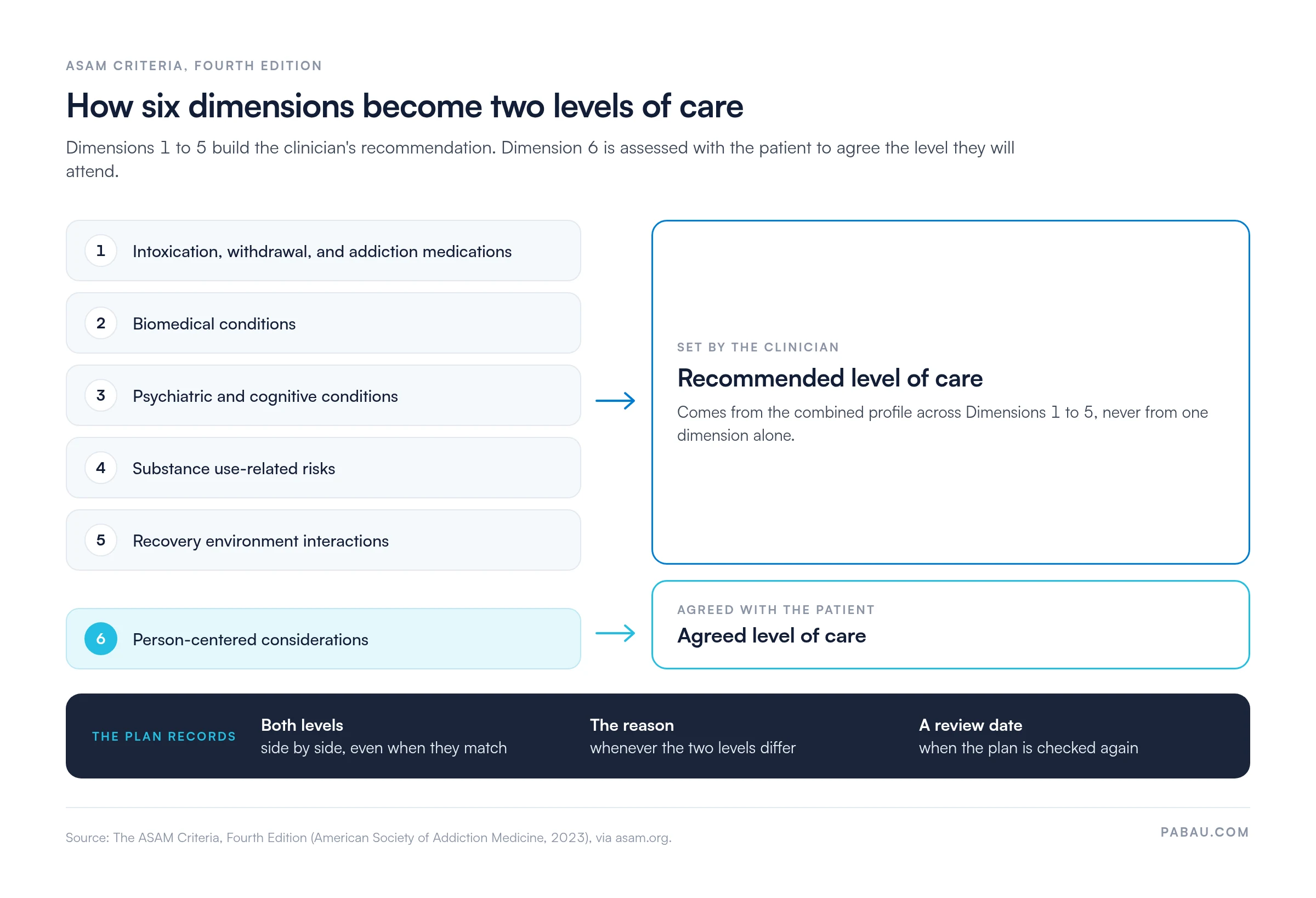
Dimensions 1 to 5 build the level of care recommendation. ASAM states that Dimension 6 is assessed with the patient through shared decision-making, to agree which level the patient is willing and able to attend.
That split is why the template asks for two levels of care. A recommendation the patient declines still belongs in the record, alongside the level they accepted and the reason. The diagram shows how each dimension feeds one of the two levels.
The Third Edition, published in 2013, used different dimension names, and many payer forms and older templates still carry them. The crosswalk below shows where each 2013 heading went.
ASAM says readiness to change no longer contributes independently to the recommended level of care. It now shapes clinical judgments about risk in the other dimensions and the services a patient receives.
If a payer or state form still asks for Third Edition headings, complete it as required. Keep the Fourth Edition dimensions in the clinical plan, and note the mapping where the two differ.
The Fourth Edition keeps four broad levels, with decimals for gradations of intensity within each. It drops Level 0.5 Early Intervention and adds Level 1.0 for long-term remission monitoring. Medically managed services now sit inside the main continuum.
ASAM also defines co-occurring enhanced versions of several levels, plus Level 3.7 BIO for enhanced biomedical capability. The criteria may recommend a recovery residence alongside Level 1 or Level 2 care.
Placement comes from the combined profile across Dimensions 1 to 5, never from one dimension alone. Many state Medicaid programs reference ASAM criteria in coverage policy, though the edition and rules differ by state.
The free template runs to three pages and follows the Fourth Edition dimension order.
The form supports documentation of an assessment. It does not replace ASAM’s own Level of Care Assessment or its dimensional admission criteria. Programs that also need DSM-5 severity, relapse prevention and medication-assisted treatment sections can pair it with a substance abuse treatment plan.
Work through the template in the order the assessment runs.
Where Dimension 3 records trauma exposure, a processing trauma worksheet can give the treatment focus box a structured first exercise. Keep the signed plan in one place so every clinician on the case works from the same version.
ASAM’s transition and continued service criteria are applied at each reassessment. They decide whether the patient steps down, steps up, or stays at the current level.
Compare each goal against progress notes, then mark it as met, revised, or closed with a date. Clinical notes that track progress against each goal make these updates faster. In software for therapy practices, the notes and the plan sit on one record, so the review reads both together.
On paper, an ASAM plan is easy to start and hard to keep current. The signed copy sits in one folder, while progress notes and the next review date live somewhere else.
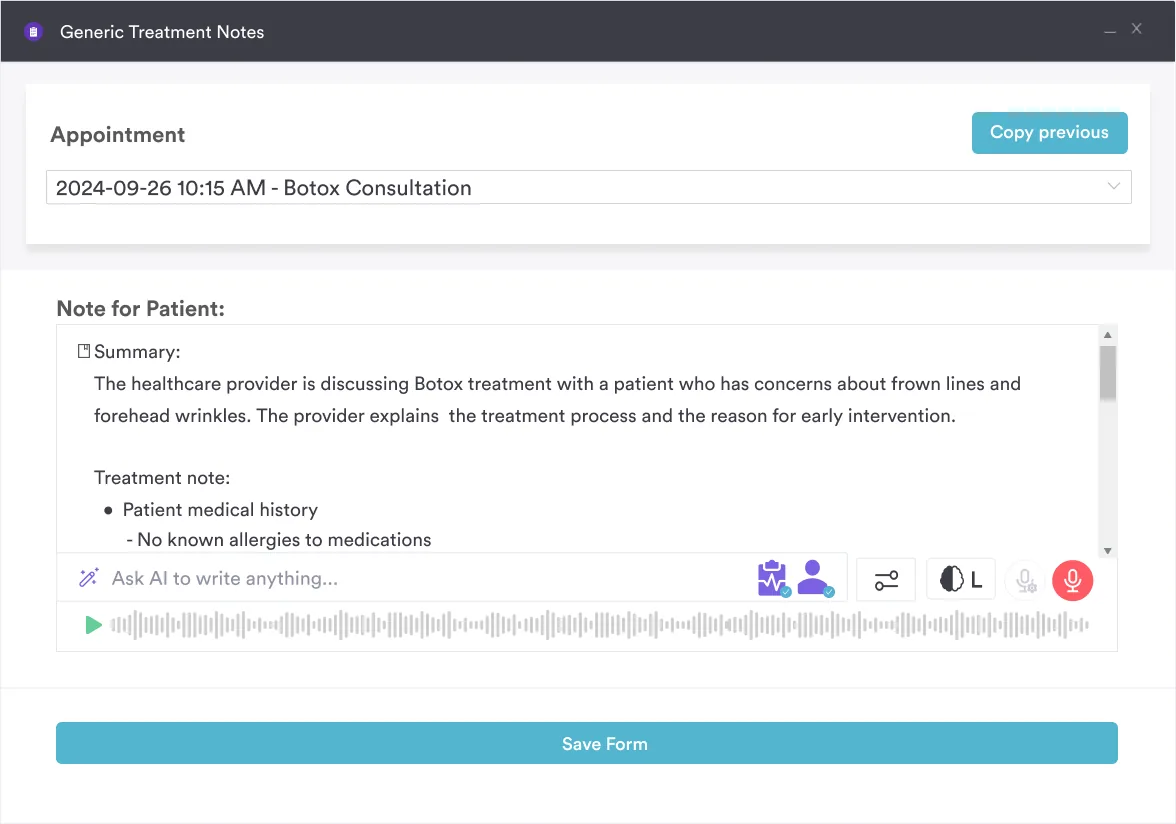
Pabau stores the plan as a digital form on the patient record. Each review is saved there with its date, so the team can see how the level of care changed over time. Pabau Scribe, our AI scribe, can draft session notes for the clinician to review, while the clinician owns every finding and decision.
Practices that hold documentation to a set standard across the team can run compliance management software in the same system.

Pabau stores treatment plans, assessments and session notes on one patient record, so each review starts from the latest version.

If your team still plans care under the 2013 headings, switch the clinical plan to the Fourth Edition now. Keep a crosswalk for payers that have not caught up. The biggest change in practice is Dimension 6, because the patient’s agreed level now sits beside the recommended one.
A plan that names both levels, links each goal to a dimension, and sets a review date will hold up at audit. Book a demo to see how Pabau keeps treatment plans, notes and reviews on one patient record.

Need a structured evaluation framework? Psychiatric evaluation template provides a step-by-step guide for comprehensive mental health assessments.
Working on Dimension 5 with the family? Family roles in addiction worksheet helps map how each household member adapts to a loved one’s substance use.
Building plans for patients outside addiction care? Individualized treatment plan template covers SMART goals, interventions, review dates and discharge criteria in six sections.
Yes. The ASAM treatment plan template on this page is a free three-page PDF built on the Fourth Edition dimensions. It covers patient details, the six dimensions, level of care, review date and clinician sign-off.
The six dimensions are Intoxication, Withdrawal, and Addiction Medications; Biomedical Conditions; Psychiatric and Cognitive Conditions; Substance Use-Related Risks; Recovery Environment Interactions; and Person-Centered Considerations. Dimensions 1 to 5 drive the level of care recommendation.
The 4th edition, published in 2023, renamed the dimensions and added Person-Centered Considerations as Dimension 6. Readiness to change no longer counts on its own toward the level of care. The continuum dropped Level 0.5 and added Level 1.0 Long-Term Remission Monitoring.
The 4th edition groups care into four broad levels: outpatient, intensive or high-intensity outpatient, residential, and inpatient. Decimal levels run from 1.0 Long-Term Remission Monitoring to 4 Medically Managed Inpatient. Level 0.5 Early Intervention is no longer part of the continuum.
It often does. Federally assisted programs fall under 42 CFR Part 2, a set of confidentiality rules that goes beyond HIPAA. Applicability depends on the program, so confirm requirements with legal counsel.