Emotional awareness worksheet
An emotional awareness worksheet is a structured psychoeducational tool that hel...

2
Last Updated: Oct 16, 2026
Marriage counseling questions are the structured prompts therapists use to assess a couple’s history, communication, trust, intimacy, and shared goals. This template gives you 40+ questions grouped by session type, from intake and conflict resolution to infidelity recovery, finances, and premarital counseling. It also shows when to re-ask baseline questions, so you can measure progress across a 12-week cycle.
More than 40 questions grouped into intake, communication, trust, intimacy, financial goals, and premarital sections. Use it as a printed session guide or load it into a digital intake form.
Download template
The question set covers intake, communication, trust, intimacy, finances, and premarital planning, so one template carries a couple from the first session to the last.
Structured questions help therapists gather clinical history quickly while giving couples a safe frame for hard topics.
Several questions follow Gottman Method principles, including the Four Horsemen and the Sound Relationship House.
Re-asking baseline questions at weeks 4, 8 and 12 turns the template into a progress record you can document.
Practice management software like Pabau lets you customize the questions per session type, store responses securely, and track progress across appointments.
A marriage counseling questions template is a clinical assessment tool that therapists use to structure conversations with couples during intake, ongoing sessions, and specialized interventions. It contains open-ended and targeted questions designed to surface relationship dynamics, communication patterns, conflict cycles, intimacy issues, and mutual goals.
A clinical template differs from a self-help quiz because it follows therapeutic frameworks such as the Gottman Method. It also reflects the ethics code of the American Association for Marriage and Family Therapy (AAMFT). It documents baseline functioning and gives you a starting point for treatment planning. It doubles as a compliance record, because session notes tied to specific questions are easier to defend in an audit.
The template works best when you adapt it to the couple’s stage and presenting problem. These five steps fit it into your practice workflow.
The intake phase establishes the couple’s history, current presenting problem, and therapeutic goals. These questions belong in session one and should be revisited at termination to measure movement.
Communication breakdown is one of the most commonly cited reasons couples seek counseling. These questions expose recurring argument cycles and the moments where a couple could de-escalate.
These patterns map onto the Gottman Institute’s Four Horsemen framework. Psychology practices using evidence-based models often find that naming the patterns (criticism, contempt, defensiveness, stonewalling) gives couples a shared language for change.
A trust breach or infidelity calls for sensitive, structured questioning. Keep these questions clinician-guided and frame them within a recovery plan so neither partner feels interrogated.
Clinical note: These questions belong in a dedicated session after both partners have stabilized and agreed to work on recovery. Screen for active abuse or continuing deception before proceeding.
Emotional and physical intimacy often recede during conflict. These questions help couples reconnect and name the barriers without shame.
Money and a shared vision of the future are two of the most common stressors in a marriage. These questions invite couples to state their values and plan together.
Couples preparing for marriage benefit from structured conversation about expectations, values, and compatibility. Asked before the wedding, these questions help couples settle expectations before they turn into conflict.
Research on premarital education links it to a lower risk of divorce, largely because couples clarify their expectations before they commit. Couples who plan to sign an antenuptial agreement can use the financial questions above to prepare for the full disclosure it requires.
The Gottman Institute’s research identifies core patterns in successful long-term relationships. These questions draw on the Sound Relationship House, Gottman’s model of what keeps a relationship stable.
Revisit baseline questions at weeks 4, 8 and 12 to measure therapeutic progress. Asking the same questions again gives you a before-and-after record for outcome documentation.
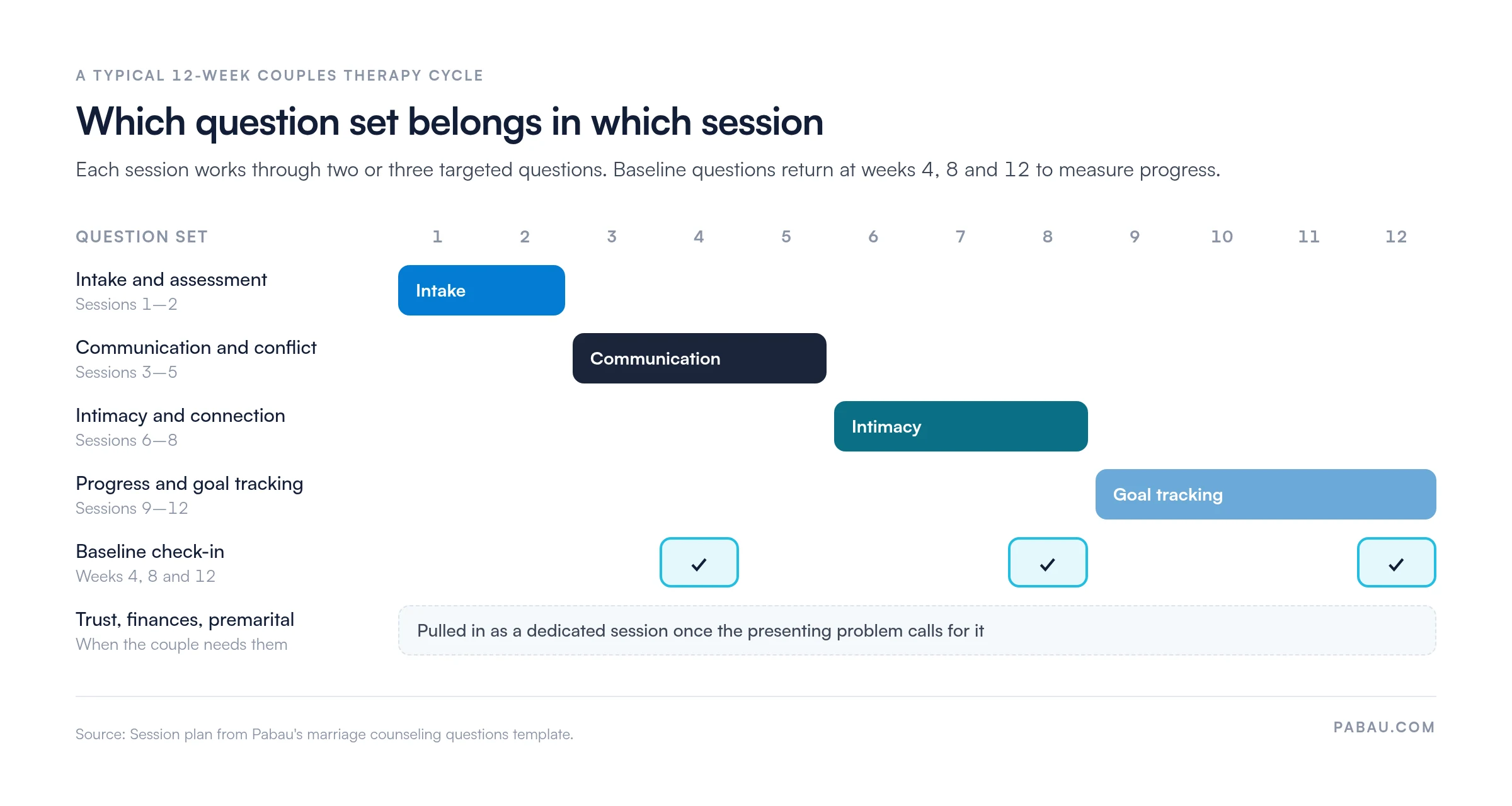
A typical 12-week cycle runs intake questions in sessions 1–2 and communication and conflict questions in sessions 3–5. Intimacy questions follow in sessions 6–8, and goal tracking closes the cycle in sessions 9–12. Each session focuses on two or three targeted questions instead of the full battery.
The trust, finance, and premarital sets slot in as dedicated sessions when the presenting problem calls for them. The plan below shows where each set lands, and where the baseline check-ins fall.
Licensed marriage and family therapists (LMFTs), clinical psychologists, clinical social workers, and mental health counselors use this template to structure their work with couples. It fits private practices, community mental health centers, and hospital-based programs alike.
For practice managers, the template standardizes intake and cuts paperwork. Group practices often run it inside therapy practice management software, so every couple gets the same foundational assessment whichever therapist they see.
The template applies across contexts: Couples therapy, premarital counseling, infidelity recovery, and maintenance counseling for stable couples who want to deepen their connection.
Clinical consistency: Every couple receives the same foundational assessment, which reduces clinician bias and keeps the assessment complete. A structured approach catches issues that a conversational assessment might miss.
Compliance and defense: Documented questions and responses create an audit trail. If a licensing board or malpractice insurer reviews your records, structured intake documentation shows you followed the standard of care.
Outcome measurement: By revisiting questions at midpoint and termination, you track measurable progress. That record supports your treatment plan and shows insurers why ongoing care is justified.
Psychological safety: Couples often find structured questions easier to answer than open-ended conversation. The template gives them permission to discuss sensitive topics (infidelity, sex, money) in a clinical frame.
Efficiency: When couples complete the intake questions online before the first session, you can spend that hour on the relationship itself.
Plenty of couples therapists still run a question set like this on paper or as an emailed PDF. Answers come back in different formats, get retyped into notes, and are rarely compared side by side at week 12.
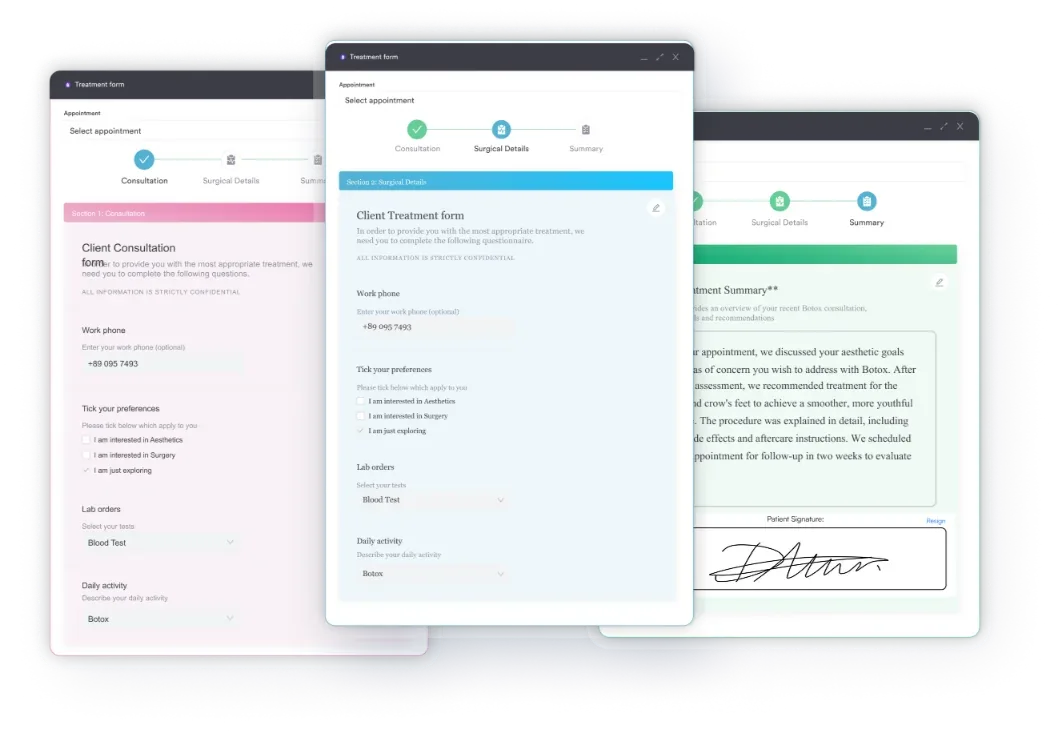
In Pabau, you load the questions into the form builder and send the intake set to both partners before session one through the Client Portal. Each partner’s answers land in the patient record, next to the session notes you write afterward.
Because the same questions sit in the record from the first session, re-asking them at weeks 4, 8 and 12 shows you exactly what changed. In a group practice, a shared house version of the form means every therapist starts couples on the same questions.

Send the intake questions to both partners before session one, keep their answers in the patient record, and compare them at every check-in.

The questions matter less than the order you ask them in, and whether you ask them again. Start with the intake set, give each later session two or three targeted questions, and re-ask the baseline questions at weeks 4, 8 and 12.
That repetition is what turns a good conversation into a treatment record you can measure and defend. The trade-off is patience. The trust and intimacy sets only work once both partners have stabilized, so resist the urge to front-load them.
Book a demo to see how Pabau sends couples their intake questions before session one and keeps every answer ready for your progress reviews.

Need exercises between sessions? The couples therapy worksheet gives couples structured homework that builds on what you covered in session.
Working on limits and expectations? The marriage boundaries worksheet helps partners name and agree on boundaries in a guided session.
Want a lighter follow-up tool? The relationship check-in template offers 30 questions couples can work through between appointments.
Planning a longer program? The couples therapy workbook collects exercises for multi-week work with a couple.
Marriage counselors ask about relationship history, communication patterns, areas of conflict, intimacy, finances, shared values, and therapeutic goals. A structured template covers these systematically, starting with intake questions in session one. Specialized questions (infidelity, intimacy, financial planning) follow as the couple’s needs become clear.
Most couples benefit from 8-16 sessions, with noticeable improvement by session 6. Some couples continue for 20+ sessions if they address infidelity or deep-seated patterns. Progress is best measured by revisiting baseline questions rather than by a fixed number of sessions.
Both partners should answer in couples therapy. Hearing each other’s responses to the same question is therapeutic in itself. It reveals differences in perception and opens dialogue. Your role is to facilitate their conversation, not to administer a one-sided assessment.
Yes. This template includes a dedicated premarital section. Many therapists also pull select intake and values-alignment questions (financial expectations, family goals, conflict resolution style) for couples preparing for marriage.
Use a dedicated session for sensitive topics, framed as clinical exploration rather than interrogation. Assess safety first. If abuse or ongoing deception is present, address that before expecting honest responses about intimacy or trust. Screen individually (in private with each partner) if you suspect undisclosed breaches.
This template is clinician-designed, evidence-informed (Gottman Method, AAMFT standards), and includes follow-up questions for progress tracking. It’s structured for licensed therapists providing ongoing couples therapy, not a self-help quiz or intake screening for general practices.