Getting along with siblings worksheet
A getting along with siblings worksheet is a printable that helps children and t...

2
Last Updated: Oct 23, 2026

A relationship check-in is a scheduled conversation about how the relationship is going, held before problems build up.
The template covers eight areas: communication, emotional needs, trust, conflict resolution, plans, personal space, social life, and money.
Most couples do well with 15 minutes weekly or 30 minutes monthly, and consistency matters more than length.
Run it in five steps: pick the time, agree on how you will listen, work through prompts, reflect back, then close with appreciation.
Practice management software like Pabau lets a therapist send the form to both partners and store the answers in the client record.
A one-page form with 15 prompts across eight areas of a relationship, from communication and emotional needs to conflict, personal space, and money. Fill it in together, or answer separately and compare notes before you talk.
Download templateA relationship check-in is a scheduled conversation about how your relationship is going, held before problems build up. Most couples never book one, opting to talk when something breaks instead.
But fifteen minutes with a set list of prompts beats an hour of circling the same argument.
Below you will find the eight areas worth covering, a five-step way to run the conversation, and 30 questions to choose from.
A check-in is a planned conversation with a set agenda, a time limit, and an agreement to listen.
Therapists have taught this kind of structured conversation for decades. The Gottman Institute, a long-standing authority on couples research, treats deliberate conversation as one of the habits that keeps couples steady. A check-in is that habit in a repeatable format.
The template works through eight areas, and they run from the ones couples expect to the ones they avoid. Communication, emotional needs, trust, and conflict resolution come first. Then come plans and goals, personal space, social life, and money.
That second group is the practical half, and it drops out of most relationship conversations. A partner who feels short of time alone rarely leads with it. Neither does the one who is uneasy about the joint account. Having the prompt on the page gives them a way in without making it an accusation.
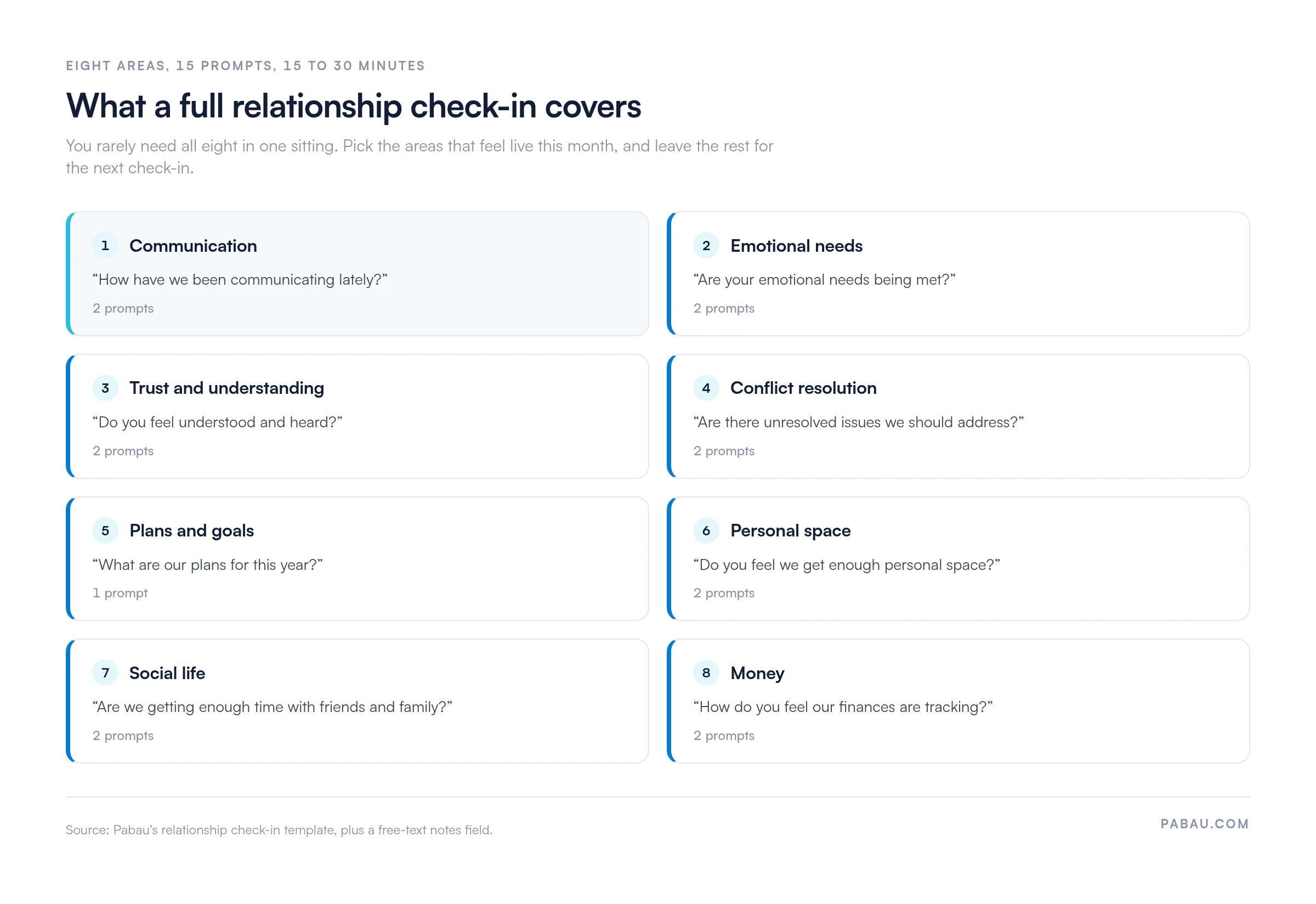
Pick the two or three that feel live this month, then note which ones you skipped so they open the next conversation. If one of you would rather gather thoughts alone first, a mental health check-in worksheet suits that solo step.
Check-ins work because they move the difficult conversation away from the moment of conflict. When the only time you discuss the relationship is during an argument, every topic arrives with heat attached.
A scheduled slot takes that heat out, so a small request stays a small request.
Structured communication is standard in couples work. The American Association for Marriage and Family Therapy, known as AAMFT, builds it into its guidance for practitioners.
A therapist managing couples cases will often set a check-in as homework, so the skills get practiced where the arguments happen.
Weekly if things are tense, monthly if they are steady. That covers most couples, and the cadence matters less than holding it.
Start with the shorter cadence and stretch it later if it starts to feel forced. The same pattern shows up in patient engagement work, where people keep the routines that feel manageable.
A monthly check-in you keep beats a weekly one you skip twice.
Run the same five steps in the same order every time. The conversation takes 15 to 30 minutes once you have done it twice.
One habit helps more than any prompt. Put the check-in in the calendar as a repeating event, the same way you would a standing appointment.
The same rule drives patient compliance in practice, where people stick with the routines they see as protective rather than punishing.
Choose five to eight of the 30 prompts below, then rotate the rest into your next check-in. Asking all 30 in one sitting turns the conversation into an interview.
If one of you thinks better on paper, write your answers down before you sit together. Gratitude is also the easiest section to rush, so a positive psychology worksheet is a useful backup when that part starts to feel thin.
A check-in goes wrong for predictable reasons, and each one has a simple fix.
Therapists assign check-ins as homework because the work has to carry on at home. A couple who practices listening on a Tuesday evening arrives with something to examine, so the session starts further along.
Framing the form as between-session care also lands better than calling it homework.
The completed form gives the therapist something to read, too. Patterns show up over a few months, such as the same area flagged every time, or a partner who leaves the conflict section blank.
A psychology practice can adapt the wording to its modality, whether that is the Gottman Method, Emotionally Focused Therapy, or Imago Dialogue.
Whatever the couple brings back belongs in the session record, in the format the practice already uses. A PIE note format keeps that write-up to the problem, the intervention, and the evaluation, which is about right for a homework review.
Stop the self-guided version and book a therapist when the check-in itself turns unsafe or keeps going nowhere. A template cannot referee, and it should not have to.
A therapist teaches skills a form cannot, and gives you a neutral room to use them in. That matters most when talking at home has stopped working. Check-ins and therapy sit well side by side.
Most practices hand the check-in out on paper at the end of a session. The couple takes it home, fills in half of it, and forgets to bring it back.
At the next session the therapist rebuilds the conversation from memory, and the progress stays invisible.
Practice management software like Pabau closes that loop with digital forms. You send the check-in to both partners a few days before the next session.
They complete it on their phones, and the answers save straight into the client record. The record no longer depends on a sheet of paper surviving the week.
The client portal is where couples find the form, past summaries, and any resources you have shared with them. That is the same reason patient portals cut down on resend requests.
Answers stay in one place, so you can look back over six months of check-ins before a session instead of hunting through notes.

Send check-in forms to both partners before the session, store their answers in the client record, and see how a couple’s themes shift over time.

A check-in is worth doing badly before it is worth doing well. The first two feel stiff, and that wears off. What you are really building is a habit. You raise the small request on a Tuesday, rather than saving it for a bad night in three months.
So pick a cadence you can hold, download the template, and put the next check-in in the calendar before you close this page.
If you run a therapy practice, the same rule applies to the form. It only helps you if it comes back. Book a demo to see how Pabau sends check-in forms to couples and files their answers against the client record.

Working with a couple for the first time? The couples therapy worksheet gives you exercises to run inside the session, not only at home.
Need a longer program to work through? The couples therapy workbook sets out a multi-week structure you can follow with clients.
Are boundaries the sticking point? The marriage boundaries worksheet helps partners name what they need before resentment sets in.
Writing the session up afterwards? The therapy progress notes cheat sheet keeps documentation short without losing clinical detail.
Still choosing which model to work in? The counseling theories chart compares the main therapeutic approaches side by side.
They overlap. State of the union is the Gottman Method’s weekly version, and it opens with appreciation before either partner raises an incident. A general check-in follows no single model, so you can borrow that running order without adopting the whole method.
No. Park the issue and keep the scheduled slot. A check-in needs both partners calm enough to listen, and a live argument removes that. Say out loud that you want to raise it at the check-in, then leave it alone until then.
Take turns, and swap the order each time. Going second can feel like replying to a verdict, so rotating keeps it even. If one of you talks more by nature, let the quieter partner open.
Keep a short record rather than a transcript. Note the one request each of you made, then read it back at the start of the next check-in. Long write-ups get abandoned by the second month.
Yes, with a narrower agenda. Cover schedules, money, and the children, and leave the relationship itself out of it. A monthly slot suits this well, because the logistics carry on long after the relationship ends.
Yes, and long-distance couples often get the most from it. Book a video call for the check-in and use the same prompts. Writing answers in a shared document first helps when the time zones refuse to line up.