Trauma response test: Free template for clinicians
A trauma response test is a structured screening questionnaire that helps clinic...

3
Last Updated: Oct 15, 2026
The Gottman Repair Checklist is a one-page list of about 70 scripted phrases that couples use to stop an argument from escalating. The six categories are I Feel, Sorry, Get to Yes, I Need to Calm Down, Stop Action!, and I Appreciate. Dr. John Gottman built it from his research on repair attempts, the small bids partners make to de-escalate a fight.
Couples read the list together while calm and agree in advance which phrases they will respond to. During conflict, either partner can then use one of those phrases as a signal to slow down. This guide covers each category, how to run the checklist in session, and how to keep a record of which phrases work for each couple.
A fillable session form for recording the situation that triggered the conflict, the category and phrases chosen, and each person’s response. It closes with agreed next steps and reflection notes on how well the phrases worked.
Download template
The Gottman Repair Checklist lists about 70 repair phrases in six categories. They are I Feel, Sorry, Get to Yes, I Need to Calm Down, Stop Action!, and I Appreciate.
Each category serves a different purpose, from naming a feeling and apologizing to finding common ground, pausing the fight, and expressing appreciation.
Couples get the most from it when they review the list together while calm and each mark the phrases they want to hear.
Phrases such as “I feel defensive. Can you rephrase that?” and “Let’s take a break” are single items inside a category, not category names.
Storing each couple’s completed checklist in their record shows which categories they rely on and how their repair skills change over time.
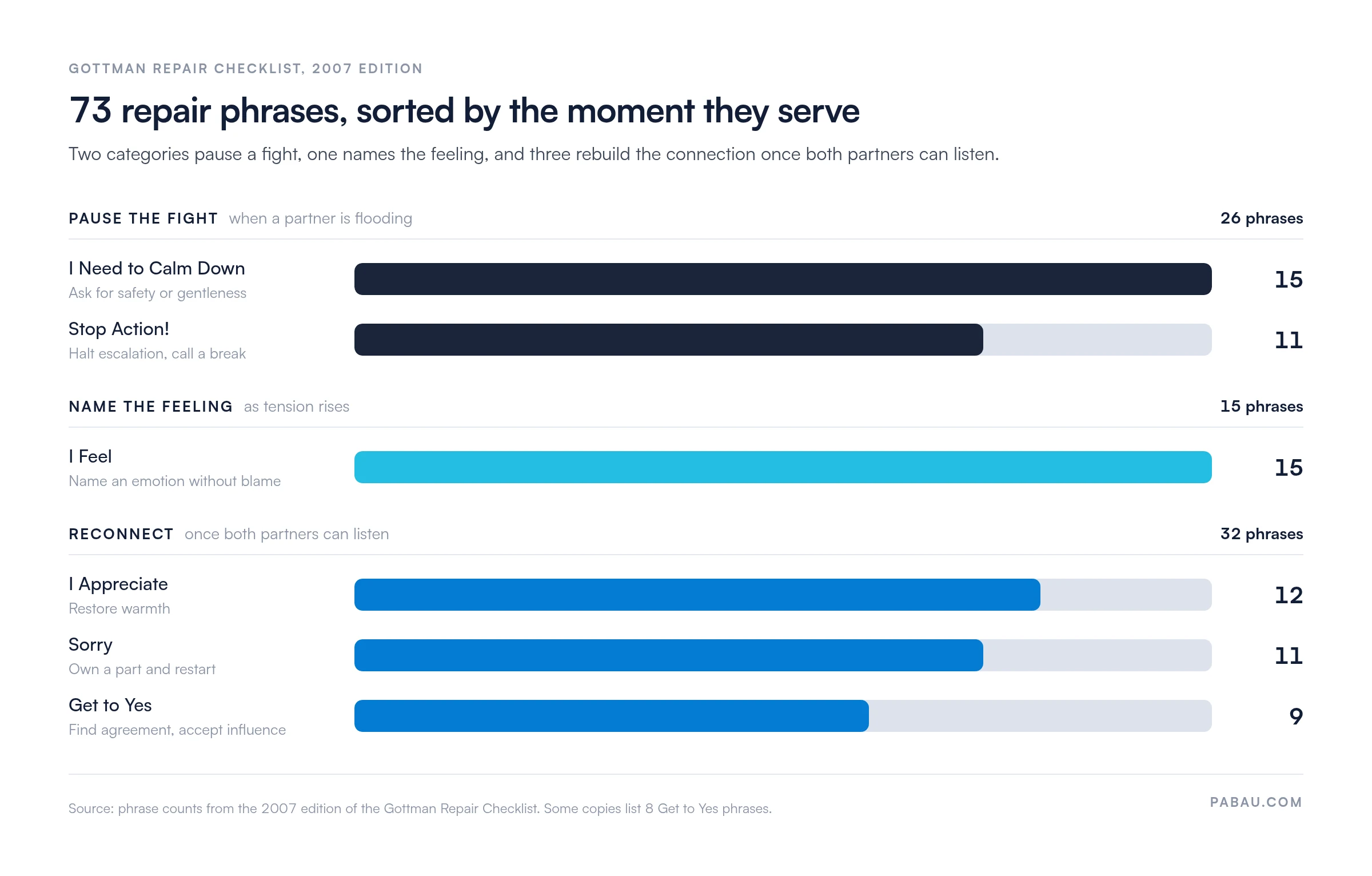
The Gottman Repair Checklist is a one-page worksheet of about 70 numbered repair phrases grouped into six categories. The widely distributed 2007 edition, copyright Dr. John Gottman, carries 73 phrases. Partners pick the phrases they would welcome hearing during a fight, and those phrases become their shared de-escalation script.
Dr. John Gottman and colleagues developed the checklist after decades of research into what separates couples who stay connected from those who drift apart. That research found that repair attempts are among the strongest predictors of how a relationship fares after conflict.
Repair attempts are statements or actions that stop a conflict from escalating and restore calm. The checklist targets emotional flooding, the point where stress floods the nervous system and a partner can no longer listen or problem-solve.
Gottman’s research found that couples who repair well stay together, even when they argue often. Frequent conflict matters less than the ability to de-escalate and reconnect afterward.
The checklist sorts its phrases into six categories, and each one meets a different need during conflict. The counts below come from the 2007 edition; some circulating copies list eight Get to Yes phrases instead of nine.
The six categories give couples a concrete menu in place of a vague instruction to “communicate better.” A partner who is flooding can reach for Stop Action! or I Need to Calm Down. A partner ready to reconnect can reach for Sorry, Get to Yes, or I Appreciate.
Therapists usually introduce the checklist in one of three moments:
Answers to your first-session couples therapy questions often show how each partner handles conflict, which helps you judge when to introduce the checklist. When the moment arrives, work through these six steps.
Repair phrases only become automatic with repeated practice, so revisit the marked checklist every few sessions. Gottman also notes that whether a repair attempt lands depends on the strength of the couple’s friendship, not only on the words chosen.
The Gottman Method includes two related but distinct tools. The Repair Checklist works during a conflict, while the Aftermath of a Fight or Regrettable Incident worksheet is for processing it later.
Many couples therapy plans use both tools. The checklist settles the conflict as it happens, and the aftermath worksheet builds understanding once it is over. Both belong to the wider set of Gottman Method worksheets used across a course of couples therapy.
If you run multi-couple groups, describe both tools in your group therapy informed consent so participants know what the work involves.
The phrases each partner marks tell you a lot about how they fight. Three patterns are worth watching for as couples work with the checklist over several weeks.
Many therapists complete the repair checklist on paper and file it, or lose it. That leaves no easy way to see which phrases worked for a couple, or to show progress over time. Couples also forget which phrases they agreed on once they leave the room.
Moving the checklist into therapy practice management software like Pabau turns it into a tracked part of the couple’s record. Here’s how:

Pabau’s digital forms save each completed Gottman Repair Checklist to the couple’s record. You can see which phrases work and follow progress session by session.

The Gottman Repair Checklist does its work before the argument, when both partners are calm enough to choose their phrases. Have each partner mark the phrases they want to hear across all six categories before the next conflict arrives. That way a single phrase like “Let’s take a break” carries a meaning both partners have already accepted.
Revisit the marked checklist every few sessions and keep each version on file. The changes in which categories a couple uses become your clearest evidence that repair is taking hold. Book a demo to see how Pabau’s digital forms and patient records keep each couple’s completed checklists in one place.

Want ground rules couples can agree on before the next argument? Fair fighting rules for therapists sets out the conversation limits that pair naturally with an agreed list of repair phrases.
Need a structured exercise for the sessions around the checklist? Couples therapy worksheet gives you a form for mapping recurring conflicts, goals, and progress between sessions.
Working with couples on what each partner will and won’t accept? Marriage boundaries worksheet helps partners name their limits, which makes Get to Yes phrases easier to offer.
Interested in de-escalation techniques beyond the checklist? Crisis intervention strategies explores broader de-escalation approaches that complement Gottman repair work in high-stress settings.
The Gottman Repair Checklist is a one-page tool listing about 70 repair phrases, grouped into six categories. The categories are I Feel, Sorry, Get to Yes, I Need to Calm Down, Stop Action!, and I Appreciate. Couples use it during conflict to de-escalate emotional flooding and reconnect.
Read the checklist together while you are both calm. Each partner marks the phrases they would welcome hearing, and you agree on a shared set. When tension rises, either partner uses one of those phrases, and the other treats it as a signal to slow down.
Repair attempts are statements or actions one partner uses to de-escalate conflict and restore emotional safety. Examples from the checklist include “I feel defensive. Can you rephrase that?”, “Let’s take a break,” and “I see your point.” Gottman’s research links successful repair to relationship stability.
The Repair Checklist is used during conflict to calm emotional flooding with agreed phrases. The Aftermath of a Fight or Regrettable Incident worksheet is used later, once both partners are calm, to process what happened and prevent a repeat. Gottman-informed couples therapy often uses both.
Therapists introduce the checklist after a conflict in session or when a couple describes a recent argument. The therapist walks through the six categories, has each partner mark and practice phrases aloud, and reflects on what landed. The couple then uses the checklist at home between sessions.
Yes. Storing completed checklists in each couple’s record lets therapists see which categories each partner relies on over time. It also shows whether the couple is using a wider range of phrases, which supports documentation for insurance and accreditation.