Despina Petrushevska

Biopsychosocial questionnaire
What is a biopsychosocial questionnaire? A biopsychosocial questionnaire is a st...

1
Last Updated: Nov 18, 2026
Free PDF 3 pages, print-ready Clinician-reviewed
A social skills worksheet for autism is a printable session form for practicing facial expressions, conversation and body language with autistic patients. Social communication differences are a core diagnostic feature of autism spectrum disorder under DSM-5-TR, so targeted practice matters across the lifespan. The CDC's ADDM Network estimates that about 1 in 31 eight-year-old children in the US were identified with autism spectrum disorder. That estimate covers the 2022 surveillance year and was published in April 2025. This free three-page template pairs each activity with notes, then closes with reflection, homework and a next session plan. It supports individualized assessment and therapy but does not replace either.
A three-page session worksheet with facial expression, conversation and body language activities, each with a role-play and notes. It closes with reflection prompts, homework and a next session plan.
Start from scratch, or upload this PDF or any form you already use, and Pabau's AI Form rebuilds it with tick boxes, text fields and a signature. Attach it to the treatment once, and every patient gets it on time.
AI Form rebuilds the consent, history and aftercare forms you already use. You review each one, then publish.
Patients complete forms on their phone before they arrive, so the front desk stops retyping paper.
Every signed form is versioned and attached to the treatment record, ready when you need it.
Set how long a consent stays valid. Returning patients skip forms they have already signed.
Supports HIPAA and GDPR compliance AES-256 encryption 4.8 on G2 4.7 on Capterra Trusted by 4,000+ practices worldwide

The worksheet runs one session in order: a goal, three skill activities, then reflection, homework and a next session plan.
Each activity pairs an identification or discussion task with a role-play, and every exercise has a notes box for observations.
Social communication deficits are the first DSM-5-TR criterion for autism spectrum disorder, so these skills are a common therapy target.
Speech-language pathologists, occupational therapists, ABA providers and school teams can run it one-to-one or in groups.
In Pabau, the practice management platform we build, completed worksheets sit on the patient record next to session notes.
A social skills worksheet for autism is a structured session form that walks a patient through practicing social communication skills. Those skills sit at the center of the diagnosis. The CDC’s DSM-5 diagnostic criteria list persistent deficits in social communication and social interaction as the first criterion. This version covers three areas in turn: facial expressions, conversation and body language.
Each activity pairs a task with a role-play and a notes box. The clinician records what the patient managed in each box. Over several sessions, those notes become a record you can compare and share with families, schools and the rest of the care team.
The worksheet follows the order of a typical session, so work through it from top to bottom.
Those six steps fall into three phases, and the closing plan feeds the next session’s goal.
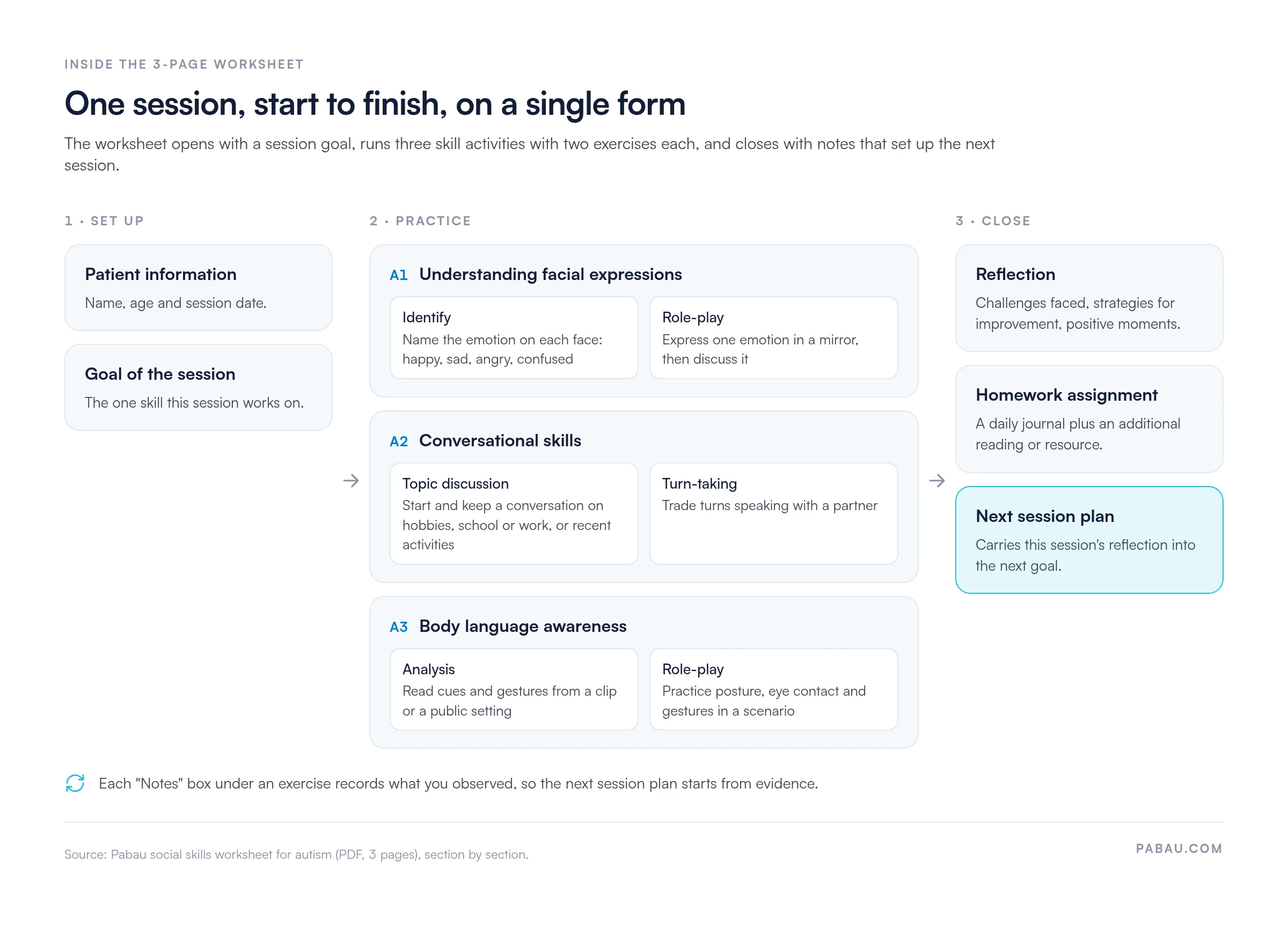
The worksheet suits any service where social communication is a treatment target. It is most useful where several professionals contribute to one plan and need a shared reference point.
A standard format reduces variation between practitioners. When two therapists record the same activities in the same order, the plan is easier to audit and hand over.
Structured records also support progress reviews. Comparing notes across sessions shows whether a target is moving or needs a different approach.
You don’t need to run all three activities in one sitting. Pick the one that matches the session goal and save the others for later sessions. Short, focused practice keeps the team on the priority targets and makes the notes easier to compare.
Child-focused social skills work usually starts with foundational skills. Emotion recognition, greetings, eye contact and turn-taking are common early targets for children in speech and occupational therapy.
Record whether the child names the four emotions on the worksheet, from pictures or real situations. Visual supports such as picture cards make the task concrete. A facial expression chart adds more faces once the child has the basic four.
Note whether the child starts an exchange, keeps a topic going and takes turns. Group sessions give more chances to observe these skills than one-to-one work. When a child needs more practice than one activity allows, a separate conversation skills worksheet can carry it into later sessions.
Adolescents face more complex social situations, including peer relationships, perspective-taking and handling disagreement. The same three activities still apply, with role-plays built around school, friendships and part-time work. Where perspective-taking is the main goal, a perspective-taking worksheet gives it more room than the conversation activity does.
Adults, including those previously diagnosed with Asperger’s syndrome, or who have lower support needs, often work on workplace communication, friendships, and independent living. The worksheet’s role-plays can be built around these situations.
Clinicians should avoid assuming that high verbal ability means no support is needed. Social scenarios that look simple can still be demanding.
Speech-language pathologists, occupational therapists and teachers often run social skills worksheets in groups. A group lets the facilitator observe several participants at once and compare how each responds to the same prompt.
ABA is widely recognized as an evidence-based approach for autism. Practitioners often use structured worksheets to reinforce social skills in discrete and naturalistic contexts. Practice standards from the Behavior Analyst Certification Board set the expectation that programs are individualized and data-driven.
Use the worksheet to set a baseline before a program begins and repeat the same activities at review points. Logging each session in your ABA session notes keeps the worksheet observations next to the program data. Worksheets do not replace direct teaching or behavior-analytic supervision.
Early intervention, generally before age five, is associated with better developmental outcomes, though response varies between children. For toddlers and preschoolers, use the worksheet as a simplified observation tool completed with parents or caregivers.
Nonverbal and minimally verbal learners can still show social understanding, but the response mode needs to change. Pointing, selecting a picture or using an AAC device can replace spoken answers on the same activities.
| Adaptation | How to apply it |
|---|---|
| Picture response | The patient points to or selects a picture card instead of answering verbally. |
| AAC integration | The patient responds through a device or card set already used in therapy. |
| Simplified notes | Record each skill as present, emerging or not yet observed. |
Pabau is an all-in-one practice management system that keeps client records, session notes, and treatment plans together. As software for therapy practices, it lets social skills teams file each completed worksheet next to the session notes it relates to.
Clinicians can use client records to review previous notes before a session, and digital forms can collect intake information before the first assessment. Pabau does not diagnose autism or replace clinical judgment.
Many teams still keep paper worksheets in a folder and retype the key points into the record. Uploading the completed form to the patient’s file keeps the observations, the homework and the next session plan in one place for the whole team.

Pabau helps practices store worksheet results, treatment plans and session notes on each patient record, so the whole team works from the same information.

Use the worksheet to run the session in order. Set one goal, choose the activity that matches it, and write what you observe in each notes box.
The reflection and the next session plan carry the most weight, because they turn one session’s notes into the next session’s target. Adapt the response mode for younger or nonverbal learners, but keep the activities the same so progress stays comparable.
Book a demo to see how Pabau keeps each completed worksheet and session note on the patient record.

Planning visual supports for the same patient? Visual schedule autism template shows how to set out a session in pictures for autistic patients.
Turning social targets into school goals? IEP goal banks gives measurable goal examples you can adapt for social communication.
Working out whether a child’s delay is autism? Autism and speech delay explains how to tell the two apart.
Building on the conversation activity? Friendship worksheet adds structured practice on making and keeping friends.
Running a group or classroom program? Social emotional learning activities collects activities for social and emotional skills.
A social skills worksheet for autism is a structured session form for practicing social communication skills. This one covers facial expressions, conversation and body language, with notes, reflection and homework.
Yes, this template is free to download as a PDF. It is designed for clinical use within a supervised program.
Yes, facilitators can run one activity as a shared exercise and note individual responses afterward. Group use suits classroom and practice settings.
No, the worksheet is a therapeutic and planning tool, not a diagnostic instrument. Diagnosis requires a qualified assessment.