









Problem solving worksheet for adults: Free PDF and 5-step guide
Download your free problem solving worksheet for adults Five prompted sections t...

3
Last Updated: Sep 4, 2026


Primary emotions are immediate, instinctive responses such as fear, anger, and sadness. They arrive before any thinking happens.
Secondary emotions are learned reactions to those first feelings. Shame about anger is the example clients recognize fastest.
The worksheet traces one chain at a time, from trigger to primary emotion to secondary emotion to behavior.
DBT, EFT, and CBT all use the distinction, but each one intervenes at a different point in the chain.
Practice management software like Pabau sends the worksheet out, chases completion, and files the answers in the client record.
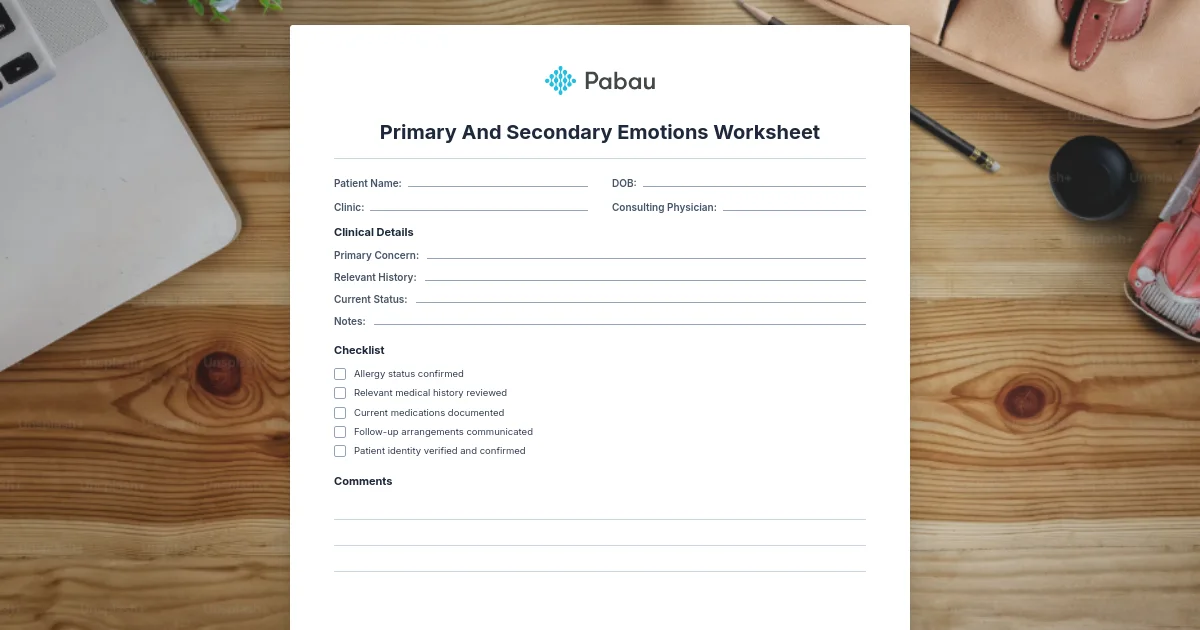
Inside you get an emotion chain table, a primary emotion checklist, a secondary emotion list, and reflection prompts. A feelings wheel is included for clients who struggle to put a name to what they feel.
Download templateClients rarely walk in able to name what they felt first. They report the loud feeling, usually anger or shame, and stop there.
The primary and secondary emotions worksheet slows that moment down. It asks for the trigger, the first feeling underneath, and the response that followed. Clinicians in therapy practices use it to turn a vague account of a bad week into a chain they can work with.
This guide covers what the worksheet is, what it includes, and how to use it in session. It also shows how practice management software like Pabau keeps the work going between appointments.
A primary and secondary emotions worksheet is a structured form for separating two layers of feeling. The primary vs secondary emotions split below takes about a minute to explain to a client.
| Aspect | Primary emotions | Secondary emotions |
|---|---|---|
| Timing | Arrive in seconds, before any thinking | Follow once the mind interprets the first feeling |
| Origin | Hardwired, and recognized across cultures | Learned from family rules, culture, and past experience |
| Examples | Fear, anger, sadness, joy, disgust, surprise | Shame, guilt, jealousy, embarrassment, anxiety, resentment |
| Function | Signal a need, such as safety, comfort, or a boundary | Manage or hide the first feeling, often to stay socially safe |
The working definition of a primary emotion sits in that middle column. It is the reaction that lands before the client has decided what the event means.
Secondary emotions are what clients usually report instead. Personal history, family rules, and culture all shape them. When a therapist asks what sits underneath the anger, they are reaching for the primary layer, usually fear, hurt, or sadness.
The worksheet turns that idea into something a client can fill in. They map one chain at a time, from trigger to primary emotion to secondary emotion to behavior. The National Institute of Mental Health, or NIMH, treats accurate emotion labeling as a foundation for evidence-based treatment.
The primary and secondary emotions examples below pair in patterns you will recognize from the room. Each row adds the body sensation and the action urge that came with it, which is often what the client noticed first.
| Trigger situation | Primary emotion | Secondary emotion(s) | Body sensation | Typical urge or behavior |
|---|---|---|---|---|
| Criticism at work | Fear of judgment, inadequacy | Anger, defensiveness, shame | Heat in the face, tight chest | Justify yourself, or replay the meeting all evening |
| A partner canceling plans | Sadness, hurt | Anger, resentment | Heavy chest, sinking stomach | Reply curtly, then go quiet for the rest of the day |
| Making a mistake | Fear of failure | Shame, self-criticism, avoidance | Flushed skin, stomach drop | Hide the error, over-apologize, or put off the next task |
| Feeling unheard | Sadness, loneliness | Anger, withdrawal | Tight throat, restlessness | Raise your voice, or stop talking altogether |
| Loss or change | Sadness, fear | Grief, guilt, worry about the future | Fatigue, hollow chest, broken sleep | Stay busy, avoid reminders, cancel plans |
The secondary emotion is usually the louder one. Anger covers hurt. Shame covers fear. That is why a client insists they are angry rather than sad. The worksheet makes the quieter first feeling visible and workable.
All three modalities separate primary from secondary emotions. Where they differ is the point in the chain they treat.
| Modality | Where it intervenes | What the worksheet does in that model |
|---|---|---|
| DBT | The secondary emotion, such as shame about anger | Validates the primary feeling, then builds tolerance for it |
| EFT | The primary emotion hidden under a defense | Guides the client beneath secondary anger to sadness, fear, or longing |
| CBT | The thought that links the two layers | Separates the feeling from the interpretation so the thought can be tested |
The difference shows up in the question you ask next. A DBT question asks what the shame is doing for the client. An EFT question asks what the sadness needs. A CBT question asks what the client told themselves in between.
The page in front of the client is the same in all three cases. Only the follow-up changes, which is why one worksheet can travel across your caseload.
The Pabau template is built around five sections.
Together the sections make emotion work repeatable. The same structure carries from the session into homework and back into your clinical notes.
How you introduce it depends on the client, and on how much language they already have for feelings.
Adults, teens, and children can all use the form once you adjust the language. Teens often find that embarrassment covers a fear of rejection, which makes a self-esteem worksheet a useful companion.
Clients who can name the first feeling report more control over what they do next. Reactivity drops because a step now sits between the trigger and the response.
Less avoidance. Secondary emotions push clients away from the problem. Shame hides and anger attacks. The primary emotion underneath usually points at a need. Fear wants safety, sadness wants comfort, and both give you something to work with.
Better engagement. A client with a concrete form to fill in is easier to keep in treatment than one told to reflect more. A self-compassion script pairs well with it when the primary feeling turns out to be grief or hurt.
Skills that transfer. Once a client has mapped one chain, the same lens works on a difficult manager, a sibling, or a partner. You do not have to teach anything new for the next context.
Many therapy practices still hand the worksheet over on paper at the end of a session. It comes back a week later, half completed, and someone types it into the record by hand.
Pabau’s digital forms send the same worksheet to the client before or after the appointment. Whatever they write lands straight in their client record, so nothing has to be rekeyed.
Pabau Scribe, our AI scribe, drafts the session summary while you talk. The emotion-regulation work you did gets written up without a second pass at the end of the day.
Automated reminders keep the homework alive between appointments, and that kind of client engagement shows up in completion rates. Clients fill in the row while the feeling is still fresh.
For psychology practices running dozens of clients on emotion-focused goals, every worksheet sits in one place. You can see who completed what without opening a filing cabinet or a shared drive.

Pabau sends worksheets to clients, chases completion, and files the answers in the client record. Your notes stay current without extra admin after every session.

The difference between primary and secondary emotions is easy to explain and hard to apply under pressure. That is the argument for putting it on paper. The worksheet gives the client a procedure to follow when the loud feeling takes over.
Start with one chain in your next session and let the client watch you fill it in. Set the second one as homework. Most of the clinical value shows up in the debrief rather than in the completed form.
Book a demo to see how Pabau delivers worksheets, tracks completion, and keeps emotion work documented for every client.

Working with clients who over-accommodate? People pleasing worksheet maps the fear sitting underneath the habit.
Need a defusion exercise to pair with emotion work? Leaves on a stream gives you a script to read straight from the page.
Is family conflict driving the secondary emotion? Setting boundaries with parents turns a recurring pattern into concrete requests.
Client stuck on what they actually want? Find your why worksheet moves the session from feeling to direction.
Tracking what happens after the emotion? Behavioral intervention plan documents each trigger, the response, and the plan for it.
Primary emotions are immediate, instinctive responses to what just happened. Fear, anger, sadness, joy, disgust, and surprise are the usual six. Secondary emotions are learned reactions to those first feelings, shaped by memory and culture, such as guilt, shame, or embarrassment.
Often, yes. In therapy sessions anger is usually the secondary layer, sitting on top of fear, hurt, or sadness. It can also be primary, arriving as a direct response to a threat or a crossed boundary. The worksheet shows which layer is active in a specific incident.
Most clinical models count six of them. Anger, fear, sadness, joy, surprise, and disgust all arrive before any interpretation of the event. Paul Ekman identified this set by studying facial expressions across cultures. Anything else a client names, including shame or jealousy, builds on top of one of the six.
Ask whether the feeling arrived instantly, before any thinking. If it did, it is probably primary. If it followed a judgment, a comparison, or a story about what happened, it is probably secondary.
Yes. One primary emotion can trigger several secondary ones together. Fear can produce anxiety, shame about being afraid, and anger at yourself for feeling it. The worksheet has room for all three branches.
Weekly homework suits most clients, plus any week when a reaction feels out of proportion. Many clients internalize the steps after a few months and stop needing the page. Coming back to it during a hard stretch still helps.