Antipsychotic medication list
An antipsychotic medication list is a structured reference that organizes psychi...

2
Last Updated: Oct 13, 2026

A self-compassion meditation script guides clients through acknowledging suffering, recognizing common humanity, and offering themselves kindness.
Kristin Neff’s three-component framework of mindfulness, common humanity, and self-kindness underpins every evidence-based self-compassion script.
The self-compassion break is a five-minute practice you can lead in session or assign as homework.
Practice management software like Pabau lets you log each practice against the client record and track progress over time.
Three ready-to-read scripts with pause markers: the self-compassion break, loving kindness, and affectionate breathing. Facilitation notes and wording changes for trauma survivors, children, teenagers, and groups are included.
Download templateMost therapists want a script they can read aloud without writing one from scratch. This guide gives you three complete self-compassion meditation scripts rooted in Kristin Neff’s Mindful Self-Compassion (MSC) program. Each one is verbatim, so you can use it in session or send it home as practice.
You will also find facilitation guidance, plus wording changes for trauma survivors, children, teenagers, and groups. Teams running mental health practices can fold these scripts into an existing treatment plan without adding admin.
A self-compassion meditation script is a guided text that builds kindness toward the self during difficult emotions. You read it aloud in session, or hand it to the client to read alone.
Affirmations state something positive and hope it sticks. A self-compassion script names the pain first, then works through mindful awareness, shared human experience, and direct kindness.
The scripts come out of Kristin Neff’s research. Neff is a professor of educational psychology at the University of Texas at Austin. Her work found that self-compassion predicts resilience, lower anxiety, and lower depression more reliably than self-esteem does.
Before you introduce the practice, it helps to know where the client is starting from. A psychiatric evaluation or a comprehensive assessment gives you that baseline. It also tells you whether a client can tolerate sustained inward focus yet.
The clinical value is portability. Once a client knows the sequence, they can run it at home, on a commute, or in the middle of a hard day.
Every script rests on Neff’s three-part model. Knowing the parts helps you explain the practice to a client and adjust the wording for what they need.
Mindfulness here means noticing emotional pain without fixing it, escaping it, or feeding it. The script asks the client to name the feeling. “This is a moment of suffering” and “I feel anxious right now” both do the job. Naming it heads off the second arrow, the shame or judgment that usually follows the first feeling.
Common humanity counters isolation. When a client frames their struggle as part of being human, rumination and self-blame lose some of their force. Scripts carry phrases such as “Many people feel this way” or “Suffering connects us to others.”
Self-kindness is the active ingredient. Scripts prompt a hand on the heart, soothing phrases such as “May I be kind to myself,” or the image of a compassionate figure. That combination engages the parasympathetic nervous system and signals safety to the body.
Together the three parts cover thought, isolation, and physiology. Leave one out and the practice loses most of its hold.
The self-compassion break is Neff’s signature five-minute practice. Read it aloud slowly and pause where the script marks a pause. Clients can also read it silently or listen to a recording.
The whole practice runs five minutes, and you can stretch or trim it to fit the session. Good clinical notes keep the useful detail attached to the record rather than in your memory.
Loving kindness meditation, or metta, extends the same warmth outward. Some clients take to phrase-based practice more readily than to open awareness. This version stays self-directed, which is the direction that helps most with shame and self-criticism.
This one suits clients with perfectionism or a trauma history. Therapists working in acceptance and commitment therapy often pair it with a leaves on a stream exercise. Digital intake forms capture which practice a client prefers, so you are not guessing next week.
Affectionate breathing comes from the Mindful Self-Compassion curriculum built by Kristin Neff and Christopher Germer. It ties the phrases to the breath, which gives the client a somatic anchor. They can run it with their eyes open, standing in line or sitting in traffic.
Therapists who work somatically tend to reach for this one. It asks for no introspection and no cognitive processing, so it suits trauma-sensitive work.
Facilitation matters as much as the wording. Here is how therapists, counselors, and mindfulness instructors fold the scripts into ordinary sessions.
Use the self-compassion break when a client is in acute distress from anxiety, shame, overwhelm, or grief. Read slowly and let each phrase land. Watch for physical shifts, such as softer shoulders, slower breathing, or a hand moving to the heart.
Afterward, ask what they noticed and which phrase carried the most weight. That conversation ties the practice into the therapeutic relationship instead of leaving it as an exercise.
Assign one script three to five times a week. Give clients the PDF so the wording sits in front of them. Ask them to note the date and what set the practice off. Therapy practice management software shows those patterns across sessions, so you can adjust the plan.
Lead all three scripts in one group session. Start with the five-minute break, since it is the most accessible. Offer loving kindness next for clients who prefer phrases, then close with affectionate breathing. Everyone can do that last one standing, sitting, or lying down.
Group practice normalizes self-compassion and takes some of the edge off shame. It also lifts client engagement, because people hear that others struggle too. Leading it week after week asks a lot of you, and therapist burnout builds quietly.
Most clients do well with the standard wording. Some need different pacing or plainer language, and the changes below come from clinical work with each group.
Closed eyes, slow breathing, and inward focus can all feel unsafe after trauma. Keep the eyes open and use grounding language such as “Feel your feet on the floor.” Swap “place a hand on your heart” for “hold yourself firmly,” and keep the phrases short.
Instead of “May I be kind to myself,” try “I can take this at my own pace.” Many therapists keep crisis intervention frameworks to hand in case the practice stirs something up.
Children respond to concrete, playful language. Trim the practice to two or three minutes. Replace “common humanity” with “I’m having a hard time, and that’s okay.” Invite them to picture a kind animal or a friend offering help. Movement earns its place too: “Show me how you would give yourself a hug.”
Teens are self-conscious by design, so frame the practice as a skill rather than a feeling. Compare it to training at the gym. Tie it to perfectionism and peer pressure, and use their language: “everyone messes up” beats “common humanity.”
A self-esteem worksheet for teens works well alongside the script. Audio versions also get far more use than a printed handout does.
Kindness phrases can land as invalidating when someone already feels broken. Start with the mindfulness part alone and name the difficulty without adding the kindness. Build from there over a few weeks. Loving kindness is often easier to accept than the break, so it can be the better first step.
Normalize the practice before you lead it. Say something like: “This may feel awkward. That’s normal. You don’t have to believe the phrases, just try them.” Offer a few phrase options so people can pick one that fits.
Close with a short reflection, such as one word each about the experience. Confirm consent before you record or share anything, which a group therapy consent form covers.
Most practices hand the script over and lose sight of it there. The PDF goes home with the client, the homework gets discussed from memory, and none of it reaches the record. Six weeks later, nobody can say whether the practice helped.
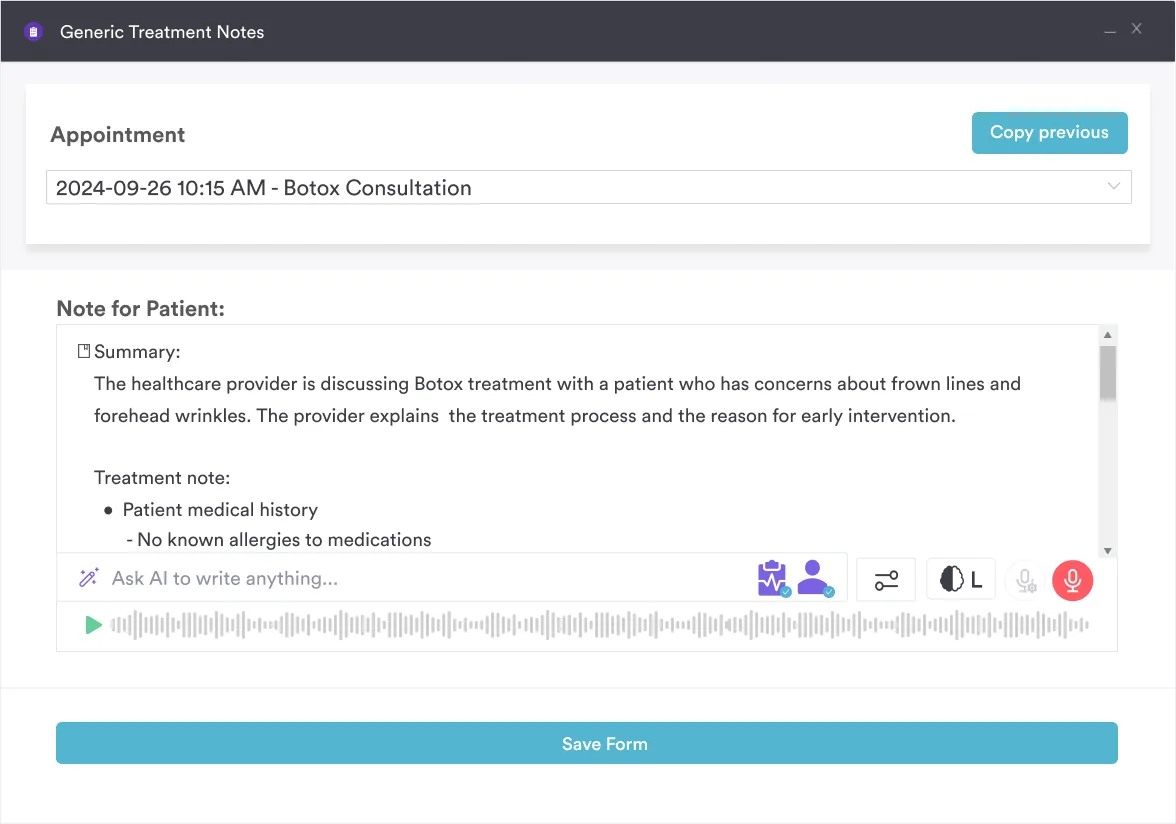
Practice management software like Pabau keeps the forms and the notes in one place. You can send the script out as a digital form and collect a distress rating beforehand. Afterward, log the practice against the client’s record. Pabau Scribe, our AI scribe, drafts the session note so the detail survives a busy day.
That leaves you a trail worth reading at review time. You can see how often a client practiced, which script they chose, and what moved in their scores. Every subscription includes every feature, so the forms, notes, and reporting come as standard.

Pabau’s digital forms and treatment notes keep every script, homework log, and progress score attached to the client record. You can see what is working before the next session starts.

A script only earns its place if the client reaches for it when you are not in the room. So teach one properly and keep the wording steady until it feels familiar. Swapping scripts every session teaches a client very little.
Choose the practice by what your client can tolerate, not by what reads best on the page. A trauma survivor may need grounding before kindness, and a client with depression may need mindfulness alone for a month. Book a demo to see how Pabau keeps each client’s practice and progress in one record.

Want a longer guided practice? Body scan meditation script gives you a full-body practice for clients who need more than five minutes.
Need grounding before kindness? Grounding techniques worksheet covers the sensory exercises that steady a client before any inward practice.
Working on distress tolerance? Distress tolerance skills worksheet sets out the skills clients use when an emotion is too strong to sit with.
Need a care plan for anxiety instead? Anxiety nursing diagnosis structures anxiety symptoms, related factors, and NANDA-I aligned nursing interventions.
Screening for autism spectrum traits? Autism pattern recognition test gives clinicians a structured way to screen pattern recognition with scoring guidance.
It is a guided text that walks a client through Kristin Neff’s three components: mindfulness, common humanity, and self-kindness. Therapists read it aloud in session or assign it as homework, and the client keeps it as a portable regulation skill.
Read the script aloud slowly and pause so each phrase can settle. Watch the client’s body for softer shoulders, slower breathing, or a hand moving to the heart. Afterward, ask what they noticed and which phrase carried the most weight.
Mindfulness means noticing suffering without judgment. Common humanity means recognizing that difficulty is part of being human. Self-kindness means offering yourself the care you would give a good friend. All three matter, and dropping one weakens the practice.
It is a five-minute practice that moves through the three components in order. Clients can use it in session, at home, or in the middle of a difficult moment as a quick way to settle.
Yes. Self-compassion scripts are used in cognitive behavioral therapy, acceptance and commitment therapy, and mindfulness-based programs. They help most with anxiety, depression, shame, and self-criticism. Use one during acute distress, or as a weekly skill-building practice.
The standard break runs five minutes. You can stretch it to 10 or 15 minutes for deeper work, or trim it to two or three minutes for quick grounding. Shorter practices tend to survive as homework.
Yes. The download above holds all three scripts, plus facilitation notes and population adaptations. Print it for clients, or keep it open on screen while you lead the practice in session.