Postural assessment: Free template and step-by-step guide
A postural assessment is a structured clinical evaluation of how a patient’...

1
Last Updated: Oct 13, 2026

A find your why worksheet is a structured set of prompts that leads you to a written statement of purpose. It follows Simon Sinek’s three-step method.
The three steps are collecting peak-moment stories, spotting the themes that repeat across them, and writing a statement shaped as ‘To [contribution] so that [impact].’
Set aside 60 to 90 minutes. Most people need eight to 10 stories before a pattern is clear enough to name.
The statement earns its keep in decisions. Run your hiring, pricing, and service choices through it, and the ones that fight it stand out fast.
Practice management software like Pabau stores reflection work in the client record, so you can pick it up again at the next appointment.
Guided prompts for 10 peak-moment stories, a grid for pulling out the themes that repeat, and space to draft and refine your own why statement. Print it, or send it to your team before a purpose workshop.
Download templateYour why is the purpose behind your work. It sits underneath the job title, the credentials, and the treatment list. For practitioners, that purpose shows up in how you talk to clients, who you hire, and which services you keep offering. A find your why worksheet gives the thinking a structure.
The worksheet walks through Simon Sinek’s three-step method. You collect stories, find the pattern, then write the statement. Plan on 60 to 90 minutes. The harder part comes later, when you use the statement to decide what to offer, who to hire, and what to charge.
A find your why worksheet is a structured set of prompts that leads you from your own stories to a written statement of purpose. It comes from Simon Sinek’s Start With Why framework, which reached a wide audience through his 2009 TED Talk and the book that followed.
Your why sits below your what and your how. Your what is the treatment you deliver. Your how is the method you use to deliver it. Your why answers a different question. Why do this particular work at all?
A dermatologist might land on “to help patients feel at home in their own skin.” A therapist might write “to help people untangle limiting beliefs so they can build closer relationships.” Both are specific enough to argue with, which is what makes them useful.
The worksheet exists for your own clarity. Nobody else has to read what you write in it, so keep the language plain and skip the polish.
Each stage feeds the next one. You move from raw material, meaning your own experiences, to a refined statement you can say out loud. Book the time in a quiet room and turn your phone over.
Start by recalling five to 10 peak moments, the times you felt most like yourself at work. These are rarely the promotions or the awards. They are the moments you lost track of time, or helped someone in a way that stayed with you.
For each one, note what happened, who was there, and why it mattered to you. A clinical psychologist might write: “I gave a teenage patient an extra 20 minutes. When she finally named the feeling, she cried with relief.”
Write freely and stop editing yourself. Grammar doesn’t matter here, volume does. If your mind keeps drifting back to the schedule, a short defusion exercise such as the leaves on a stream script settles it first. The worksheet leaves room for 10 stories, which is enough material to see a pattern.
Read your stories back and mark the threads that repeat. You are looking for the same value, action, or effect showing up in more than one moment.
Themes that come up often in clinical and wellness work include:
Circle the ones you recognize and stop there. This is pattern spotting, not a final draft. If three stories mention moving clients from confusion to clarity, and a fourth mentions the relief of being understood, collapse all four into one idea.
The formula is To [contribution] so that [impact]. The first half names what you bring. The second half names what changes in someone else because of it.
Draft two or three versions from the themes you marked, then cut each one back to about 10 to 15 words.
A therapist working with trauma survivors might write: “To create rooms where people can face pain, so that they take back control of their lives.” A coach might land on: “To ask better questions so that clients find their own answers.”
Read your favorite aloud. Would you still stand behind it in three years? If yes, you have your statement. If it still sounds like a brochure, leave the themes alone for a day and come back to them.
The exercise suits practitioners whose work runs on trust, where purpose and values shape the quality of care directly.
Owner-operators get the most out of it. In small psychology practices, the owner’s purpose and the practice’s positioning are the same thing. The same holds in coaching practices, where clients buy the practitioner as much as the program.
It works on teams too. When everyone completes it alone and then reads their statement out loud, the overlap is usually a surprise. So is the lack of it, which is a signal worth acting on.
Vague motivation becomes a sentence. Plenty of practitioners enter the field with a sense of calling and never put it into words. The worksheet turns that feeling into something you can quote back to yourself when a decision is murky.
Decisions get a filter. Which services to add, whether to hire an associate, how to price a package. Each one can be held up against the statement and tested.
Misalignment surfaces early. Clinician burnout often starts with work that quietly contradicts your values. Naming the purpose makes that contradiction visible while you can still restructure around it.
Hiring conversations get sharper. Saying what you stand for attracts people who want the same thing. It also puts off the ones who wanted something else, and that saves everybody a bad six months.
Clients hear the difference. Credentials establish that you are qualified. Purpose is what makes someone trust the plan you put in front of them, and patient engagement improves when that trust is there.
Filling in the worksheet is the easy half. The statement only does something once it starts shaping choices you were going to make anyway.
Use it in interviews. Describe your practice’s why and watch what the candidate does with it. Skills can be taught later. Agreement about what the work is for can’t be.
Revisit it once a year. Book the reflection like any other appointment and ask two questions. Does the statement still fit, and have I drifted from it? Regular alignment checks are part of therapist burnout prevention. Where you have drifted, change the practice or change the statement, but say out loud which one you picked.
Put it where the team sees it. Pin it in the staff room or the team chat and quote it in meetings. When a difficult client situation comes up, ask how the options serve it.
Use it in marketing and intake. Your why travels further than your qualifications. Work it into your website, your intake forms, and the first five minutes of a consultation.
This check is what turns the statement from a poster into a tool. List the last 10 business decisions you made, whatever they were. A new service, a price change, a hire, a supplier, a Saturday clinic.
Mark each one as aligned, neutral, or against your statement. Then look only at the “against” column. Two entries is normal. Five means either the statement describes who you wish you were, or the practice has drifted and needs pruning.
Repeat the check every quarter and keep the sheets. Over a year, the “against” column becomes the clearest record you have of where the practice actually points.
Run a team purpose workshop. Have every staff member complete the worksheet alone, then bring the group together to read their statements out loud. Write down the themes that repeat and treat them as the practice’s shared why. Pull that list out again at hiring, planning, and review meetings, so it stays a working document rather than a poster. When somebody is running flat, the shared why is often what restarts them.
Paper is the default for reflection work. The finished sheet goes into a folder or a drawer, and nobody opens it before the next session. Whatever the client wrote about their own motivation is gone by the time you’d want it.
Practice management software like Pabau handles it differently. You can build the worksheet as a digital form, send it out before the appointment, and file the answers straight into the client record. Their own words sit next to the treatment notes and the consent forms.
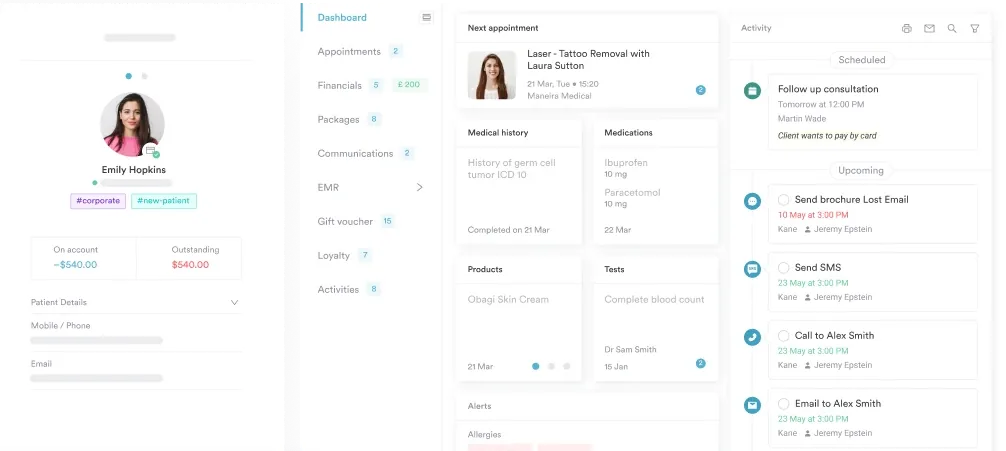
So purpose work carries forward instead of restarting every time. You can open a chart before a session and pick the conversation up where it stopped. The same applies to your own statement and your team’s, which live in one place rather than six notebooks.
The payoff is time back for the work that matches your why. Balanced Aesthetics by Jam reclaimed hours each week after moving its admin into Pabau.

Pabau’s digital forms send your worksheet out before the appointment and file the answers in the client record. You open the chart and the client’s own words are already there, next to their treatment notes.

A why statement is worth exactly as many decisions as you run through it. Write one this week, then use it the next time you price a service or interview a candidate.
Expect the first draft to feel slightly off. That’s normal. It usually sharpens after a week of watching your own choices against it, and the 10-decision check will tell you whether it holds.
If it survives that test, put it somewhere your team reads it, and keep the completed worksheets. Book a demo to see how Pabau stores reflection work alongside every client record.

Working with younger clients on the same questions? The self-esteem worksheet for teens adapts the reflection format for adolescents who are still forming a sense of self.
Found that your work no longer matches your purpose? The boundaries worksheet gives clients a structure for the conversations that protect what matters to them.
Client struggling to name what they feel? emotion wheel worksheet is a free, print-ready template that helps clients explore emotions from primary feelings to complex ones.
Working with clients stuck in old trauma? brainspotting therapy guide covers a technique for trauma that talk therapy alone has not resolved.
Need a structured way to challenge negative thoughts? ABCDE CBT worksheet expands the classic ABC model into a systematic method for challenging distorted thinking.
A why statement is personal. It answers “why do I do this work?” and names the change you create in someone else. A mission statement is organizational and operational, describing what the practice does and how. Your why is the belief sitting underneath that mission.
Aim for 10 to 15 words. It has to be short enough to recall without notes, and specific enough to still sound like you. Shorter is usually better.
Yes. It may shift as you gain experience, as your circumstances change, or as the practice grows. Revisit the worksheet once a year and update the statement if it no longer fits. That’s healthy reflection rather than failure.
Have each person complete the worksheet alone first, then bring the group together to read their statements out loud. Look for values that overlap. The overlap usually strengthens the team, and the mismatches show you what needs a conversation.
You need at least five stories before a pattern shows. If you’re stuck, widen what counts as a peak moment. It doesn’t have to be a professional achievement, so include times you helped a friend or came through a hard stretch. The why often shows up in small interactions.
The three steps come from Simon Sinek’s Start With Why framework and the follow-up book, Find Your Why, which sets out the discovery process. The worksheet puts that method into a form you can work through on your own.