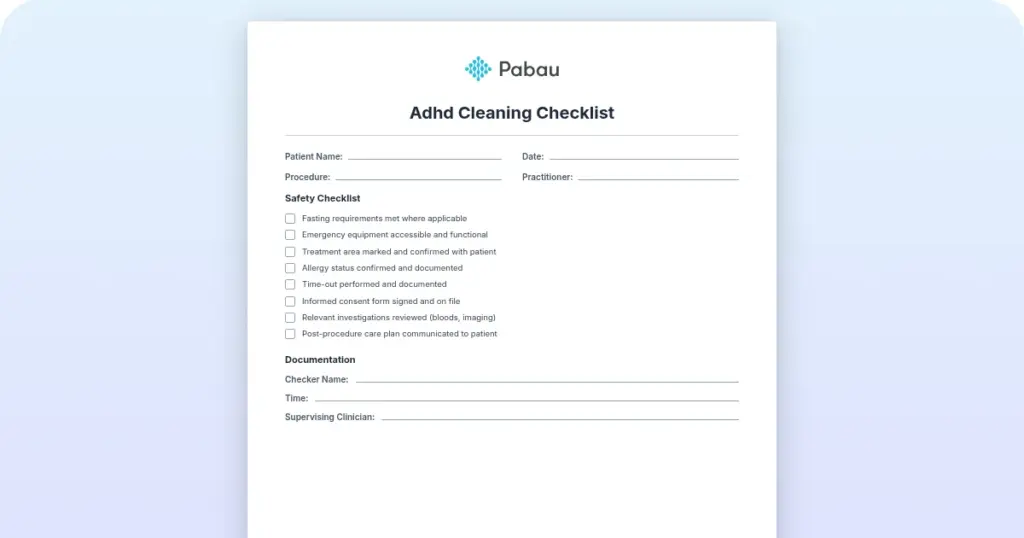
Antipsychotic medication list
An antipsychotic medication list is a structured reference that organizes psychi...

2
Last Updated: Oct 13, 2026

A setting boundaries with parents worksheet is a two-page therapy form that helps adult clients name their limits and plan how to communicate them.
The free template below opens with four reflection questions, then gives space to list boundaries, outline practical steps, and record progress.
The form is deliberately open-ended, so the boundary domains, the assertive phrasing, and the guilt work come from you in session.
Pabau’s digital forms send the worksheet before an appointment and file the completed answers in the client record automatically.
A two-page fillable worksheet with four reflection questions about the parent relationship and three plain-language communication strategies. It also gives clients space to list their boundaries, outline practical steps, and track progress between sessions.
Download templateAdult children often struggle to hold healthy boundaries with their parents. A setting boundaries with parents worksheet gives them a place to write down what they need and how they plan to ask for it. It gives you a repeatable structure for that conversation.
This guide explains exactly what the free template contains, how to use it across sessions, and where you need to add clinical depth yourself. The form is short and open-ended on purpose, so the wording, the boundary categories, and the guilt work stay with the clinician.
A setting boundaries with parents worksheet is a clinical form that helps an adult client identify the limits they want to set with their parents. It then asks them to plan how they will put those limits into practice.
Boundaries with a parent are harder to name than boundaries with a friend or a colleague. Enmeshment, financial dependency, and emotionally immature parental responses all raise the cost of speaking up. A written form lowers that cost, because the client drafts the boundary before anyone has to hear it.
Boundary work is recognized across cognitive-behavioral therapy (CBT), dialectical behavior therapy (DBT), and psychodynamic practice as a legitimate intervention. The logic behind a structured psychiatric assessment applies here too. Clear prompts come first, graded practice comes after.
The template runs to two pages and is fillable. These are its fields, in the order the client meets them:
That is the whole form. It does not script the conversation, sort boundaries into categories, or coach the client through a parent’s reaction. Those pieces come from you, and the sections below cover each one.
The worksheet works best spread across two or three sessions rather than handed over once. Here is a workflow that fits most caseloads:
Logged in a clinical practice management system, each completed worksheet can sit in the client record against a named treatment goal. You can then compare answers session to session instead of relying on memory.
The worksheet is written for licensed therapists and clinical counselors working with adult clients aged 18 and over. It earns its place when:
Private practices, community mental health teams, and larger services with formal patient care management processes all use boundary worksheets. The form suits individual therapy, and it also prepares an adult client for a family session.
It makes the work concrete. Boundary-setting stops being a theme and becomes a written list the client can take home and reread. Nobody has to remember what was said in session.
It creates homework accountability. The client returns with completed sections, which gives the next session an obvious starting point. That structure helps anxious and avoidant clients who otherwise postpone the conversation indefinitely.
It saves setup time. The reflection sequence and the basic communication guidance are already on the page. You spend session time on this family’s dynamics rather than on explaining what a boundary is.
It normalizes the intervention. Handing a client a professional form signals that boundary-setting is a recognized clinical goal. It is not proof of being a bad daughter or an ungrateful son, and that reframe is often the first win.
It supports follow-through. Written homework is a standard CBT component for good reason. A client who leaves with a plan on paper is more likely to attempt the conversation than one who leaves with encouragement.
Filing completed worksheets in a client record system also builds a usable trail for treatment planning, supervision, and case review. Read next to your clinical progress notes, it shows how the boundary goal developed rather than leaving you to recall it.
The worksheet asks clients to list their boundaries without breaking them into categories. Offering these five domains in session gives them a vocabulary for that field, and most people find limits they had not thought to write down.
Most clients struggle in several domains at once. Help them rank the list before they leave, because trying to establish five limits in one conversation usually backfires.
The worksheet names three strategies and stops there: I-statements, an appropriate time and place, and active listening. It gives no wording, so bring phrasing of your own into the session. These examples work in most parent conversations:
Each one holds the limit without attacking the parent, which is the same balance that good patient engagement communication relies on. Role-play them until the client can say the words without rehearsing them in their head first.
Some parent-child dynamics are genuinely harder than others, and the worksheet’s open fields will not surface why. Two patterns deserve explicit attention before a client attempts a boundary.
Enmeshment is a family systems concept coined by Salvador Minuchin in structural family therapy. It describes a lack of emotional separation between family members. Murray Bowen described a parallel problem as fusion, the opposite pole of differentiation of self.
In an enmeshed family, the client’s feelings and decisions sit so close to the parent’s that a boundary can feel like betrayal. The parent may intend no harm and still experience the limit as rejection. Name the pattern out loud, then use the reflection questions to separate the client’s needs from the parent’s.
Emotionally immature parents, a description popularized by clinical psychologist Lindsay C. Gibson, struggle to regulate emotion, take criticism, or respect autonomy. Faced with a boundary, they may escalate, sulk, or go quiet for weeks. Those reactions trigger the guilt and abandonment fear that make a client retreat.
The worksheet has no section on pushback, so plan that part of the work yourself. Clients with enmeshed or emotionally immature parents also need more session time, not less. Budget three or four sessions for boundary work, and expect the client to restate the limit several times before it holds.
These cases sit heavily with clinicians too. Watching for the early signs of therapist burnout matters when a caseload carries several enmeshed families at the same time.
Because the form is open-ended, it adapts to whichever model you work in. What changes is the question you ask about each answer:
Tracking each stage through automated clinical workflows keeps the boundary goal in front of you. Reminders go out on schedule, and the goal is attached to the record instead of a loose note.
Boundary attempts usually fail after the fact, not during. The client says the words, the parent reacts badly, and guilt overrides their resolve within days. The worksheet does not cover this stage, so it belongs in session. Four moves help:
Put the pre-commitment in the progress field. Have the client write down what they will do when they feel themselves caving. That might be calling a friend or rereading their own boundary list.
Plenty of therapy practices email a worksheet as an attachment and hope it comes back. The completed copy lands in an inbox, the boundary goal lives in a handwritten note, and nobody sees either until the next appointment starts.
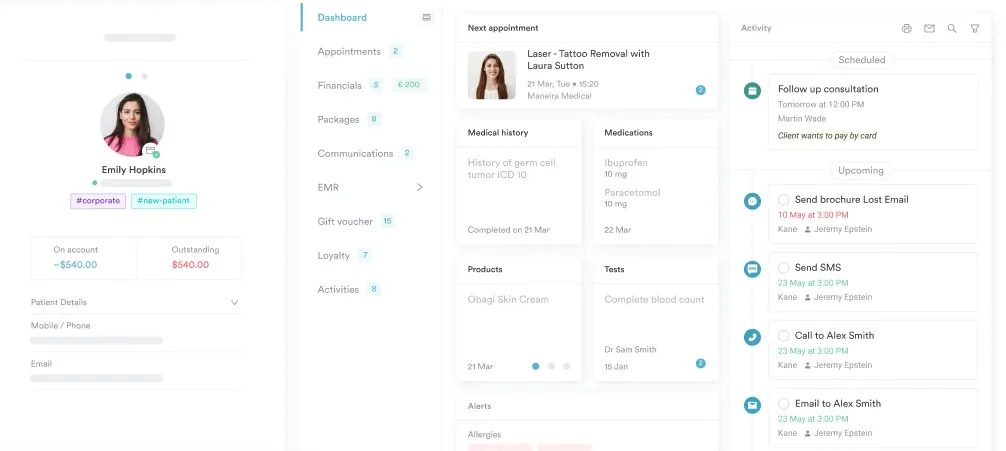
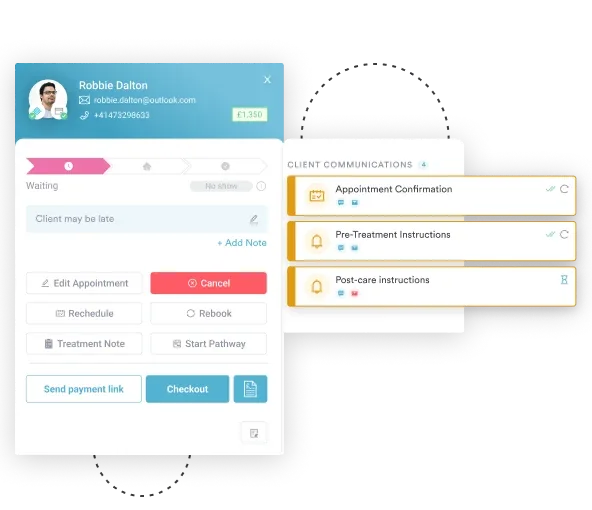
Practice management software like Pabau closes that loop. Digital forms send the worksheet out before the session, and the client fills it in on their phone. The answers arrive in the client record, attached to the right appointment.
From there, automated messages can prompt the follow-up you agreed on. The client hears from you before pressure from a parent wears the boundary down. Session notes, completed worksheets, and treatment goals sit in one timeline. You can see how three months of boundary work has moved without reopening a paper file.

Pabau sends worksheets before the session and files completed answers in the client record. Automated follow-ups keep boundary work moving from one appointment to the next.

Treat this worksheet as scaffolding rather than a program. It gets the client’s needs onto paper and turns a vague grievance into a specific request, which is most of the first session’s work.
The rest is yours. The domain vocabulary, the wording the client will use, and the support that keeps a boundary standing all come from the room. None of it comes from the page. Clients who leave with only the form tend to stall at the practical steps field.
Download the template and adapt it to your client population. Then book a demo to see how Pabau delivers worksheets and stores every completed answer.

Need the full intake picture first? Biopsychosocial assessment template covers biological, psychological, and social history alongside a risk assessment.
Working with a younger client instead? Self-esteem worksheet for teens covers similar ground at an age-appropriate level, before adult boundary work applies.
Want the boundary to turn into weekly action? Intention setting worksheet turns a stated intention into small steps the client can attempt between sessions.
Need boundaries agreed between two households? Parallel parenting plan sets out written rules for contact when direct co-parenting keeps breaking down.
Healthy boundaries with parents take three steps. First, identify where a parent crosses your line. Second, decide what you will do differently, which is the boundary itself. Third, say it calmly and clearly. The worksheet gives you space for the first two steps. Practice the wording with a therapist before the conversation.
The five common domains are emotional, time, financial, physical, and digital. Emotional means you do not manage their feelings or accept criticism dressed up as care. Time means you are available by arrangement, not on demand.
A boundary you can enforce beats one you only announce. If a parent keeps ignoring the limit, decide in advance what you will do instead of arguing, such as ending the call. The worksheet has no section on pushback, so bring that part to your therapist. Guilt and pressure are much easier to hold with support.
A therapist adds four things the form cannot. They name patterns like enmeshment that you may not see yourself. They confirm that your need for a boundary is legitimate. They rehearse the conversation with you until it feels possible. They also help you process guilt and your parent’s reaction afterward.
Guilt is normal and does not mean the boundary is wrong. Ask yourself three questions. Am I responsible for my parent’s emotions? Is this guilt about something I did, or about how I was raised to feel? The worksheet does not cover guilt, so plan for it with your therapist.