Trauma response test: Free template for clinicians
A trauma response test is a structured screening questionnaire that helps clinic...

7
Last Updated: Oct 15, 2026

The Trauma History Questionnaire (THQ) is a validated 24-item self-report tool that screens for exposure to crime, disasters, and physical or sexual trauma.
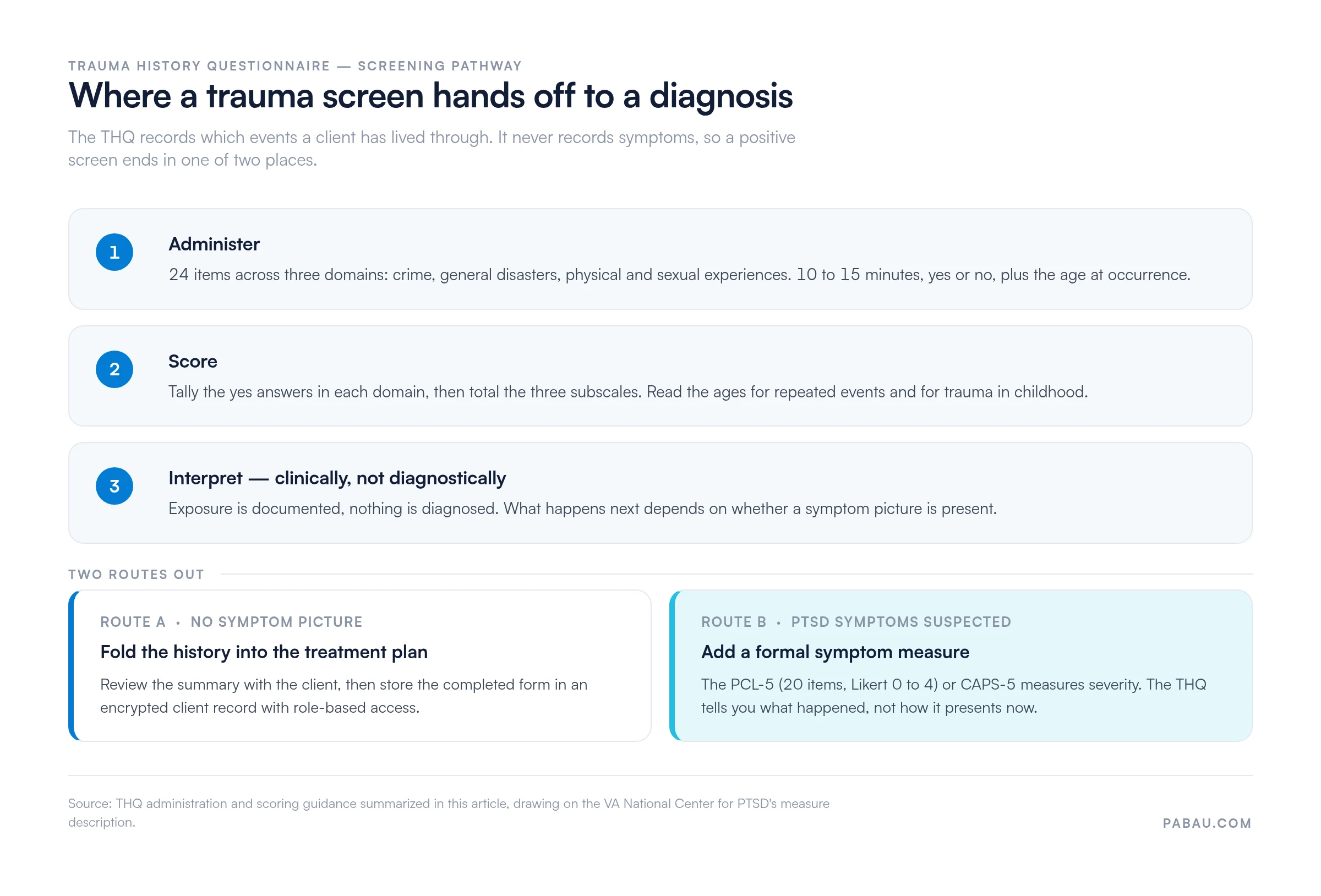
Administration takes 10 to 15 minutes and needs no specialist training. Clients answer yes or no to each event, then give their age at the time.
Scoring means tallying the endorsed items in each domain and totaling them, so the questionnaire documents exposure rather than diagnosing PTSD.
A positive screen is a prompt, not a diagnosis. Follow up with a symptom measure such as the PCL-5 when PTSD symptoms are suspected.
Practice management software like Pabau stores completed questionnaires in the client record, so sensitive trauma histories stay encrypted and access-controlled.
A ready-to-use trauma screening form covering 24 potentially traumatic events across crime, disasters, and physical or sexual experiences. It carries the yes or no response format, the age-of-occurrence fields, and administration guidance. Free for clinical and research use.
Download templateThe Trauma History Questionnaire (THQ) is a 24-item self-report form that records which potentially traumatic events a client has lived through, and at what age. Psychologist Bonnie Green published it in 1996, and most clients finish it in 10 to 15 minutes.
The form covers three domains: crime, general disasters, and physical or sexual experiences. It documents exposure only. That makes it a screening instrument rather than a diagnostic one, which is the distinction that decides how you use the result.
This guide walks through administration, scoring, and the evidence behind the tool. It also covers cultural adaptation and how to store completed forms safely. The free PDF above is ready to drop into your intake pack today.
The THQ is a 24-item self-administered assessment that measures exposure to potentially traumatic events. Clients mark yes or no for each event and note the age at which it happened. Administration takes roughly 10 to 15 minutes and needs no specialist training.
Symptom measures such as the PCL-5 ask how a client feels now. The THQ asks only what happened. It says nothing about PTSD symptoms or functional impairment, and it was never designed to.
Researchers have validated the questionnaire in trauma-exposed civilians, military personnel, substance-use treatment samples, and multicultural community samples. Its brevity and psychometric record have made it a standard first pass in mental health EMR systems and in psychology intake workflows.
The questionnaire sorts exposure into three domains, so you can see both the type and the breadth of what a client has experienced. That structure is what guides your clinical focus afterwards.
Each domain holds several event types, and clients answer yes or no to each one. The form also records the age at which an endorsed event happened. That gives you developmental timing and a rough sense of cumulative burden.
The THQ works on paper or as a digital intake form. The sequence below keeps administration both valid and ethical.
Most clients finish in 10 to 15 minutes, so the form fits an intake slot without crowding out the rest of the conversation. In practice it rarely travels alone. Many teams attach it to a broader mental health intake form, so the trauma history sits beside presenting problem, history, and risk.
Scoring is a count, not a calculation. Tally what the client endorsed, then read the pattern underneath the total.
When childhood events stand out in the answers, a separate instrument can say how severe they were. The Childhood Trauma Questionnaire scores maltreatment severity across five types, each with its own published bands.
Review the results with the client rather than filing them away, and set the history alongside the rest of the biopsychosocial picture. The pathway below shows where the questionnaire stops and a diagnostic measure takes over.
The THQ has solid empirical support behind it. The VA’s National Center for PTSD lists it among the trauma exposure measures it recognizes. The findings that matter in practice:
That record is why the questionnaire holds up as a defensible first pass at trauma history, including in research protocols.
Any clinician who needs a documented trauma history at intake can administer it. These settings get the most out of it:
One limitation matters more than the rest. The THQ is not built to carry a clinical decision on its own. Results need a qualified clinician’s interpretation, and a suspected PTSD picture needs a formal diagnostic assessment. Exposure by itself never justifies medication or crisis intervention.
Several trauma instruments overlap, and the THQ is the one that asks what happened rather than how the client feels now. Here is how the four compare.
The key distinction: the THQ screens exposure. Reach for the PCL-5 when you need symptom severity, and for the TLEQ when you need frequency data alongside exposure. What the THQ gives you is speed and a long validation record.
Trauma events carry different meanings across cultures, and wording that works in one population can miss experiences in another. Research shows the THQ adapts well when four changes are made.
Look for a peer-reviewed adaptation in your client’s language before you translate anything yourself. Academic databases and the published trauma literature are the place to check. Where no validated version exists, work with cultural and linguistic advisers before you administer the English one.
Collecting a trauma history creates a duty of care around the record itself. The tools you use to run a therapy practice are the same ones that have to keep it safe. Practice management software like Pabau covers that path, from sending the form out to controlling who can open it later.
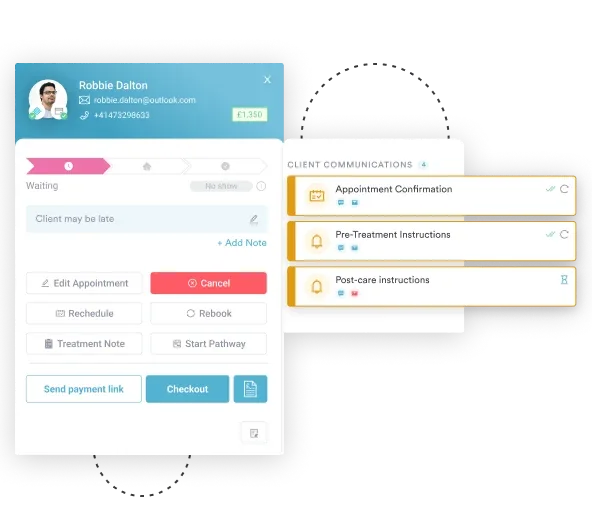
Clients fill the questionnaire in on a tablet or at home, so nobody answers a page about sexual assault at a busy front desk. The answers land encrypted in the client record, next to the notes, the treatment plan, and any risk assessment. Role-based access keeps that material away from staff who have no reason to read it.
Automated workflows can flag a high-risk profile and route that client into a safety protocol. Nobody has to spot it in a pile of forms first. HIPAA and GDPR controls come as standard, and every subscription includes every feature. Nothing about trauma screening sits behind a higher tier.

Pabau’s digital intake forms send the Trauma History Questionnaire out before the appointment and file the answers straight into an encrypted client record. Your team spends less time chasing paper and more time in the session.

The THQ earns its place because it is short, free, and well validated, and because it asks a question most intake packs skip entirely. Adopt it and you stop inferring trauma history from what a client happens to mention.
The trade-off is that a completed form creates a duty you then have to meet. A client who discloses childhood abuse on page two expects the next conversation to reflect it. Decide in advance who reads the form, how quickly, and what happens when the answers are heavy.
Download the template, add it to your intake pack, and agree on the follow-up pathway before the first client fills it in. Book a demo to see how Pabau collects and protects trauma histories for therapy practices.

Need to measure symptoms after a positive screen? PCL-5 template gives you the 20-item symptom measure that picks up where trauma exposure screening stops.
Looking for a fuller diagnostic framework? Psychiatric evaluation template structures the diagnostic interview that a trauma history feeds into.
Worried about a client who discloses active risk? Mental health safety plan gives you a documented protocol to reach for in the same session.
Running trauma work in a group setting? Informed consent in group therapy covers consent where disclosure happens in front of other clients.
The Trauma History Questionnaire is a validated 24-item self-report tool. It screens for exposure to potentially traumatic events across three domains: crime, general disasters, and physical or sexual experiences. It takes 10 to 15 minutes and is used at intake in mental health, psychology, psychiatry, and research settings.
Scoring is a count. Tally the yes answers within each of the three domains to get subscale scores, then add them for a total exposure count. A higher score means broader exposure, not worse symptoms. The THQ documents exposure but does not diagnose PTSD or any other condition. A formal diagnostic assessment, such as the PCL-5 or CAPS-5, is required where PTSD symptoms are suspected.
Yes. The THQ is in the public domain and free for clinical and research use. The template above carries no licensing fee, and neither do the versions published by the VA’s National Center for PTSD and the NIWAP Library.
The three domains are crime-related trauma, general disasters and trauma, and physical and sexual experiences. The first covers robbery, assault, and sexual assault. The second covers natural disasters, accidents, and fires. The third covers childhood abuse, adult sexual assault, and incest. Clients answer yes or no to each item and give their age at the time.
Yes, with adaptations. Research reports successful linguistic and cultural adaptations of the THQ. The usual changes are simpler language, localized event descriptions, and trauma types the population actually faces. Look for a validated adaptation in your client’s language first. Where none exists, consult cultural and linguistic advisers before you administer the English version.
The THQ documents trauma exposure with a yes or no checklist. The PCL-5 measures PTSD symptom severity on a Likert scale. Use the THQ to capture the history at intake, then follow up with the PCL-5 where symptoms or severity tracking are the question.