Mental health self-care checklist
A mental health self-care checklist is a structured daily tool for tracking the ...

5
Last Updated: Oct 20, 2026

A teenage bipolar test is a clinician-administered screener, not a diagnosis. It flags the mood episodes and behavioral changes that warrant a psychiatric evaluation.
Teen bipolar disorder cycles between manic or hypomanic episodes and depressive ones. Overlapping impulsivity and distractibility mean it is often mistaken for ADHD.
Validated instruments such as K-SADS, the Young Mania Rating Scale, and CDRS-R go deeper than any parent-facing screener can.
Pabau’s digital intake forms deliver the screener before the appointment, store the score in the patient record, and trigger specialist follow-up automatically.
A clinician-led screening questionnaire covering manic and depressive episodes, behavioral change, and functional impairment. It includes the scoring bands and the referral action each band calls for.
Download templateIdentifying bipolar disorder in teenagers is clinically hard. Mood symptoms overlap with ordinary adolescent development, ADHD, and anxiety disorders, so the pattern matters more than any single symptom.
A structured teenage bipolar test helps clinicians and parents spot the cycle of manic and depressive episodes behind bipolar spectrum disorder. This guide covers how to administer the questionnaire, how to score it, and what each band should trigger. The scoring section sets a referral clock, not a label.
A teenage bipolar test is a structured screening tool that evaluates mood patterns, behavioral change, and functional impairment in adolescents. It is not a diagnostic instrument. Parents, school counselors, and primary care clinicians administer it as a first step, to decide whether a formal psychiatric evaluation is warranted.
The questionnaire records the frequency, duration, and severity of two episode types. Manic or hypomanic episodes bring elevated or irritable mood lasting days or weeks. Depressive episodes bring persistent sadness, withdrawal, and loss of interest. Results guide clinician judgment, but they never replace a diagnosis made through a structured psychiatric interview against DSM-5 criteria.
Bipolar disorder in adolescents is a mood condition marked by distinct episodes of elevated and depressed mood that cycle over weeks or months. Teen presentations differ from adult-onset bipolar. They show faster mood shifts, more irritability than euphoria, and greater behavioral dyscontrol.
DSM-5 splits the condition into two main types. Bipolar I requires at least one manic episode lasting seven days or more. Bipolar II involves hypomanic episodes alternating with major depression. Early-onset bipolar disorder tends to be more severe and more treatment-resistant than the adult form. Early identification therefore shapes school accommodations, family planning, and medication management.
Bipolar symptoms in teens rarely match the textbook adult presentation. Manic episodes show up less as grandiose euphoria and more as irritability, rage, and increased sexual interest. Risky behavior follows, including substance use and reckless driving. Depressive episodes mirror clinical depression, often with social withdrawal and school refusal.
Duration is the clearest signal. Bipolar episodes run for days or weeks. Ordinary teenage mood swings resolve within hours.
Episode structure is what separates the two. ADHD is chronic and present daily from early childhood, while bipolar involves distinct mood episodes lasting days or weeks with symptom-free periods in between.
Both conditions include distractibility, impulsivity, and hyperactivity, which is why the overlap drives so much misdiagnosis. Bipolar adds prominent mood change, a decreased need for sleep rather than simple sleep deprivation, and risk-taking that clusters inside an episode.
Where the picture leans toward attention symptoms rather than mood episodes, an ADHD screening test is the better instrument to reach for first.
The questionnaire is built for clinician administration during an initial mental health intake. Run it in a private, confidential setting and allow 10 to 15 minutes. For teens under 16, collect parent or guardian responses too, since parents often notice patterns the teen plays down.
Beyond brief screeners, clinicians use validated instruments for in-depth assessment. The University of Pittsburgh Child and Adolescent Bipolar Spectrum Services (CABS) publishes three gold-standard tools.
The Young Mania Rating Scale is the instrument to add to the record once a diagnosis is confirmed. It gives you a repeatable severity score to track treatment response over time.
Scoring is a triage decision, so read the total rather than any single striking answer. The three bands below set the referral timeframe.
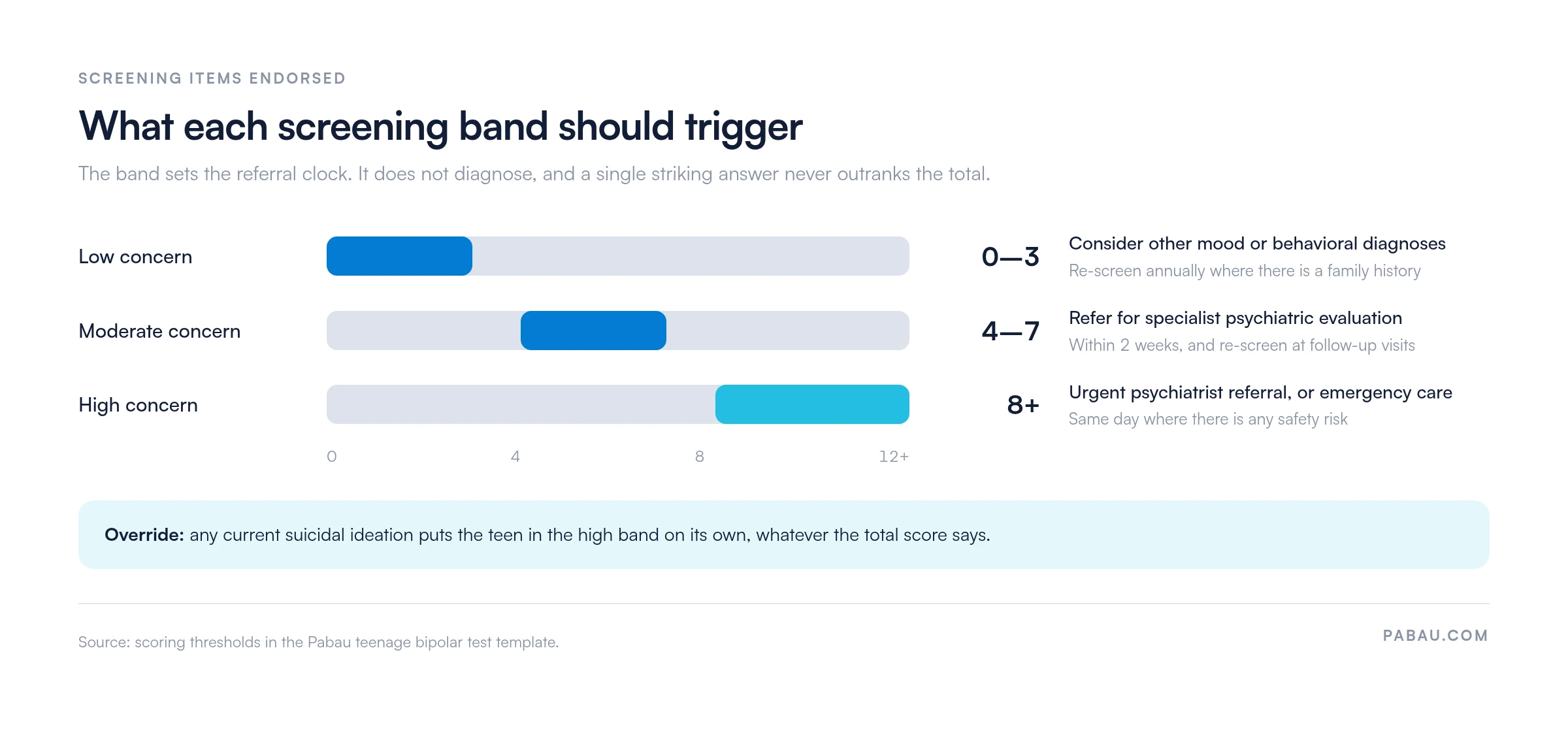
Low concern (0 to 3 items endorsed): Symptoms are inconsistent with bipolar disorder. Consider other mood or behavioral diagnoses, and re-screen annually where there is a family history.
Moderate concern (4 to 7 items): Symptoms warrant specialist consultation. Recommend a psychiatric evaluation within two weeks, and keep screening at follow-up visits to track the pattern.
High concern (8 or more items, or any current suicidal ideation): Refer urgently to a psychiatrist. Go to the emergency department instead where there is an immediate safety risk. Obtain parental consent, and coordinate with the school on behavioral accommodations during the evaluation period.
A positive screen is not a diagnosis. It signals that the teen needs a professional psychiatric evaluation. Share the results with the parents, with the teen’s consent where that is age-appropriate. Recommend a consultation with a child psychiatrist or developmental psychologist within two weeks.
Give the family written psychoeducation on what the evaluation involves, so the appointment is not their first encounter with the process. Document the screening in the patient record along with the referral you recommended.
Follow up after four weeks to confirm the specialist appointment was booked and to check for interim mood or safety concerns. Where suicidal ideation came up during the screening, put a safety plan for teenagers in place before the family leaves.
Evidence-based treatment combines medication with psychotherapy. Lithium is FDA-approved for pediatric bipolar disorder from age 12. The atypical antipsychotics quetiapine, aripiprazole, and risperidone are approved for ages 10 to 17. Valproate and lamotrigine are prescribed off-label in this age group rather than under a pediatric approval.
Psychotherapy options include cognitive behavioral therapy (CBT), dialectical behavior therapy (DBT), and family-focused therapy, which works on family stress and communication patterns. School accommodations under a 504 plan or an IEP address the impact on academic performance, attendance, and peer relationships.
The first year of treatment carries the most weight. Close medication monitoring and regular therapy visits, weekly or every two weeks at the start, improve outcomes and cut hospitalization risk. Families also benefit from psychoeducation on sleep hygiene, stress management, and medication adherence.
Writing the plan down keeps the medication schedule, the therapy cadence, and the school accommodations in one place. A bipolar treatment plan gives the family and the prescriber the same reference between appointments.
Paper screeners get handed over in the waiting room, then transcribed into the record after the appointment. The score ends up inside a scanned PDF, where nobody can search it or compare it to the last visit.
Practice management software like Pabau delivers the same screener as a digital intake form ahead of the appointment. The teen or parent completes it on a tablet or online, and the answers land in the patient record before the clinician walks in.
Because the score is a stored field rather than a scan, it can trigger the next step on its own. A high band flags the record for same-day specialist consultation, and automated workflows book the follow-up appointment.
Our therapy practice management platform keeps the screening, the referral, and the clinical note on one patient timeline. The next clinician sees the whole sequence without a records request.
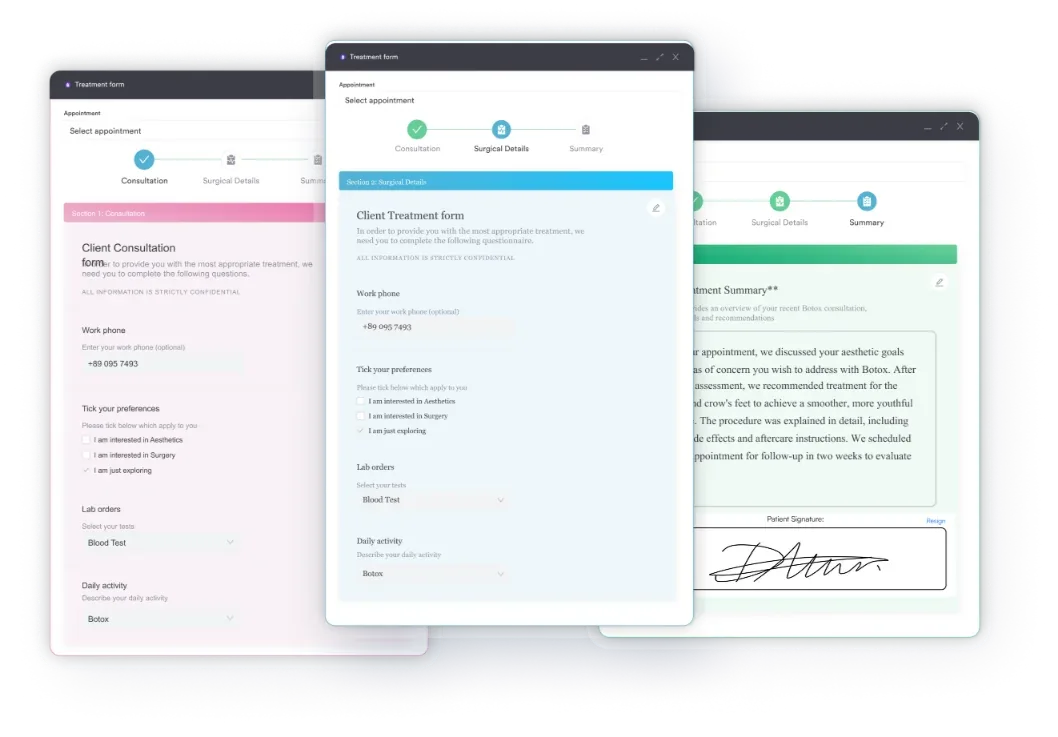

Digital screening forms, automated specialist referrals, and integrated patient records help your practice identify and manage bipolar disorder risk with confidence.

A teenage bipolar test earns its place by shortening the distance between a worried parent and a psychiatric evaluation. It will never produce a diagnosis, and treating it as one is the failure mode to guard against.
The judgment worth keeping is the duration rule. Mood that lifts within hours is ordinary adolescence. Mood that holds for days or weeks is a reason to refer. Score the screener, act on the band it lands in, and document the referral you recommended.
Book a demo to see how Pabau delivers screening forms, scores them into the patient record, and books the specialist follow-up for you.

Screening an adolescent for the first time? Adolescent intake questionnaire collects the developmental, family, and school history the bipolar screener assumes you already hold.
Need to rule ADHD in or out? ADHD screening test template covers the attention and impulsivity items that overlap with mania, so you can separate the two.
Tracking mood between appointments? Daily mood chart gives the family a simple log that shows episode duration rather than a single bad day.
Ruling out chronic irritability? Disruptive mood dysregulation disorder sets out the DSM-5 criteria for the diagnosis most often confused with pediatric bipolar.
Documenting the full evaluation? Psychiatric evaluation template structures the mood, cognition, and risk sections of the diagnostic interview your referral leads to.
A teenage bipolar test is a structured screening questionnaire administered by clinicians or parents to identify potential signs of bipolar disorder in adolescents. It is a preliminary assessment rather than a diagnostic tool, and it flags whether a professional psychiatric evaluation is warranted. Results guide referral decisions and help separate bipolar symptoms from ADHD, anxiety, or normal developmental mood variation.
No. A screening questionnaire cannot diagnose bipolar disorder. Only a psychiatrist or psychologist running a comprehensive evaluation against DSM-5 criteria can make the diagnosis. A positive screen means your teen should see a specialist. That specialist will conduct a detailed interview, review family history, and may order lab tests before confirming anything.
The key difference is episode structure. Bipolar involves distinct mood episodes lasting days or weeks, with clear symptom-free periods, while ADHD is chronic and present daily. Bipolar also brings a decreased need for sleep, whereas ADHD involves difficulty falling asleep. Risky behavior in bipolar clusters inside manic episodes, while ADHD impulsivity is less pattern-based.
Schedule a consultation with a child psychiatrist or developmental psychologist within two weeks. If your teen is having suicidal thoughts or is in immediate crisis, contact the 988 Suicide & Crisis Lifeline or go to the nearest emergency department. Do not delay the evaluation, because early treatment significantly improves outcomes.
Yes. Adolescent bipolar disorder responds well to a combination of medication, psychotherapy, and school accommodations. Lithium and several atypical antipsychotics carry pediatric FDA approval, while valproate and lamotrigine are prescribed off-label. With early identification and consistent treatment, many teens reach a stable mood and return to normal school and social functioning.
Three gold-standard instruments cover the assessment. K-SADS is a structured diagnostic interview against DSM-5 criteria. YMRS, the Young Mania Rating Scale, rates manic symptom severity, and CDRS-R rates depressive severity. All three are clinician-administered, published by the University of Pittsburgh CABS program, and widely used in psychiatry practices.