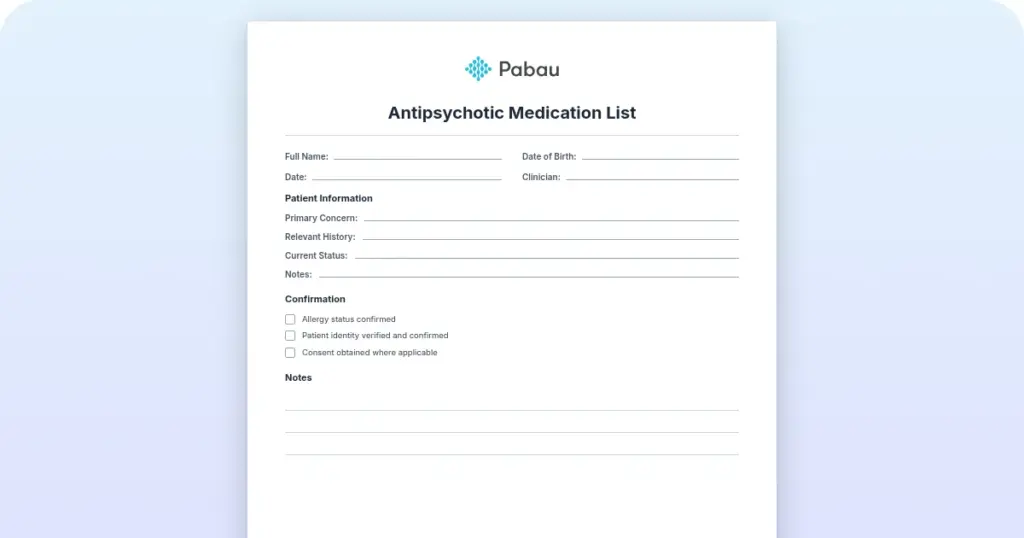
Antipsychotic medication list
An antipsychotic medication list is a structured reference that organizes psychi...

2
Last Updated: Oct 13, 2026

A people pleasing worksheet helps clients name their approval-seeking patterns and trace where those patterns started.
The worksheet pairs trigger identification with a gain-versus-cost review and a short action plan.
Assign it through your client portal before the session, then review completed entries across appointments to spot which boundaries stay hardest.
The clearest signs are chronic over-apologizing, conflict avoidance, and resentment that arrives after giving.
The template downloads as a free PDF you can print for the session or complete on screen.
This people-pleasing worksheet PDF covers name and date fields, a recent-situation reflection, trigger identification, a gain-versus-cost review, and action-plan prompts. Print it for in-session use or share it as a fillable file.
Download templateSearch for a people pleasing worksheet and most results are self-help handouts aimed at the person doing the pleasing. This one is written for the clinician. It is a tool you assign, review, and track across a course of therapy.
A mental health EMR paired with a structured worksheet gives you both halves of the job. The worksheet does the clinical work. The system handles delivery, reminders, and the record of what the client wrote.
If you came looking for a workbook to fill in yourself, the exercises work that way too. Below you’ll find what the worksheet contains, the cognitive behavioral therapy (CBT) techniques behind it, and how to run it across sessions.
People-pleasing is a pattern of putting other people’s approval ahead of their own needs, feelings, and limits. It usually traces back to fear of rejection, low self-worth, or earlier relational trauma. According to the American Psychological Association, approval-seeking behavior is frequently linked to anxiety disorders and anxious attachment styles.
In session the pattern shows up as difficulty saying no, over-apologizing, and over-explaining ordinary choices. Clients drop their own boundaries to keep a relationship steady, then feel guilty when they finally set a limit. The worksheet gets those moments onto paper so you can examine them together.
The clearest signs of people-pleasing behavior are chronic over-apologizing, an inability to refuse a request, and resentment that arrives after giving. The list below covers those three and five more to watch for in session.
Clients often describe these behaviors as a personality trait rather than a habit they can change. Naming each behavior reframes it. A specific list turns “I’m just too nice” into habits you can work on.
People-pleasing causes usually sit in one of five places. The five below are the ones worth working through in session.
Naming the origin gives clients self-compassion, which matters because the alternative is treating the pattern as a character flaw. The Beck Institute identifies the core beliefs that drive the behavior. Two show up constantly: “I am only worthy if others approve of me” and “conflict is dangerous.”
Clients often describe the resentment as other people taking advantage of their kindness. Sometimes they are right. The gain-versus-cost prompts help separate genuinely one-sided relationships from the ones a client’s approval-seeking belief has distorted.
A people pleasing worksheet is a clinical tool that combines psychoeducation with structured exercises, working as both an assessment and an intervention. Used in session or assigned as homework, it moves a client through awareness, triggers, the payoff and the cost, then a concrete action plan.
Its second job is to carry the work between appointments. Clients record the moments where a boundary slipped, then draft the response they wish they had given. You review those entries at the start of the next session and refine the script together.
Clients stop people-pleasing by learning to notice the approval-seeking thought, testing it against evidence, and practicing a boundary in a low-stakes situation first. These five steps run that sequence through the worksheet.
Three cognitive-behavioral interventions do the clinical work around the worksheet. Core belief identification asks the client to name the thought underneath the behavior, such as “if I say no, they will reject me.” Cognitive restructuring then weighs the evidence for and against that belief and produces a balanced replacement.
Thought records follow the standard CBT sequence of situation, automatic thought, emotion, evidence for and against, then revised thought. Here is how that looks filled in for a typical people-pleasing moment.
| Situation | Automatic thought | Emotion | Evidence for and against | Revised thought |
|---|---|---|---|---|
| A colleague asks you to cover their Friday shift for the third week running. | “If I say no, they will think I am selfish and stop asking me anything.” | Anxiety at 80 percent, guilt at 65 percent. | For: they looked annoyed last time. Against: I declined in March and nothing changed between us. | Saying no once may disappoint them briefly. It will not end the working relationship. |
The row above is an illustration rather than a client case. Filling one in during the session shows the client how the sequence works. The homework version then comes back completed far more often.
The people-pleasing exercises in this section are graded, so a client starts small and works up. Early prompts cover declining a minor request or setting a small limit with a colleague. Later ones move into a primary relationship, or into family territory where boundaries with parents are hardest to hold.
Give the client a four-part formula for the wording.
Role-play in session before the client tries any of it outside. The reflection section then asks them to record what they felt afterward. Over a few rounds, clients collect their own evidence that relationships survive an honest no.
The pattern looks the same on the surface across these three groups, but the clinical work underneath differs. Adjust how you frame the worksheet accordingly.
Autistic people pleasing usually functions as masking. The client suppresses genuine preferences, sensory needs, and communication style to match neurotypical expectations. Frame the worksheet around the cost of masking rather than around social skills, and the exercises land differently.
That overlap matters for treatment planning. Pushing an autistic client toward more assertive social behavior can deepen the masking you are trying to reduce.
A people pleasing empath absorbs other people’s emotional states and then treats managing them as a duty. The boundary work here is emotional rather than logistical. Psychoeducation on compassion fatigue tends to open the conversation faster than the assertiveness scripts do.
Clients with anxiety disorders use approval-seeking as a safety behavior, managing fear by controlling how others see them. Treat boundary-setting as exposure work. Language like “this might make them briefly unhappy, and that is survivable” does more than reassurance.
Assign the worksheet early when you are still building awareness, or later when the client is ready to practice skills. For clients with severe social anxiety, complete the first pass in session. Filling it in with you present reduces shame and models the honesty you are after.
Therapy worksheets work best in a sequence rather than as a single handout. Pair this one with a boundaries worksheet or a cognitive distortions record, depending on where the client is stuck. Clients then have something concrete to work from between appointments.
Set expectations about pace. People-pleasing is often a decades-old pattern, so progress shows up as a slightly better boundary response or a moment of guilt-free limit-setting. Say that out loud early and clients stop reading slow progress as failure.
Review completed worksheets in sequence rather than one at a time. Watch for which boundaries stay hardest, which relationships trigger the most approval-seeking, and which assertiveness scripts a client reuses. That pattern tells you where to spend the next session, and it gives you something concrete to show a client who thinks nothing has changed.
Emailing the PDF and then chasing it by hand is the usual routine. Practice management software like Pabau turns the worksheet into a digital form you assign to a named client with a due date. It arrives in their client portal, and they complete it on a phone before the appointment.
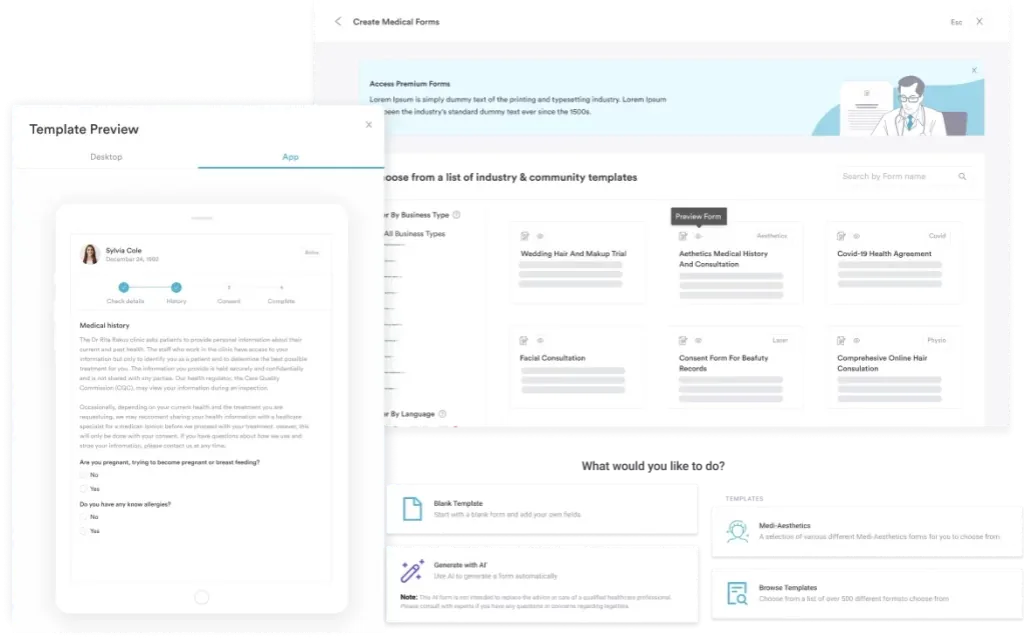
Anything still outstanding flags as overdue on your dashboard, so nobody has to remember who was sent what. Completed answers save straight into the client record, alongside your psychotherapy progress notes. At the next appointment you open one screen and see every entry the client has written since intake.
That last part is what turns a handout into data. A therapy practice management system lets you read six weeks of boundary attempts side by side and see which relationship keeps showing up.

Pabau’s digital forms send the people pleasing worksheet to a client’s portal, flag it when it’s overdue, and file the answers in their record. Your session time goes to reviewing the answers instead of handing out paper.

A worksheet handed over once is a handout. The same worksheet assigned, reviewed, and reassigned across a course of therapy becomes a record of how a client’s boundaries changed.
The trade-off is administrative. Running it properly means tracking who has completed what, and that gets heavy past a dozen clients. Decide up front whether you will carry that manually or let a system do it.
Download the template, run it through two or three clients, and see what the completed entries tell you. Book a demo to see how Pabau assigns worksheets, chases the overdue ones, and files every answer in the client record.

Working with anxious, intrusive thoughts? Leaves on a stream script gives you a defusion exercise for the approval-seeking thoughts this worksheet surfaces.
Ready to challenge a client’s fixed belief? Core belief worksheet helps a client name a belief, weigh the evidence, and test it with an experiment.
Not sure which relationships drain the client most? Friendship questionnaire maps where the giving runs one way before the boundary work starts.
Working on emotional limits rather than logistical ones? Emotional boundaries worksheet suits empathic clients who absorb other people’s moods.
Need to soften the shame this work surfaces? Self-compassion meditation script gives clients a practice for the guilt that follows a first boundary.
A people pleasing worksheet is a structured clinical tool for assessment and intervention. It helps clients identify approval-seeking behaviors, explore where they came from, and practice boundary-setting and assertiveness using CBT techniques.
Start by naming the core belief driving the approval-seeking, such as “I must keep everyone happy.” Then test that belief against evidence, and practice setting boundaries in low-stakes situations before harder ones. The worksheet structures that progression.
Yes. CBT targets the core belief behind the behavior, such as “if I say no, I’ll be rejected.” Cognitive restructuring builds a more balanced replacement thought. Boundary-setting then works as a behavioral experiment that shows disapproval is survivable.
Yes. People-pleasing is frequently associated with anxiety disorders, anxious attachment from early relationships, and trauma where conflict was unsafe. The Anxiety and Depression Association of America (ADAA) notes that approval-seeking behaviors intensify under stress.
Complete the behavior checklist together in the first pass, so you can model the level of honesty you want. Assign the boundary exercises as between-session work. Then open the next appointment by reviewing what the client wrote.
They get a pattern out of the client’s head and onto paper, where you can both examine it. They carry the work between appointments. Over time they build a record you can read back to show a client how far they have moved.