Bear hug test: Procedure, interpretation and free template
The bear hug test is a quick shoulder special test that screens for subscapulari...

3
Last Updated: Oct 23, 2026

Pain management treatment plans structure assessment, goal-setting, and multimodal interventions for acute and chronic pain conditions.
Templates must document pain scales (NRS/VAS), patient history, intervention protocols, and progress metrics for clinical compliance and patient safety.
Multimodal approaches combining pharmacological, interventional, and non-pharmacological therapies improve outcomes and reduce opioid dependence.
Practice management software like Pabau streamlines template completion with digital forms and AI-assisted documentation, keeping clinical records consistent and compliant.
Pain Management Treatment Plan Template
A comprehensive clinical documentation tool covering patient history, pain assessment scales (NRS/VAS), treatment goal setting, multimodal intervention protocols (pharmacological, interventional, and non-pharmacological), and progress tracking for acute and chronic pain conditions.
Download templatePain often gets assessed reactively, with observations documented after the fact instead of within a structured framework. That produces inconsistent records, unclear treatment decisions, and compliance risk.
According to the CDC, a documented pain management treatment plan is foundational to safe prescribing, multimodal therapy coordination, and measuring patient progress. This guide covers the essential elements of a pain management treatment plan and how to implement one in your practice.
A pain management treatment plan is a clinical document that outlines the assessment, diagnosis, goals, and intervention strategy for a patient experiencing acute or chronic pain. It serves as both a clinical guide and a compliance record. It documents the clinician’s reasoning, the patient’s baseline pain level, and the therapeutic pathway chosen.
The template typically includes:
Pain management treatment plans are essential in physical therapy, sports medicine, chiropractic, osteopathy, functional medicine, and primary care settings. They align with current clinical best practice and support evidence-based decision-making, particularly when coordinating care across multiple practitioners (e.g., physical therapist, physician, and interventional pain specialist).
The template is structured in five operational steps that mirror the clinical decision-making process. Complete each section systematically during the initial consultation, then review and update at each follow-up appointment.
When using digital forms to deliver this template to patients pre-appointment, you streamline data collection and ensure no fields are missed.
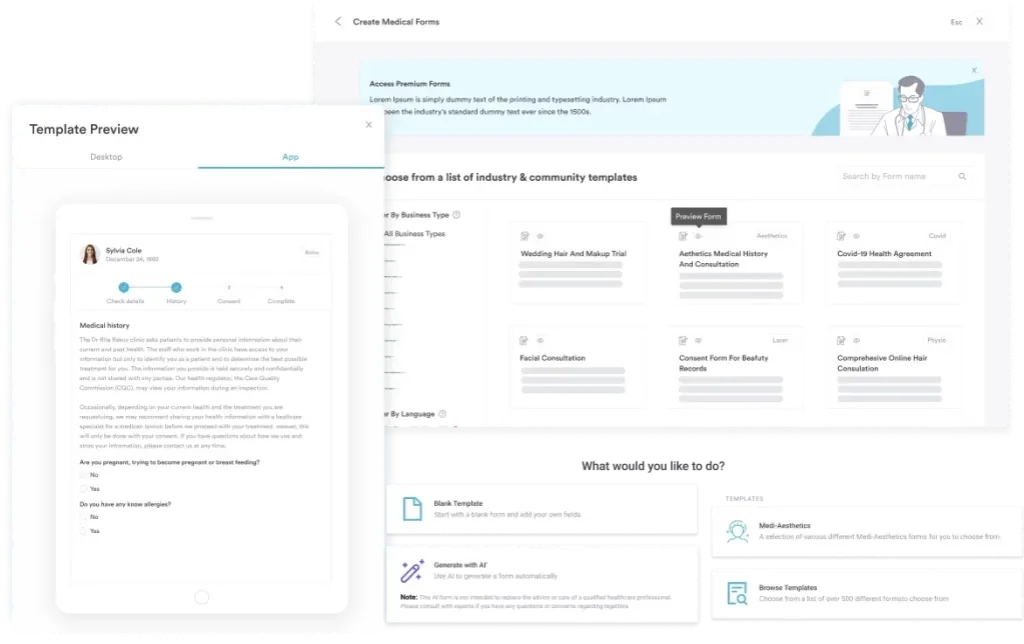
Completed forms belong in structured medical records management, not a filing cabinet.

Digital forms and AI-assisted notes transform pain management template completion into a frictionless workflow. Clinicians spend less time writing, more time treating patients.

This template is designed for any clinician or multidisciplinary team managing pain. Specific use cases include:
Physical therapy software and sports medicine clinic software that supports digital templates reduce administrative burden and keep clinicians focused on treatment outcomes. Practices considering opening a physical therapy clinic in Arizona need to meet its licensing and registration requirements first.
Clinical consistency: Standardized templates ensure every patient receives the same quality of assessment and documentation, reducing clinician-to-clinician variation and improving care continuity when patients see multiple providers.
Regulatory and legal protection: A documented plan demonstrates to regulators, licensing boards, and insurers that treatment decisions are evidence-based and intentional. If care is questioned, the written plan provides a clear audit trail of your clinical reasoning.
Improved treatment outcomes: Written goals and intervention selection increase patient adherence and clinician accountability.
Multimodal coordination: When managing complex chronic pain, a shared written plan ensures physical therapy, medication management, interventional procedures, and psychology are sequenced logically and communicated across the care team.
Progress measurement and adjustment: Baseline pain scores and functional goals allow you to measure treatment efficacy objectively. At each reassessment, you can modify interventions based on evidence rather than assumption.
Time efficiency: Digital templates with prefilled fields and dropdown selections speed up documentation.
Document contraindications and relative risk factors upfront – allergies, medication interactions, structural barriers to procedures, psychological comorbidities. Revisit these at every reassessment. A patient’s contraindication status may change (e.g., pregnancy status, new medication), and early flagging prevents adverse events and litigation risk.
Standardized pain assessment tools ensure reliable baseline measurement and track treatment response. The most widely used include:
Select one primary tool for your practice (e.g., NRS) and administer it consistently at baseline and follow-up. Pairing it with a quality of life assessment captures how pain affects daily function beyond the numeric score. A dedicated ADL assessment tool added to the same intake captures activities of daily living alongside the pain score.
Evidence supports multimodal approaches that combine pharmacological, interventional, and non-pharmacological interventions. These outperform single-modality treatment for most pain types, and a documented protocol keeps the entire team on the same sequence and rationale.
Document the rationale for sequencing. For example: “Patient will begin weekly physical therapy and daily home stretches (non-pharmacological) for 4 weeks. If pain remains >5/10 at week 4, topical and oral non-opioid agents will be added. Reevaluate at week 8 for interventional referral consideration.”
A documented pain management treatment plan transforms pain care from reactive documentation into proactive, evidence-based treatment. It aligns with regulatory standards, protects your practice from liability, and most importantly, improves patient outcomes by making the treatment strategy transparent and measurable.
The template covers the five pillars of safe, effective pain management: intake and history, pain assessment, pain classification, goal-setting with multimodal intervention selection, and reassessment. Book a demo to see how Pabau’s digital forms and clinical documentation tools make template completion seamless and keep your team synchronized on every patient’s care plan.

Assessing a cavovarus foot deformity? Coleman block test shows in under two minutes whether the deformity needs soft-tissue release or bony osteotomy.
Scoring an expressive vocabulary test? EOWPVT scoring guide covers administration, score bands, and the differences between EOWPVT-4 and EOWPVT-5.
Suspecting a high ankle sprain that tests missed? fibular translation test catches high ankle sprains when standard lateral ligament tests come back clean.
A pain management treatment plan template is a structured clinical document used to assess, plan, and monitor pain interventions. It captures patient history, baseline pain severity, treatment goals, multimodal interventions, contraindications, and reassessment schedules — serving as both a clinical guide and a compliance record.
It depends on acuity and intervention type. Acute pain typically requires weekly or biweekly reassessment; chronic stable pain monthly or quarterly. After any new intervention, reassess within 2–4 weeks to evaluate efficacy. Always document the reassessment schedule in the plan.
The Numeric Rating Scale (NRS, 0–10) is the most practical — simple, fast, and sensitive to change. The Visual Analog Scale (VAS) is more precise but slower. For functional outcomes, use condition-specific tools like the Oswestry Disability Index (back pain) or Brief Pain Inventory (chronic or cancer pain). Pick one and use it consistently.
Write out the sequence and rationale for each modality. Example: “Begin physical therapy for 4 weeks. If pain remains above 5/10, add a non-opioid analgesic. At week 8, consider interventional referral.” This shows decisions are evidence-based, intentional, and reviewed at defined checkpoints.
List absolute contraindications (medication allergy, structural barriers to a procedure) and relative contraindications (pregnancy, uncontrolled comorbidities, drug interactions). Update this section at every reassessment — patient status changes over time and new contraindications may require plan modification.