Head to toe assessment cheat sheet: Printable nursing guide
A head to toe assessment cheat sheet gives you one fixed order at the bedside, s...

3
Last Updated: Oct 23, 2026

The lift off test, also called Gerber’s lift off test, checks subscapularis muscle and tendon integrity through active internal rotation against resistance.
A positive result means the patient cannot lift or hold the back of the hand away from the lumbar spine. That points to a possible full-thickness subscapularis tear.
Sensitivity is moderate (18-50%) and specificity high (84-100%), so a positive test rules pathology in far better than a negative test rules it out.
When restricted internal rotation blocks the standard test, substitute the Bear Hug or Belly Press test. Both reach the subscapularis from a different arm position.
Practice management software like Pabau keeps special test findings, clinical notes, and shoulder assessment outcomes in one structured client record.
Anterior shoulder pain with weakness on internal rotation is one of the most common presentations in musculoskeletal (MSK) practice. The subscapularis is frequently the culprit, and it is also the rotator cuff muscle most often missed. The lift off test, also known as Gerber’s lift off test, isolates subscapularis function at the bedside with a single maneuver.
The patient places the back of the hand against the lumbar spine and tries to lift it away. Failure to lift the hand, or to hold it there against resistance, is a positive sign. Christian Gerber first described the test in 1991, and it has stayed in routine use since.
For physical therapists and sports medicine practitioners, reading the result correctly shapes whether a patient goes to imaging or straight into rehab. This guide covers the procedure, the positive-sign criteria, the accuracy data, and the limitations. It also compares the test with the Bear Hug, Belly Press, and Napoleon alternatives.
The lift off test, also known as the lift off sign test, is a clinical test of subscapularis muscle and tendon integrity.
The patient places the dorsum of the hand against the lumbar spine, then tries to lift the hand away from the back. Being unable to do that, or to hold the position against examiner resistance, is a positive finding.
It earns its place in a shoulder assessment because subscapularis tears behave differently from the rest of the cuff. Supraspinatus tests will not find them. A shoulder examination with no subscapularis-specific maneuver can read as clean over a torn tendon.
Consistency matters as much as technique. A team that agrees on one testing sequence gets findings that compare cleanly across clinicians and across visits. Settle that sequence early, the way you would any other protocol when opening a physiotherapy clinic.
The subscapularis lift off test targets the largest and strongest of the four rotator cuff muscles. The muscle originates from the subscapular fossa of the scapula and inserts onto the lesser tubercle of the humerus. Its main jobs are glenohumeral internal rotation and anterior stabilization of the humeral head in the glenoid.
Subscapularis tears present differently from supraspinatus or infraspinatus pathology. Patients report anterior shoulder pain, weakness carrying objects with the arm internally rotated, and difficulty reaching behind the back. Isolated subscapularis tears are less common than supraspinatus tears. They are also frequently missed without targeted testing.
To perform the lift off shoulder test, have the patient place the back of the hand on the lumbar spine and lift it away. The three steps below break that down. Check first that the patient has enough internal rotation range of motion (ROM) to reach the lumbar spine. Use the same sequence every time to keep examiner variability down.
Have the patient stand. Ask them to place the back of the hand of the affected side flat against the lumbar spine, roughly at L3 to L5. The arm sits in internal rotation with the elbow moderately flexed. The dorsal surface must contact the lower back, not the palm.
Instruct the patient to lift the hand away from the back, pushing posteriorly against no resistance. This screens active subscapularis function. Record whether they can start the movement and sustain it without help.
If the patient can lift the hand off, place your own hand between their hand and their back. Apply gentle isometric resistance and ask them to hold the position. Being unable to sustain it against resistance also counts as a positive finding.
The internal rotation lag sign is a variant of the same test. The examiner passively holds the hand away from the back in maximum internal rotation, then lets go.
A positive lag sign is the patient failing to hold that position, so the hand drops back toward the lumbar spine. This variant picks up larger or complete subscapularis tears and carries higher specificity.
The lag sign reuses the starting position you are already in, so it adds one maneuver rather than a whole extra test. That makes it cheap enough to include in every shoulder screen.
A positive lift off test means the patient cannot lift the back of the hand off the lumbar spine, or cannot hold it there. Either failure counts. Specifically, the test is positive when the patient cannot do one or both of the following:
A positive result raises suspicion for subscapularis tendon pathology. Within a full shoulder assessment it is consistent with a partial or full-thickness tear. Imaging by MRI or ultrasound is still needed for definitive characterization. Pain during the test without motor weakness is a much less specific finding.
The lag sign has its own positive criterion. If the hand drops when the examiner releases passive support, the patient cannot hold internal rotation actively. That correlates more strongly with complete subscapularis tears. Always record which component was positive: the active lift, the resisted hold, or the lag sign. That single detail is what a referring surgeon reads first.
The Barth et al. (2006) study in Arthroscopy remains the most cited reference for lift off test accuracy. Sensitivity is moderate and specificity is high for full-thickness subscapularis tears. In practice, that means the test rules pathology in better than it rules pathology out.
The wide sensitivity range reflects variation in study populations, tear size, and whether partial tears were included. High specificity means a positive lift off test carries meaningful diagnostic weight, because false positives are uncommon. Gerber and Krushell (1991) first described these characteristics, and later studies refined the figures as sample sizes grew.
Read the accuracy data against the clinical picture in front of you. The lift off test alone is not diagnostic, and a positive finding should prompt an imaging referral.
The test has one significant practical constraint. It cannot be performed reliably when the patient cannot get the back of the hand onto the lumbar spine. That happens when internal rotation is restricted by pain, joint stiffness, post-surgical limits, or a concurrent supraspinatus tear.
When the test cannot be completed, the note matters more than usual. Write down what stopped it, what you did instead, and what you concluded. A blank field in the record reads as if the subscapularis was never assessed at all. In older patients who struggle to follow the positioning instructions, a screen like the Montreal Cognitive Assessment test can clarify whether comprehension, not the shoulder, limited the exam.
Document which component of the lift off test was positive, or note that it could not be performed. Record whether the weakness was motor-driven or pain-limited. That single distinction shapes onward management and gives a referring surgeon something to act on.
No single subscapularis test has enough sensitivity to rule out pathology on its own. The four main tests each load a different part of subscapularis function, which makes them complementary rather than interchangeable. Chiropractic practice software with structured examination templates keeps these tests recorded the same way across a team.
The Bear Hug test has the highest sensitivity of the four, at roughly 60% for full-thickness tears in the Barth study. That makes it the preferred substitute when the standard lift off test cannot be completed. The Belly Press and Napoleon tests share a similar elbow-anterior position but differ at the wrist.
In the Napoleon test, a positive sign is the wrist dropping into flexion as the patient presses the hand into the abdomen. That drop suggests the subscapularis cannot hold a neutral wrist under load.
Neer’s test belongs to a different family of examination, despite often appearing in the same shoulder screen. It loads the subacromial space to look for impingement, so it says nothing about subscapularis integrity. The same goes for Speed’s test, which loads the long head of the biceps. Keep the two groups of test separate when you interpret a shoulder exam.
Use the lift off test in any shoulder special test battery where subscapularis pathology is on the differential. The presentations below are the ones that should trigger it.
Practices carrying sports injury and post-operative shoulder caseloads gain most from a standardized approach to cuff testing. Running the same tests in the same order keeps findings comparable across reassessment visits and across clinicians. The return-to-sport physical therapy protocols used in elite sport lean on that same consistency for confident discharge decisions.
In the same sports caseload, the Elson test screens a jammed finger for central slip rupture before the athlete returns to play.
Most MSK caseloads run more than one special test battery. The Thessaly test at the knee and the Gaenslen test at the sacroiliac joint belong to the same family of orthopedic maneuvers. Standardizing all of them together is less work than standardizing each one on its own.
For wider context, the American Physical Therapy Association publishes guidance on musculoskeletal shoulder examination. NHS shoulder pain guidance sets out when examination findings should prompt an imaging referral in the UK.
Record the result while the patient is still in front of you, using a template that prompts for each component of the test. Written up from memory hours later, the specifics rarely survive intact.
A shoulder battery produces more detail than free text holds well. Most notes shorten the label to the subscap lift off test, but the entry still has to carry:
A clinician with 10 minutes to write up a 20-minute assessment will not capture all four consistently. What drops out first is the reasoning behind the referral, which is exactly what the next reader needs.
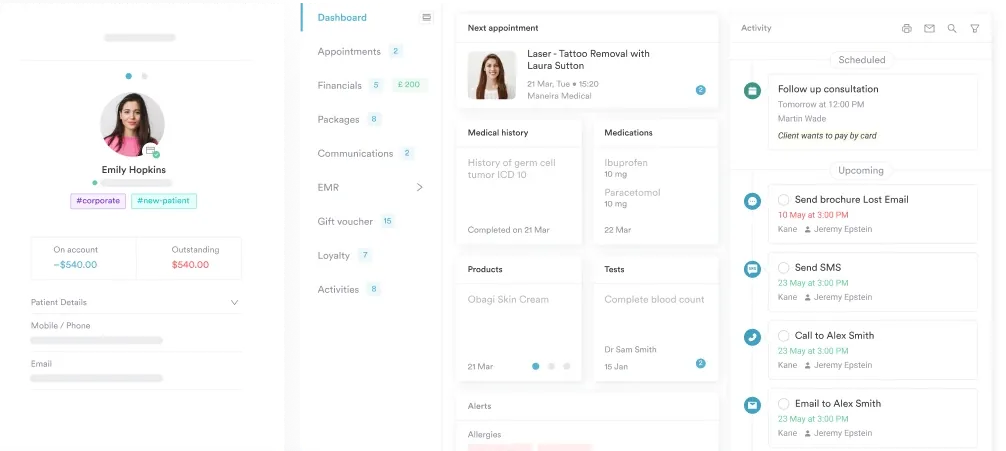
Practice management software like Pabau closes that distance. Its structured client records let MSK clinicians build a shoulder assessment template, then link special test findings to treatment notes and the follow-up plan. Digital intake forms collect MSK history before the visit, so you spend the appointment examining rather than typing.
Structured SOAP note templates are what make that work at the point of care. SOAP stands for subjective, objective, assessment, and plan. The format asks directly for special test results, shoulder range of motion measurements, functional limits, and a clinical impression.
Physiotherapy clinic management software with customizable note templates cuts documentation time and keeps a team consistent. Teams weighing options can compare sports medicine software on how much of an examination each one lets you template.
Safer clinical note-writing practices tie every finding to a named clinician and a date, which protects continuity when patients see different practitioners. Digital medical forms let you capture structured findings during the appointment rather than after it.
For osteopathy practices and physical therapy teams running a full rotator cuff protocol, one documentation structure pays off twice. It supports audit and outcome tracking, and it holds up if a record is ever reviewed.

Pabau gives MSK teams customizable note templates, SOAP documentation, and structured client records. Special test findings like the lift off test stay with the client, appointment after appointment.

The lift off test earns its place on specificity rather than sensitivity. A positive result is worth acting on. A negative one settles very little, which is why the test belongs in a battery alongside the Bear Hug or Belly Press.
The lag sign is the cheapest addition you can make to that battery. It reuses the same starting position and gives a second, more specific read on complete tears. Add it once and it stays in the routine.
Documenting the finding is what makes the next appointment easier. Pabau’s structured records and customizable MSK templates capture lift off results, lag sign findings, and shoulder exam outcomes in one place. Book a demo to see how Pabau supports MSK documentation from exam to discharge.

Comparing EMR options for a physical therapy practice? Physical therapy EMR software walks through the features that matter most for MSK caseloads.
Need a documentation form for a knee test? Quadriceps active test form records translation and pain findings across both knees with a positive or negative call.
Need a starting point for MSK history taking? Physical therapy intake form gives you a structured questionnaire patients can complete before the visit.
Assessing scapular strength and posture? Rhomboid Manual Muscle Test template assesses rhomboid muscle strength and function as part of shoulder girdle evaluation.
Need a balance scale for frail patients? Sitting Balance Scale template scores postural control through 11 items on a 4-point scale for frail patients.
The lift off test is a clinical shoulder examination used to assess the integrity of the subscapularis muscle and tendon. It tests whether the patient can actively lift the dorsum of the hand away from the lumbar spine, isolating subscapularis function during internal rotation.
The patient stands and places the back of their hand against the lumbar spine with the arm in internal rotation. They then attempt to actively lift the hand away from the back. If successful, the examiner applies gentle resistance and asks the patient to hold the position. Inability to lift or hold constitutes a positive result.
A positive lift off test points to subscapularis tendon pathology, most often a partial or full-thickness tear. It is not diagnostic on its own, so MRI or ultrasound is needed to confirm and characterize the tear. Note whether the lift-off test positive finding came from motor weakness or from pain inhibition, because the two carry different weight.
According to Barth et al. (2006), the lift off test has sensitivity of 18-50% and specificity of 84-100% for full-thickness subscapularis tears. The wide sensitivity range reflects variation across study populations and tear size. High specificity means a positive test is rarely a false positive, so the test is better for ruling in than ruling out.
The Bear Hug test, Belly Press test, Napoleon test, and internal rotation lag sign all assess subscapularis integrity through different arm positions. The Bear Hug test has the highest sensitivity of the four, at roughly 60%. It is the preferred alternative when restricted internal rotation blocks the standard lift off position.
No. The test needs the patient to place the back of the hand against the lumbar spine. If restricted internal rotation or pain prevents that position, the test cannot be completed. Substitute the Bear Hug or Belly Press test, which both reach subscapularis function without full internal rotation range.
The Gerber lift off test assesses the subscapularis muscle, specifically its role in shoulder internal rotation. It is the largest and strongest of the four rotator cuff muscles. It runs from the subscapular fossa to the lesser tubercle of the humerus.