Despina Petrushevska
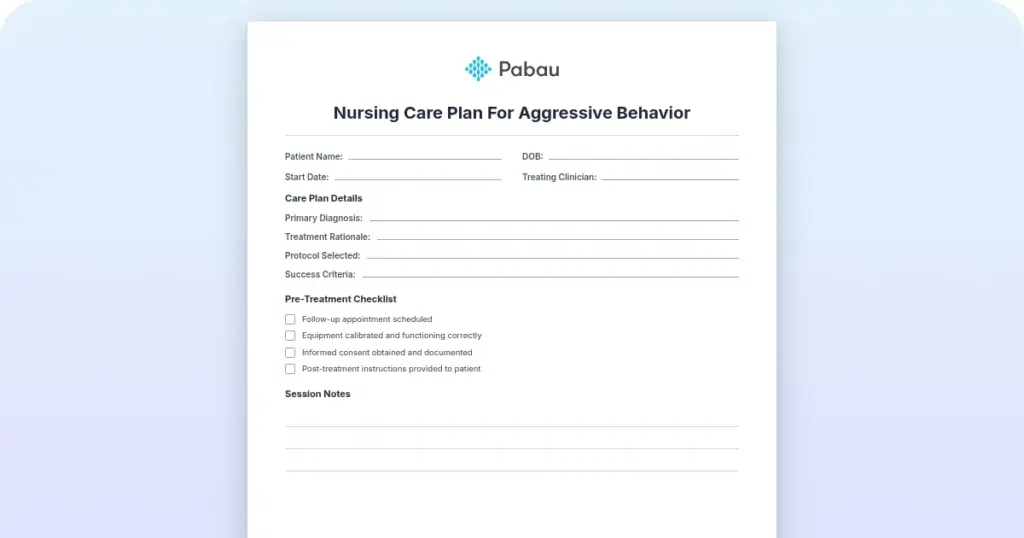
Nursing care plan for aggressive behavior
A nursing care plan for aggressive behavior is a structured clinical document fo...

2
Last Updated: Oct 26, 2026
Free PDF 4 pages, print-ready Clinician-reviewed
This template is based on the World Health Organization’s WHOQOL-BREF questionnaire. The WHOQOL-BREF is free to use, but the WHOQOL Group and WHO require you to register before using it in practice.
Standard diagnostic metrics tell only part of the patient story. A quality of life questionnaire captures the rest: how a patient feels, functions, and copes outside the consulting room. Clinicians across mental health, therapy, wellness, and primary care use these patient-reported tools to track how treatment shapes daily life.
This free quality of life assessment template gives you a ready starting point you can adapt or pair with a validated quality of life questionnaire.
A comprehensive evaluation template measuring patient wellbeing across physical, emotional, social, and psychological functioning domains for mental health, therapy, wellness, and private practice settings. Adapted from the World Health Organization’s WHOQOL-BREF instrument.
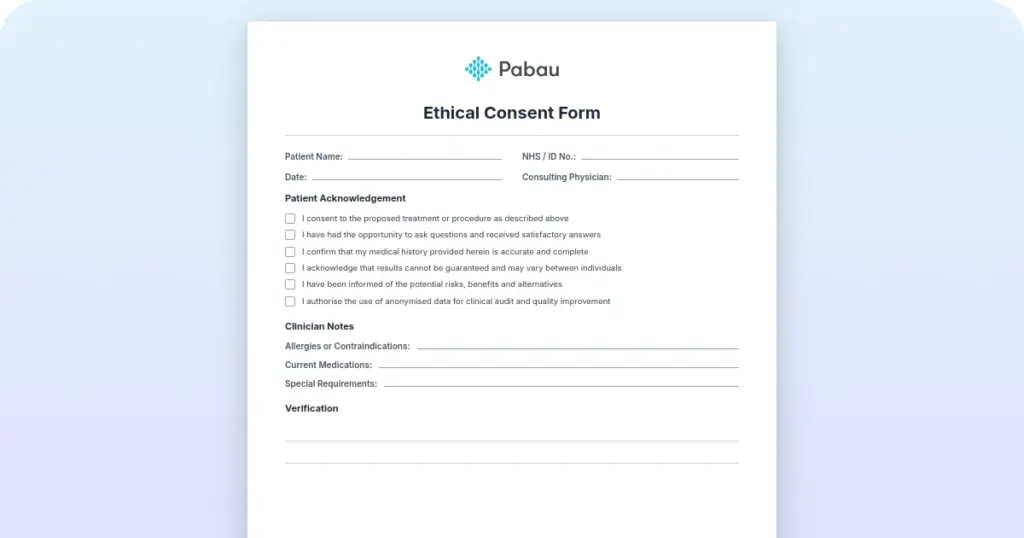
Upload this PDF, or any form you already use, and Pabau's AI Form rebuilds it with tick boxes, text fields and a signature. Attach it to the treatment once, and every patient gets it on time.
AI Form rebuilds the consent, history and aftercare forms you already use. You review each one, then publish.
Patients complete forms on their phone before they arrive, so the front desk stops retyping paper.
Every signed form is versioned and attached to the treatment record, ready when you need it.
Set how long a consent stays valid. Returning patients skip forms they have already signed.
Supports HIPAA and GDPR compliance AES-256 encryption 4.8 on G2 4.7 on Capterra Trusted by 4,000+ practices worldwide

A quality of life assessment measures how physical health, emotional wellbeing, social functioning, and life circumstances impact a patient’s overall quality of life.
Validated QoL tools (SF-36, WHOQOL-BREF, EQ-5D) are evidence-based instruments that enable clinicians to track patient outcomes objectively across clinical specialties.
QoL assessments surface issues in patient wellbeing that standard clinical metrics miss, supporting measurement-based care and personalized treatment planning.
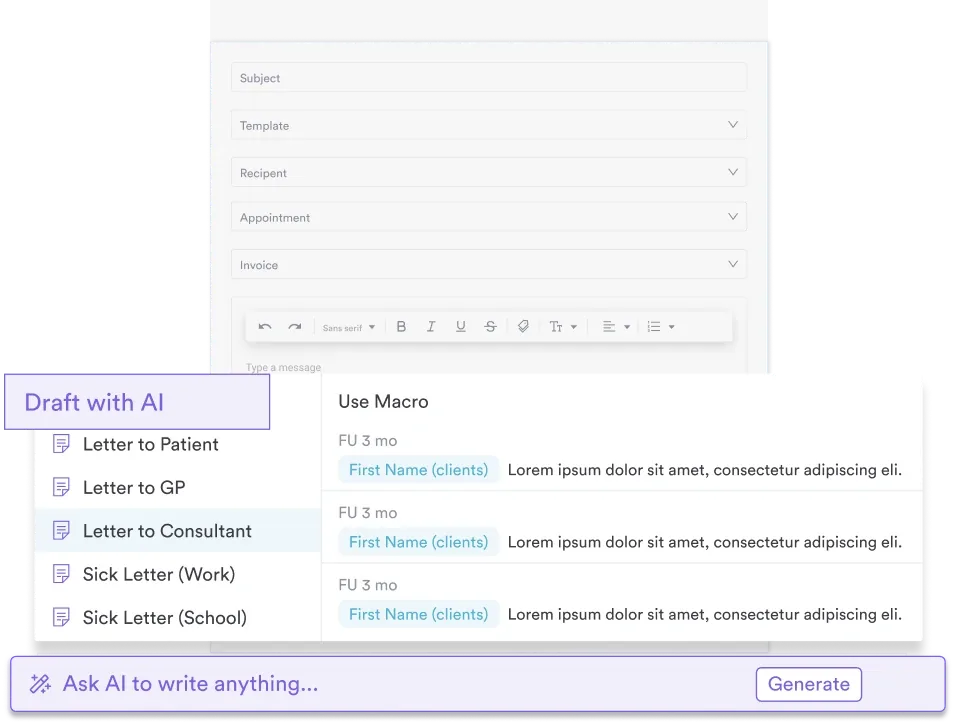
Practice management software like Pabau — with digital forms and AI-powered documentation — helps clinicians administer, score, and integrate quality of life assessments into patient records and clinical workflows.
A quality of life assessment is a structured evaluation tool that measures a patient’s subjective wellbeing across multiple life domains. Rather than focusing on diagnosis alone, a QoL questionnaire asks how treatment affects the patient’s daily functioning: Are they sleeping better? Are relationships improving? Can they return to work?
The World Health Organization (WHO) defines quality of life as “an individual’s perception of their position in life in the context of the culture and value systems in which they live, and in relation to their goals, expectations, standards, and concerns.” This patient-centered approach underpins every validated QoL tool, from the SF-36 to the WHOQOL-BREF.
Most of these instruments are patient-reported outcome measures, and together they capture health-related quality of life (HRQoL) — the aspects of wellbeing most directly shaped by a patient’s health, symptoms, and treatment.
For example, validated instruments like the WHOQOL-BREF (26 items) and the SF-36 (36 items) are standardized, evidence-based tools that allow clinicians to measure QoL consistently and compare results across patient populations. These tools have been tested for reliability and validity across cultures and disease states, making them the benchmark for clinical research and practice.
Administering a quality of life assessment follows a structured five-step workflow that integrates seamlessly into routine patient care.
This measurement-based care (MBC) approach — using objective QoL data to guide treatment decisions — has been shown to improve outcomes in mental health, oncology, and chronic disease management.
Quality of life assessments apply across healthcare disciplines wherever clinicians need to understand how illness, treatment, or life circumstances affect the whole patient. A quality of life assessment in mental health, for example, tracks the functional recovery that symptom scores alone can miss.
With a tool that tracks clinical measurements, baseline and follow-up scores sit side by side in the patient record.
Objective outcome tracking: QoL scores create a measurable baseline and progress metric. “Patient feels better” is clinical observation; a WHOQOL-BREF score rising from 52 to 68 is evidence.
Identifies hidden problems: A patient with controlled blood pressure may still report severe anxiety or social withdrawal — issues that vital signs alone won’t reveal.
Supports shared decision-making: When patients see their own QoL scores, they engage more actively in treatment choices. A declining score prompts collaborative problem-solving rather than passive compliance.
Improves treatment outcomes: Practices using measurement-based care report better adherence, earlier detection of treatment failure, and more cost-effective resource allocation.
Demonstrates clinical value: QoL data builds a portfolio of patient outcomes for accreditation, peer review, and insurance negotiations — particularly valuable for private practices and specialist clinics.
Not all QoL instruments are equivalent. Validated tools have undergone rigorous psychometric testing for reliability, validity, and responsiveness to change, which makes their scores trustworthy and comparable across studies and settings.
Beyond the SF-36 questionnaire and the WHOQOL-BREF, widely used quality of life measures include the EQ-5D, the Quality of Life Inventory (QOLI), and Flanagan’s Quality of Life Scale (QOLS). Choosing among these quality of life scales comes down to your discipline, the domains you need to capture, and how long the questionnaire takes to complete.
Each tool carries its own licensing requirements. The SF-36’s licensing depends on the version: the RAND-36 is free from the RAND Corporation, while the trademarked SF-36®/SF-36v2 needs a paid license through QualityMetric (Optum). The WHOQOL-BREF and EQ-5D are free for clinical use, but both require registration first, with the WHOQOL Group and the EuroQol Research Foundation respectively. Always verify licensing before clinical use.

See how Pabau’s digital forms and client record system help you administer, score, and track quality of life data for every patient — building measurement-based care into your workflow.

Administering QoL assessments adds minimal time when they’re built into your systems:
Schedule QoL assessments at regular intervals: monthly for acute mental health, quarterly for chronic disease, and annually for wellness screening. Use your calendar system to trigger reminder emails, and integrate results into pre-visit summaries so clinicians review scores before each session.
Train your team on interpretation. Treat a QoL score as a conversation starter rather than a diagnosis. For example, if the physical health domain drops sharply, ask about medication side effects, pain changes, or activity level. If psychological wellbeing declines, explore mood, sleep, relationship stress, or substance use.
Before that training session, a learning styles self-assessment records how each staff member says they prefer to take in new material. Treat the result as one input when you plan the session, since research does not back teaching to a single preference.
Quality of life assessments collect sensitive health information. Store them in patient data security tools compliant with HIPAA (US), GDPR (EU/UK), or your local health privacy regulations. Ensure patient consent covers storage and use of QoL data for treatment and quality improvement.
When discussing results with patients, frame QoL scores neutrally: say “your wellbeing score has changed,” not “you’re getting worse.” Use validated tools only within their intended scope. Do not repurpose QoL scores as diagnostic criteria or use them to make unilateral treatment decisions without clinical judgment.

Need a way for prospective patients to reach you? contact form template captures patient details, contact preferences, and appointment request information.
Need to track every patient interaction? contact log template records communication method, interaction time, outcome notes, and follow-up actions.
Caring for a patient with COPD? COPD nursing care plan covers NANDA-approved diagnoses, interventions, measurable goals, and discharge planning checklists.
Quality of life assessment changes how clinicians measure success. Rather than relying on clinical impression alone, validated QoL tools give you and your patients an objective, evidence-based picture of how treatment is working.
This measurement-based care approach — supported by tools like Pabau’s integrated practice management system — improves outcomes, supports shared decision-making, and demonstrates the value of your clinical care.
A quality of life assessment measures how a patient’s overall wellbeing — across physical, emotional, social, and psychological domains — is affected by illness, treatment, or life circumstances. Clinicians use QoL data to track treatment effectiveness, guide adjustments, and support shared decision-making with patients.
Frequency depends on clinical context. Mental health practices typically administer assessments monthly; chronic disease management uses quarterly intervals; wellness programs often assess annually. Regular administration allows tracking of trends and early detection of declining wellbeing.
The SF-36 is a 36-item generic tool most widely used in Western populations and health research. The WHOQOL-BREF is a shorter 26-item tool developed by the WHO specifically for cross-cultural application. Choose SF-36 for comparative research; choose WHOQOL-BREF for briefer administration and global populations.
No. QoL assessments are outcome measures, not diagnostic tools. They complement — not replace — clinical evaluation, physical examination, and diagnostic testing. Use QoL data alongside clinical judgment to guide holistic care decisions.
Some are, some are not. WHOQOL-BREF and EQ-5D are available through their governing bodies at no cost, though WHOQOL-BREF requires registration with the WHOQOL Group. The SF-36’s licensing depends on the version: the RAND-36 is free from RAND, while the trademarked SF-36®/SF-36v2 needs a paid license through QualityMetric (Optum). Always verify licensing requirements before using any validated tool in clinical practice.
A quality of life questionnaire is a standardized, patient-reported measure that scores wellbeing across domains such as physical function, emotional health, and social participation. Validated examples include the SF-36 and the WHOQOL-BREF, and most patient quality of life questionnaires can be repeated over time to track change.
Yes. You can download a free quality of life assessment template (PDF) from the top of this page and use it as-is or adapt it for your practice. It gives you a ready structure for capturing patient-reported quality of life measures without building a form from scratch.