Anja Dodevska
What state has the most plastic surgery per capita? America’s cosmetic map in 20 numbers
What state has the most plastic surgery per capita? Florida is America’s p...

Last Updated: Oct 16, 2026
Free PDF 2 pages, print-ready Clinician-reviewed
Cheek implants are a permanent form of cheek augmentation that adds volume and definition to the midface. For the surgical practices that perform them, consistent records at every step protect informed consent, patient safety, and compliance.
This cheek implants template standardizes the patient journey from the first consultation through aftercare. Practice management software like Pabau then turns that template into a digital workflow your whole team follows. Many cosmetic surgery practices also run medical spa services that depend on dedicated EMR software for bookings and records.
A comprehensive cheek implants template package for cosmetic surgery practices, including patient consultation checklists, surgical planning documentation, pre/post-operative instruction sheets, aftercare guidance, and patient FAQ resources.
Upload this PDF, or any form you already use, and Pabau's AI Form rebuilds it with tick boxes, text fields and a signature. Attach it to the treatment once, and every patient gets it on time.
AI Form rebuilds the consent, history and aftercare forms you already use. You review each one, then publish.
Patients complete forms on their phone before they arrive, so the front desk stops retyping paper.
Every signed form is versioned and attached to the treatment record, ready when you need it.
Set how long a consent stays valid. Returning patients skip forms they have already signed.
Supports HIPAA and GDPR compliance AES-256 encryption 4.8 on G2 4.7 on Capterra Trusted by 4,000+ practices worldwide

Cheek implants are permanent, biocompatible inserts, and surgeons place them to add cheekbone definition and midface volume.
A standard consultation template keeps patient education, consent, and surgical planning consistent across your practice.
Clear records protect both patient safety and practice compliance, because they show the pre-op assessment and aftercare plan.
Pabau’s digital consent and aftercare tools automate patient messages, so surgical staff spend less time on paperwork.
A cheek implants template is a structured record that keeps every phase of surgical planning and aftercare consistent. In one place, it captures patient history, aesthetic goals, and exam findings. It also records the implant material, the surgical approach (malar versus submalar), and the aftercare plan.
Clear records also protect both patients and practices. Signed consent forms show that the patient understands the risks, benefits, and likely outcomes. Following American Society of Plastic Surgeons (ASPS) guidance on documentation also supports your defense if a claim ever arises.
Like a med spa consultation form, this template pulls every required element into one place:
Most cheek implant templates also include a few core parts:
A cheek implants template guides patients through five clear steps, from the first consultation to discharge. The workflow splits into two stages.
This template suits plastic surgery practice management and medical spa software users who perform cheekbone augmentation surgery and related facial procedures. It helps a few roles in particular:
Software designed for GP practices can attach this form to the consultation record automatically.
Informed consent and legal protection: a standard template gives every patient the same clear briefing on implant types, techniques, risks, and likely outcomes. Signed consent then creates a clear record. That record supports your defense and meets the documentation standards that accreditation bodies and ASPS guidance set out.
Consistent surgical planning: when you record the implant choice, the placement, and the measurements, you cut out guesswork. It also keeps care smooth if another surgeon handles the follow-up. That way, the whole team works from the same plan.
Reduced admin: ready-made checklists replace free-text notes, so staff write less and spend more time with patients. Going paperless speeds this up even more, because it sends and files forms automatically.
Patient safety and compliance tracking: careful pre-op screening flags contraindications and drug interactions before surgery. Afterward, the template tracks complication rates, revision rates, and satisfaction. As a result, you hold the exact data that audits and inspections call for.
Better patient communication: clear written aftercare cuts down on phone calls and confusion. Patients know what to expect while they heal, and when to call the practice. In turn, satisfaction rises and follow-up no-shows drop.

Automate cheek implant consultations, consent management, and post-operative patient communication in one integrated platform.

Whether cheek implants suit a patient depends on their goals, their anatomy, and the material they prefer. So surgical teams use the template criteria to match each patient with the best option.
There are three main types of cheek implants, so your template should record which one the surgeon picked. First, malar implants sit on the upper cheekbone to add projection. Next, submalar cheek implants fill the lower and mid-cheek to soften a hollow look. Combined implants do both at once. Finally, for patients with clear asymmetry, custom cheek implants can be shaped to match their own facial anatomy.
Material matters as much as placement, so record what each patient’s cheek implants are made of. Silicone cheek implants are the most common option, and they give a natural feel and a permanent result. Porous polyethylene, known as Medpor, lets tissue grow into the implant, so it stays firmly in place. Gore-Tex, meanwhile, feels a little softer.
Alloderm works differently from the other three. It is an acellular dermal graft, not a solid implant, so surgeons use it to soften contours rather than build firm cheekbone projection. It also breaks down sooner than the solid options, with published estimates closer to a year. So set clear expectations about how long it lasts, and note them for each patient.
Age is not a barrier. Younger patients with flat cheekbones and older patients who have lost volume are both good candidates. In fact, cheek implants for hollow cheeks last far longer than repeat filler sessions. Some patients first weigh a non surgical cheek augmentation, such as dermal fillers or fat grafting. Many then move to implants for more predictable, lasting volume. A detailed cosmetic client consultation checklist captures these details, so planning stays centered on the patient.
How cheek implants are inserted comes down to two main approaches. Surgeons usually work as a same-day procedure, under local anesthesia with sedation or under general anesthesia. First, intraoral incisions inside the upper lip hide the scar and give direct access to the malar pocket. This is the standard for a standalone procedure. Second, infraorbital incisions below the eye reach both the malar and submalar areas. Surgeons prefer this route when they combine cheek implants with a lower facelift or eyelid surgery.
Your template should record which approach the surgeon chose, and why. Note that solid cheek implants are sized by projection in millimeters, not by volume. So operative notes should list the size as roughly 4 to 6 mm of projection for malar implants, and 4.5 to 6 mm for submalar. The notes should also confirm positioning, by finger palpation and visual symmetry. Finally, they should record the fixation method: sutures, a screw, or none, depending on the surgeon and the implant.
Aftercare photos, taken with the same lighting and pose each time, let you judge swelling and the final result clearly.
When you describe these steps in plain language, on your website and in consultation materials, you set clear expectations. That also builds trust in your team’s skill.
Flag every patient on blood thinners (aspirin, warfarin, NSAIDs) in your pre-operative checklist. Most need to stop them 7 to 10 days before surgery, or need a hemostatic plan (vitamin K, fresh frozen plasma). This one documented step helps prevent bleeding during surgery. It also shows regulators that your team takes safety seriously.
As with any cheekbone surgery, a few metrics show how well cheek implants work. These include patient satisfaction, complication rates (infection, displacement, asymmetry, nerve changes), revision rates, and consistent results. So your template should include a 3-month and a 1-year outcome section. Over time, this data drives quality improvement. It also backs up a marketing claim like “consistent, natural results.”
For the team. Structured templates also speed up turnaround and cut documentation errors.
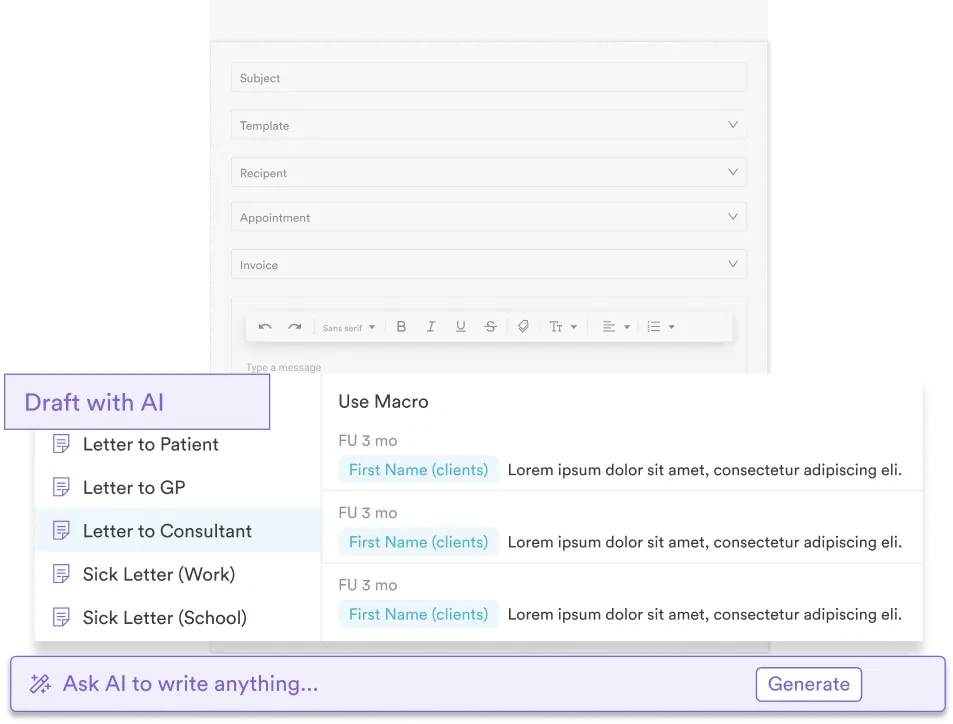
In short, a cheek implants template turns scattered notes into one clear, compliant process. That protects both patient safety and your practice. To see it in action, your team can book a demo. You will see how digital consent forms, automated aftercare messages, and structured records come together in one workflow.

Need to structure surgical consent workflows? Aesthetic practice software can automate consent form distribution and signature capture while maintaining HIPAA and GDPR compliance.
Want to improve before-and-after documentation? Before-and-after photo software with standardized lighting and patient positioning creates a reliable visual record of your surgical outcomes.
Looking for guidance on surgical risk communication? Plastic surgery software with integrated templates helps clinicians document patient education and informed consent consistently.
A cheek implants template is a standard form that guides consultations, surgical planning, consent, and aftercare. It holds patient history, goals, exam findings, the chosen material, the surgical approach, and aftercare notes in one record.
Cheek implant surgery usually takes 30 minutes to an hour. It depends on whether the surgeon works alone or alongside other facial surgery. That hour covers the incision, the implant pocket, positioning and fixation, and closing up.
There are four main materials. Silicone is the most common, and it is permanent with a natural feel. Porous polyethylene (Medpor) lets tissue grow in for a fixed position. Gore-Tex feels softer. Alloderm is different, though: it is an acellular dermal graft, not a solid implant, so surgeons use it for softer contouring, and it breaks down sooner. Malar implants target the upper cheekbone, while submalar implants fill the lower and mid-cheek. The surgeon then picks a type based on the patient’s anatomy and goals.
Early recovery takes one to two weeks as swelling and bruising ease. Most patients resume light activity after 7 to 10 days. Hard exercise and contact sports usually wait 3 to 4 weeks. So your aftercare template should lay out this timeline, so patients know what to expect.
Yes, cheek implants are removable, and that is a key advantage over fillers or fat grafting. If a patient wants them out later, the surgeon can reach and remove the implant through the original incision. Your template should note this in the consent section.
Cheek implants are permanent inserts placed under the soft tissue, so they give steady volume that does not fade. Dermal fillers, by contrast, are temporary and last 6 to 18 months, so they need repeat visits. Implants suit patients who want a permanent result. Fillers suit those who want a reversible option, or a trial first.
Cheek implants have been used in facial surgery for decades, so serious problems are uncommon with a qualified surgeon. Careful pre-op screening for contraindications, such as active infection or a bleeding disorder, keeps the risk low. Your template should record this screening and the risks you discuss with each patient.
Silicone, porous polyethylene, and Gore-Tex implants are meant to be permanent, so many patients choose them over repeat fillers. Alloderm is different, though: it is a soft-tissue graft, not a solid implant, so it breaks down sooner, with estimates closer to a year. Recording the material in your template helps set clear expectations.
Most cheek implants are made of solid medical-grade silicone or porous polyethylene, both long used in facial surgery. Gore-Tex is a softer solid option. Alloderm, by contrast, is a soft-tissue graft rather than a solid implant, used for gentle contouring. The right material depends on the patient’s anatomy and goals, so your template should capture both.