CPT code 93503: Swan-Ganz catheter billing and modifiers
CPT code 93503: Official descriptor and procedure overview In the AMA CPT code s...

Last Updated: Oct 23, 2026

CPT code 19380 covers revision of a previously reconstructed breast, including pocket revision and malposition correction.
The code carries a 90-day global period, so a revision inside that window usually needs modifier 78.
The current work RVU is about 10.89, and the total RVU is about 22.03 before geographic adjustment.
Commercial coverage rests on WHCRA and each plan’s own medical necessity criteria, so pre-authorization is almost always required.
Practice management software like Pabau keeps the operative records and code libraries that clean 19380 claims depend on.
CPT code 19380 is the billable code for revision of a reconstructed breast. It applies to secondary surgery on a breast that already carries a reconstruction, whether implant-based or autologous.
The American Medical Association defines the code as revision of a reconstructed breast. Pocket revision, correction of implant malposition, capsular revision, and fat grafting during a revision all sit inside its scope. Initial reconstruction is reported with 19340, 19342.
CPT guidance sets a threshold for what counts as a 19380 revision. Qualifying work includes significant tissue removal, re-advancement or re-inset of a flap in autologous reconstruction, or significant capsular revision combined with soft tissue excision. Minor capsular work on its own belongs to 19370. A revision that no specific breast code describes goes to unlisted CPT code 19499 instead.
The global period is 090 days, which classifies 19380 as a major surgical procedure. A revision performed inside the global window of the original reconstruction needs documentation of a separately identifiable indication.
Payers separate reconstructive revision from cosmetic revision. Billing 19380 for work a payer reads as cosmetic will produce a denial. Confirm the clinical indication supports medical necessity before the claim goes out.
The plastic surgery EMR software your team writes operative notes in shapes how well these indications get captured at the point of care. Indications usually accepted as medically necessary include:
Work performed purely to improve the appearance of a successful reconstruction is usually excluded from coverage. The Women’s Health and Cancer Rights Act (WHCRA) requires group health plans and issuers to cover breast reconstruction after mastectomy. That duty covers every stage of reconstruction and revision, but not elective aesthetic work unrelated to the original cancer treatment. First-pass rate measures how often a claim is paid without anyone touching it again. Two practices can bill the same encounter at a different visit level, and the note settles which was right.
Missing or incomplete documentation is the most common reason 19380 claims are denied or audited. The operative report has to tell a complete clinical story, not just list what was done.
Structured digital forms and operative templates help the team capture the essential elements before the claim is submitted. A complete client record carrying the prior reconstruction history matters just as much, because payers ask for it during pre-authorization and post-pay audits.
Those records also have to be stored properly.
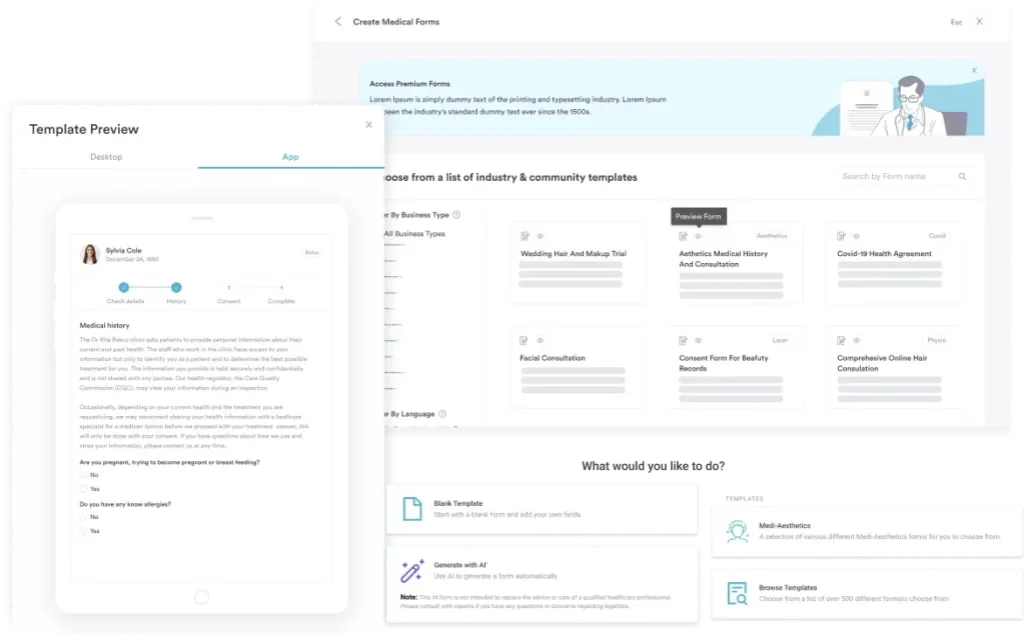
Nearly every payer expects these elements on a 19380 claim:
Standardizing your medical forms around a pre-operative checklist cuts denial rates. Have the surgical team confirm the prior reconstruction history before every 19380 case.
Create a standing pre-authorization checklist for 19380 cases. Include the prior reconstruction date and operative note, the current clinical indication, the planned revision technique, and laterality. Run the checklist five days before surgery, so missing documentation surfaces before the claim date.
Medicare pays 19380 under the Physician Fee Schedule (PFS). Payment varies by geographic locality and by place of service. Verify the current rate for your MAC jurisdiction before you quote a patient or set a fee schedule.
Relative Value Units drive Medicare payment. The FastRVU lookup tool checks current work, practice expense, and malpractice RVUs by code and locality. Here is how the components break down for 19380:
*RVU values are approximate and change with the annual CMS updates. Multiply the total RVUs by the current conversion factor and your locality’s GPCI to estimate the payment, and check the CMS data file before billing.
Place of service decides which practice expense RVU applies, and therefore the total Medicare payment. Breast reconstruction revisions are almost always performed in a facility, but the distinction still shapes your fee schedule.
The facility bills its own payment separately. Neither sits inside the surgeon’s 19380 claim.
Correct modifier use decides whether a 19380 claim pays. A missing required modifier and an inappropriate one are both common denial triggers.
Most payers require laterality modifiers on breast procedures. Omitting LT or RT causes an automatic rejection rather than a clinical denial. Append the correct one to every unilateral 19380 claim.
The diagnosis code has to support the medical necessity of the revision. Payers review the ICD-10 pairing as part of that determination. These codes appear most often alongside 19380:
Use the most specific ICD-10 code that matches the finding documented in the operative report. Payers question a generic code like N64.89 when a specific complication code such as T85.44XA clearly applies.
Knowing how 19380 relates to the adjacent breast reconstruction codes prevents miscoding and unbundling errors. Each of these codes has its own place in the reconstructive billing picture:
The most common miscoding error in this family is confusing 19342 with 19380. The distinction turns on whether the patient has an existing reconstruction being revised, or is receiving a first permanent implant after a tissue expander phase.
Use 19342 when the surgeon inserts a permanent prosthesis for the first time in a previously expanded breast. Use 19380 when a reconstruction is already in place and the surgeon operates to correct or improve it. Reporting either one in the other’s place is a miscoding error and an audit red flag.
19371 covers a complete periprosthetic capsulectomy, including removal of all intracapsular contents. It may be separately reportable alongside 19380 when both procedures are distinctly performed and documented. National Correct Coding Initiative (NCCI) edits govern that pairing, so check the current Procedure-to-Procedure tables first.
Where 19371 is separately reportable, append modifier 59. The operative report has to describe the capsulectomy and the revision as separate, independently necessary interventions rather than parts of one procedure. Capsular work that stops short of a complete capsulectomy is 19370, not 19371.
Fat grafting alongside a reconstruction revision is a common clinical scenario. Whether it can be billed separately with 19380 is a payer-specific question, so verify before you submit.
Both codes raise the documentation bar. Record the harvest site, the processing method, and the injected volume for fat grafting, or the product and graft size for a biologic implant. Practices that run autologous work through a regenerative medicine EMR capture those fields during the case rather than after it.
Some commercial payers bundle fat grafting into the 19380 payment and deny 15771 outright. Others accept it with modifier 59 and supporting documentation. Treat the pairing as payer-dependent until you have confirmed it for the specific plan.
Before billing 15771 or 15777 alongside 19380, pull the current NCCI Procedure-to-Procedure tables at cms.gov and check the payer’s own policy. Flag the pairing in your billing system, so every 19380 claim with fat grafting or a biologic implant triggers a payer-specific check first.
Breast reconstruction revision billing draws scrutiny from Medicare and commercial payers alike. These are the error patterns that show up again and again in 19380 denial and audit data:
Commercial coverage for 19380 adds a layer of complexity that Medicare billing does not. Each plan sets its own medical necessity criteria, and pre-authorization is the norm rather than the exception.
Three dynamics drive that variability:
Tracking those authorizations is part of wider revenue cycle management. One authorization missed before surgery writes off the whole claim, and the appeal rarely recovers it.
A reconstructive practice billing 19380 carries a documentation-heavy workflow. Prior reconstruction records have to be on file and pre-authorizations have to be tracked. Each operative report also has to carry the clinical detail the payer will look for.
Practice management software like Pabau brings that workflow into one place. Pabau’s claims management software supports code libraries, treatment record linking, and pre-authorization tracking. Your team knows before surgery whether the documentation is complete.
For a practice running a high volume of reconstructive cases, that is the difference between clean first-pass claims and a standing denial queue.
Pabau’s plastic surgery EMR is built for the documentation depth reconstructive billing demands. It holds structured operative notes, before-and-after photo records, and full patient history in one client record. That is exactly what payers ask for during an audit.
Teams comparing plastic surgery software usually weigh documentation depth against ease of use. For 19380 work, depth wins, because the denial almost always traces back to what the note left out.

Pabau’s claims management and documentation tools help plastic surgery practices capture the operative detail 19380 needs. Claims go out clean the first time.

19380 pays well and gets read closely, so treat the operative note as the claim. Build the prior reconstruction reference, the indication, the technique, and the laterality into a template your surgeons complete every time.
The trade-off worth remembering is speed against certainty. Checking the NCCI edits and the payer’s policy before every 19380 case with an add-on costs you a day in scheduling. It saves you the appeal.
Book a demo to see how Pabau keeps reconstruction documentation, pre-authorizations, and claims in one workflow.

Coding the tissue expander stage of a reconstruction? 19357 covers placement, the exchange sequence, and the documentation payers expect.
Billing an augmentation on a breast that was never reconstructed? 19325 explains where primary augmentation sits and how payers treat it.
Reporting wound preparation alongside a surgical repair? 15005 walks through the add-on rules and the edits that apply.
Coding a breast lesion excision with a radiological marker? 19125 covers the descriptor, the modifiers, and Medicare reimbursement.
CPT code 19380 covers revision of a previously reconstructed breast. Qualifying work includes significant tissue removal, re-advancement or re-inset of a flap, and significant capsular revision with soft tissue excision. Minor capsular work on its own is reported with 19370. Initial reconstruction is reported with 19340, 19342, or 19357.
Medicare pays 19380 under the Physician Fee Schedule, and the amount varies by locality and place of service. The work RVU is about 10.89, and the total RVU is about 22.03. Multiply the total RVUs by the annual conversion factor and your locality’s GPCI, then confirm the figure in the CMS PFS lookup tool.
A 19380 claim needs proof of the prior breast reconstruction, with the date and the procedure. It also needs a clinical indication that meets medical necessity criteria, a detailed operative description of the revision technique, and explicit laterality. Add the surgeon’s attestation that the work is reconstructive rather than cosmetic. Most commercial payers want the pre-authorization confirmation on file first.
19342 covers delayed insertion of a breast prosthesis, meaning the first permanent implant after a tissue expander. 19380 applies when a completed reconstruction already exists and the surgeon operates to correct or improve it. Reporting one where the other belongs is a miscoding error that creates audit exposure.
15771 and 15777 may be separately reportable with 19380 when both procedures are distinctly performed and documented. Payer acceptance varies, and some plans bundle fat grafting into the 19380 payment. Check the current NCCI Procedure-to-Procedure tables and the payer’s own policy first. Apply modifier 59 when you report them as distinct services.
The official CPT descriptor for 19380 is “Revision of reconstructed breast.” The code sits in the repair and reconstruction of the breast subsection of the CPT surgery section. It carries a 090-day global period, consistent with a major surgical procedure.