GLP-1 usage by state: Who’s taking, searching and paying in 2026
GLP-1 usage by state peaks in West Virginia, America’s GLP-1 capital, with...

Last Updated: Oct 16, 2026

All 21 days of the plan are set out on this page, in three tables split by phase.
The target is a 5–10% loss of body weight, which is what measurably reduces liver fat in NAFLD and MASLD.
Every phase runs on the same Mediterranean pattern of olive oil, oily fish, whole grains, legumes, and vegetables.
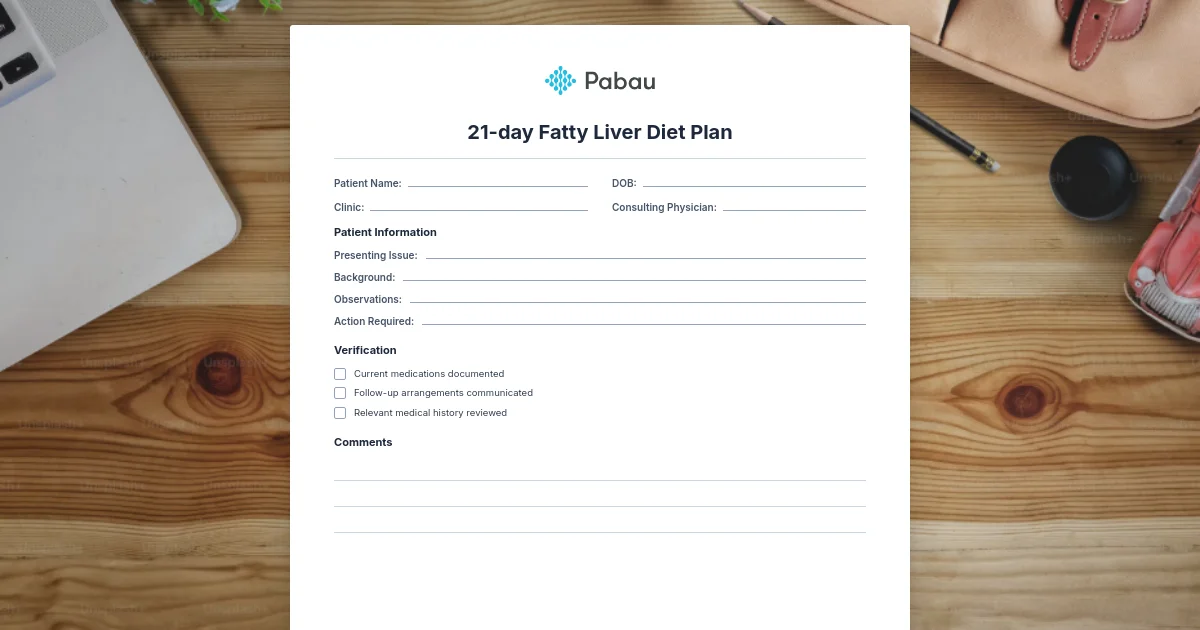
The free download is a blank one-page form you complete with the patient, with a signature line for sign-off.
Practice management software like Pabau keeps the completed form, the phase check-ins, and the day-21 measurements on one patient record.
A free printable fatty liver diet plan PDF, set up as a one-page clinical form you complete with the patient. It has fields for patient details, diagnosis, the day’s breakfast, lunch, dinner, snacks and notes, plus a signature line.
Download templateAll 21 days of this fatty liver diet plan are laid out below, in three tables you can read or print straight from the page. They all work toward one number, a 5–10% loss of body weight.
That is the threshold that starts to move liver fat in non-alcoholic fatty liver disease (NAFLD), now also called metabolic dysfunction-associated steatotic liver disease (MASLD). Most patients reach it after the three weeks rather than inside them.
Anyone searching for a fatty liver diet plan free PDF tends to find one sample day, or a plan locked behind a signup form. The full three weeks are on this page instead, so you can print them or read them out in the appointment.
The download is a printable diet chart for fatty liver PDF that you complete with the patient. It records what they will actually eat and how the week went, so the plan comes back to you filled in.
A diet plan for fatty liver also has to survive a normal working week. Every meal below is built from supermarket ingredients, and most of them repeat across the three phases on purpose.
A 21-day fatty liver diet plan is a structured eating protocol divided into three seven-day phases. Each phase is designed to progressively reduce hepatic fat and improve metabolic markers. It sets out what the patient eats, in what order, for three weeks, aligned with NIDDK guidance on NAFLD nutrition.
The plan targets de novo lipogenesis, the liver’s production of new fat. It limits refined carbohydrates, fructose, and trans fats, and leans on whole grains, legumes, lean protein, and monounsaturated fats, particularly olive oil.
Three weeks is a deliberate length. It is long enough for a new shopping and cooking routine to hold. It is also short enough that a patient will commit to it at the end of a consultation.
What separates a healthy diet for fatty liver from general healthy eating is the fructose rule. A liver diet plan can be otherwise unremarkable and still work, provided sugary drinks and juice come out of the house on day one.
The plan builds on the same whole-food principles recommended by the EASL–EASD–EASO clinical guidelines as first-line care for NAFLD and MASLD. It is designed as a patient education handout, issued alongside lifestyle counseling and a booked follow-up.
The Mediterranean diet for fatty liver anchors all three phases because it lowers liver fat even before the scale moves. Swapping saturated fat for olive oil and oily fish changes what the liver stores, independently of how much weight the patient has lost.
That matters clinically. It gives you something to point at during week one, when the patient is doing everything right and the scale has barely shifted.
Four parts of the pattern do the work:
Insulin resistance is the thread running through all four. Every phase leans on the same pattern, and only the emphasis changes as the three weeks progress.
Phase 1 strips out the fructose and refined starch. Phase 2 tightens portions to open a calorie deficit. Phase 3 repeats the meals the patient has already cooked twice, so the pattern outlasts the plan.
Patients often ask for a Mediterranean diet for fatty liver PDF they can stick on the fridge. The calendar in the next section is that, printable straight from this page.
It is also why a 21 day Mediterranean diet plan PDF and this template look so similar. The phases change emphasis and portion size, never the underlying food list.
Here is the whole meal plan for fatty liver, day by day. The phases change the emphasis, not the food list, so the weekly grocery run stays broadly the same across all three weeks.
Meals repeat on purpose. A fatty liver diet menu plan that needs 21 different recipes gets abandoned in week one, usually on the first busy evening.
Healthy meals for liver patients do not need special ingredients either. Everything below comes from a normal supermarket run, and a single grocery list covers all three weeks. Portion sizes are left to the patient’s appetite rather than a calorie count.
Breakfast for fatty liver is where the refined-carbohydrate habit usually sits. Every day opens with whole grains, plain yogurt, or eggs, and never with juice or pastry.
Print the page and you have a fatty liver meal plan PDF with every day filled in, which is what patients want to take home.
Week one removes sugary drinks, juice, and white starch, and puts fiber and protein at every meal. Nothing else changes yet.
| Day | Breakfast | Lunch | Dinner | Snacks |
|---|---|---|---|---|
| Day 1 | Steel-cut oats with berries, chia seeds, and walnuts | Lentil and quinoa salad with greens, tomatoes, olive oil, and lemon | Grilled salmon with roasted broccoli and brown rice | Apple with almonds; plain Greek yogurt with cinnamon |
| Day 2 | Plain Greek yogurt with raspberries, flaxseed, and pistachios | Chickpea and spinach soup with whole-grain rye bread | Baked mackerel with braised cabbage and barley | Carrot sticks with hummus; a small pear |
| Day 3 | Vegetable omelet with spinach and whole-grain toast | Brown rice bowl with black beans, roasted peppers, and avocado | Roast chicken breast with Brussels sprouts and farro | A handful of walnuts; plain kefir |
| Day 4 | Overnight oats with grated apple, cinnamon, and chia seeds | Tuna and white bean salad with arugula and olive oil | Lentil and vegetable stew with steamed kale | Celery with almond butter; blueberries |
| Day 5 | Whole-grain toast with mashed avocado and a poached egg | Quinoa tabbouleh with parsley, cucumber, tomato, and chickpeas | Grilled sardines with roasted zucchini and bulgur wheat | Greek yogurt with pumpkin seeds; an orange |
| Day 6 | Oatmeal with banana, flaxseed, and a spoon of nut butter | Minestrone with cannellini beans and a green salad | Baked cod with cauliflower, olives, and brown rice | A small handful of almonds; cucumber with olive oil |
| Day 7 | Scrambled eggs with tomatoes, herbs, and rye toast | Warm farro salad with roasted broccoli, chickpeas, and lemon | Turkey and vegetable sheet-pan bake with sweet potato | A pear; plain yogurt with cinnamon |
Week two shrinks the starch portion at lunch and dinner, and lets vegetables and legumes take the space. Oily fish appears three times.
| Day | Breakfast | Lunch | Dinner | Snacks |
|---|---|---|---|---|
| Day 8 | Greek yogurt with strawberries, chia seeds, and walnuts | Mixed-leaf salad with grilled salmon and olive oil dressing | Chickpea and spinach curry with a small portion of brown rice | A handful of almonds; carrot and pepper sticks |
| Day 9 | Steel-cut oats with blueberries and ground flaxseed | Lentil soup with roasted cauliflower | Grilled mackerel with green beans and quinoa | A small apple; plain kefir |
| Day 10 | Vegetable frittata with spinach, peppers, and herbs | Whole-grain pita with hummus, cucumber, tomato, and arugula | Roast chicken thigh with braised fennel and barley | Walnuts; sliced orange |
| Day 11 | Overnight oats with raspberries, chia seeds, and cinnamon | White bean and tuna salad with red onion and parsley | Baked salmon with roasted Brussels sprouts and wild rice | Greek yogurt with pumpkin seeds; celery sticks |
| Day 12 | Whole-grain toast with avocado, tomato, and a boiled egg | Quinoa and roasted vegetable bowl with tahini dressing | Vegetable and lentil chili with a small baked sweet potato | A handful of pistachios; blueberries |
| Day 13 | Plain yogurt with grated pear, flaxseed, and almonds | Cabbage, carrot, and chickpea slaw with olive oil and lemon | Grilled sardines with sauteed kale and bulgur wheat | Cucumber with hummus; a small apple |
| Day 14 | Buckwheat porridge with berries and chia seeds | Minestrone with borlotti beans and a green salad | Baked cod with roasted broccoli, olives, and farro | Walnuts; plain kefir |
Week three repeats meals the patient has already cooked, adds batch cooking, and builds in one flexible meal out. That last one is what makes the pattern survive week four.
| Day | Breakfast | Lunch | Dinner | Snacks |
|---|---|---|---|---|
| Day 15 | Steel-cut oats with berries, chia seeds, and walnuts | Batch-cooked lentil and vegetable soup with rye bread | Grilled salmon with roasted peppers and quinoa | Greek yogurt with cinnamon; an orange |
| Day 16 | Greek yogurt with raspberries, flaxseed, and pistachios | Farro salad with chickpeas, spinach, and olive oil | Chicken and vegetable sheet-pan bake with brown rice | Almonds; carrot sticks with hummus |
| Day 17 | Vegetable omelet with herbs and whole-grain toast | Leftover sheet-pan bake with a large green salad | Mackerel with braised cabbage and barley | A pear; plain kefir |
| Day 18 | Overnight oats with apple, cinnamon, and chia seeds | White bean and roasted vegetable bowl with tahini | Lentil bolognese with whole-grain pasta and a side salad | Walnuts; blueberries |
| Day 19 | Whole-grain toast with avocado and a poached egg | Tuna, arugula, and cannellini bean salad | Baked cod with cauliflower, olives, and brown rice | Greek yogurt with pumpkin seeds; cucumber sticks |
| Day 20 | Plain yogurt with strawberries and ground flaxseed | Quinoa tabbouleh with chickpeas and plenty of parsley | Flexible meal out: grilled fish or chicken, vegetables, olive oil | Almonds; a small apple |
| Day 21 | Steel-cut oats with pear, chia seeds, and walnuts | Minestrone with cannellini beans and a green salad | Grilled salmon with Brussels sprouts and farro | Carrot sticks with hummus; plain kefir |
Protein intake should stay adequate to preserve muscle mass during weight loss. The 1.2–1.5 g/kg body weight daily range is drawn from ESPEN liver-disease guidance and applied here to help maintain lean mass.
Any effective diet for fatty liver follows the same principle. Prioritize whole, unprocessed foods rich in fiber, plant antioxidants, and monounsaturated fats, and take out refined carbohydrates, added sugars, and trans fats.
The third column is the one worth reading out to the patient. Knowing why a food is on the list is what keeps it out of the shopping cart in week three.
| Eat freely | Limit or avoid | Why it matters for liver fat |
|---|---|---|
| Olive oil, up to 4 tablespoons daily | Butter, fatty meat cuts, fried foods | Monounsaturated fat takes the place of saturated fat without adding to what the liver stores. |
| Fatty fish: salmon, mackerel, sardines | Processed meats | Omega-3 fats lower circulating triglycerides and shift the fat balance in the liver. |
| Whole grains: oats, brown rice, quinoa | Refined carbohydrates: white bread, pasta, white rice | Slower glucose release means less insulin, and less signal to make new fat. |
| Legumes: lentils, chickpeas, beans | Soda, fruit juice, added sugars | Fructose is processed in the liver and drives de novo lipogenesis. Fiber does the opposite. |
| Cruciferous vegetables, leafy greens, berries | Trans fats in fried and processed baked goods | Fiber and plant antioxidants support the liver while trans fats worsen inflammation. |
| Nuts and seeds: almonds, walnuts, chia | Alcohol, in any amount | Alcohol adds a second route to fat accumulation on top of the metabolic one. |
| Unsweetened coffee and water | Sweetened coffee drinks and energy drinks | Coffee is linked to lower liver enzymes. The sugar added to it is not. |
Nothing on the left is rationed by weight or measured out, apart from the olive oil. That is deliberate, because a plan with two rules is followed more often than a plan with twenty.
Weight loss for fatty liver has a measurable target, not vague “eat healthier” advice. In NAFLD and MASLD, ≥5% body weight loss reduces liver fat, ≥7–10% can resolve steatohepatitis, and ≥10% is associated with improvement in fibrosis.
Weight loss for fatty liver disease is the one variable here with a dose response. It is worth naming the actual numbers in the appointment instead of asking the patient to “lose a bit of weight”.
| Weight loss | What the evidence shows | How it applies to these 21 days |
|---|---|---|
| ≥5% | Liver fat falls measurably | The first milestone, and most patients are still working toward it at day 21. |
| ≥7–10% | Steatohepatitis can resolve | A three to six month target. Name it on day 1 so the patient does not stop at day 21. |
| ≥10% | Associated with improvement in fibrosis | Relevant where fibrosis is already staged, and the clearest reason to keep going past week three. |
A structured weight-loss plan makes these targets easier to reach. The three-phase progression also lets the patient adapt gradually rather than through an all-or-nothing approach they abandon by day 10.
Metabolic markers move on a similar schedule. ALT, AST, triglycerides, and fasting blood sugar can improve within 3–4 weeks of genuine adherence. That is why the day-21 review is worth booking at the start.
A 7-day meal plan for fatty liver sets the pattern, and 21 days is what it takes for the habit and the first measurable trend. Neither is long enough for reversal, and that is the point patients need said out loud.
| Plan length | What it realistically achieves | Best used for |
|---|---|---|
| 7 days | Clears sugary drinks and refined starch out of the kitchen and proves the meals are edible | A trial run for a patient who is not yet convinced |
| 21 days | Long enough for the routine to hold, and for weight, waist, and adherence to show a trend | The default first protocol after a NAFLD or MASLD diagnosis |
| 30 days | Adds a fourth week of repetition, with no extra clinical milestone attached to it | Patients who prefer a calendar month, or who are restarting after a lapse |
Patients arrive at this looking for a 7-day meal plan for fatty liver PDF, or for a 7-day liver cleanse diet. The two searches want the same thing, and only one of the phrases describes what actually happens.
No menu detoxes the liver. A 7-day liver cleanse diet menu works, when it works, because it removes fructose and cuts calories, and that is the whole mechanism.
The same goes for a 21 day liver cleanse diet or a fatty liver detox diet plan. The liver clears what it needs to clear on its own, and what you change is the fat it is being asked to store.
It is worth saying this plainly at the first appointment. A patient who believes they are cleansing will stop at day 21, and a patient who understands the mechanism keeps going.
Consumer diet plans stop at the menu and leave the monitoring schedule out. The table below is the practitioner’s half of the 21 days.
| Checkpoint | What to measure | What to do if it is off track |
|---|---|---|
| Day 0 | Weight, waist circumference, ALT, AST, triglycerides, and imaging if it is not already on file | Record all of it in the patient record. Without a baseline, nothing measured later has anything to compare against. |
| Day 7 | Weight, plus a note on which sugary drinks and refined starches are still in the house | If nothing has changed, agree one swap rather than adding more rules. |
| Day 14 | Weight, waist circumference, and adherence notes from the form | If weight has stalled, check portion size and alcohol before you change the plan itself. |
| Day 21 | Weight, waist circumference, symptoms, and the decision on what happens next | Repeat ALT and AST only if the baseline was abnormal. Otherwise wait for the three-month review. |
Waist circumference earns its place at every checkpoint. It often moves in week two while the scale sits still, and it is the measurement that keeps a discouraged patient going.
Together, these steps turn a printable handout into an intervention with measurable follow-up.
Any patient with confirmed NAFLD or MASLD who has not progressed to cirrhosis benefits most, particularly those with Grade 1 hepatic steatosis. Patients with established cirrhosis need specialist oversight and more intensive intervention.
On the practitioner side, the plan suits several settings:
Insulin resistance drives fatty liver in both sexes, so the plan carries the same clinical weight for women. Losing estrogen’s protective metabolic effect after menopause raises NAFLD risk further.
Regular reviews matter for structured plans. Patient scheduling software keeps the day-21 follow-up from slipping into month two.
Physical activity, coffee, alcohol, sleep, and hydration all move liver fat independently of what is on the plate. The plan pairs the food changes with:
Of these, the alcohol conversation is the one worth having properly. Patients with NAFLD often assume the “non-alcoholic” in the name means alcohol is no longer relevant to them. A short drug and alcohol evaluation gives that conversation some structure.
The plan fails in the same place every time. The form goes home with the patient. The day-7 call never gets made, and by the day-21 review nobody can say what was eaten or what the baseline weight was.
Practice management software like Pabau keeps all of it on one patient record. The completed form is attached to the patient’s timeline, the day-0 measurements sit alongside it, and each check-in is added to the same file.
You can issue the plan as one of your digital patient forms, filled in from the patient’s phone. What they submit lands straight in their record, so week two’s notes are waiting for you before the call starts.
The day-7, day-14, and day-21 check-ins can be scheduled at the same time as the first appointment. Nobody drops off on day 8 because the follow-up was never booked, and you can see across your whole caseload who is still on track.


Pabau lets you issue the 21-day plan as a digital form and log the day-0, day-7, day-14 and day-21 checkpoints against one patient record. Follow-ups are booked in advance, so you see who is still on track without chasing paper.

Three weeks is a starting protocol, not a cure. The 21 days buy the habit and the first measurable trend in weight, waist, and adherence, and reversal remains a three to six month project.
Set that expectation on day 1. Patients who expect the scale to move overnight drop off in week one. Patients who know what week three is actually for tend to reach it.
The trade-off worth remembering is that the plan asks for very little precision and a lot of repetition. That is what makes it survive a busy week, and it is also why the day-21 review matters more than the menu itself.
Want to see the whole 21 days tracked against one patient record? Book a demo to see how Pabau handles nutrition-plan distribution, check-ins, and follow-up.

Need a weight target the patient can see? Men’s BMI chart turns the day-0 weight into a range you can talk through in the room.
Building a food-focused plan around fish and plants? pescatarian diet food list groups approved foods, adds a printable grocery checklist, and includes a sample 7-day meal plan.
Documenting the dietary review? Nutrition SOAP note gives you a structure for the day-7 and day-14 check-ins.
Need to adapt the menu for one patient? Nutritionist meal plan rebuilds the week around allergies, budget, or preference.
Managing type 2 diabetes alongside NAFLD? Type 2 diabetes diet follows the same low-fructose, high-fiber pattern as these 21 days.
A 21-day fatty liver diet plan is a structured three-phase eating protocol that reduces hepatic fat over three weeks. It emphasizes whole grains, lean protein, olive oil, legumes, and vegetables, and takes out fructose, refined carbohydrates, and trans fats.
Not fully. Partial reduction in hepatic steatosis can happen within three weeks, especially alongside 5–10% body weight loss. Complete reversal usually takes three to six months of sustained adherence.
Sugary drinks, fruit juice, and added sugars come out first, because fructose is processed in the liver. Also limit refined carbohydrates, trans fats in fried and baked goods, excess saturated fat, processed meats, and alcohol.
Yes. The Mayo Clinic, the British Liver Trust, and the European Association for the Study of the Liver all recommend it. It is the first-line dietary approach for NAFLD and MASLD.
Losing 7–10% of body weight produces significant improvements in liver fat, liver enzymes, and metabolic markers, and can resolve steatohepatitis. Even 5% shows measurable benefit, and more than 10% can improve fibrosis.
Yes. The download at the top of this page is a free fatty liver diet plan PDF, printable as a one-page clinical form. All 21 days of meals sit on the page itself, in the three phase tables.
No. The plan follows EASL–EASD–EASO guidance used across Europe, alongside NIDDK guidance from the US. The same three phases and the same food list apply on both sides of the Atlantic.
Water and unsweetened coffee. Coffee is linked to lower liver enzyme levels and reduced fibrosis risk in NAFLD, while sugary drinks and alcohol work directly against the plan.
Steel-cut oats with berries, chia seeds, and walnuts, which is Day 1 in the calendar above. Whole grains and fiber slow glucose absorption, and the fruit and nuts add antioxidants and monounsaturated fat.
A lentil and quinoa salad with mixed greens, cherry tomatoes, and olive oil dressing, the Day 1 lunch above. It pairs plant protein and fiber with the monounsaturated fat central to the Mediterranean pattern.
Unsweetened almond milk is a reasonable swap. It carries no added sugar, so it adds nothing to the fructose load that drives fat production in the liver. Check the label, because sweetened versions do.
No, not while the plan is running. Alcohol worsens hepatic lipid accumulation even at low intake. It also competes with the weight loss the 21 days are aiming for.
Yes. Swap the fish and poultry dinners for lentils, chickpeas, tofu, or tempeh, and keep the same grains and vegetables. Walnuts and ground flaxseed cover the omega-3 fats the oily fish would have supplied.
The NHS does not publish a fixed 21-day menu. Its advice matches the food list here, so UK patients can follow the calendar above and take it to their GP or dietitian.