GLP-1 diet plan
A GLP-1 diet plan is a structured eating framework for patients taking semagluti...

2
Last Updated: Oct 13, 2026

The Dr Now diet plan caps daily intake at about 1,200 calories, eaten as two or three protein-forward meals with no snacks.
Dr. Younan Nowzaradan built it to shrink the liver and cut surgical risk before bariatric surgery.
Meals come from lean protein and non-starchy vegetables, with sugar, refined carbs and liquid calories left out.
A full week of approved food lands between 805 and 1,005 calories a day, and the free PDF carries it meal by meal.
Anyone following it needs medical supervision, because sustained calorie restriction carries nutritional and gallstone risk.
A printable Dr Nowzaradan diet plan PDF that comes filled in. Inside you get seven days of meals with calories and protein, a swap list, and fields for starting weight, goal weight and your provider’s notes.
Download templateThe Dr Now diet plan is a 1,200-calorie, high-protein, low-carbohydrate eating plan built by bariatric surgeon Dr. Younan Nowzaradan. Patients follow it before weight-loss surgery to drop weight and shrink the liver, which makes the operation safer to perform. Before adding aesthetic services like body contouring to a weight-loss practice, compare systems in our ranking of the best medical spa software.
This page gives you a full week of meals, costed, plus the per-meal calorie budget behind them. It also carries a swap list, so meals can change without breaking the budget. A stage-by-stage tracker for the supervising practice sits further down.
The seven-day Dr Now 1,200 calorie diet menu is free to print. It sits in the same PDF as the weight and measurement pages a supervising practice needs.
Here is a full week on the plan, with every meal chosen and every meal costed. Each day stays inside the 1,200-calorie ceiling, and the week averages 870 calories and 116 grams of protein a day.
Days one to six run on three meals. Sunday runs on two, which is the other structure the plan allows, so you can see both shapes in the same week.
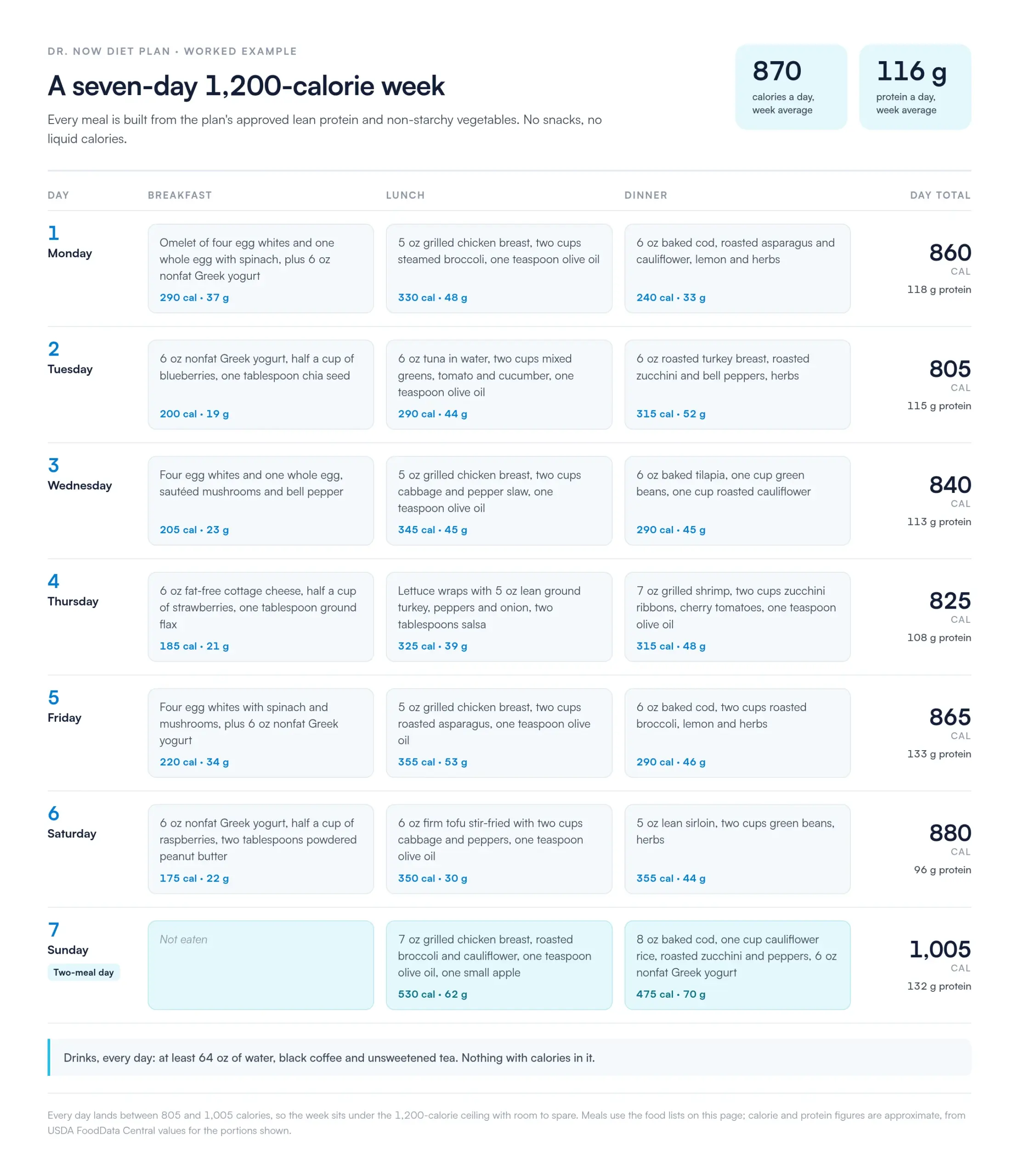
The same week reads out below, meal by meal, with the calories and protein each one costs.
| Day | Breakfast | Lunch | Dinner | Day total |
|---|---|---|---|---|
| Day 1 · Monday | Omelet of four egg whites and one whole egg with spinach, plus 6 oz nonfat Greek yogurt (290 cal, 37 g) | 5 oz grilled chicken breast, two cups steamed broccoli, one teaspoon olive oil (330 cal, 48 g) | 6 oz baked cod, roasted asparagus and cauliflower, lemon and herbs (240 cal, 33 g) | 860 cal, 118 g protein |
| Day 2 · Tuesday | 6 oz nonfat Greek yogurt, half a cup of blueberries, one tablespoon chia seed (200 cal, 19 g) | 6 oz tuna in water, two cups mixed greens, tomato and cucumber, one teaspoon olive oil (290 cal, 44 g) | 6 oz roasted turkey breast, roasted zucchini and bell peppers, herbs (315 cal, 52 g) | 805 cal, 115 g protein |
| Day 3 · Wednesday | Four egg whites and one whole egg, sautéed mushrooms and bell pepper (205 cal, 23 g) | 5 oz grilled chicken breast, two cups cabbage and pepper slaw, one teaspoon olive oil (345 cal, 45 g) | 6 oz baked tilapia, one cup green beans, one cup roasted cauliflower (290 cal, 45 g) | 840 cal, 113 g protein |
| Day 4 · Thursday | 6 oz fat-free cottage cheese, half a cup of strawberries, one tablespoon ground flax (185 cal, 21 g) | Lettuce wraps with 5 oz lean ground turkey, peppers and onion, two tablespoons salsa (325 cal, 39 g) | 7 oz grilled shrimp, two cups zucchini ribbons, cherry tomatoes, one teaspoon olive oil (315 cal, 48 g) | 825 cal, 108 g protein |
| Day 5 · Friday | Four egg whites with spinach and mushrooms, plus 6 oz nonfat Greek yogurt (220 cal, 34 g) | 5 oz grilled chicken breast, two cups roasted asparagus, one teaspoon olive oil (355 cal, 53 g) | 6 oz baked cod, two cups roasted broccoli, lemon and herbs (290 cal, 46 g) | 865 cal, 133 g protein |
| Day 6 · Saturday | 6 oz nonfat Greek yogurt, half a cup of raspberries, two tablespoons powdered peanut butter (175 cal, 22 g) | 6 oz firm tofu stir-fried with two cups cabbage and peppers, one teaspoon olive oil (350 cal, 30 g) | 5 oz lean sirloin, two cups green beans, herbs (355 cal, 44 g) | 880 cal, 96 g protein |
| Day 7 · Sunday | Not eaten, because Sunday runs as a two-meal day | 7 oz grilled chicken breast, roasted broccoli and cauliflower, one teaspoon olive oil, one small apple (530 cal, 62 g) | 8 oz baked cod, one cup cauliflower rice, roasted zucchini and peppers, 6 oz nonfat Greek yogurt (475 cal, 70 g) | 1,005 cal, 132 g protein |
Swap any meal you like. Trade protein for protein and vegetable for vegetable using the swap list further down, and the calorie figure barely moves.
Drinks stay at zero calories on every one of these days. Aim for at least 64 oz of water, plus black coffee and unsweetened tea if you want them.
Print it from the PDF above if you want it on paper. The same file carries the swap list and the weekly tracking fields a supervising provider fills in.
The Dr Now diet plan is a 1,200-calorie-a-day eating plan created by Dr. Younan Nowzaradan, a Houston bariatric surgeon. It cuts out sugar, refined carbohydrates and fried food. Every meal is built from lean protein and non-starchy vegetables, and patients follow it under medical supervision before weight-loss surgery.
Dr. Nowzaradan is the surgeon most viewers know from the TLC series My 600-lb Life. The same protocol goes by several names. Dr Now’s diet plan and the Dr Nowzaradan diet both describe this one.
Viewers also search for the diet used by My 600-lb Life patients, which is this one. On the show it’s a condition of surgery rather than a side note. Patients who can’t follow it usually don’t get a date.
Clinically the plan sits one step above a very-low-calorie diet. Formal VLCDs run under 800 calories a day, usually on meal replacements. At 1,200 calories of ordinary food, this is a low-calorie diet for severe obesity, usually class 3 on a BMI chart.
The plan strips out added sugar entirely. For patients who mainly need to break a sugar habit, our no-sugar meal plan template is a lighter starting point.
The calorie ceiling exists to shrink the liver. In severe obesity the left lobe of the liver is enlarged and fatty, and it sits directly over the stomach. That blocks the surgeon’s view and working space during laparoscopic gastric bypass or sleeve gastrectomy.
Cutting calories and carbohydrates drains hepatic glycogen and the water bound to it, then starts on liver fat. One Obesity Surgery trial measured a 14.6% drop in liver volume after just two weeks of a preoperative low-calorie diet.
A systematic review of preoperative very-low-calorie diets puts the range at 5% to 20% of starting liver volume. Most of that arrives in the first two to four weeks, which is worth telling patients early.
Visceral fat matters for the same reason. Fat packed around the abdominal organs crowds the space the surgeon needs to work in. Preoperative weight loss buys back some of that room, and surgical teams commonly frame the target as 5% to 10% of starting weight.
The “30 pounds in 30 days” figure people remember is television. On the show, Dr. Now sets a personal target before he will agree to operate, and it varies patient by patient. Your surgical team sets yours.
The Dr Now 1200 calorie diet plan runs on three rules, often shortened to FAT: frequency, amount and type. Every food decision on the plan comes back to one of the three.
That second rule is where the plan gets misread most often. The 1,200 is a ceiling for the day, not a per-meal figure, so the split below is what patients have to work with.
| Meal | On a 2-meal day | On a 3-meal day | Protein focus |
|---|---|---|---|
| Breakfast | Not eaten | About 400 calories | Egg whites or nonfat Greek yogurt |
| Lunch | About 600 calories | About 400 calories | Chicken breast, turkey or white fish |
| Dinner | About 600 calories | About 400 calories | Fish, lean beef or tofu |
| Snacks | None | None | Not part of the plan |
| Drinks | Zero calories | Zero calories | Water, black coffee, unsweetened tea |
| Day total | 1,200 calories | 1,200 calories | Protein at every meal |
Those per-meal figures are plain arithmetic on the 1,200 total, not a number Dr. Now publishes. Patients still ask for them first. “1,200 calories a day” tells you nothing about what to put on a plate at noon.
Hydration does the rest of the work. Most supervising teams ask for at least 64 ounces of water a day, and no liquid calories at all. Juice, soda, sweetened coffee and alcohol are out, because they spend the budget without registering as a meal.
The Dr Now 1200 calorie diet plan PDF above is built to those figures. Its seven days are written out meal by meal, and the tracking pages stay blank for the weekly provider review. If you want the same structure without the surgical context, our 1200 calorie diet plan template covers it.
On the Dr Nowzaradan diet plan you eat lean protein and non-starchy vegetables. You avoid sugar, refined carbohydrates, fried food, full-fat dairy and starchy sides. The table below sorts both lists by food category.
| Category | Eat freely | Avoid |
|---|---|---|
| Protein | Egg whites, skinless chicken and turkey, white fish, tuna, tofu | Fatty red meat, bacon, sausage, breaded or fried protein |
| Vegetables | Spinach, broccoli, cauliflower, zucchini, peppers, cabbage, asparagus | Potatoes, corn, peas, plantain, anything deep-fried |
| Fruit | Berries, a small apple, half a grapefruit | Bananas, grapes, mango, dried fruit, canned fruit in syrup |
| Dairy | Nonfat Greek yogurt, skim milk, fat-free cottage cheese | Whole milk, cream, hard cheese, sweetened yogurt |
| Grains and starches | Very small portions of whole grains, if your provider allows them | White bread, pasta, rice, cereal, pastry, crackers |
| Fats | A teaspoon of olive oil, a spoon of chia or flax seed | Butter, mayonnaise, frying oil, nut butters by the spoonful |
| Drinks | Water, black coffee, unsweetened tea, sugar-free flavored water | Juice, soda, smoothies, sweetened coffee, alcohol |
| Condiments | Herbs, spices, vinegar, lemon, mustard, hot sauce | Ketchup, barbecue sauce, creamy dressings, sweet marinades |
Two rows cause most of the arguments. Fruit is allowed, but only the low-sugar end of it, and one banana can cost a quarter of a meal’s budget. Grains are technically permitted in small amounts, and plenty of supervising teams cut them entirely for the pre-op window.
A day on the Dr Now meal plan is eggs at breakfast, poultry at lunch and fish at dinner. Two or three cups of vegetables go with the two later meals. Here is what that costs in calories and delivers in protein.
| Meal | Example | Approx. calories | Protein |
|---|---|---|---|
| Breakfast | Omelet of four egg whites and one whole egg with spinach, plus 6 oz nonfat Greek yogurt | 290 | 37 g |
| Lunch | 5 oz grilled chicken breast, two cups steamed broccoli, one teaspoon olive oil | 330 | 48 g |
| Dinner | 6 oz baked cod, roasted asparagus and cauliflower, lemon and herbs | 240 | 33 g |
| Drinks | At least 64 oz water, black coffee, unsweetened tea | 0 | 0 g |
| Day total | Three meals, no snacks | About 860 | About 118 g |
That day lands about 340 calories under the ceiling, which surprises people. A plate of protein and vegetables is bulky and cheap in calories, so patients following the plan honestly often eat less than 1,200. The headroom is what the swap list below spends.
Want it on paper? The Dr Nowzaradan diet plan PDF is free. It carries the seven days above, breakfast to dinner, with the swap list below printed alongside them.
You can change almost any meal on this plan without leaving the budget, as long as you trade like for like. Protein swaps for protein, vegetable for vegetable, and anything that arrives as a liquid gets treated as a luxury rather than a meal.
The traps are the foods that read as healthy and price like a dessert. Smoothies, granola, nut butters and bottled dressings all clear the “wholesome” test and still take 200 calories off a 400-calorie meal.
| Instead of | Swap to | Why it works |
|---|---|---|
| A 16 oz fruit smoothie | 6 oz nonfat Greek yogurt with half a cup of berries | Same fruit, roughly 200 fewer calories, and you chew it |
| Granola or overnight oats | Four egg whites with spinach and mushrooms | Drops the refined carbs and adds about 12 g of protein |
| Two tablespoons of peanut butter | Powdered peanut butter mixed with water | Saves around 140 calories for a similar taste |
| Ranch or Caesar dressing | Lemon juice, vinegar and dried herbs | A two-tablespoon pour of dressing costs 120 to 150 calories |
| Olive oil for roasting | Oil spray, broth or a nonstick pan | Every tablespoon of oil you skip is 120 calories back |
| Chicken thigh with skin | Skinless chicken breast | Same portion size, roughly 100 fewer calories |
| Sweet potato, corn or peas | Roasted cauliflower, zucchini or green beans | Starchy sides eat about 150 calories of the meal budget |
| Rice or pasta under a sauce | Cauliflower rice or spiralized zucchini | Keeps the plate looking the same and drops about 180 calories |
| Orange juice or regular soda | Water, black coffee or unsweetened tea | Liquid calories never register as a meal, so hunger returns |
Use the headroom from the sample day on protein rather than fat. An extra 3 oz of white fish costs about 80 calories and buys 18 g of protein. The same 80 calories of olive oil buys nothing that keeps a patient full until dinner.
Expect fast weight loss in the first few weeks, then a slower grind. Much of the early drop is glycogen and the water stored with it, so the scale moves before body fat does. Published preoperative low-calorie diet studies report losses of roughly 6 to 33 pounds over the diet period.
The spread is that wide because starting weight and diet length vary enormously. What the Dr Now weight loss diet reliably delivers is a smaller liver and a shorter, safer operation. Here is the honest ledger on both sides.
Nobody should run this plan without a supervising clinician. At 1,200 calories a day the risks are nutrient deficiencies, muscle loss, electrolyte imbalance and gallstones. Each one is manageable when somebody is watching for it.
Before day one, a bariatric dietitian should review the plan against the medications and blood work on the patient’s bariatric intake form. Oversight then runs for as long as the plan does, because rapid weight loss needs watching throughout.
Tell patients which symptoms end the experiment. Any of these means a call to the practice the same day.
Most patients follow this plan for three to six months before surgery. At every stage the practice tracks what the patient does, what gets measured and what gets written down.
| Stage | What the patient does | What the practice checks | What gets documented |
|---|---|---|---|
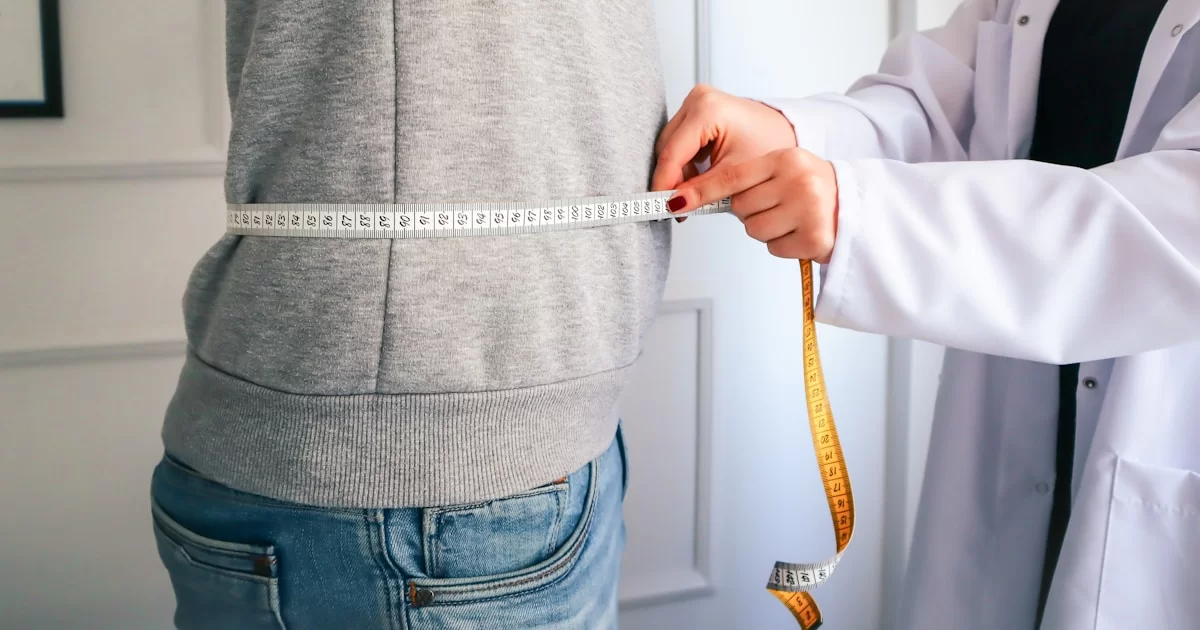
| Baseline, week 0 | Records starting weight and goal weight on the template | Height, weight, BMI, waist measurement, full medication list | Baseline vitals, contraindication screen, agreed calorie target |
| Weeks 1 to 4 | Fills in the weekly grid and logs every meal | Weekly weight, hydration, hunger and dizziness reports | Weekly weights, adherence notes, any symptom the patient reports |
| Months 2 to 3 | Keeps going and rotates meals using the swap list | Weight trend, blood pressure, glucose control where relevant | Percentage of starting weight lost, blood work the surgeon asked for |
| Final pre-op review | Confirms the surgery date and the last-week instructions | Whether the pre-op weight target has been met | Surgeon sign-off, final weight, plan for the days before surgery |
Plateaus are where most plans fall apart. Around week six the weekly loss shrinks and patients assume the diet has stopped working. Checking the patient’s nutrition worksheet against the swap list usually finds the answer, and it is normally oil, dressing or a drink.
Keep the documentation trail tight from week one. Insurers often want documented, supervised weight loss before they approve surgery, so those notes feed the prior authorization too. If surgery gets rescheduled, the weight history decides whether the runway restarts or simply extends.
Running this plan across a caseload is an admin problem before it is a clinical one. Practice management software like Pabau keeps the template, the weights and the review dates on one patient record. Nobody rebuilds the protocol from scratch for each new patient.
Today most weight management practices email the PDF, then chase the patient for a weight by text and type it into a spreadsheet. That works for five patients. At fifty, the weekly numbers arrive in four places and nobody can see the trend.
With everything in one record, you issue the template straight from the patient’s file. Each weight and waist measurement logs against the same timeline, and the pre-op review reminders send themselves. Your team spends review time reading the trend instead of assembling it.
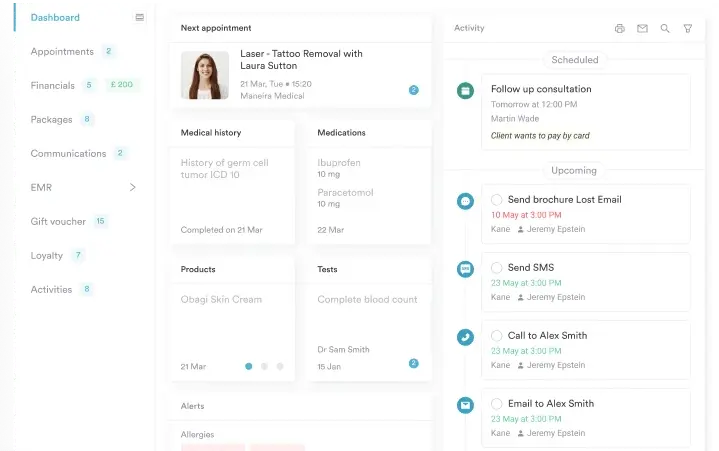
The same setup covers the paperwork around the plan. Consent, the medication review and the dietitian’s notes attach to the record, so the surgeon’s final sign-off has one place to look. See how Pabau’s weight loss practice software handles the tracking side.

Pabau keeps the diet plan, every weekly weight and the next review reminder on the same patient record. Your team spends review time reading the trend instead of rebuilding it from emails and spreadsheets.

Judge this plan by what it is for. It’s a surgical preparation tool with a start date, an end date and a supervising team. On that job it performs. As a general diet for someone who wants to lose 15 pounds, it’s the wrong instrument.
The food list is simple enough to memorize in a morning, so it rarely decides the outcome. What decides it is whether somebody reviews the weekly numbers and acts on them. A plan nobody reads is a plan nobody follows.
So download the template, set the review cadence before the patient starts, and decide up front who checks the weights each week. Book a demo to see how Pabau keeps pre-op diet tracking and provider sign-off on one patient record.

Need the shopping list that goes with it? Bariatric food list template sorts approved proteins, vegetables and dairy into a printable list a patient can take to the store.
Wondering what eating looks like after surgery? Bariatric diet plan walks through the liquid, pureed and soft stages that follow the operation this plan prepares for.
Focused on the liver rather than the surgery? 21-day fatty liver diet plan covers the same fat-reduction target for patients who are not heading into an operating room.
Need the week’s groceries costed out? Grocery list for weight loss gives patients a category-by-category list so the 1,200-calorie week survives a supermarket trip.
Looking for a plan patients can stay on afterwards? Clean eating meal plan offers a maintenance structure for the months after the pre-op window closes.
It is a 1,200-calorie eating plan from bariatric surgeon Dr. Younan Nowzaradan. The Dr Nowzaradan diet builds every meal from lean protein and non-starchy vegetables. Snacks and liquid calories are out. Patients follow it under medical supervision to lose weight and shrink the liver before weight-loss surgery.
About 1,200 calories a day, taken as two 600-calorie meals or three 400-calorie meals. Protein does most of the work inside that ceiling. A full day of the approved foods usually lands between 90 and 120 grams of protein. That helps preserve lean mass during rapid weight loss.
Dr. Younan Nowzaradan, a Houston bariatric surgeon best known from the TLC series My 600-lb Life. He designed it as preparation for weight-loss surgery rather than as a standalone diet. The rules come straight from bariatric practice, where preoperative weight loss lowers surgical risk.
Allowed: egg whites, skinless poultry, white fish, tofu, non-starchy vegetables, nonfat dairy and low-sugar fruit. Restricted: sugar, refined carbohydrates, fried food, full-fat dairy, potatoes, rice, pasta and high-sugar fruit. Drinks are limited to water, black coffee and unsweetened tea.
No published 21-day version exists. The 21-day Dr Now diet is a popular search term rather than a protocol Dr. Nowzaradan sets. In practice the pre-op diet runs for weeks to months, and the surgical team fixes the length from the patient’s starting weight and surgery date.
Yes. Cutting calories and carbohydrates drains hepatic glycogen and the water held with it, then reduces liver fat. One Obesity Surgery trial measured a 14.6% fall in liver volume after two weeks. A smaller liver gives the surgeon better access during laparoscopic surgery.
It depends heavily on starting weight and how long the diet runs. Published preoperative low-calorie diet studies report losses of roughly 6 to 33 pounds across the diet period. Most of the early drop is glycogen and water, so the weekly figure slows after the first month.
Some people do, under medical supervision, but it was designed as surgical preparation. At 1,200 calories a day it is not built for long-term use without clinical review. Talk to your own clinician first, especially if you take medication for diabetes or blood pressure.
No. Both cut carbohydrates, but keto is high in fat and usually has no calorie limit. This plan restricts fat as well as carbohydrates and holds a hard 1,200-calorie ceiling. The supervision requirement is the other difference that matters.
Standardize the template, then track it in one place. Practice management software like Pabau lets a weight management practice issue the plan from the patient record. Weekly weights log against it, and the pre-op reviews get scheduled from the same screen. Centralized tracking also flags a stalled patient early.
Every template below works the same way. A wellness practice platform turns them into trackable client programs rather than PDFs sitting in an inbox.