HCPCS Code E0272: Foam rubber mattress billing guide
HCPCS Code E0272: official descriptor and code overview HCPCS Code E0272 is the ...

Last Updated: Nov 6, 2026
V5260 is the HCPCS Level II code for a digital, binaural, in-the-ear (ITE) hearing aid. It covers two ITE aids fitted at the same visit, one per ear, and bills them as one unit.
All three descriptor terms must match the fitting. A single ITE aid takes V5256, the digital monaural ITE code. A pair worn in the canal takes V5259, and a behind-the-ear pair takes V5261. Original Medicare excludes hearing aids by statute, so most V5260 claims go to commercial plans, Medicaid, or Medicare Advantage plans with a hearing benefit.
Let Pabau's smart automation suggest the right codes, reduce claim denials, and keep your practice compliant—effortlessly.
Automate repetitive tasks and focus on what matters most—your patients.
Reduce coding errors and ensure compliance with the latest regulations.
Clean claims, fewer denials, and faster reimbursements.
Powerful insights and reporting to help your practice thrive.
HIPAA compliant SOC 2 certified GDPR-compliant Trusted by 4,000+ clinics worldwide

HCPCS code V5260 bills two digital in-the-ear (ITE) hearing aids, fitted at one visit, as a single unit.
Original Medicare excludes hearing aids under 42 U.S.C. § 1395y(a)(7), so V5260 claims usually go to commercial plans, Medicaid, or Medicare Advantage.
A single ITE aid bills as V5256, and a behind-the-ear pair bills as V5261, not V5260.
Payers expect a current audiogram, an order, a medical necessity letter, fitting notes, and serial numbers for both devices.
Get prior authorization before you order the devices, because payers routinely deny retrospective requests.
HCPCS code V5260 is the HCPCS Level II code for a digital, binaural, in-the-ear hearing aid. One claim line covers both devices, so the quantity is 1.
CMS maintains the code set, and V5260 sits in its V5008-V5299 hearing services range. Our HCPCS reference for coders lists the neighboring V-codes.
Each qualifier in the V5260 descriptor has a specific meaning. Misread one, and the claim goes out with the wrong V-code.
When all three conditions hold for both ears, V5260 is correct. When any one differs, a different code applies, so check the manufacturer’s product classification before you code.
The digital hearing aid codes follow a simple grid. Style (CIC, ITC, ITE or BTE) crosses with the number of ears fitted. The grid below shows where V5260 sits among its seven neighbors.
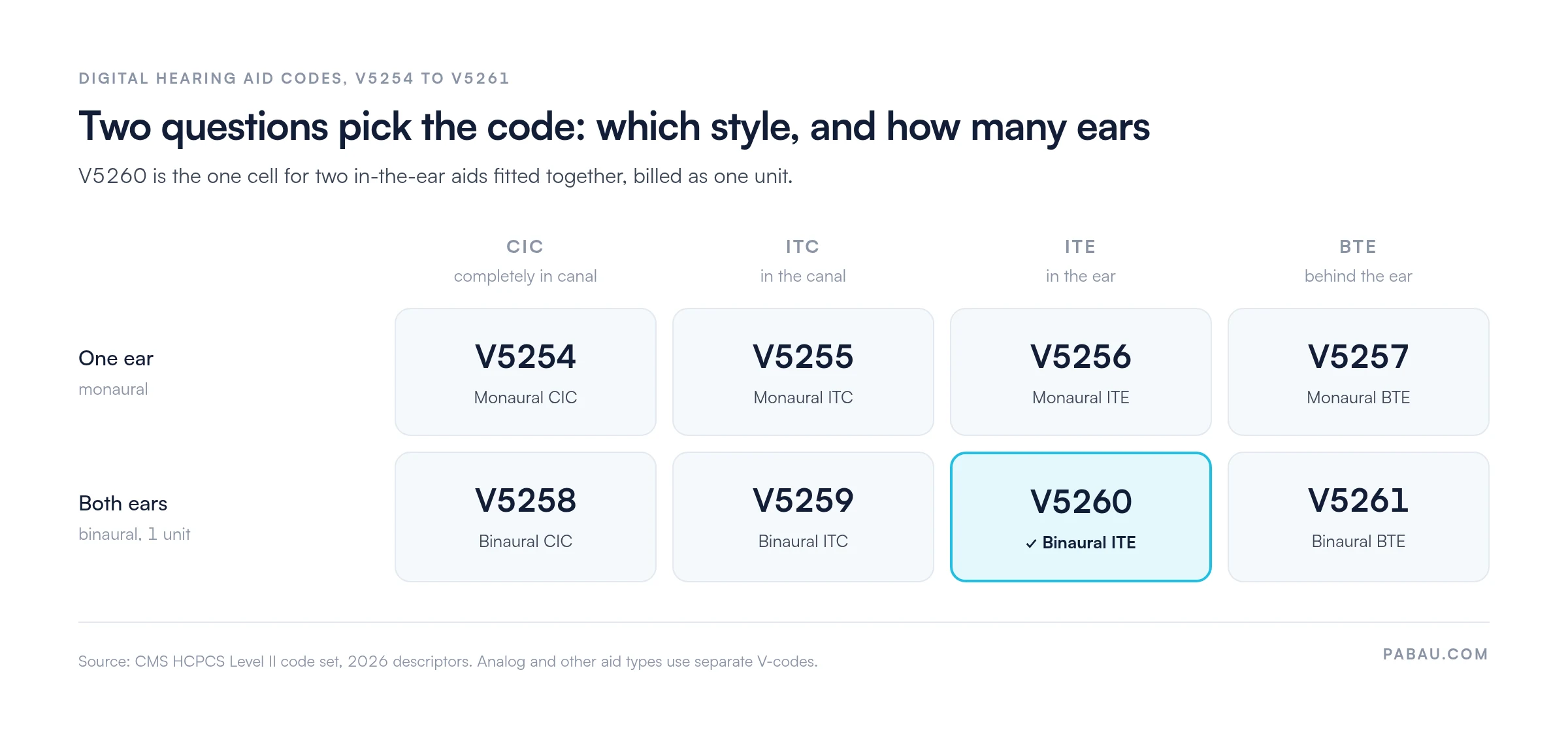
ITE vs ITC distinction: An ITE shell fills the outer ear bowl (concha) and may reach partway into the canal. An ITC device sits mostly within the canal and shows little from outside.
If the pair is ITC, bill V5259 instead. If it sits behind the ear, bill V5261. When the record is unclear, ask the dispensing professional to confirm the style in writing.
V5260 covers one binaural pair of digital ITE hearing aids. Depending on the benefit design, commercial, Medicaid or VA payers may also pay for fitting services and follow-up visits. Those are billed separately.
Original Medicare does not cover hearing aids. The exclusion sits in 42 U.S.C. § 1395y(a)(7), which is section 1862(a)(7) of the Social Security Act. A V5260 claim sent to Original Medicare will be denied.
Elsewhere, coverage depends on the payer. Each plan’s benefit document governs, but typical positions look like this.
Verify coverage before dispensing. For an Original Medicare patient, explain in writing that hearing aids are not covered. An ABN is not required for this statutory exclusion, though you can give one voluntarily. For commercial plans, confirm the V5260 benefit limit and any waiting period first.
Original Medicare does not pay for V5260, so no Medicare payment rate applies. Commercial, Medicaid and Medicare Advantage rates are payer-specific, and no single national table publishes them.
To find the rate for a specific claim, work through these sources in order.
Third-party code sites sometimes list V5260 figures. Treat them as a rough guide, and confirm the payer’s contracted rate before you quote a patient.
Payers that cover V5260 expect a complete documentation package. A missing document is one of the easiest denial triggers to prevent.
Keep the file for at least seven years, or longer if state law requires it. Audits of hearing aid claims focus on the audiogram and the medical necessity evidence.
Prior authorization (PA) is common for V5260 with commercial insurers and many state Medicaid programs. Rules differ by payer, so check each policy before the fitting. Careful insurance eligibility verification at intake surfaces PA requirements before anyone orders the device.
Never dispense first and chase PA afterward. Payers routinely deny retrospective requests for hearing aids.
A clean V5260 claim follows six steps in order. Skipping one is a common reason hearing aid claims bounce back.
Example: A patient with bilateral sensorineural hearing loss is fitted with two ITE aids on the same day. The claim carries one line, V5260 with a quantity of 1, pointing to H90.3 in field 21. The PA number goes in box 23, and both serial numbers sit in the attached fitting notes.
Run these checks on every V5260 claim before it leaves the practice.
V5260 needs an ICD-10-CM code that supports amplification in both ears. Payers use it to confirm the patient’s condition qualifies. These codes pair with V5260 most often.
Bilateral sensorineural loss, coded H90.3, is the pairing payers see most. Confirm each code is active for the fiscal year with the CDC/NCHS ICD-10-CM web tool. Some payers also publish coverage policies that limit the diagnosis codes they accept, so check the policy before you submit.
Hearing aid claims deny more often than most HCPCS categories, because coverage is discretionary and documentation rules are strict. A structured denial management process stops repeat errors and recovers revenue.
Track V5260 denial patterns by payer. If a plan keeps denying for medical necessity, tailor your template letter to the language its clinical reviewers use in their coverage policies. Matching the payer’s own terms reduces denials faster than a generic letter.
Many audiology practices track V5260 claims across a clearinghouse portal, a spreadsheet and the patient chart. Statuses get missed, and a denial can sit unnoticed until the patient calls about a bill.
Pabau, the practice management platform we build, submits claims from the patient record through Claim.MD in the US. Its claims management for audiology shows each claim’s status and any denials in one place. Eligibility checks run before the visit, so a missing hearing benefit shows up early.
The result is fewer claims lost between systems, and faster follow-up when a payer pushes back.
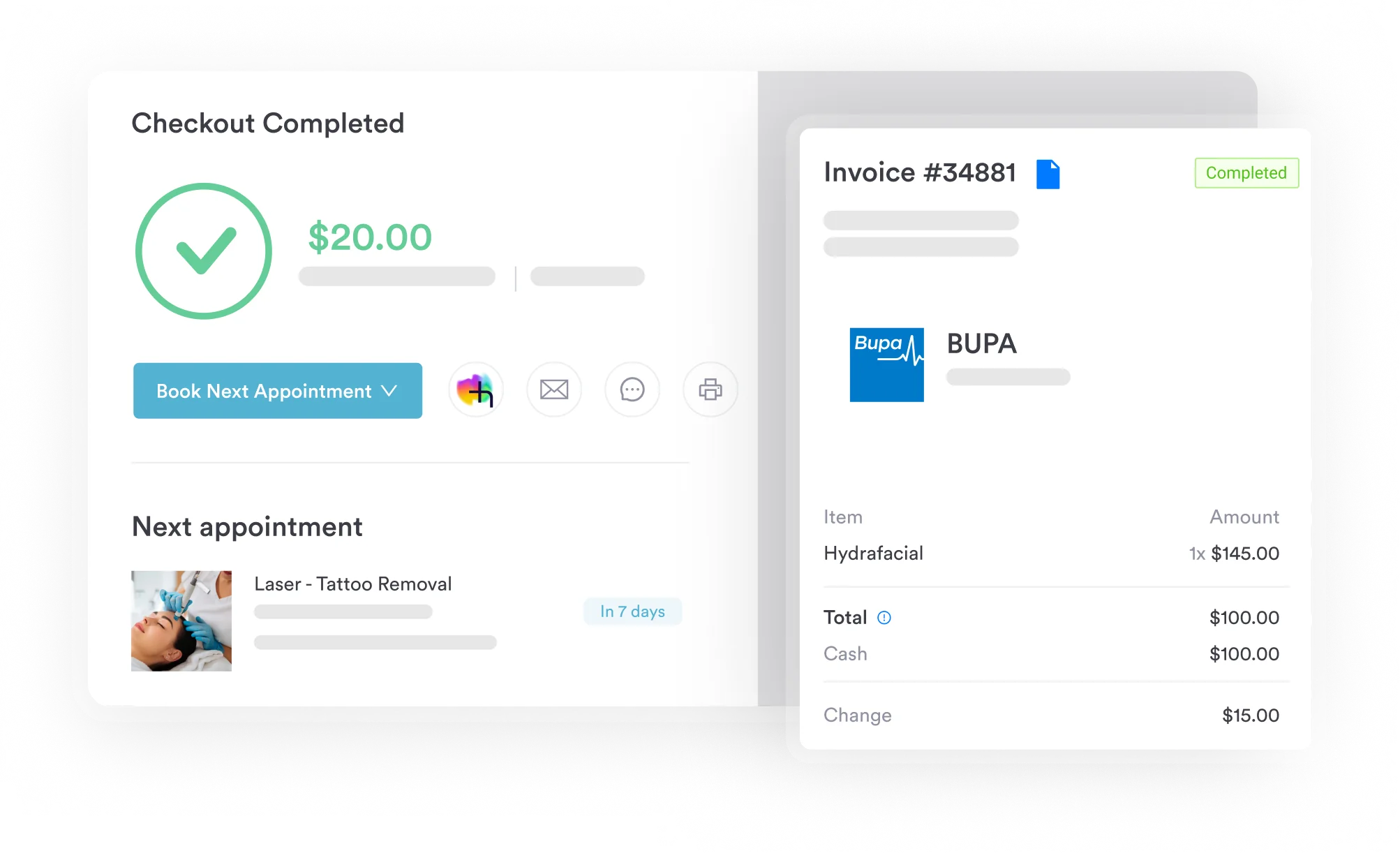

Pabau submits and tracks claims from the patient record, with statuses and denials in one view. Your team spends less time chasing V5260 claims and more time with patients.

Code V5260 only when the fitting matches all three terms: digital, both ears, and ITE. When one term slips, switch codes before the claim goes out, not after the denial comes back.
The payer decides the rest. Treat Original Medicare as a non-covered item from day one. For every other payer, secure PA and the full file before you order the devices.
Book a demo to see how Pabau helps your team submit and track hearing aid claims in one place.

New to the claims process? Medical billing fundamentals explains the claims process from payer enrollment through remittance advice.
Dealing with a pattern of claim rejections? Denial management in healthcare covers how to categorize, appeal, and prevent the most common denial types.
Want to make sure your billing practices meet payer audit standards? Medical billing compliance outlines the documentation and coding requirements that keep practices audit-ready.
Fitting the smaller completely-in-canal style? HCPCS code V5258 covers the digital binaural CIC pair.
V5260 is the digital binaural ITE code, and V5256 is the digital monaural ITE code. Bill V5256 when the patient gets one device. Bill V5260 as one unit when two ITE devices are fitted at the same visit. The binaural BTE code is V5261.
Original Medicare does not cover V5260, because hearing aids are excluded under 42 U.S.C. § 1395y(a)(7). An ABN is not required, though you can give one voluntarily. Tell the patient in writing that the item is non-covered. Some Medicare Advantage plans do include a hearing benefit.
V5160 is the HCPCS code for a binaural dispensing fee. Some payers bundle dispensing into the device payment, so check the contract before you add a V5160 line.
Yes, once the plan’s replacement interval has passed. Most plans limit how often they pay for a new pair. If the aids were lost or damaged, check the manufacturer’s loss and damage warranty before you bill.
No. V5260 covers the devices only. The audiologic evaluation is reported with its own CPT codes, on a separate claim line.