HCPCS code V5170: CROS hearing aid status and replacements
HCPCS code V5170 is a retired CROS hearing aid code HCPCS code V5170 is a delete...

Last Updated: Oct 22, 2026
V5259 is the HCPCS Level II code for hearing aid, digital, binaural, ITC. It reports a matched pair of digital in-the-canal aids fitted to both ears in one dispense.
The code covers the devices only. Ear impressions, the binaural dispensing fee (V5160), and the fitting visit are reported separately. Its single-ear counterpart is V5255, and a digital behind-the-ear pair is V5261.
Let Pabau's smart automation suggest the right codes, reduce claim denials, and keep your practice compliant—effortlessly.
Automate repetitive tasks and focus on what matters most—your patients.
Reduce coding errors and ensure compliance with the latest regulations.
Clean claims, fewer denials, and faster reimbursements.
Powerful insights and reporting to help your practice thrive.
HIPAA compliant SOC 2 certified GDPR-compliant Trusted by 4,000+ clinics worldwide

HCPCS code V5259 describes a hearing aid, digital, binaural, ITC. It reports a matched pair of digital in-the-canal aids fitted to both ears.
V5255 is the single-ear version. A digital behind-the-ear pair is V5261, so the shell style decides which code applies.
Traditional Medicare Part B excludes hearing aids by statute, so V5259 claims go to Medicaid, Medicare Advantage, or commercial plans.
Ear impressions, the binaural dispensing fee, and the fitting visit are reported on their own lines, not inside V5259.
Pabau, the billing and patient-record platform we build, pre-fills each claim from the patient record and checks required fields before it sends.
HCPCS code V5259 reports a matched pair of digital in-the-canal (ITC) hearing aids, dispensed to both ears together. The Centers for Medicare & Medicaid Services (CMS) maintains this Level II code. Its official descriptor reads Hearing aid, digital, binaural, ITC.
Coverage is the fact that shapes every V5259 claim. Traditional Medicare excludes hearing aids by statute, so payment comes from Medicaid, Medicare Advantage, or a commercial plan.
Getting the code right matters early, because each ITC shell is custom-made. A wrong code or a missed authorization can leave you with a pair no one else can wear.
Below, you will see how to tell V5259 from its neighbors, what each payer expects, and how the claim moves to payment.
First, each term in the descriptor narrows what the code can report:
The table below summarizes the attributes a pair must meet to be reported with V5259.
V5259 reports only the two hearing aids handed to the patient. The binaural dispensing fee goes on its own line as V5160, and so do the related items below.
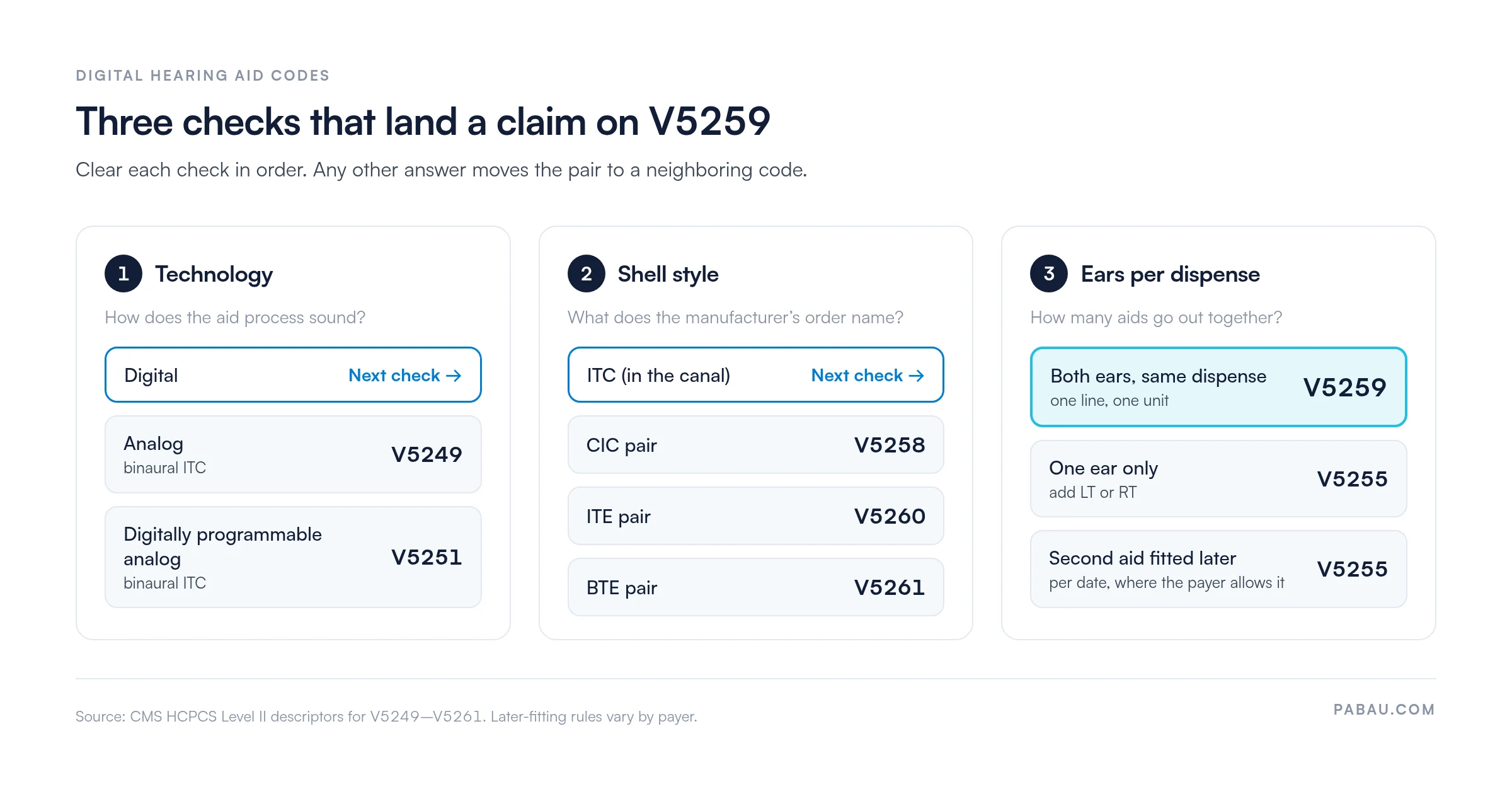
The digital hearing aid codes form a grid of four styles and two fittings. Style mismatch is the most frequent V5259 error, so confirm the shell type from the manufacturer’s order before coding.
Check the technology: Analog binaural ITC aids are V5249, and digitally programmable analog binaural ITC aids are V5251. The manufacturer’s spec sheet settles which one applies.
Check the style: ITC and ITE aids are both custom shells, so V5260, the binaural ITE code, is an easy slip. A binaural CIC pair is V5258, and a binaural behind-the-ear pair is V5261.
Check the fitting: V5255 and V5259 both describe digital ITC aids. V5255 covers one ear, and V5259 covers a pair dispensed together. If the second aid is fitted on a later date, check the payer policy first. Where the payer allows it, bill each aid on its own date as V5255 with an LT or RT modifier.
Put together, the three checks form a short path, and each wrong answer points straight to the right code.
V5259 already describes a pair, so the binaural line usually needs no laterality modifier. A few modifiers still apply in specific claim scenarios.
Medicare does not require an Advance Beneficiary Notice for a statutorily excluded item such as a hearing aid. A voluntary written notice still records the cost conversation before the impressions are taken.
Payers that cover hearing aids usually expect these six records on file before a V5259 claim goes out. Good medical billing compliance for hearing devices starts with this list.
The diagnosis must support a bilateral fitting. Report bilateral conductive, sensorineural, or mixed hearing loss from the H90 category, and make sure the audiogram backs it up.
Because ITC shells are custom-made, the claim starts at the impression appointment. Verify the benefit and the authorization before you take impressions, since a returned custom pair is expensive to unwind.
Coverage for V5259 depends on the payer, so check the benefit before the evaluation. Insurance eligibility verification at booking tells you which of these rules applies before the impressions are taken.
Traditional Medicare does not pay for V5259. Section 1862(a)(7) of the Social Security Act, codified at 42 U.S.C. § 1395y(a)(7), excludes hearing aids and examinations for them.
No local or national coverage determination overrides that exclusion for conventional hearing aids. Extra documentation cannot reverse the denial, because the device sits outside the benefit.
So for a Medicare patient, look for coverage elsewhere. A Medicare Advantage plan or a secondary plan with a hearing benefit may pay, under that plan’s own criteria.
Traditional Medicare publishes no rate for an excluded item, so V5259 has no national allowable. Instead, payment comes from three sources.
Quick check before a Medicaid fitting: ITC aids are custom-built, so compare the state allowable with your invoice cost first. A flat allowable can fall below the cost of a premium custom pair.
Most V5259 denials trace back to the six errors below. A structured denial management process shows which one your practice hits most.
When a denial does arrive, the claim adjustment reason code points to the fix. The guide to denial codes in medical billing explains what each one means.
Payer replacement rules vary. Many state Medicaid programs allow a new pair only every few years, and each program publishes its own interval.
Early replacement needs documented medical necessity, such as loss, damage beyond repair, or a significant change in hearing thresholds. Some payers also expect a replacement modifier such as RA.
A clean V5259 claim follows the same order every time, and it starts before the impressions. Claims management software that pre-fills the claim from the patient record cuts retyping errors at the final step.
A quick desk check catches the errors from the denial table before the payer does. Tick each line before the claim goes out.
A custom ITC pair builds a long paper trail before any claim exists. Impressions, a manufacturer order, an authorization, two serial numbers, and a delivery receipt all have to agree.
Pabau pre-fills each claim from the patient record, so the codes are not retyped at the billing desk. Before the claim can be sent, it checks that required fields, such as the authorization number, are complete.
For US practices, claims go out through Claim.MD. Claim status and ERA remittances then post back to the same claim, so a part-paid pair is easy to spot and follow up.

Pabau pre-fills claims from the patient record and checks required fields, so audiology practices can track V-code claims through to payment.

V5259 is settled long before the claim is built. The shell style and the number of aids fix the code, and the payer’s benefit decides whether it gets paid.
So move the coding decision to the impression appointment. Confirm a digital ITC pair, verify the benefit and authorization, and code V5259 before the order goes out. The trade-off is a few extra minutes at booking, set against a custom pair that is expensive to unwind.
Handled that way, the claim reaches the payer with its paperwork already in place. Book a demo to see how Pabau pre-fills and tracks hearing aid claims through to the posted payment.

Need a broader view of the claims cycle? What is medical billing covers each stage, from charge capture to payment posting.
Want to know how clearinghouses handle V-code claims? The medical claims clearinghouse guide explains how device claims are checked before they reach the payer.
Looking for a framework to track denials across your practice? The revenue cycle management guide outlines the metrics and workflows that stop denials from compounding.
Billing a completely-in-canal pair instead? The V5258 billing guide covers the digital binaural CIC code.
Looking up another V-code? The procedure code library collects CPT, HCPCS, and CCSD billing guides in one place.
Yes. V5259 has been an active Level II code since January 1, 2002, and it remains in the 2026 HCPCS file.
No. CMS lists V5259 with coverage code S, non-covered by statute, under Section 1862(a)(7) of the Social Security Act. Medicare Advantage plans may cover it under their own rules.
Both report digital ITC aids. V5255 is one aid for one ear, and V5259 is a pair dispensed together. For a second aid fitted later, check the payer policy before billing V5255 with LT or RT.
No. V5259 is the digital binaural in-the-canal code. A digital behind-the-ear pair is V5261, and a single digital behind-the-ear aid is V5257.
Many Medicaid programs use the delivery date, when the patient receives both aids and signs the proof of delivery. The impression date starts the order, not the claim. Check the payer manual, because rules differ.
One. The descriptor already says binaural, so a quantity of 1 covers both aids. Bill the binaural dispensing fee, V5160, on its own line.