CPT Code 62284: Injection procedure for myelography
CPT Code 62284: official descriptor and procedure overview The American Medical ...

Last Updated: Oct 19, 2026
V5258 is the HCPCS Level II code for hearing aid, digital, binaural, CIC.
Audiology practices and hearing aid dispensers use V5258 when they fit digital CIC devices in both ears. It does not apply to a single ear or a different device style. Its monaural counterpart is V5254, and billing one in place of the other is a common error in hearing device claims. V5257 is often mistaken for that single-ear code, but it describes a monaural BTE device.
Let Pabau's smart automation suggest the right codes, reduce claim denials, and keep your practice compliant—effortlessly.
Automate repetitive tasks and focus on what matters most—your patients.
Reduce coding errors and ensure compliance with the latest regulations.
Clean claims, fewer denials, and faster reimbursements.
Powerful insights and reporting to help your practice thrive.
HIPAA compliant SOC 2 certified GDPR-compliant Trusted by 4,000+ clinics worldwide

HCPCS Code V5258 covers a digital binaural CIC hearing aid, meaning both ears receive a completely-in-canal digital device.
Medicare Part B excludes hearing aids, so traditional Medicare does not reimburse V5258, though Medicare Advantage plans may cover it.
V5254 is the monaural counterpart of V5258, and swapping the two is a common cause of CIC hearing aid claim denials.
Style errors cause denials too, because V5257 and V5261 describe BTE devices and never fit a CIC fitting.
Pabau’s claims management software keeps the audiogram, order and PA number with the claim before it goes out.
HCPCS Code V5258 is the Level II code for a pair of digital completely-in-canal (CIC) hearing aids, one fitted in each ear. It sits in the hearing services range of HCPCS Level II. The Centers for Medicare and Medicaid Services maintains that code set for services CPT does not describe.
The V-code series for hearing aids spans V5030 through V5267. Each code differs by technology (analog or digital) and fitting configuration (monaural or binaural). It also differs by placement style: behind-the-ear, in-the-ear, in-the-canal, or completely-in-canal.
The official CMS descriptor for V5258 is: Hearing aid, digital, binaural, CIC. Every word in that descriptor is a billing decision point.
V5258 covers the supply of one pair of digital CIC hearing aids dispensed to a patient who requires bilateral amplification. The code represents the hearing aid devices themselves; professional services provided by the dispensing audiologist are billed separately using the appropriate CPT codes.
Technology level drives the code as much as style does. A binaural ITE pair that is digitally programmable rather than fully digital bills as V5252, not V5260. A disposable aid fitted to one ear bills as V5262, whatever its style.
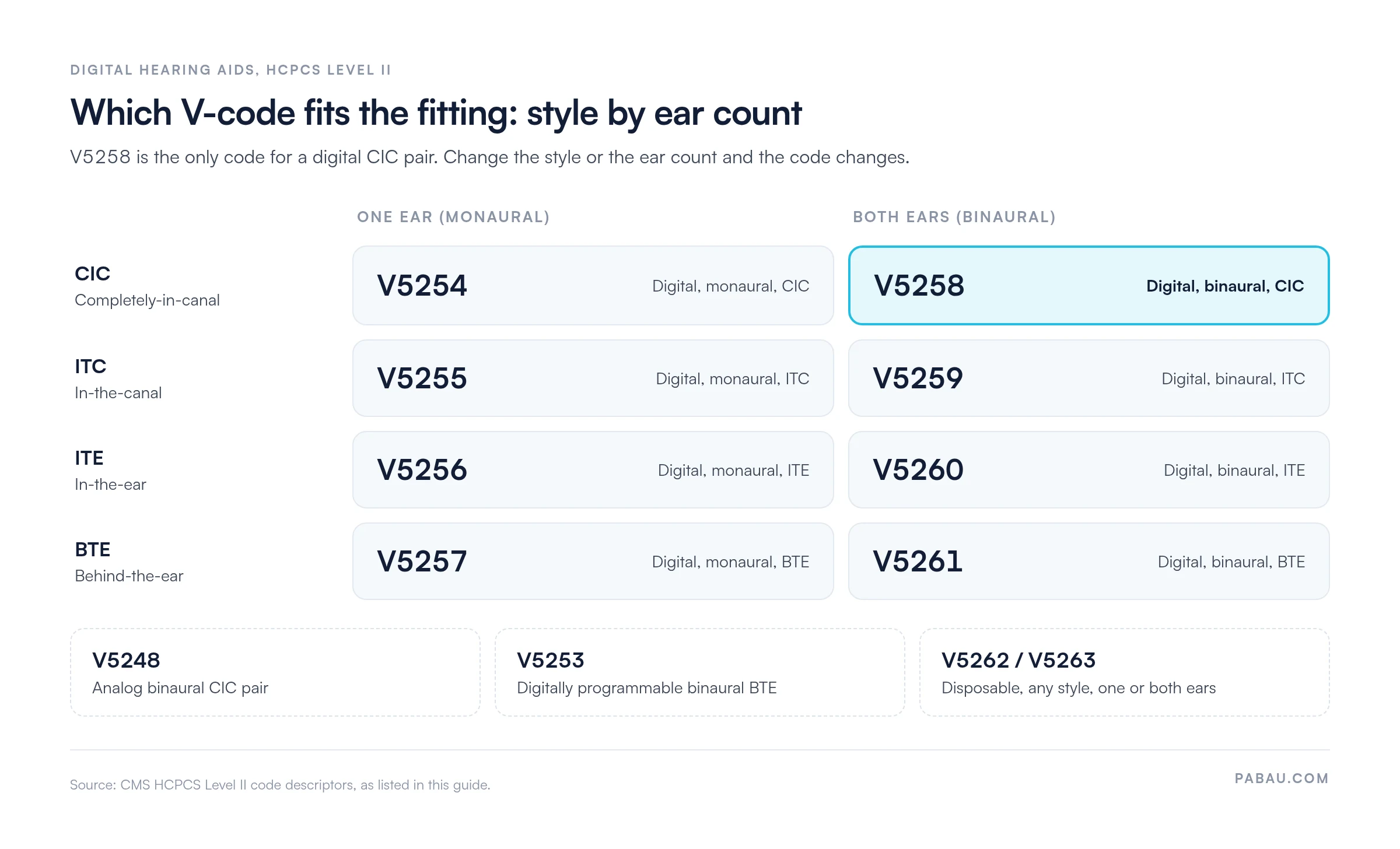
The digital hearing aid codes run in two blocks of four. V5254 through V5257 cover monaural CIC, ITC, ITE and BTE devices, and V5258 through V5261 cover the same four styles fitted to both ears. The table below lists that series plus two neighboring codes that are often confused with V5258 at claim submission.
The V5254/V5258 distinction is a common audit trigger. A practice that routinely dispenses bilateral CIC fittings but bills V5254 is systematically underbilling. The reverse, billing V5258 for a single-ear fitting, creates an overpayment exposure and draws payer denials once utilization review flags the pattern.
Style errors cause a second group of denials. V5257 and V5261 are BTE codes, so neither one fits a CIC device, whatever the ear count. The grid below puts style and ear count side by side, so the right code sits where the two meet.
Medicare Part B does not cover routine hearing aids. The statutory exclusion sits in Medicare Benefit Policy Manual Chapter 16, Section 100, “Hearing Aids and Auditory Implants.” It excludes hearing aids, and examinations for prescribing or fitting them, from Medicare benefits.
The exclusion applies regardless of medical necessity, audiogram results, or degree of hearing loss. Even a patient with profound bilateral sensorineural hearing loss cannot receive V5258 reimbursement from traditional Medicare Part B.
For practices with a mixed payer panel, the coverage check belongs at scheduling. Knowing the payer’s coverage status before dispensing prevents patient billing disputes after the claim is denied.
Medicare Advantage (Part C) plans may offer hearing aid coverage as a supplemental benefit. Coverage terms, device allowances, and copays vary by plan and region. Some plans set an annual dollar allowance per ear, and others require devices from an in-network supplier.
Verify coverage directly with the specific plan before dispensing, and get the plan’s prior authorization requirements in writing.
Because traditional Medicare does not cover V5258, CMS publishes no Medicare Part B allowed amount for it in the standard Physician Fee Schedule. Private payer rates and Medicare Advantage plan allowances are set by individual contracts.
For current fee schedule data, use the CMS Physician Fee Schedule lookup tool. Check supplemental plan rates through each plan’s provider portal. Each state Medicaid agency publishes its own rates, and they vary widely.
Medicaid coverage of hearing aids under V5258 varies by state. Most state Medicaid programs cover hearing aids for children. Adult coverage is less consistent and subject to frequency limits, typically one device per ear every three to five years.
Commercial plans often cover hearing aids but impose device allowances, network restrictions, and prior authorization requirements. Verify payer-specific coverage before dispensing.
Before billing V5258 to any payer other than traditional Medicare, pull the member’s current benefit summary or call the plan’s provider line. Confirm that (1) the hearing aid benefit is active and (2) CIC digital devices are a covered device category. Also confirm (3) whether the plan requires purchase from a preferred network supplier. Documenting this verification call protects against retroactive denial.
Prior authorization (PA) for V5258 depends entirely on the payer. Traditional Medicare does not require PA because it does not cover the code at all. Medicare Advantage plans, commercial insurers, and state Medicaid programs each set their own PA thresholds.
A PA request stands or falls on the documents gathered before submission. Most payers that cover V5258 require the following to process one:
PA timelines range from 48 hours (urgent requests via some plans) to 14 business days for standard submissions. Dispensing before PA approval is confirmed puts the practice at financial risk. Most payers will deny a claim retroactively if the device was provided before authorization.
Supporting documentation must be in the record before the claim is submitted. Capture each element at its own point in the visit, from intake through dispensing, so the file is complete when the claim goes out.
Every V5258 claim requires a supporting ICD-10 diagnosis code. The diagnosis must reflect the patient’s hearing loss type and laterality. Commonly paired codes include:
Always verify the specific diagnosis codes against the payer’s Local Coverage Determination (LCD) or Coverage Determination policy before billing. Some payers maintain a covered-diagnosis list that restricts reimbursement to specific ICD-10 codes.
Most V5258 denials fall into a small set of predictable patterns, and each has a prevention step you can build into the billing workflow. When a claim does come back, the code on the remittance advice tells you which pattern you hit. Our guide to medical billing denial codes explains how to read each one.
A clean V5258 claim needs documentation, coverage verification, and accurate code selection to line up. Hearing aid dispensing has more moving parts than a standard office visit claim, so a checklist prevents the omissions that generate denials.
Run a monthly audit of your V5254 and V5258 claim volumes against your dispensing log. If V5254 claims outnumber V5258 claims by more than your patient mix explains, bilateral CIC fittings are likely being miscoded as monaural. Check for V5257 or V5261 on CIC fittings too, since both codes describe BTE devices.
Most V5258 denials start at the dispensing appointment, not in the billing office. The ear count, device style, audiogram date and PA number often sit in different places. The coder then pieces them together after the patient has left.
Pabau, the practice management platform we build, keeps those details in the patient record. The coder sees them at the point of billing. Its claims management software tracks documentation status, attaches the audiogram and order before submission, and monitors claim outcomes by HCPCS code.
The result is fewer V5254/V5258 swaps and less time spent chasing denial explanations. Billing records also stay organized for the day a payer asks for the file on audit.

Pabau helps hearing care practices manage patient documentation, track claim statuses, and keep billing records audit-ready, all in one place.

V5258 is correct only when three facts line up. The device is digital, both units sit completely in the canal, and both ears are fitted together. Change one of those facts and the code changes with it. A single ear takes V5254, and another style takes its own ITC, ITE or BTE code.
The habit worth building is to pick the code from the dispensing record, not from memory. Most V5258 errors come from a code that sounds close enough. A monthly check of V5254 against V5258 volumes catches that drift before a payer audit does.
Book a demo to see how Pabau keeps hearing aid claims matched to the fitting recorded in the patient file.

Need to understand how claim denials are managed at scale? Denial management in healthcare covers the strategies practices use to reduce denial rates and recover revenue faster.
Looking for a clean-claim checklist to reduce first-pass rejection? Submitting a clean claim walks through the documentation and coding checks payers run at intake.
Want to understand how hearing aid billing fits into the broader revenue cycle? Revenue cycle management explains the end-to-end process from patient scheduling to final payment posting.
Dispensing an analog CIC pair? HCPCS Code V5248 explains the analog binaural CIC code and when it applies.
HCPCS Code V5258 is the billing code for a hearing aid, digital, binaural, completely-in-canal (CIC). It covers a pair of digital signal processing hearing aids fitted to both ears, where the device bodies sit entirely within the ear canals. The code belongs to the HCPCS Level II V-series maintained by CMS for hearing, vision, and speech services.
No. Traditional Medicare Part B excludes routine hearing aids under a statutory exclusion in the Medicare Benefit Policy Manual, Chapter 16, Section 100. V5258 claims submitted to traditional Medicare will be denied. Some Medicare Advantage plans cover hearing aids as a supplemental benefit, but terms vary by plan and must be verified individually.
V5254 is the code for a digital monaural CIC hearing aid (one ear). V5258 covers a digital binaural CIC hearing aid, with both ears fitted at the same encounter. The ear count is the only difference, since both codes describe a digital device in the completely-in-canal style. V5257 is often mistaken for the monaural CIC code, but it describes a digital monaural BTE device.
It depends on the payer. Traditional Medicare does not require PA because it does not cover the code. Medicare Advantage plans, commercial insurers, and state Medicaid programs each set their own PA rules. Most plans that cover hearing aids require authorization before the device is dispensed. Check each payer’s current policy before scheduling the fitting.
No. V5258 is specifically defined as binaural, meaning both ears must be fitted at the same encounter. If only one ear receives a digital CIC hearing aid, the correct code is V5254. Billing V5258 for a single-ear fitting is incorrect and creates an overpayment that payers will recover on audit.
Medicaid coverage varies by state. Most state Medicaid programs cover hearing aids for children. Adult coverage is less consistent, with many states imposing frequency limits (typically one device per ear every three to five years) and requiring prior authorization. Contact the specific state Medicaid program or check the state’s fee schedule for current coverage rules.