HCPCS Code Q4185: Cellesta flowable amnion billing guide
HCPCS Code Q4185: definition and official descriptor HCPCS Code Q4185 is the Lev...

Last Updated: Nov 20, 2026
HCPCS Code V5275 is the Level II code for an ear impression, each. It reports one mold of a patient's ear canal and outer ear, taken so a lab can build a custom earmold or hearing aid shell.
Bill one unit per impression, so a two-ear set usually means two units with RT and LT. Medicare excludes impressions taken to fit a hearing aid, while Medicaid and commercial plans set their own rules.
Let Pabau's smart automation suggest the right codes, reduce claim denials, and keep your practice compliant—effortlessly.
Automate repetitive tasks and focus on what matters most—your patients.
Reduce coding errors and ensure compliance with the latest regulations.
Clean claims, fewer denials, and faster reimbursements.
Powerful insights and reporting to help your practice thrive.
HIPAA compliant SOC 2 certified GDPR-compliant Trusted by 4,000+ clinics worldwide

HCPCS Code V5275 reports an ear impression, each. It covers one mold of the ear canal, not a hearing aid.
Bill one unit per impression, so impressions of both ears usually mean two units, one with RT and one with LT.
Medicare excludes impressions taken to fit a hearing aid under section 1862(a)(7), so file with GY when a secondary payer needs the denial.
The earmold built from the impression is billed separately, under V5264 (non-disposable) or V5265 (disposable).
Medicaid and commercial plans set their own rules, including whether V5275 is paid on its own or bundled into the fitting.
HCPCS Code V5275 is a Level II code in the hearing services range (V5008-V5299), and its long descriptor is Ear impression, each. The CMS HCPCS overview confirms that the Centers for Medicare and Medicaid Services (CMS) maintains Level II codes for supplies and services outside CPT. The code reports the impression itself, not the hearing aid or the earmold made from it.
The word “each” carries most of the billing logic. Each impression is one unit, so the descriptor never covers a pair. That makes V5275 different from the binaural hearing aid codes, which report two devices on one line.
An ear impression is a physical mold of the ear canal and outer ear. The audiologist or hearing aid dispenser takes it in the office, and a lab uses it to build a custom piece that fits that ear. A typical impression follows five steps.
The impression feeds two kinds of product. A behind-the-ear hearing aid often needs a custom earmold, which is billed under V5264 or V5265. Custom in-the-ear, in-the-canal, and completely-in-canal aids are built on a shell cast from the impression.
Some practices now capture the ear with a 3D scanner instead of silicone. The descriptor says impression and does not name a method. Confirm with each payer that it accepts V5275 for a digital scan before you bill it that way.
Bill one unit for each impression taken. A patient fitted in both ears usually gets two impressions, so the claim carries two units. Most payers want them on two lines, one with RT and one with LT.
Billing a single unit for a two-ear set leaves money on the table. Billing two units for one ear invites a frequency denial and an audit question.
Original Medicare does not pay for hearing aids. Section 1862(a)(7) of the Social Security Act excludes hearing aids and examinations to prescribe, fit, or change them. 42 CFR 411.15(d) repeats that exclusion for all air and bone conduction hearing aids.
An ear impression is a step in fitting a hearing aid or its earmold. When V5275 is part of that work, the exclusion reaches it too, and Medicare will deny the line. The exclusion does not cover devices such as cochlear implants and osseointegrated implants, but an earmold impression is rarely tied to those.
Hearing aids are an optional Medicaid benefit for adults, so states decide whether to cover them. Children under 21 are different. EPSDT rules require states to cover medically necessary hearing services for them.
Payment for V5275 varies even where hearing aids are covered. Some states pay the impression as its own line, and others fold it into the hearing aid or dispensing fee. Read the state fee schedule and provider manual before you bill.
Managed care Medicaid plans can pay differently from the fee-for-service schedule. Verify each plan on its own, and record what you found on the patient record before the appointment.
V5275 sits among several hearing service codes that billers mix up. The table below uses the current CMS descriptors, confirmed through the NLM Clinical Tables HCPCS API.
The common mistake is coding the impression as V5010. V5010 is the assessment that decides whether a patient needs an aid. V5275 is the mold taken once that decision is made.
The fitting visit after the device arrives is a separate service under V5011. Repairs and modifications to an existing aid go under V5014, not V5275. Laid end to end, the codes trace one fitting, with the impression as its own line in the middle.
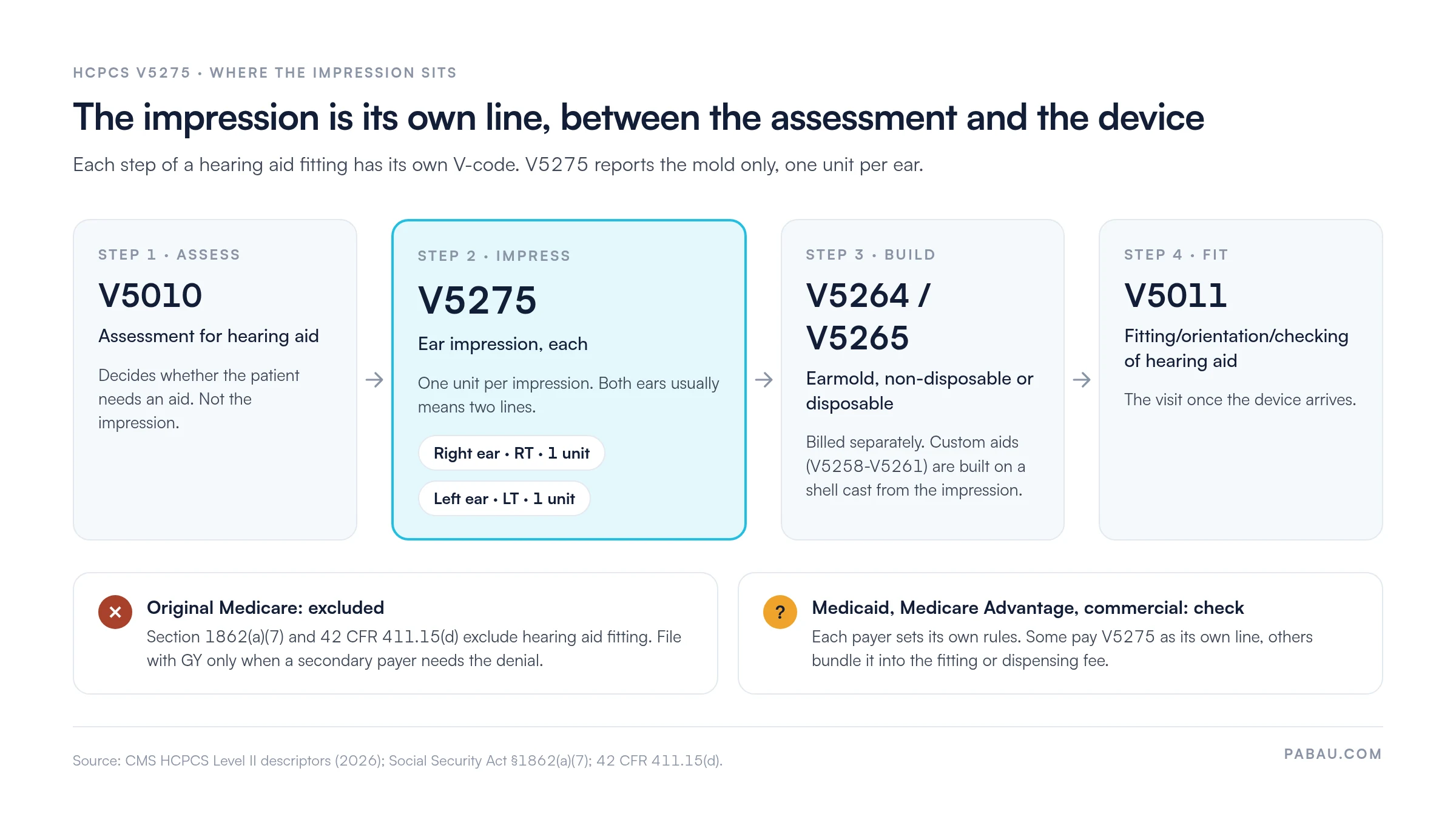
Payers that cover V5275 want to see why the impression was taken and which ear it came from. Check these items before the claim leaves the practice.
Check coverage before the appointment. An insurance eligibility verification confirms the plan covers hearing services and flags any authorization the payer wants.
V5275 needs a hearing loss diagnosis that matches the ears impressed. Impressions of both ears call for a bilateral code, and a single impression calls for the code for that ear. The codes below are common examples, not a coverage guarantee.
If the provider removed impacted cerumen before the impression, code that separately with the right H61.2- code and the removal procedure. The impression note should still state the canal was clear when the material went in.
Modifiers on V5275 do two jobs. They name the ear, and they tell Medicare you expect a denial. Add only the ones the record supports.
V5275 denials repeat in a few patterns, so fix the cause before the next claim goes out. The denial codes guide explains each CARC in full.
A clean claim for V5275 has the right units, a side on every line, and a diagnosis that matches those sides. Most denials on this code trace back to one of those three.
An ear impression touches the front desk, the clinical note, and the claim. Pabau’s practice management software keeps all three on one patient record, so the units and sides on the claim match what was done.
Pabau records the impression in the clinical note and stores the order and any ABN as signed digital forms. If a payer issues an authorization, your team logs its code, dates, and approved sessions on the patient case.
In the US, Pabau’s claims software for practices submits claims through the Claim.MD clearinghouse and tracks their status. Authorization requests still go through the payer’s own portal, and your billers still choose the modifiers.
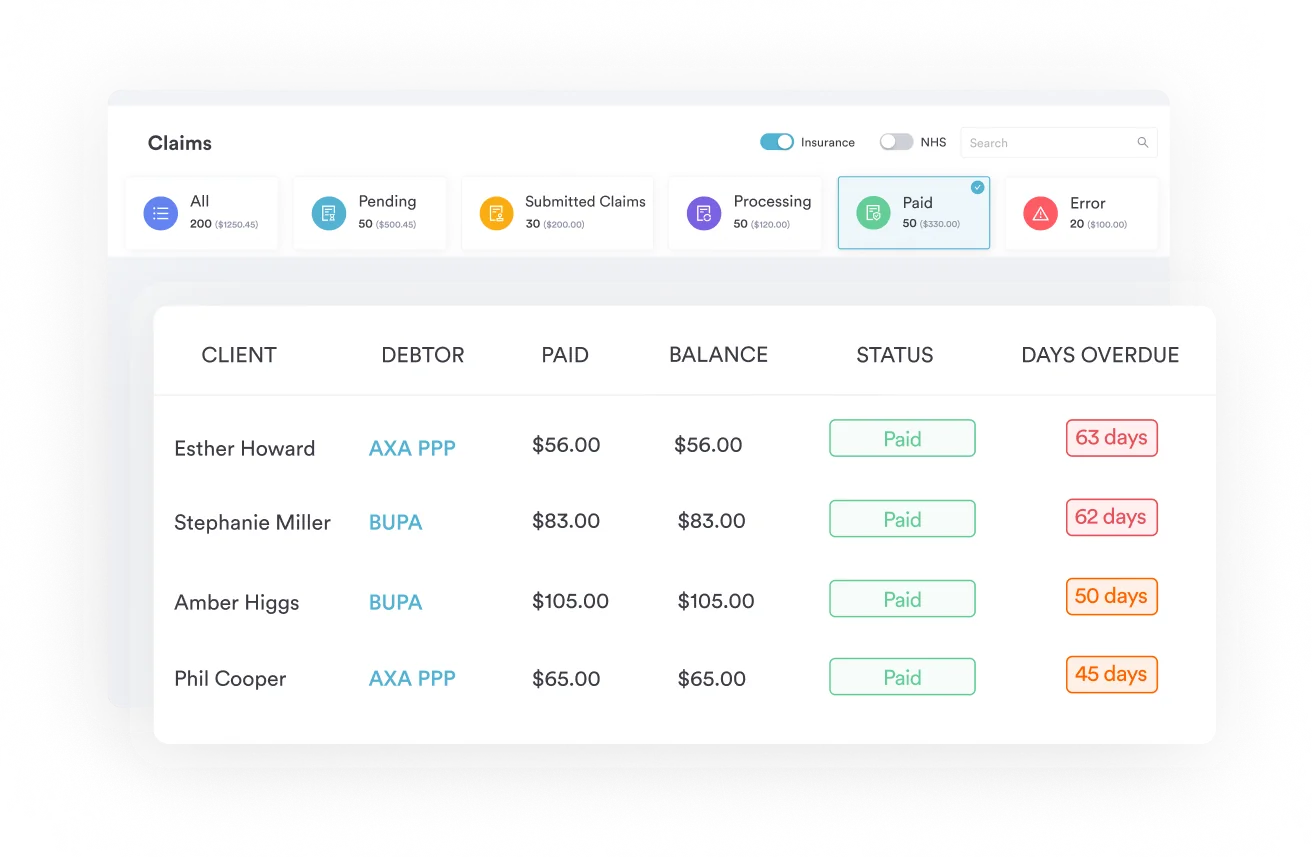

Pabau keeps the impression note, signed forms, and authorization details on one patient record. In the US, claims go out through Claim.MD with their status tracked.

Count ears, not visits, when you bill V5275. The code reports one ear impression, not a hearing aid, so the units and sides decide whether the claim is right.
Medicare will deny it as part of a hearing aid fitting, so your effort belongs with Medicaid, Medicare Advantage, commercial plans, and the patient. Confirm how each payer treats the impression before you take it.
Book a demo to see how Pabau keeps hearing service notes, forms, and claims on one record.

Billing the earmold made from the impression? HCPCS Code V5264 covers the non-disposable ear mold or insert.
Billing the candidacy visit? HCPCS Code V5010 explains the assessment for a hearing aid.
Sending claims through a clearinghouse? The Claim.MD clearinghouse guide covers how edits catch errors before a claim reaches the payer.
HCPCS Code V5275 is the Level II code for an ear impression, each. It reports one mold of the ear canal and outer ear, taken so a lab can build a custom earmold or hearing aid shell. It does not report the hearing aid itself.
Bill two units, one per impression. Most payers want two lines, one with RT and one with LT. Some accept one line with two units, so follow the payer’s own instructions.
Not when the impression is part of fitting a hearing aid. Section 1862(a)(7) of the Social Security Act and 42 CFR 411.15(d) exclude hearing aids and examinations to fit them. File with GY only when a secondary payer needs the denial. Some Medicare Advantage plans cover hearing services, so check the plan.
No. V5275 covers the impression only. The earmold the lab makes from it is billed under V5264 for a non-disposable mold or V5265 for a disposable one.
V5010 is the assessment for a hearing aid, the visit that decides whether a patient needs one. V5275 is the ear impression taken after that decision, to build the custom earmold or shell.
The descriptor says ear impression and does not name a method. Payers differ on whether a digital scan qualifies, so confirm with each payer before you bill a scan as V5275.