CPT code 28615: Open Lisfranc dislocation billing guide
What CPT code 28615 means, in plain terms CPT code 28615 is the code for open tr...

Last Updated: Oct 20, 2026
V2313 is the HCPCS Level II code for one trifocal spherocylinder spectacle lens with high astigmatism. It covers a sphere of plus or minus 7.25 to 12.00D and a cylinder of 4.25 to 6.00D, billed per lens.
V2311 and V2312 share the same sphere band, so the cylinder value on the prescription decides between the three codes. Medicare pays for the lens only after cataract surgery or for aphakia, never for routine glasses.
Let Pabau's smart automation suggest the right codes, reduce claim denials, and keep your practice compliant—effortlessly.
Automate repetitive tasks and focus on what matters most—your patients.
Reduce coding errors and ensure compliance with the latest regulations.
Clean claims, fewer denials, and faster reimbursements.
Powerful insights and reporting to help your practice thrive.
HIPAA compliant SOC 2 certified GDPR-compliant Trusted by 4,000+ clinics worldwide

V2313 covers one trifocal spherocylinder lens with a sphere of plus or minus 7.25 to 12.00D and a cylinder of 4.25 to 6.00D.
The sphere band is shared with V2311 and V2312, so the cylinder value on the prescription decides between the three codes.
Any sphere over plus or minus 12.00D moves the lens to V2314. A lenticular trifocal goes to V2315 for a myodisc design, or V2321 otherwise.
Traditional Medicare pays only after cataract surgery with an implanted lens, or for aphakia, never for routine glasses.
The code is billed per lens, so a pair goes on two claim lines marked RT and LT, one unit each.
HCPCS code V2313 is the Level II supply code for one trifocal spherocylinder spectacle lens. The sphere runs from plus or minus 7.25 to 12.00D, and the cylinder from 4.25 to 6.00D.
In plain terms, the patient needs strong distance correction, a large astigmatism correction, and three viewing zones in one lens. The “plus or minus” matters too. The code fits a high myope and a high hyperope alike, as long as both powers sit inside the band.
Confirm the current wording on the CMS HCPCS code information page before you update a fee sheet or a lab order template.
V2313 describes one narrow lens. Knowing its edges is the fastest way to avoid a wrong-code denial.
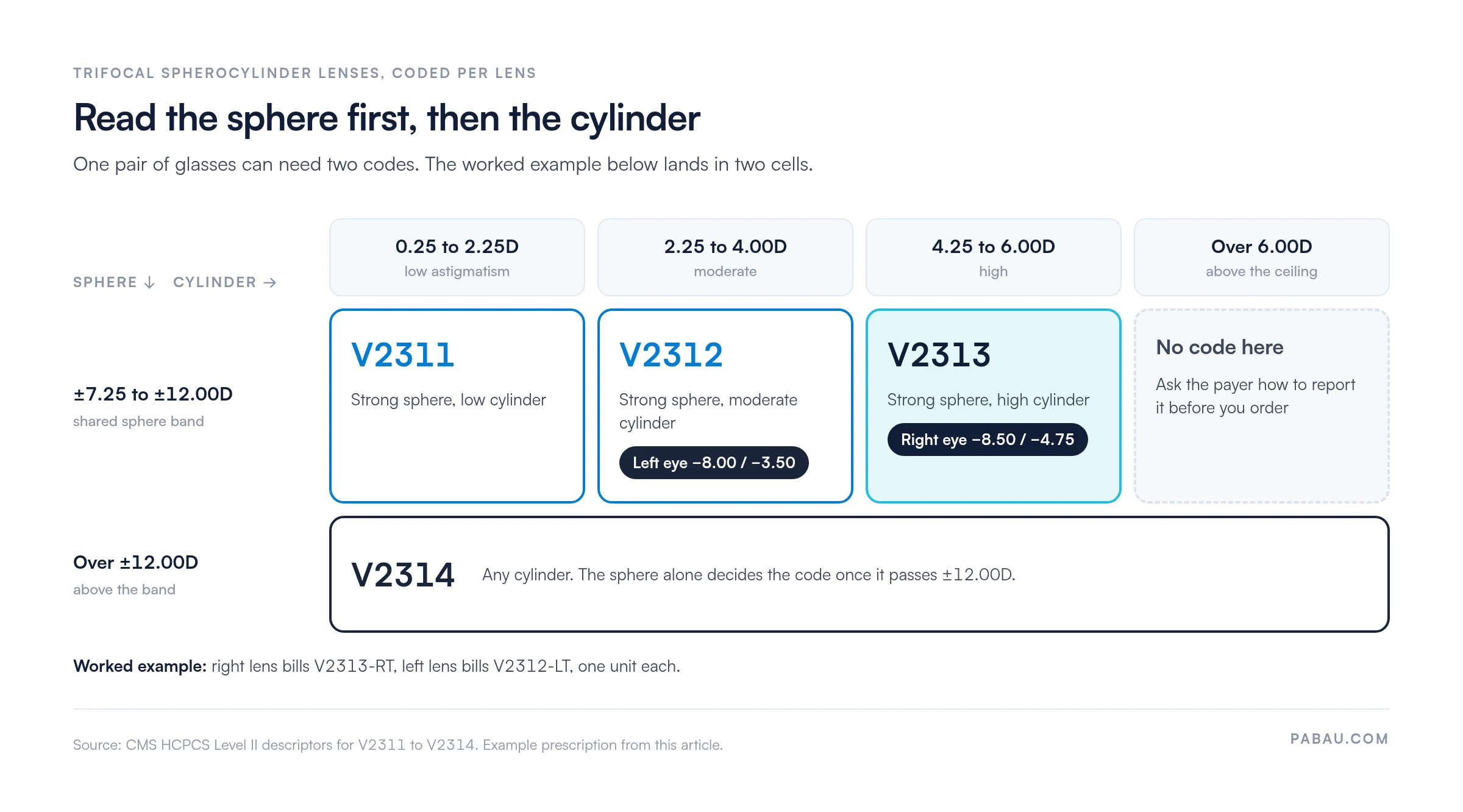
V2311, V2312, and V2313 share one sphere band. The cylinder value is the only thing that separates them. So read the sphere first, then the cylinder.
Notice that CMS lists 2.25D in both V2311 and V2312. If a prescription lands on exactly 2.25D, check how your DME MAC or plan reads the overlap, and note it in the file.
Also note the ceiling. No trifocal code in this sphere band covers a cylinder above 6.00D. Ask the payer how they want that lens reported before you order it.
Take a prescription with a right eye of -8.50 sphere, -4.75 cylinder, and a left eye of -8.00 sphere, -3.50 cylinder. The add is +2.50D.
The right lens bills as V2313-RT, because its cylinder sits in the 4.25 to 6.00D band. The left lens bills as V2312-LT. The add stays under 3.25D, so no add-power line is needed. The grid below shows where each lens lands.
Traditional Medicare excludes routine eyeglasses under Social Security Act section 1862(a)(7). V2313 is payable only when the lens counts as a prosthetic device.
That happens in two situations, both set out in the Medicare Benefit Policy Manual, Chapter 15, section 120:
So a patient with an IOL is eligible. The IOL is what triggers the post-cataract benefit, and Z96.1 (pseudophakia) supports the claim. Aphakia claims point to an H27.0- code, or Q12.3 for congenital aphakia.
Medicare pays 80% of the allowed amount once the Part B deductible is met. The patient owes the 20% coinsurance.
Most V2313 problems start long before the claim is built. Here is the path a clean lens claim follows.
Payment for V2313 comes from the CMS DMEPOS fee schedule, not the physician fee schedule. Rates vary by state and update each year, so check the current file before quoting a patient.
Traditional Medicare does not require prior authorization for post-cataract lenses. Plans that do require it will usually deny a claim sent without one. Get the number before the lab order goes in.
Most denials repeat a few patterns. Read the claim adjustment reason code (CARC) first, then match it to the fix. Our guide to medical billing denial codes lists the wider set.
One code often gets misread. CO-97 means the payer bundled the lens into another service paid that day. It is not a coverage denial, so check the payer’s bundling policy before you appeal.
Run these checks on every V2313 line before it leaves the practice.
Add the cylinder value to your lab order form next to the sphere. When both numbers sit side by side, the biller can pick V2311, V2312, or V2313 without reopening the chart.
Much of the rework on lens claims comes from retyping. A cylinder value gets copied wrong, a modifier slips, or a payer ID is missing.
Pabau, the practice management platform we build, pre-fills the CMS-1500 from the patient record. Its ICD-10 and CPT/HCPCS lookup libraries help billers find the right code, and the system checks required claim fields before you send.
In the US, claims go out through Claim.MD, with eligibility checks before the visit. Remittances post back as ERAs, and your team tracks each claim’s status in one place. Your billers still choose the code and the modifiers. Pabau’s claims software for billers keeps the form around them complete.

Pabau pre-fills the CMS-1500 from the patient record and checks required fields before you send. Fewer lens claims come back for missing details.

V2313 rewards a fixed routine more than deep coding knowledge. Read the sphere, then the cylinder, and code each eye on its own line.
The payer question deserves the same care. Medicare pays only after cataract surgery or for aphakia, and other plans set their own rules. Settle that before the lab order, and the claim has far fewer ways to fail.
Still keying lens claims by hand? Book a demo to see how Pabau pre-fills each claim and checks it before it goes out.

Is the reading add above 3.25D? HCPCS code V2320 explains how to report a high trifocal add alongside the lens.
Working with a lower sphere and a very high cylinder? HCPCS code V2310 covers a sphere of plus or minus 4.25 to 7.00D with a cylinder over 6.00D.
Want to understand what sits behind a clean claim? What is medical billing explains the claim lifecycle from charge entry to remittance.
Looking for compliance guidance for your billing team? Medical billing compliance outlines the records and audit steps that apply across code sets.
Need the bigger financial picture? What is revenue cycle management shows how supply claims fit into practice cash flow.
No. The axis only sets the orientation of the astigmatism correction. The code depends on the sphere and cylinder powers, so any axis from 1 to 180 degrees stays in V2313.
No. Bill the base lens code on one line and V2781, progressive lens, per lens, as an add-on line. Medicare treats the progressive feature as a patient-paid upgrade, so add GA when a signed ABN is on file, or GZ when it isn’t.
Report prism on its own line with V2715, prism, per lens. Add RT or LT to match the lens line it belongs to.
Yes. V2313 covers the lens only. Medicare pays for a standard frame, V2020, only when the glasses are covered after cataract surgery. A deluxe frame, V2025, is not covered, so the patient pays the difference.
No. V2313 is a spectacle lens code. Contact lenses use the V2500 to V2599 series, which sorts lenses by material and design.