CCSD Code H3334: Low anterior resection billing guide
CCSD Code H3334: Definition and clinical scope CCSD Code H3334 covers an open an...

Last Updated: Oct 16, 2026
V2320 is the HCPCS Level II code for trifocal add over 3.25d. It reports a trifocal spectacle lens whose near addition is stronger than +3.25 diopters. It is billed on its own line, next to the base trifocal lens code.
V2320 never replaces that base code. V2300 to V2314 describe the lens by power, while V2315, V2318, V2319 and V2321 report other trifocal features on separate lines. Medicare pays for these lenses only under its eyeglass benefit for aphakia and for patients after cataract surgery with an intraocular lens.
Let Pabau's smart automation suggest the right codes, reduce claim denials, and keep your practice compliant—effortlessly.
Automate repetitive tasks and focus on what matters most—your patients.
Reduce coding errors and ensure compliance with the latest regulations.
Clean claims, fewer denials, and faster reimbursements.
Powerful insights and reporting to help your practice thrive.
HIPAA compliant SOC 2 certified GDPR-compliant Trusted by 4,000+ clinics worldwide

HCPCS code V2320 reports a trifocal add over 3.25D, which is a spectacle lens whose reading segment adds more than +3.25 diopters.
It is an add-on line. Bill it beside the base trifocal lens code from V2300 to V2314 or V2399, never in place of it.
Medicare excludes routine eyeglasses. It covers lenses for aphakia, and one pair after each cataract surgery with an intraocular lens implant.
Every V2320 line needs RT or LT. Bill a pair as two lines of one unit each, not one RTLT line with two units.
In Pabau, our practice management software, the prescription and the claim sit on one patient record, and claims are submitted and tracked from there.
HCPCS code V2320 is the Level II code for a trifocal add over 3.25D. It reports a trifocal spectacle lens whose near addition is stronger than +3.25 diopters. The official descriptor, published by the Centers for Medicare and Medicaid Services (CMS), reads “Trifocal add over 3.25d”.
The add is the extra plus power in the reading segment of a multifocal lens. Most reading adds stay at or below +3.00D, so a V2320 add sits above the usual range. The code lets the supplier report that extra power on its own claim line.
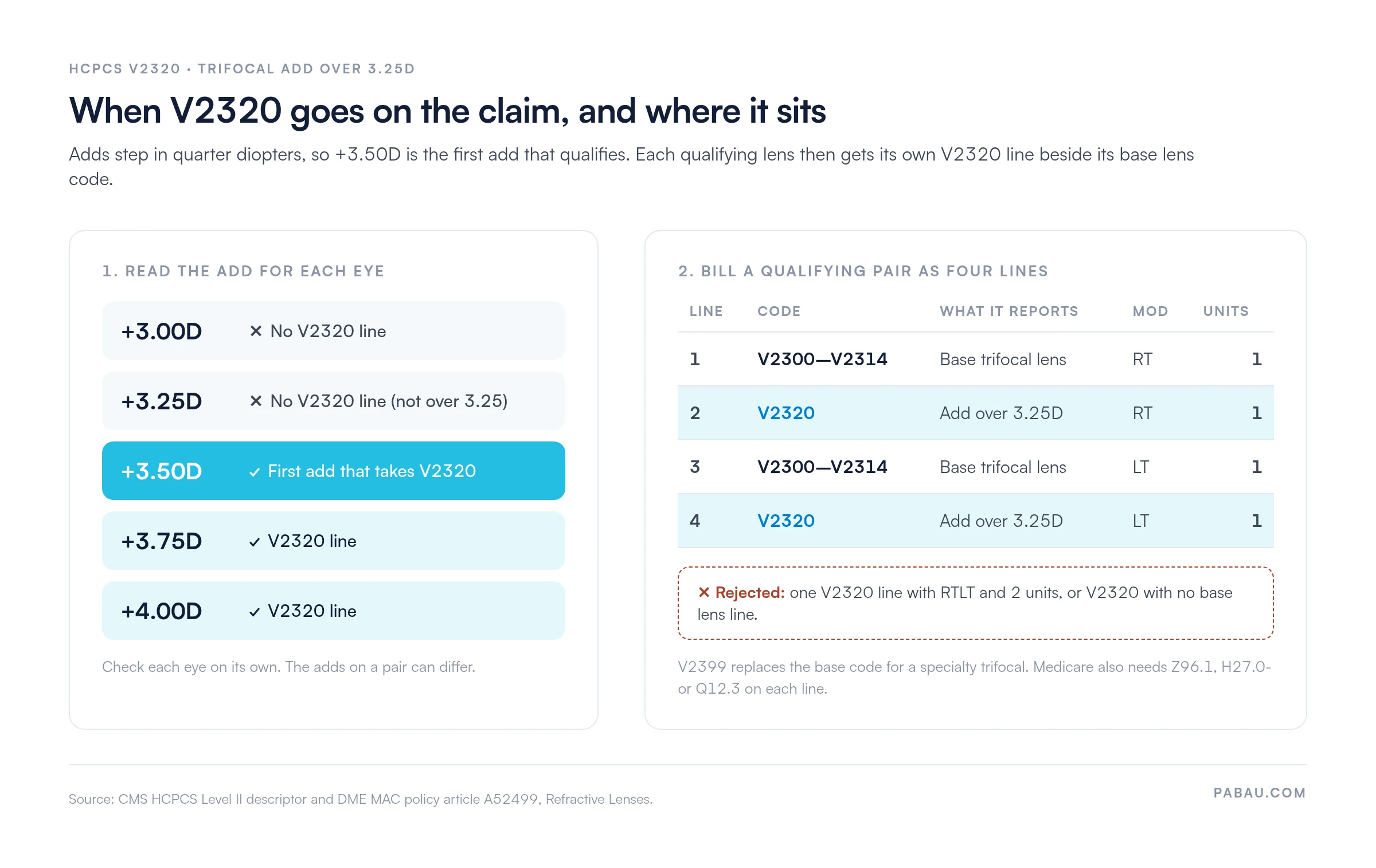
Adds are written in quarter-diopter steps, so the first add that qualifies is +3.50D. An add of exactly +3.25D does not meet the descriptor and takes no V2320 line.
Coverage code C means the Medicare contractor decides coverage for each claim, within the national rules. Pricing indicator 38 puts the code on the fee schedule for durable medical equipment, prosthetics, orthotics and supplies (DMEPOS).
The trifocal block holds two kinds of code. Base lens codes describe the lens by its sphere and cylinder power, and each lens takes exactly one. Add-on codes describe a feature of that lens and go on extra lines. The Refractive Lenses policy article A52499 lists V2320 among the add-ons.
Read the table by role, not by number. A trifocal claim always starts with one base code per lens. V2320 joins it only when the add on that lens is over +3.25D. Swapping the base code for V2320 leaves the lens itself unbilled. The chart below shows where the add threshold falls and how a qualifying pair lays out on the claim.
There is no V2322 in the HCPCS file. V2321 is the last numbered trifocal feature, and V2399 covers specialty trifocals by report. V2321 describes a lenticular lens, so it is a construction feature, not a second add-power code.
An intraocular lens implanted during cataract surgery is a different item with its own codes, V2630 to V2632. A posterior chamber lens, for example, is V2632. V2320 only ever describes the reading power in a pair of spectacles.
The bifocal block has its own version of this code. V2220 reports a bifocal add over 3.25d, so the lens design decides which add code applies.
Medicare Part B does not pay for routine eyeglasses. Section 1862(a)(7) of the Social Security Act excludes them, along with eye exams for prescribing glasses. A V2320 line billed for an ordinary presbyopia prescription is therefore not covered.
The exception sits in the prosthetic device benefit, Section 1861(s)(8). It covers one pair of conventional eyeglasses or contact lenses after each cataract surgery with insertion of an intraocular lens. Patients with aphakia, including congenital aphakia, also qualify for corrective lenses.
The pseudophakic benefit attaches to each surgery, not to the patient. A later operation on the second eye supports a second pair. If both eyes are operated on before any glasses are supplied, only one pair is covered after the second surgery.
Within that benefit, V2320 is paid alongside the base lens. The four DME Medicare Administrative Contractors apply LCD L33793 and its policy article. Payment comes from the DMEPOS fee schedule, so check the current amount for your state before you quote a patient.
Only suppliers enrolled with Medicare to furnish DMEPOS can bill these lens codes to a DME MAC. A practice that dispenses without that enrollment cannot send V2320 to Medicare.
The Refractive Lenses policy accepts six diagnosis codes for refractive lenses. A Medicare claim needs one of them on each lens line, including the V2320 line.
Match the eye in an aphakia code to the RT or LT modifier on the lens line. Z96.1 carries no laterality, so the operative note has to show which eye received the implant.
A refractive diagnosis such as H52.4 (presbyopia) explains why the reading add exists. It does not establish Medicare coverage on its own. Commercial vision plans set their own diagnosis rules, so check the plan policy.
The Refractive Lenses policy requires RT or LT on every lens code it covers, V2320 included. Lines without them are rejected as incorrect coding.
When both lenses carry the add, bill two V2320 lines, one RT and one LT, with one unit each. A single line with RTLT and two units is rejected. That rule has applied to dates of service from March 1, 2019.
The policy ties the KX modifier to a short list of other lens add-ons, and V2320 is not on it. A routine V2320 line needs laterality, plus GA, GZ or GY only when coverage fails.
A clean V2320 claim starts at the dispensing table, with the prescription in front of you. Work through these steps for each lens.
An auditor checking V2320 wants to see three things: the add power, the coverage basis, and proof of delivery. Keep each one in the patient record before the claim goes out.
Write the add for each eye on the dispensing ticket, next to the base lens code. A +3.25 add stays off the claim, while a +3.50 add gets its own V2320 line.
Most V2320 problems come from treating it as a lens rather than a feature of one. The table pairs each error with its fix.
Read the CARC and RARC codes on each remittance before you correct a line. A wider guide to denial codes in medical billing explains how to act on each one.
In many optical practices, the prescription lives in the exam record while the claim gets typed up later. Each retyped value is a chance for the add power, or the eye it belongs to, to drift.
In Pabau’s practice management software, the clinical notes, the prescription and the claim share one patient record. Your team builds the V2320 lines from data already on that record.
Its claims software for billing teams then submits the claim through Claim.MD and tracks its status. Each claim shows as pending, submitted, processing, paid or error on one dashboard. A rejected V2320 line is visible as soon as its status changes, so your biller can correct it while the order is fresh.

Pabau keeps the prescription, clinical notes and claim on one patient record. Claims are submitted and tracked from the same place, so your team sees each line’s status without switching systems.

V2320 is a small line with a narrow trigger. It belongs on the claim only when a trifocal add tops +3.25D, and only beside a base lens code. Settle that at the dispensing table, where the prescription is already in front of you.
The bigger decision is coverage. For a Medicare patient with no aphakia and no recent IOL surgery, the whole pair falls outside Medicare coverage. Telling the patient before the lenses are ordered protects them from a surprise bill and protects your receivable.
Book a demo to see how Pabau keeps the prescription and the claim on one record for your optical team.

Want to understand how clean claims reduce rework? Clean claim best practices covers the elements every billing team should verify before submission.
Need a framework for handling denials across your practice? Denial management in healthcare covers tracking, appealing and preventing repeat denials.
Need a primer on the revenue cycle behind your claims? What is revenue cycle management explains how billing connects from patient registration to final payment.
Coding the base lens that V2320 sits beside? HCPCS code V2307 covers one of the spherocylinder trifocal base lens codes and how to bill it.
Billing a bifocal add-on instead? HCPCS code V2219 explains the bifocal segment-width add-on and when it takes its own line.
HCPCS code V2320 is the Level II code for a trifocal add over 3.25D. It reports a trifocal spectacle lens whose reading segment adds more than +3.25 diopters. It is billed as an add-on line, next to the base trifocal lens code.
Only in limited cases. Medicare Part B excludes routine eyeglasses. It covers corrective lenses for aphakia, and one pair of conventional eyeglasses or contact lenses after each cataract surgery with an intraocular lens. V2320 is payable within that benefit when the add exceeds +3.25D.
No. CMS policy treats V2320 as an add-on feature of a trifocal lens. Each lens needs one base code from V2300 to V2314 or V2399, and V2320 goes on a separate line beside it.
V2320 reports a trifocal add over 3.25D. V2321 reports a lenticular trifocal lens, which is a construction feature rather than an add power. Both are add-on codes billed beside a base lens code, and neither replaces the other.
Every V2320 line needs RT or LT. Bill a pair as two lines with one unit each, not one RTLT line with two units. Add GA or GZ when Medicare coverage criteria are not met, depending on whether an ABN is on file.
For Medicare, the Refractive Lenses policy accepts Z96.1 for presence of an intraocular lens. It also accepts H27.00 to H27.03 for aphakia and Q12.3 for congenital aphakia. Without one of these, routine eyeglasses are statutorily excluded.