

HCPCS code E0198: Water pressure pad billing guide
HCPCS code E0198 is a water pad for a standard mattress HCPCS code E0198 is the ...

Last Updated: Oct 13, 2026
V2311 is the HCPCS Level II code for a trifocal spherocylinder lens: ±7.25 to ±12.00D sphere and 0.25 to 2.25D cylinder, per lens. It corrects a high sphere power plus low to moderate astigmatism, and a complete pair takes two claim lines.
Most V2311 denials trace to three causes. The lens may fall in a neighboring sphere or cylinder band, or the RT or LT modifier may be missing. The diagnosis may also fail to support coverage. Medicare pays only after cataract surgery or for aphakia, never for routine eyeglasses.
Let Pabau's smart automation suggest the right codes, reduce claim denials, and keep your practice compliant—effortlessly.
Automate repetitive tasks and focus on what matters most—your patients.
Reduce coding errors and ensure compliance with the latest regulations.
Clean claims, fewer denials, and faster reimbursements.
Powerful insights and reporting to help your practice thrive.
HIPAA compliant SOC 2 certified GDPR-compliant Trusted by 4,000+ clinics worldwide

V2311 bills one trifocal spherocylinder lens per eye, with a sphere of ±7.25 to ±12.00D and 0.25 to 2.25D of cylinder.
V2300-V2399 is the trifocal lens range, so bifocals belong in V2200-V2299 and sphere-only trifocals use V2300-V2302.
Medicare excludes routine eyeglasses and covers V2311 only for pseudophakia after cataract surgery, aphakia or congenital aphakia.
Medicare claims need RT or LT on separate lines with one unit each, and KX is not required on V2311.
Pabau’s claims management software pulls patient, treatment and insurer details from the record into a pre-filled claim and tracks it to payment.
HCPCS code V2311 is the Healthcare Common Procedure Coding System (HCPCS) Level II code for one trifocal spherocylinder spectacle lens. CMS lists it in the V2300-V2399 trifocal lens range of the V-series vision codes. Our HCPCS code reference sets out the other V-series lens codes in the same format. A trifocal gives three zones of correction in one lens: distance, intermediate and near.
The official CMS descriptor reads: Spherocylinder, trifocal, plus or minus 7.25 to plus or minus 12.00d sphere, .25 to 2.25d cylinder, per lens. Spherocylinder means the lens corrects astigmatism as well as nearsightedness or farsightedness. The code describes the lens only, not the frame, the dispensing fee or the eye exam.
Descriptor and pricing indicator are taken from the CMS HCPCS alpha-numeric file, October 2026 release.
Trifocal lenses take codes V2300 through V2399, and bifocals sit one range lower, in V2200 through V2299. Inside the trifocal range, two numbers from the prescription decide the code: the sphere power and the cylinder power. The table below lists the neighbors billers confuse most often with V2311.
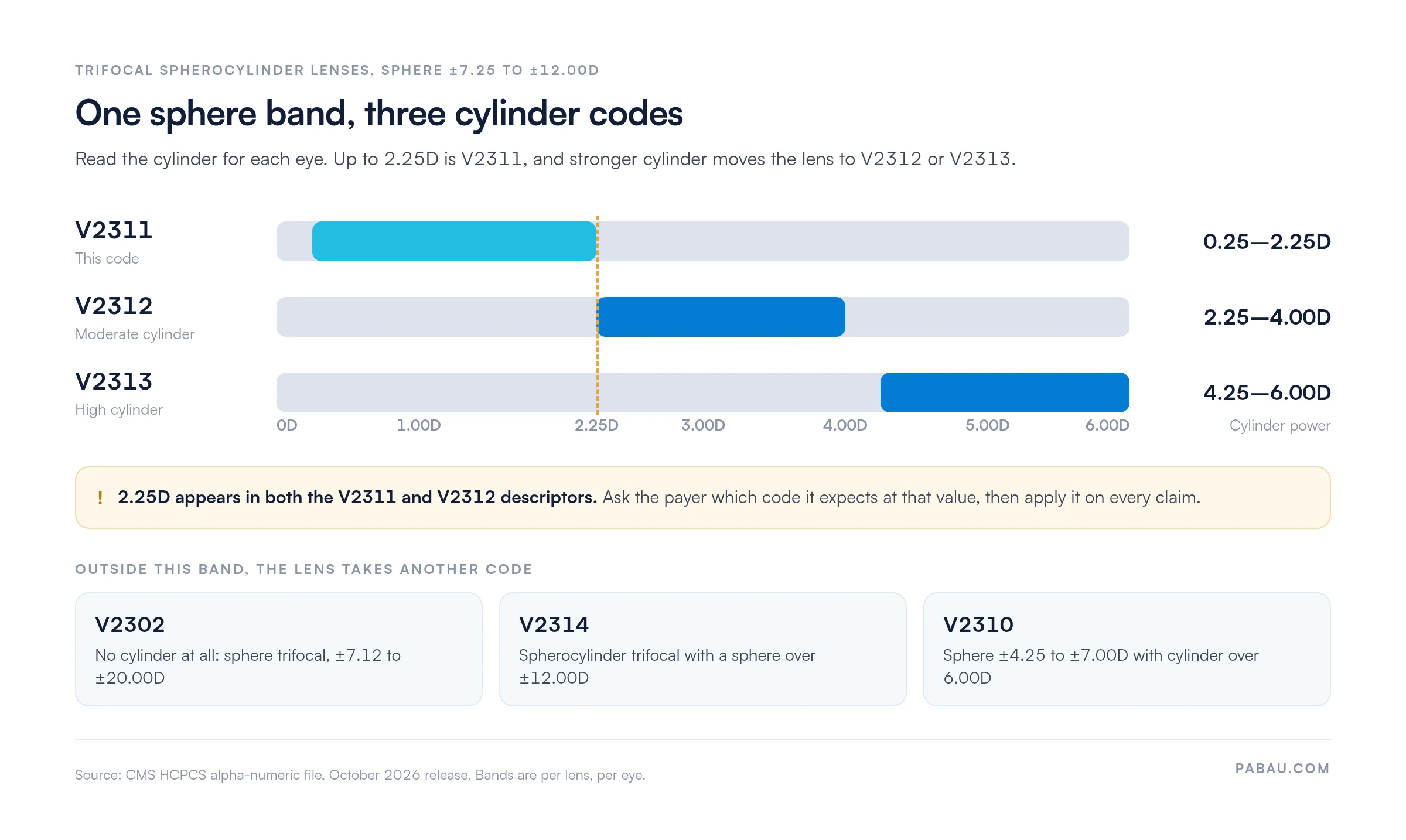
Two boundaries need care. The CMS descriptors for V2311 and V2312 both include a 2.25D cylinder, so a 2.25D prescription fits either text. Ask the payer which code it expects at that value, and apply its answer on every claim. The chart below shows where the three cylinder bands meet.
The sphere value also changes when a prescription is transposed between plus-cylinder and minus-cylinder notation. A +8.00 −1.50 × 090 prescription becomes +6.50 +1.50 × 180, which drops below the V2311 sphere band. Keep the prescription, the lab order and the claim in one notation, so an auditor reads the same sphere value you coded.
V2320 describes a trifocal add over 3.25D. It covers the near-power add rather than a sphere or cylinder band, so it never replaces V2311 as the base lens code. If the prescription carries no cylinder at all, the lens is a sphere trifocal and takes V2300, V2301 or V2302.
Knowing what falls outside V2311 prevents the most common selection errors in trifocal dispensing.
Before you choose a code, read three numbers off the written prescription for each eye: the sphere, the cylinder and the add. V2311 needs a sphere of ±7.25 to ±12.00D and a cylinder of 0.25 to 2.25D. If either value falls outside those bands, that eye needs a different code.
Medicare does not cover routine eyeglasses. Section 1862(a)(7) of the Social Security Act excludes them, so a V2311 lens for a routine prescription change is a non-covered service.
The exception sits in Section 1861(s)(8), which treats post-cataract lenses as prosthetic devices. Medicare covers one pair of eyeglasses or contact lenses after each cataract surgery with insertion of an intraocular lens. The DME MAC Refractive Lenses LCD (L33793) also covers lenses for aphakia and congenital aphakia.
Outside traditional Medicare, coverage depends on the plan. Medicare Advantage plans often add a routine eyewear benefit, but each plan sets its own rules. State Medicaid programs set their own vision benefits, including which adults qualify for eyeglasses.
Commercial vision plans usually cover one pair of lenses per benefit period, often every 12 or 24 months. Medicare Part B does not require prior authorization for refractive lenses. Some Medicare Advantage, Medicaid and commercial vision plans do, so check the plan before you order the lenses.
The right diagnosis depends on who pays. Medicare covers V2311 only when the natural lens is missing, while vision plans pay on H52 refraction codes such as H52.4. The table below separates the two.
A Medicare claim that carries only H52 refractive codes is denied, because those codes describe routine vision. Use the CDC/NCHS ICD-10-CM web tool to confirm each code is valid for the date of service.
Medicare DME MACs require RT or LT on V2311. Each lens goes on its own claim line with one unit, and a single RTLT line is rejected as incorrect coding.
KX is not required on V2311. Policy article A52499 limits KX to lens-option codes such as V2744, V2745, V2750, V2780 and V2784. Commercial plans set their own modifier rules, so check each plan before you apply RT or LT there.
Payers expect the following records behind every V2311 line. A missing item is the usual reason a post-payment review recoups the claim.
Follow these steps in order to avoid the most common submission errors on trifocal spherocylinder lenses.
V2311 denials follow a predictable pattern. The table below maps each one to its cause and fix. The adjustment codes are illustrative, since each payer applies its own.
A structured denial management process that tracks these codes by lens code shows recurring errors early. One example is a 2.25D cylinder coded as V2311 on one claim and V2312 on the next. Route those findings back into your medical billing workflows so the fix sticks.
After 30 days of billing V2311, pull a denial report for the code. If CO-4 or CO-11 appears more than once, add required sphere, cylinder and add fields for each eye to your dispensing record. Make them mandatory before the lab order goes out.
Most V2311 errors start before the claim exists. The prescription lives in the exam notes, the lens order goes to the lab, and the biller re-keys the details by hand.
Pabau, the practice management platform we build, keeps the prescription, the diagnosis and the dispensing record on one patient file. Its claims management software pulls the patient, treatment and insurer details from that record into a pre-filled submission. Validation checks run each time you send a claim, so missing details such as authorization codes surface before the payer sees them.
For US practices, Pabau submits claims through Claim.MD, runs real-time eligibility checks and posts ERA remittances. Each claim shows its status from pending to paid, which keeps revenue cycle management in one place. Fewer re-keyed values mean fewer avoidable denials and more clean claims on the first pass.

Pabau pulls patient, treatment and insurer details from the record into a pre-filled claim and checks it before submission. Your team spends less time reworking V2311 denials.

V2311 rewards precision. Code from the written prescription, one eye at a time, and check both numbers against the band. Settle the 2.25D cylinder and any transposed prescription once, in writing, rather than claim by claim.
For Medicare, the diagnosis decides payment before the lens does, so confirm pseudophakia or aphakia before you bill a DME MAC. Book a demo to see how Pabau keeps prescription, diagnosis and claim details together so trifocal lens claims go out clean.

Need to understand how claim denials are tracked and resolved? Denial codes in medical billing covers the most common remark and reason codes and how to action each one.
Want a primer on the claims submission process end to end? Medical claims clearinghouse explains how electronic claims move from practice system to payer and where errors surface.
Billing multiple supply codes on the same claim? Superbill guide walks through how to structure a superbill that includes HCPCS supply codes alongside procedure codes without triggering NCCI bundle edits.
Comparing a lower-sphere trifocal? HCPCS code V2310 covers the trifocal spherocylinder band with a ±4.25 to ±7.00D sphere and over 6.00D of cylinder.
Fitting a progressive lens instead? HCPCS code V2781 explains how progressive lenses are coded and billed per lens.
HCPCS code V2311 is the Level II code for one trifocal spherocylinder lens. The lens has a sphere power of ±7.25 to ±12.00D and 0.25 to 2.25D of cylinder. It sits in the V2300-V2399 trifocal lens range and is billed per lens.
CMS lists 2.25D of cylinder in both the V2311 descriptor and the V2312 descriptor. The descriptors do not settle that value, so ask the payer which code it expects. Record its answer and apply it on every claim.
For Medicare, the diagnosis must show pseudophakia (Z96.1), aphakia (H27.01, H27.02 or H27.03) or congenital aphakia (Q12.3). Vision plans accept refractive-error codes instead. A trifocal spherocylinder prescription points to regular astigmatism (H52.221 to H52.223) and presbyopia (H52.4).
Bill one unit of V2311 per lens. When both eyes get a V2311 lens, use two claim lines, one with RT and one with LT, each with one unit. Medicare DME MACs reject a single line with two units or an RTLT combination as incorrect coding. If the other eye falls in a different band, its lens takes its own code.
Most denials come from five causes. The lens may fall in a neighboring sphere or cylinder band, or the RT or LT modifier may be missing. The diagnosis may not support Medicare coverage, or the plan’s frequency limit may have been reached. Some plans also deny a claim that lacks a required prior authorization number.



